
Sports
How a lower-league team from an English fishing town launched the most desirable kits of the summer


“Cantiamo solo quando peschiamo.”
That’s a direct translation of one of Grimsby Town’s most coveted chants: “We only sing when we’re fishing.”
Everything sounds better in Italian but, as this League Two side from Lincolnshire, halfway up the east coast of England near the River Humber, have discovered, everything looks better in Italian, too.
Grimsby is most famous for its fishing industry, processing around 70 per cent of the UK’s seafood; hence the tongue-in-cheek song sung by its football team’s supporters, a chant they made their own after a version was initially aimed at them by Liverpool fans during a match at Anfield in 1980.
Now, Grimsby Town are turning heads for their fashion sense, having trawled through their archives for inspiration and re-collaborated with an Italian sportswear company to produce some of the standout football jerseys for next season.
“We should be unapologetically Grimsby, because we can’t be anyone else,” Jack Johnson, the fourth-division side’s head of marketing, tells The Athletic. “We didn’t want to just go down the off-the-shelf strategy. We wanted something that was going to offer storytelling. That’s what makes us, and this kit, unique.”
It’s a modern take on an all-time classic.
When they play away this season, starting at Walsall on August 22, Grimsby will regularly step on to the pitch looking like Milan from the 1990s — but also themselves from that same period.
In 1996, Grimsby linked up with Italian sportswear company Lotto for two seasons; their away shirt for 1996-97 was a carbon copy of Milan’s light-blue fourth kit from the previous campaign, down to the slim red-and-black band across the chest with a white-and-blue diamond pattern beneath. If you removed the Milan badge and sponsor’s logo, and added Grimsby’s equivalents, you had the finished product.
Milan never actually wore that kit in Serie A, leaving Grimsby to give a soon-to-be-underused Lotto design a second premiere. And now football fans have fallen in love with a modern reimagining.

(Jon Corken/Grimsby Town Football Club)
“It felt really cool that we had exactly the same strip as the Milan,” remembers Steve Young of Grimsby Town podcast View From The Findus. And despite the club’s relegation from the First Division, then English football’s second tier, that season, “It became one of those shirts people always remembered.”
It was around this time that Grimsby forged a broader Italian affinity.
In 1995, they signed former Ivano Bonetti, a two-time Serie A winner with Juventus and Sampdoria, two years before the town produced more pizzas than anywhere in Europe, including its homeland of Italy.
These quirks, and more, are paid homage to in the new away shirt’s unveiling video released on July 13, which drew nearly 800,000 views on X within a week.
It was filmed in Naples, a city with fish markets of its own and a working-class atmosphere that perfectly illustrated the parallel with Grimsby.
🇮🇹 Grimsby – inspired by Italian culture since 1878.
Introducing our 2026/27 Away Kit. Available in-store Friday and online from Monday.#GTFC pic.twitter.com/aWTNvLDr4F
— Grimsby Town F.C. (@officialgtfc) July 13, 2026
First-team players Cameron McJannet and Geza David Turi were flown out to model the outfit on the streets of Naples, the latter unexpectedly so, just a day after representing the Faroe Islands in their June internationals against Estonia and Latvia. Turi’s modelling of the shirt’s long-sleeved edition have been received so well that the club are currently out of stock and won’t have more until September.
“When you set the long-sleeve shirts with the backdrop of Italy and you’ve got random Italians on mopeds wearing it, it just looks very cool, and is extremely well thought of,“ Young says.

(Jon Corken/Grimsby Town Football Club)
The partnership with Lotto stems from Grimsby’s primary deal with KitLocker, which adopted a licensing branch four years ago to design bespoke, heritage-led kits alongside suppliers and clubs.
This season is the third year of Grimsby’s KitLocker collaboration. Their partnership, in conjunction with Umbro for its first two years, broke records last season as their away shirt — again inspired by a design from the 1990s — became the best-selling in club history, with over 10,000 sold, a figure greater than their Blundell Park stadium’s capacity.
Lotto then began a partnership with KitLocker last season, manufacturing League One side AFC Wimbledon’s kits, and getting into business with Grimsby felt like a natural progression.
“When the Lotto link came about, remaking the ’96 kit immediately sprang to mind,” Johnson says. “We didn’t want to mess with a classic, because this kit was synonymous with the Milan side containing Patrick Vieira and Roberto Baggio, and brings back warm memories for fans of my age and older.”

Roberto Baggio, left, and George Weah in action in Milan’s 1995-96 fourth kit (Getty Images)
There is a lot going on visually, and a kit incorporating a collar, pinstripes, diamonds and five shades of blue sounds too busy to work, but it does — gloriously so.
“Grimsby is a club we knew would respect the heritage of Lotto,” says Mike Atkin, KitLocker’s director of licensed brands. “We knew the away kit would be a hit, but the work has gone in across the board to ensure that every shirt tells a story.”
The new home shirt — Grimsby have played in black and white stripes since 1925 — similarly pays tribute to its Lotto-made equivalent from 30 years ago with a retro Juventus-esque look, while their training and goalkeeper kits feature landmarks and mythology connected with the origins of the town.

(Yuta Kato/Grimsby Town Football Club)
Johnson and KitLocker worked closely with JD Sports’ product director Luke Matthews, who aided the process on an advisory basis, and local photographer James Willis to bring the project to life. “Being a part of making these love letters of Grimsby that have transcended beyond the borders of Lincolnshire is awesome,” says Matthews.
It’s something Young, now living 60 miles away in Leeds, has also experienced: “I’ve had people who I play five-a-side with, many of whom only know Grimsby exists because of me, message me saying how amazing our kits look.
“Lotto feels like the quintessential Grimsby sponsor, and brings back memories of the season after we got relegated, where we visited Wembley twice (winning both the EFL Trophy and the Second Division play-off final) — the best times many of us have seen.”
On the face of it, Grimsby and Italian football should have little in common. Yet one borrowed template from the 1990s has become part of the club’s own identity, revived now not out of nostalgia alone but because it still tells the town’s story.
>
Sports
World Cup 2026 Golden Boot race: Kylian Mbappe pulls two goals clear of Lionel Messi ahead of World Cup final | Football News

Kylian Mbappe now leads the way in the Golden Boot race with 10 goals – two clear of Lionel Messi who plays in Sunday’s World Cup final.
Mbappe’s two goals in France’s 6-4 defeat to England in the third-place play-off game puts him in a commanding position to land the honour and he is now the outright record goalscorer in World Cup history with 22 goals.
Messi – on eight goals – will need to score twice against Spain on Sunday to potentially surpass Mbappe with both players currently also on four assists which is used as the tiebreaker in the event of a draw.
Knocked-out Erling Haaland and Jude Bellingham scored seven, while Harry Kane scored six.
The superstars set a blistering pace in the race to be the tournament’s top goalscorer in the USA, Canada and Mexico.
Messi bounced back after missing his penalty against Egypt to help Argentina complete their historic comeback, scoring three goals in the final 13 minutes to progress into the quarter-finals, but failed to add to his tally in the win over Switzerland.
Mbappe had an eerily similar showing against Morocco in the first of the last-eight encounters, missing from the spot as he went the same direction as Messi before giving France the lead after the hour mark.
Then it was the turn of Bellingham to stand up and deliver after scoring twice against Mexico in the previous round.
How the race for the Golden Boot stands…
Could more records tumble?
Miroslav Klose started the tournament out in front on the all-time World Cup goalscoring chart with 16 goals, but both Messi and Mbappe have overtaken the ex-Germany striker.
Haaland became Norway’s leading goalscorer at World Cups after just two games, while Kane went past Gary Lineker as England’s top World Cup scorer.
Golden Boot contenders have been targeting Just Fontaine’s 1958 record of 13 goals in a single tournament.
Only three players in World Cup history – Fontaine, Germany’s Gerd Muller in 1970 and Hungary’s Sandor Kocsis in 1954 – have ever hit double figures at a single tournament.
What other records have been broken?
Most World Cup tournaments played: Lionel Messi and Cristiano Ronaldo (six each)
First player to score in six World Cups: Cristiano Ronaldo
Oldest player to score multiple goals in a game: Cristiano Ronaldo
Smallest nation to appear at a World Cup: Curacao
Most red cards in an opening match: Mexico vs South Africa (three)
Most-attended World Cup
Highest-scoring World Cup
>
Sports
France 4-6 England: Bukayo Saka reveals he is fully fit and wanted to play more at the World Cup after hat-trick in third-place play-off | Football News

Bukayo Saka revealed he “wanted to play more” at the World Cup after scoring a hat-trick to earn England a bronze medal against France – after Thomas Tuchel tactically left him out of the semi-final loss to Argentina.
Saka hit a treble in a crazy 6-4 win over France in the third-place play-off – which included two brilliant first-half goals in an England performance that completely contrasted from the semi-final loss to Argentina.
While England were defensive and dour last time out, the Three Lions showed quality in possession, threat on the counter and ruthlessness in attack. And many asked the same question: why didn’t Saka play against Argentina?
“Of course, I would love to have played more,” Saka told the BBC after the game. “But of course, it’s not the time to talk about out that now. I try to do my talking on the pitch. It’s done now. Move on.”
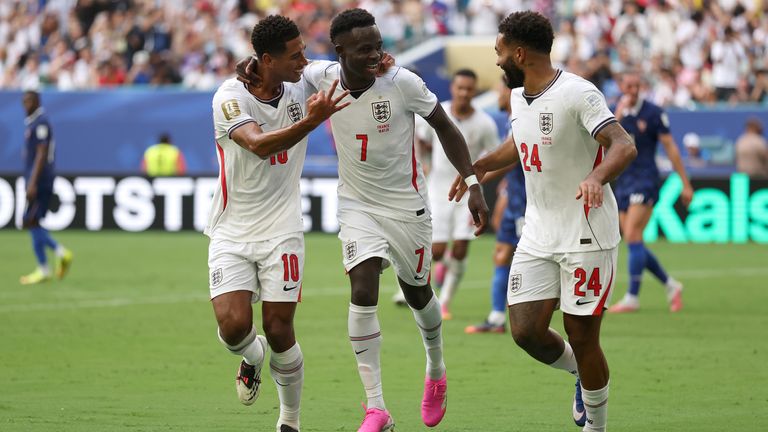
Saka scored a hat-trick against France, including two stylish first-half strikes
Asked if it’s good news for Arsenal fans to see him playing and scoring like this, Saka replied: “Yeah. I’m fit. I’m fit.”
However, despite being “fit”, Tuchel said he just “had a feeling” that Rogers would offer more in the semi-final win over Argentina.
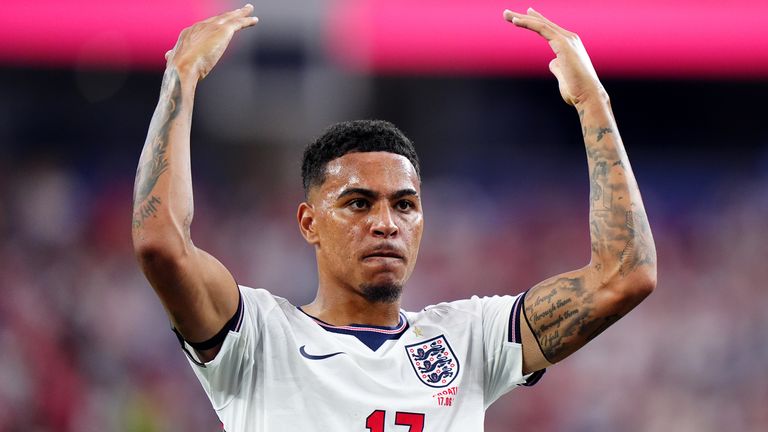
Tuchel opted for Morgan Rogers against Argentina instead of Saka
“He did everything right,” Tuchel said of Saka. “I had just a feeling in the semi-final for Morgan Rogers that he would be involved in something special. That was it.
“The [Argentina] game was so in demand that we were forced into changes because of cramps and flow of the game.
“Bukayo showed he was a key player, that was never a doubt. I was not even aware he had a hat-trick [against France]. I lost the overview of the goalscorers.”
Analysis: Is Tuchel’s Saka call vs Argentina his biggest mistake?
Sky Sports’ Sam Blitz:
Tuchel may have got himself and his team a bronze medal and he nation’s best World Cup performance since 1966. But despite a thrilling 6-4 win over France, the questions still remain.
Saka came into the tournament as England’s standout player at right wing. If fit, he starts.
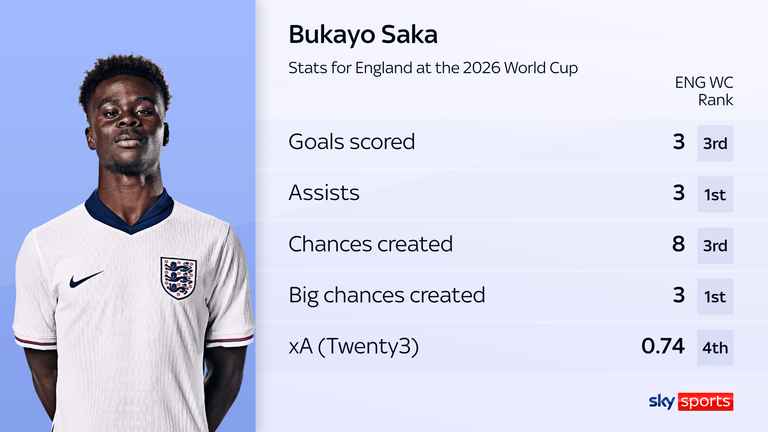
The stats that show Bukayo Saka should have started at the World Cup
Now after a bruising season with Arsenal – which ended with an anonymous performance in the Champions League final – Saka came into the World Cup with injury issues. He did not start the first two games of the tournament due to an issue that had hampered his final two months of the season with the Gunners.
But despite his injury issues, Saka still showed quality in brief moments. Come the quarter-finals, Saka had three assists in just 192 minutes of action.
Everyone knows behind Harry Kane and Jude Bellingham, Saka is England’s best, most-experienced and most successful forward player. But perhaps the most important person who matters in Tuchel didn’t – in the moment that mattered for England this summer.
Saka should have started against Argentina. Yes, Rogers provided the assist for Anthony Gordon’s goal in that semi-final. But Saka, as Tuchel even admitted after the France game, is a “key player”. What irony.
One change may not have made a difference given the other issues in the World Cup semi-final. But Saka could have helped. He has been part of an Arsenal side who showed defensive resilience all term – his ball-carrying and counter-attacking abilities could have proved useful in that tricky context England had.
England’s No 7 ended the tournament with three goals and three assists. Tuchel has ended the tournament with a regret.
It is not the only question over Tuchel despite this bronze medal achievement.
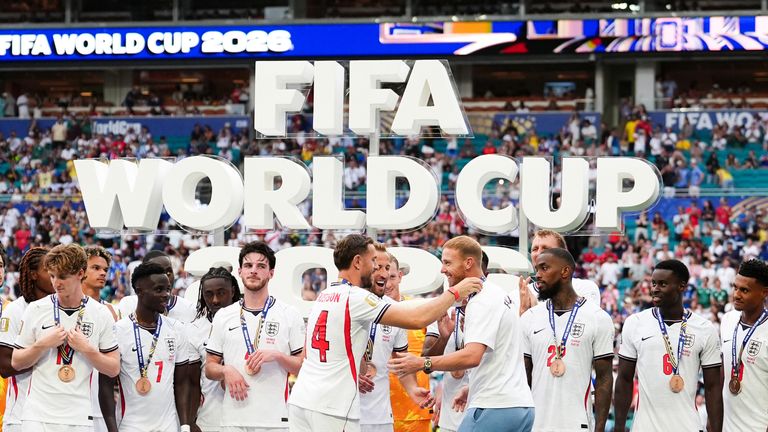
England collect their bronze medals at the World Cup
For the second World Cup game in a row, England were hanging on for dear life with 15 minutes to go. For the second game in a row, England were leading and everyone was questioning how they were going about it – especially about how they collapsed from 4-0 down to 4-3 – and almost 4-4.
Yes, the game didn’t mean much – especially given the lack of defensive quality from England and France. But asTuchel is already looking forward to the next phase of his England career, his decision-making at the back end of the tournament means he is not out of the woods.
Have England closed the gap to France?
England head coach Thomas Tuchel to BBC Sport:
“We have the ability to close it. They have the ability to open it up again.
“Eight years ago they [France] were the [World Cup] champions, four years ago they were in the final and they were the Nations League final. There is a slight gap, but we want to close it.
“I said [on Saturday, this game] is the first step to close it. We did it. We beat them. The next one is Spain in the Nations League.
Is he still energised for the England job? “Matches and seeing a team fight like this gives you energy. Sadness will come after.
“We will still feel the pain when we know that [Sunday] is the final. This will take a while. Overall, it gives you more energy than it takes.”
>

Correlation does not imply causation, but World Cup years have tended to throw up memorable Tours de France in the 21st century.
The past five editions of the World Cup have produced five different winners — and in the same corresponding years, the defending champions of the Tour de France failed to retain their titles.
Lance Armstrong, a seven-time winner until he wasn’t, was absent in 2006; Alberto Contador was later stripped of his 2010 title for a doping infraction after a thrilling and controversial tussle with the Schleck brothers, Andy and Fränk; Chris Froome crashed out of the 2014 race; Geraint Thomas took four-time winner Froome’s top spot in 2018; and Jonas Vingegaard spectacularly denied Tadej Pogačar in 2022.
That trend seems like it will end in 2026, with Pogačar having a firm grip on the Tour, and Argentina back in the World Cup final and with a chance to become the first team to retain the trophy since Brazil in 1962.
Either way, World Cup years have coincided with era-defining racing in France. Whether it has been legendary battles for the yellow jersey, or epic performances from unlikely sources, while much of the world has been focused on events on the soccer pitch, cycling’s biggest event also served up plenty of storylines.
We begin our non-scientific thesis in 2006, for no other reason than Armstrong defended his title in 2002 — before all seven of his Tour wins were eventually stripped. 2006, the first post-Armstrong year, is when the World Cup and the Tour de France truly aligned with one another.

A farmer’s display honours the Tour and France’s World Cup campaign in 2018 (MARCO BERTORELLO/AFP via Getty Images)
2006
Germany was at the centre of the footballing world in 2006 for the most recent World Cup held on western European soil. But just weeks before a ball was kicked came a police raid that eventually led to Jan Ullrich’s doping confession and Germany falling out of love with bike racing for over a decade.
Operación Puerto, however, was not to be the only scandal affecting the summer of sport.
Overshadowing the World Cup was the Calciopoli match-fixing scandal in Italy that resulted in Juventus, giants of the Italian game, being relegated to the second division Serie B. The Italy national team were not affected, though, going onto win their fourth World Cup title, beating France in a penalty shootout in a final best remembered for Zinedine Zidane’s headbutt on Marco Materazzi.
There were plenty more controversies during the month of football, not least Cristiano Ronaldo finding his face superimposed on dartboards as the English press fumed over his infamous wink after England’s Wayne Rooney was sent off during a highly-charged quarter-final with Portugal.
There was a debut too for a player you may have heard of: Lionel Messi. The Argentine maestro made his bow as an 18 year old and scored in a 6-0 win over Serbia and Montenegro.
The Tour was not without drama, too: American Floyd Landis, for many years riding in support of Armstrong, shipped 10 minutes on stage 16 while in the race lead, seemingly exiting the race for yellow. But just a day later he launched an astonishing 125km solo attack to win a shark-tooth Alpine stage by five minutes, and eventually the Tour.
It was an unbelievable ride in more ways than one: just a few days after Landis had stood on the top step of the Tour podium in Paris, news came through that he had tested positive for testosterone in an anti-doping sample taken minutes after the completion of his stage 17 heroics. Spain’s Óscar Pereiro was awarded the win.
Both 2006’s World Cup and Tour de France are best remembered for their scandals and outrage, as much as the performances of the protagonists.

Floyd Landis celebrates his astonishing stage 17 win in 2006, a result that was later stripped (FRANCK FIFE/AFP via Getty Images)
2010
Many people’s recollections of the 2010 World Cup will be the official anthem Waka Waka, the incessant sound of the vuvuzela, and of Paul the Octopus correctly predicting match outcomes.
Frank Lampard’s goal-that-never-was for England against Germany and Luis Suarez’s on-the-line handball for Uruguay that all-but-denied Ghana a spot in the semi-final were highlights away from Spain winning their first title.
At the end of the Tour in Paris, Spain thought they had sealed the soccer/cycling double, with defending champion Contador beating Andy Schleck by 39 seconds. The same margin of time that he had gained on the Luxembourger on stage 15 when he attacked at the exact moment that Schleck suffered a dropped chain in the Pyrenees.
Contador rebuffed claims of unsportsmanlike behaviour, but he wouldn’t be able to defend — no matter how hard he tried — what came a few months later.
The Spaniard had tested positive for a tiny amount of the banned substance clenbuterol while at the Tour, and claimed that it was from contaminated meat. Despite the very low trace amount, his defence wasn’t successful, and in early 2012 Schleck was subsequently awarded the win. It was the last Tour awarded in the courtroom.

Schleck leads Contador in the Col du Tourmalet in 2010 (Lionel Bonanventure / AFP via Getty Images)
The Contador-Schleck rivalry wasn’t the only interest, though. Mark Cavendish sprinted to five stage victories, while the French public had something to celebrate about with six stage victories. That soothed the huge disappointment of their soccer team — World Cup runners-up in 2006 — who went on strike and refused to train before crashing out of the group stages.
2014
A great summer for German sport. The football team produced probably the most remarkable (and unexpected) result in World Cup history, beating Brazil 7-1 in the semi-final, before then denying Argentina and Messi in the final.
Their cyclists then matched the exploits, Marcel Kittel picking up four stage victories, his sprint rival André Greipel one, while Tony Martin won the race’s only time trial and again from the break on stage nine.
Italy’s footballers did not have much to sing about, knocked out in the group stage along with England. It was left to Vincenzo Nibali to put a smile on the nation’s face, when the Shark of Messina won his only Tour — and by seven minutes too.

Nibali handled the wet, northern cobbles much better than the other GC contenders in 2014 (Doug Pensinger/Getty Images)
Nibali, who had won the Giro d’Italia and Vuelta a España in his illustrious career, was the only GC rider to escape injury on stage five’s cobbles, the day where defending champion Froome crashed out and Contador lost time before eventually withdrawing five days later.
It ended up being a procession for Nibali, but just like James Rodríguez’s emergence at the World Cup (the Colombian won the golden boot with six goals, including an memorable 25-yard volley against Uruguay), cycling was introduced to a new fan favourite: Thibaut Pinot.
The 24-year-old Frenchman finished third overall, behind his much older compatriot Jean-Christophe Peraud, and secured the white jersey for the best young rider. His attacking bravado and panache would endure for almost a decade more.
2018
At the World Cup in Russia, a new but controversial invention was introduced for the first time: VAR. The video assistant referee, on the whole, was judged to have been a success.
The same cannot be said for a new but controversial invention at the Tour de France: a Formula One-like grid start on stage 17 on a short but brutal stage in the Pyrenees. It was intended to force from-the-gun attacks but riders just didn’t play ball, waiting for their teammates to catch up. The grid start was never again repeated.

The Tour’s riders line up in their grid formation ahead of stage 17. The experiment has never been repeated (JEFF PACHOUD/AFP via Getty Images)
Thomas, for so many years the understudy to his Team Sky teammate Froome, finally got his moment in the sun, winning back-to-back mountain stages, including stage 12 to Alpe d’Huez, to win the race overall. Froome was third, with Tom Dumoulin sandwiched between them.
The inter-team rivalry between Froome and Thomas was a fascinating subplot, with Thomas later revealing that Sky were reluctant to favour him over Froome.
French dreams of the yellow jersey never really got going, but Julian Alaphilippe did win two stages and the polka dot jersey, a precursor to his valiant and oh-so-close GC tilt the following year.
But the nation’s football team did provide significant joy, winning a thrilling final against Croatia 4-2 to earn their second star.
It was mostly the World Cup of surprises. Germany were knocked out in the group stage, continuing the curse going back to 2010 of defending champions failing to reach the knockout rounds.
Belgium’s golden generation almost came good on their promise, and were treated like winners when they returned home after securing third-place. Greg van Avermaet mirrored that Belgian success, holding the yellow jersey for eight days.
2022
The best World Cup final of all time came five months after the best Tour de France this century — and possibly in the top-three of all time. Certainly, stage 11 to the Col du Granon is a contender for the best stage in the modern history of the race.
Pogačar went into the race as winner of the past two editions, but he was undone by a Jumbo-Visma masterclass on the slopes of the Col du Galibier, an epic ambush that paved the way for Vingegaard’s devastating attack on the Granon.

Pogačar crosses the line on stage 11 after being thoroughly worked over by Jumbo-Visma (ANNE-CHRISTINE POUJOULAT/AFP via Getty Images)
A week later, Wout van Aert in the green jersey (usually held by the best sprinter), paced Vingegaard in yellow and Pogačar in white (as best young rider) up the Hautacam — regarded as one of cycling’s toughest climbs — before Vingegaard sealed victory. It was an epic team performance from Jumbo-Visma.
Equally as epic was the winter World Cup in Qatar — even if it was set to the backdrop of controversy. Morocco became the first African nation to reach the semi-finals of football’s biggest tournament, while Saudi Arabia produced one of the all-time shocks by beating Argentina in the first group game.
A few weeks afterwards, however, the Argentines atoned for their embarrassment, with Lionel Scaloni’s men — led by the imperious Messi — prevailing on penalties against Kylian Mbappe’s France in a pulsating final held just a week before Christmas.
>

World Cup 2026 Golden Boot race: Kylian Mbappe pulls two goals clear of Lionel Messi ahead of World Cup final | Football News

France 4-6 England: Bukayo Saka reveals he is fully fit and wanted to play more at the World Cup after hat-trick in third-place play-off | Football News

Tours de France in World Cup years: Drama, scandal and ever-present Messi

-

 Fashion9 years ago
These ’90s fashion trends are making a comeback in 2017
-
Fashion9 years ago
According to Dior Couture, this taboo fashion accessory is back
-
Fashion9 years ago
Model Jocelyn Chew’s Instagram is the best vacation you’ve ever had
-
Fashion9 years ago
Your comprehensive guide to this fall’s biggest trends
-
Fashion9 years ago
9 Celebrities who have spoken out about being photoshopped
-
Fashion9 years ago
A photo diary of the nightlife scene from LA To Ibiza
-
Fashion9 years ago
Emily Ratajkowski channels back-to-school style
-
 Tech3 months ago
OpenAI CEO apologizes to Tumbler Ridge community

