
Anime
Super Dimension Fortress Macross: Do You Remember Love? 4K Remaster Anime Film Review – Review


The Super Dimension Fortress Macross: Do You Remember Love? has been revered as a classic for decades, holding a special place in anime history. I was fortunate to catch the special screening of the 4K-remastered version from Big West at Anime Expo 2026. I had never seen a single Macross entry before this, and coming into it with nothing but cultural osmosis, I was curious whether its reputation was built on nostalgia or genuine merit. Watching it for the first time in 2026, I came away understanding exactly why it’s endured for more than 40 years.
We’re living in a time when anime from a period many consider a golden era is now finding its way into movie theaters and Blu-ray players, lovingly restored and remastered to elevate the material to the best possible version it can be. Do You Remember Love? is one such case.
It wasn’t until after viewing the film for the first time that I learned Do You Remember Love? is actually a feature film that compresses a 36-episode TV series. That explains why some characters don’t get the attention they need to make certain moments hit as hard as they otherwise could, but it’s impressive how cleanly the story unfolds over the film’s roughly 2-hour runtime. It’s essentially a space-opera war film with a love triangle mixed in, but the core message – that culture is the unifying force – is a drum that every character’s arc gets to beat.
It helps that “culture” in the film encompasses just about everything but military conflict, including romance and kissing, music and entertainment, and all things in between. But this plays out well when several human characters are captured by the Zentradi, an alien race that knows nothing but endless war, and are awkwardly forced to demonstrate their “culture”. The aliens are somewhat hilariously agog at the basic display of affection between different sexes, but it sets up a simple concept: culture is powerful and contagious.
Exposing the aliens to culture isn’t the humans’ explicit goal for most of the film. Overall, the humans are simply trying to survive. But the film elevates the pursuit of love and a culture-filled life above senseless war, and that’s conveyed clearly and succinctly through the eventual clash between the human and alien forces. The compressed story manages to stick the narrative landing, but some characters get short shrift. Max, Milia, and Roy serve mostly as tools for supporting the film’s overall thesis, though they receive some spectacular showcase moments.
The growth arc of our hero, Hikaru, is reasonably well fleshed out. It did feel a touch hasty to have him fall in love with a different character altogether after his meet-cute with idol singer Lynn Minmay, but his relationship with Misa Hayase is what actually helps him grow into the mature leader the film needs by the end.
Admittedly, despite her pivotal role in the story and her status as an icon among anime characters, Minmay’s arc feels like it takes a surprise leap to the finish line near the end. Her emotional one-eighty near the climax arrives abruptly, as the story needs her to revert to the idol she started out as. But it happens in a gasp-worthy scene where a mature Hikaru slaps her out of her love stupor, which makes that turnaround feel somewhat earned.
Do You Remember Love? focuses on the characters that are the most essential to its central message. That leaves some supporting players feeling underdeveloped, but it keeps the film remarkably focused despite condensing an entire television series into a single feature.
The themes of the film resonate even today – perhaps especially today. Wrapped in a package of epic space battles and love triangles is the basic idea that culture, even mundane everyday things we take for granted like music and human connection, can convince the enemy to stop fighting. The film lays the groundwork early with that Zentradi alien scene where they’re utterly flabbergasted at things like simple affection between two people.
What’s smart about Do You Remember Love? is that for all its spectacle, it ultimately argues that war isn’t won by force. The alien races have only known war, and when they encounter something new like music or romance, they’re completely unequipped to take it in, while humanity takes it for granted.
When Hikaru, Misa, and the others are captured, it’s not just to advance the plot. It focuses the narrative lens on the “culture” we enjoy in our daily lives and asks what an outside observer would think if they encountered human civilization for the first time.
That frames seemingly ordinary moments into the film’s most important ones. Max and Milia’s relationship isn’t just a romantic subplot. Minmay’s singing isn’t just a rallying cry for the final battle. They both drive home the central message that love, art, and human connection are more powerful than all of the military might the alien force can bring to bear.
Do You Remember Love? has an operatic tone, achieved by conveying a sense of grand scale. It’s unafraid to linger on long tracking shots with slow, subtle parallax to communicate just how vast a space fleet is, or how utterly bleak and empty the Earth has become. Sometimes it’ll show just how tiny that space fleet is against the staggering emptiness of space. All of this contributes to a sense that the ongoing conflict really does extend to the far reaches of the world the story’s players occupy, and just how tiny and vulnerable the humans are within it.
Those slower, quieter moments are punctuated by thrilling aerial combat sequences and shots of epic, large-scale battles, and the shift between them never feels jarring. Rather than feeling disjointed, those extremes reinforce each other. These elements are beautifully combined in the final battle, where a dramatically still moment between Hikaru and Minmay is set against a massive window overlooking the chaos of the battlefield. Their tiny figures in front of massive space vessels with the backdrop of space create a truly epic atmosphere.
Maybe the strongest case for why Do You Remember Love? has earned its reputation as one of the greats is its animation and overall visuals. There’s an incredible level of craftsmanship on display in so many scenes. The mechanical animation of the Valkyries in brilliantly choreographed dogfight sequences, combined with Ichirō Itano‘s iconic missile choreography, is a sight to behold. The hand-drawn explosions and visual effects, such as lasers and smoke trails, made me nostalgic for the era’s animation techniques.
The cinematography is also worth highlighting. Establishing shots and compositions are given time to breathe, and the film uses the space setting as an opportunity to shoot in unexpected orientations. The scene of Minmay is falling downward along the vertical pavement after the Macross SDF-1 has transformed is riveting. Some of the most memorable visuals aren’t even action set pieces but slower shots, like the Macross slowly emerging from darkness before its silhouette becomes recognizable, or the structure of the ancient Protoculture civilization emerging from the water. Perhaps the most striking scene is during the fight between Max and Milia, when the hallway is illuminated by the muzzle flashes of their gunshots, mimicking strobe lights.
Do You Remember Love? manages to feel modern without looking modern. The hand-painted backgrounds are gorgeous. The character animation is expressive. The reason it holds up is that real hand-made animation done at this level doesn’t tarnish. The scene of Hikaru and Minmay on their date, changing outfits by jumping between holographic platforms, also reminds you of the types of tricks that can only be achieved with real animation. It doesn’t “look good for its age”; it simply looks good.
The restoration itself looked good to my fresh eyes, as I had never seen it before. But I can confidently attest that the linework is clean and the colors are vibrant and clear. I never got the sense that Big West had treated this film with anything but the utmost care and respect. A recent remastering project that I can contrast with is the INTERSTELLA 5555, which used upscaling tools that yielded disappointing results. There’s none of that here. Everything looks crisp, whether it’s in motion or a still shot.
One unfortunate aspect of the screening was an audio issue that caused heavy echo, so it’s difficult to speak confidently about the audio in the film. It was still watchable, but I’m sure it wasn’t how Big West had wanted it presented.
That said, the soundtrack includes some great pieces. One of the early dogfights is set to some energetic rock guitar riffs. Other segments are scored with standard orchestral background music, and it feels fitting, but nothing sticks out as especially remarkable. But you can’t talk about Do You Remember Love? without mentioning the songs Minmay – the film’s beloved idol singer – sings herself. Performed by Mari Iijima, who also voices Minmay, the song “Ai Oboete Imasu ka” (“Do You Remember Love?”) was written specifically for the film and is well known as one of the most iconic anime songs of the ’80s.
Do You Remember Love? won’t resonate with everyone. If you’re looking for nuanced character drama or the slow yet intentional character development you’ll find in a television series, the film’s compressed storytelling might not scratch that itch. But for anyone with an appreciation for classic science fiction, excellent hand-drawn animation, or anime history, it’s easy to recommend. Coming out of the screening for this new 4K restoration, I understood why the film has been so revered, and it’s not because of nostalgia. It’s because real craftsmanship doesn’t fade with time.
>

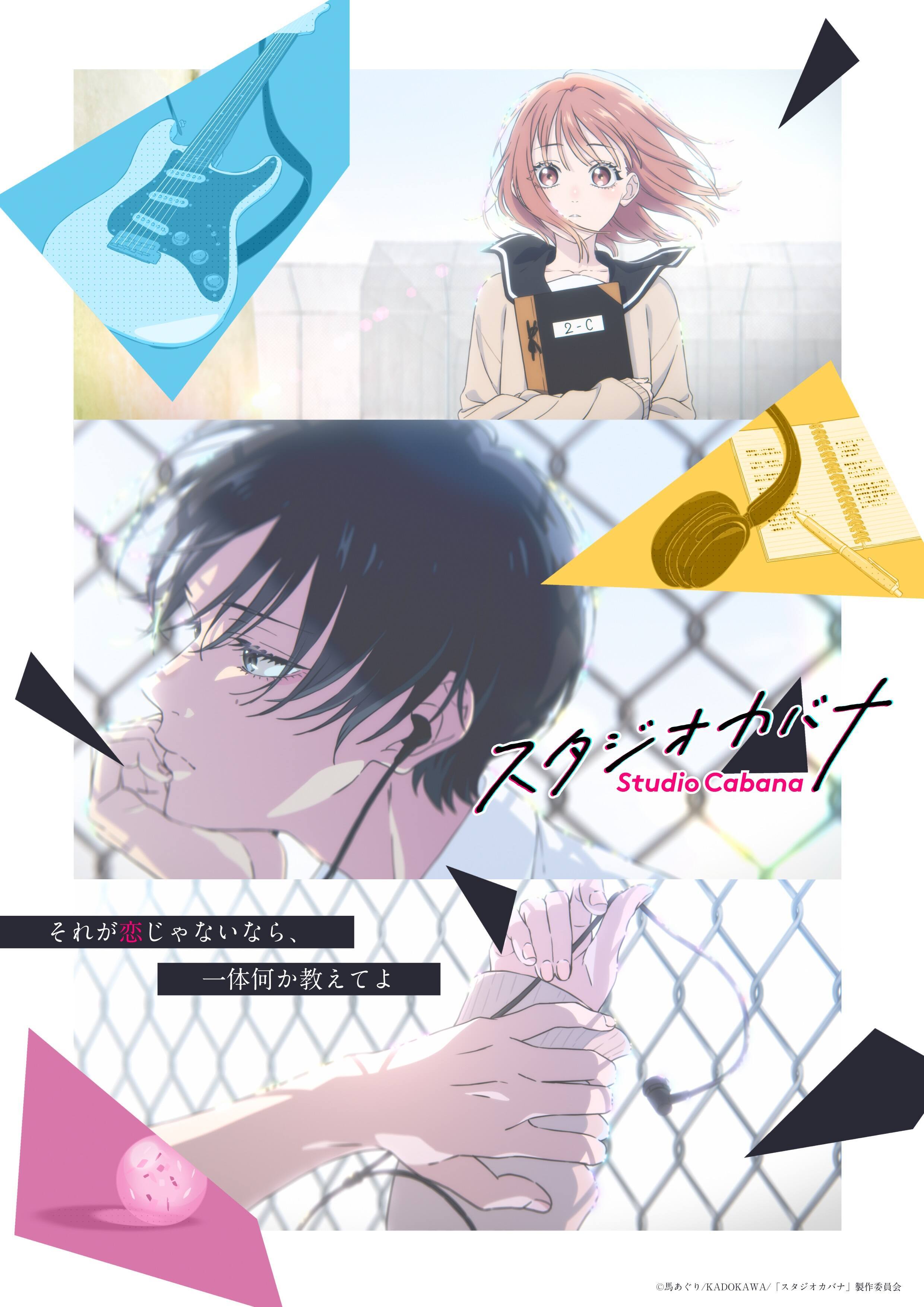 Production company Kadokawa opened an official website for a television anime adaptation of Aguri Uma‘s Studio Cabana on Wednesday, revealing the main cast, staff, and a teaser visual (pictured). The anime series will air in 2027.
Voice actress Sayumi Suzushiro (Bocchi the Rock!) is starring as the lead female character Yukari Maki.
Staff
Director: Shinichirou Ushijima (Kimi no Suizou wo Tabetai)
Series Composition: Sawako Hirabayashi (Ookami Shoujo to Kuro Ouji)
Character Design: Haruka Sagawa (Yofukashi no Uta)
Studio: Juvenage
Uma began drawing the music romance manga on the pixiv Sylph web magazine in June 2021. Kadokawa published the eighth volume in November 2025, with the ninth scheduled to be released on August 21. Studio Cabana has a cumulative 500,000 copies of its volumes in circulation.
Yen Press licensed the manga in English on May 25 and plans to release the first volume on December 15.
Studio Cabana was nominated in the Web Manga category for the 2023 Tsugi ni Kuru Manga Awards (Next Manga Awards).
Synopsis
Yukari Maki is a high school girl who prides herself on honesty—and she’s starting to get the feeling that she and her delinquent classmate, Yuusuke Kusaka, don’t have a single thing in common! But her straitlaced unwillingness to let him skate by in school earns her an almost chaperone-like reputation, and his apparent disdain. Yet, despite Yuusuke’s disapproval of her hovering, Yukari refuses to let a new rumor about him spread. After following Yuusuke home to discuss it, she watches him stop at a music studio. And there, Yukari sees—and hears—a side of Yuusuke she had never imagined… (Source: Yen Press)
Official site: https://studio-cabana.com/
Official X: studiocabana_pr
Source: Press Release
>

Manga with new interpretation of Journey to the West story launched in December 2025

©ippatu, Kodansha
This year’s 34th issue of Kodansha‘s Young Magazine announced on Tuesday that ippatu‘s Shōjōhime (Monkey Princess) manga will move to Kodansha‘s YanMaga Web website, where it is simultaneously serialized, on August 2. The manga will also start its new arc in its next chapter.
The manga simultaneously launched in Young Magazine and on the YanMaga website in December 2025. The manga is a new interpretation of the Chinese classic Journey to the West. Kodansha published the manga’s first compiled book volume on April 6 and the second volume on July 6.
ippatu began drawing the Tsugumi Project (Tora Tsugumi) manga, and French publishser Ki-oon began releasing it as an original manga in France in 2019. Kodansha‘s Weekly Young Magazine began serializing the manga in Japan in January 2021. The manga ended in September 2023, and got an epilogue chapter. Kodansha published the manga’s seventh and final volume in November 2023. Kodansha USA Publishing licensed the manga and released the final volume in September 2025, and it shipped in France in February 2024.
Tsugumi Project is inspiring a television anime adaptation.
Source: Young Magazine issue 34 and X/Twitter account
>
Anime
‘Mahou no Princess Minky Momo: Akogare no Yume e – Magokoro no Duo’ Reveals Additional Cast, Teaser Trailer

 The official website for the new Mahou no Princess Minky Momo: Akogare no Yume e – Magokoro no Duet (Fairy Princess Minky Momo) original video anime revealed additional cast members, main visual (pictured), and a teaser trailer on Wednesday. The OVA is scheduled to open in theaters on November 13 ahead of its home video release.
Cast
Databook: Fukuchi Ochiai (Karakai Jouzu no Takagi-san)
Chamocha: Natsumi Fujiwara (Saikyou no Ousama, Nidome no Jinsei wa Nani wo Suru?)
Pipirupi: Rie Kugimiya (Gintama)
Ayumu Watanabe (Summertime Render) is directing at Ashi Productions and Deko Akao (Witch Watch) is penning the script. Hiroshi Watanabe (Minky Momo in Tabidachi no Eki) and Mari Tominaga (Cardfight!! Vanguard) aare designing the characters. Tomoki Hasegawa (Jiisan Baasan Wakagaeru) is composing the music.
Produced by Ashi Productions, the original television anime aired in 63 episodes from March 1982 to May 1983. A second anime series aired in 62 episodes from Fall 1991 to Fall 1992.
The Minky Momo in Yume ni Kakeru Hashi (Minky Momo in the Bridge Over Dreams) original video anime was released in May 1993, followed by Yume no Naka no Rondo (La Ronde in my Dream) in July 1985, and Minky Momo in Tabidachi no Eki (Minky Momo: The Station of Your Memories) in June 1994.
Teaser Trailer
Source: Comic Natalie
>

How to watch Twins vs. Guardians: TV channel and streaming options for July 21

How to watch the men’s Zug Open: Streaming options for the Round of 16

How to watch the men’s Generali Open: Streaming options for the Round of 16

-

 Fashion9 years ago
These ’90s fashion trends are making a comeback in 2017
-
Fashion9 years ago
According to Dior Couture, this taboo fashion accessory is back
-
Fashion9 years ago
Model Jocelyn Chew’s Instagram is the best vacation you’ve ever had
-
Fashion9 years ago
Your comprehensive guide to this fall’s biggest trends
-
Fashion9 years ago
9 Celebrities who have spoken out about being photoshopped
-
Fashion9 years ago
Emily Ratajkowski channels back-to-school style
-
Fashion9 years ago
A photo diary of the nightlife scene from LA To Ibiza
-

 Tech3 months ago
OpenAI CEO apologizes to Tumbler Ridge community

