
Sports
AIG Women’s Open LIVE! Latest scores, updates, highlights from second round as Charley Hull, Lottie Woad chase major win | Golf News



Editor’s note: This is an updated version of an article that first appeared on The Athletic in May 2025.
For an insight into the one-upmanship between FIFA, the world football governing body, and UEFA, its European counterpart, let us begin with an anecdote about the prize money for last summer’s FIFA Club World Cup.
A pet project of FIFA president Gianni Infantino, he described the newly expanded 32-team tournament, held in the United States, as the “most coveted” trophy in club football.
According to multiple people briefed on FIFA’s planning for the tournament, who wished to remain anonymous to protect relationships, Infantino was determined to make a splash and, in FIFA-land, nothing makes a splash quite like dollar signs. Infantino wanted the winner of the Club World Cup to earn even more than the winners of the UEFA Champions League, to show it really was a bigger deal than UEFA’s prized asset, and to be able to unveil a figure that immediately captured the world’s attention.
In the end, he fell short. The winner of the Club World Cup, according to figures published by FIFA, earned up to $125m (£93.5m). This was less than the $154m UEFA announced Real Madrid earned by winning the Champions League in 2024.
That the ambition existed at all underlines how the two most powerful bodies in world football are wrapped up in a forever war for the economic and political control of the global game. That war has largely been a cold one, at times extremely frosty.
It has increasingly spilt over into public view. We saw it in Paraguay last spring when the eight European members of the FIFA Council, led by UEFA president Aleksander Ceferin, walked out midway through the FIFA Congress. This was because Infantino appeared to prioritise meetings with world leaders, including the U.S. president Donald Trump, in Qatar and Saudi Arabia. He subsequently arrived in Asuncion so late that FIFA’s congress needed to be delayed three hours.

Infantino, right, with Trump in May 2025 (Win McNamee/Getty Images)
In a later statement, UEFA admonished Infantino for disrupting the timetable “to accommodate private political interests.” Yet within a week, they climbed down, wishing to take a more conciliatory tone. A spokesperson told The Athletic back then: “We value the strong and respectful relationship with FIFA, built on mutual trust and a shared passion for football. The recent episode was isolated and does not reflect our ongoing collaboration.” FIFA secretary general Mattias Grafstrom claimed in Paraguay that FIFA has an “excellent” relationship with UEFA.
Yet through numerous conversations with football stakeholders, it became clear that the “strong, respectful and excellent relationship” has long been vulnerable to the slightest tremors, even before the earthquake this week in which FIFA has been revealed to have planned to sell off a stake in its commercial operations, which would include competitions such as the World Cup.
A senior executive within European football believed the congress in Paraguay represented a potential “inflection point” for the sport. Since then, hostilities have intensified. While other confederation presidents often indulge Infantino, Ceferin skipped the entirety of the Club World Cup. Sources close to the UEFA president claimed he was prioritising the women’s Euros in Switzerland, but he had attended only one of the opening 22 games of that European competition by the time the FIFA competition ended in mid-July last year. Ceferin previously skipped FIFA’s Women’s World Cup final in 2023, won by Spain against England, as well as missing the men’s World Cup draw last December and the World Cup final last week. He was also among the FIFA vice-presidents and FIFA Council members left aghast when Infantino unilaterally decided to garnish Trump with a FIFA Peace Prize.
It has reached the stage whereby UEFA policy appears to be designed solely by looking at what FIFA do and opting for the opposite. If FIFA says black, UEFA says white. While FIFA used dynamic ticket pricing during the World Cup, UEFA has committed to freezing most ticket fares for Euro 2028. When the Somali FIFA referee Omar Artan was barred by the Trump administration from entering the U.S. for the World Cup, and Infantino told the world to “chill, relax”, UEFA said Artan would be the referee for their UEFA Super Cup match between Champions League winners PSG and Europa League winners Aston Villa in August. When Infantino took a phone call from Trump, and his organisation then permitted USMNT forward Folarin Balogun to play a World Cup round of 16 match against Belgium, UEFA reacted furiously, expressing its “disbelief at such an unprecedented, incomprehensible and unjustifiable decision”. Statements followed from Belgium, Switzerland, Italy, Belgium and Germany.
This time, however, UEFA have wider support. Infantino’s attempt to sell a stake to Thrive, a firm owned by Joshua Kushner, a brother of Trump’s son-in-law Jared, has proved a bridge too far. UEFA’s threat to boycott FIFA competitions, including the World Cup, has not been repeated in other parts of the world, but there has been rejection of the plan from Concacaf, the confederation of North, Central America and the Caribbean, and expressions of disappointment from the Asian confederation. Europe, however, stands apart in its outright fury and action.
UEFA vice-president Laura McAllister, a former player for Wales, told BBC Radio Five Live on Thursday night: “UEFA has spoken out very strongly over recent months around ticket pricing, dynamic pricing for the World Cup, around the way supporters were treated, around the red card rescinding. Lots of us in our own federations felt very strongly about the so-called Peace Prize. There’s a whole sequence of interventions from FIFA that lots of us in Europe feel uncomfortable about. You can put that down as accumulation.
“That we’ve got to a position where, having seen the proposal set before the federations at very short notice this week with no consultation with any of the federations like UEFA, is it the final straw that breaks the camel’s back? Well, to a point it is. But let’s not kid ourselves. This could have been the most catastrophic intervention in football during the existence of the organisation of the game. Because the minute you sell a part of the game to private equity, the rules of the game change. Literally.”
FIFA declined to comment on specifics within this report when The Athletic contacted them in May 2025. A statement on Thursday night following the UEFA boycott said: “We respect the feedback and concern aired in public and reaffirm our commitment to an open and democratic consultation.”
It added: “Everyone has the right to express their opposition and to seek further clarification, but no single entity can claim to represent all 211 MAs (member associations) around the world.
“Each MA should be allowed to review the proposal and have a say in shaping their own future. These are the democratic principles of FIFA.”
At UEFA, the opposition to FIFA’s expansionism is sincere in some quarters and pragmatic in others. This is due to a growing sense within Europe that FIFA is seeking to make incursions into both UEFA’s dominance and income. For a long time, FIFA has been the organiser of World Cups and, in name at least, the most powerful organisation in the sport. But it rarely had a stake in major club competitions.
Europe is financially dominant within football. Before the 2026 World Cup, UEFA would tend to make more than double FIFA’s revenue, largely via its extremely successful annual Champions League for clubs and the European Championship for its international teams, which is held every four years.

Spain’s Lamine Yamal, left, and Nico Williams celebrate victory at Euro 2024 (Tom Weller/picture alliance via Getty Images)
For the four-year period between 2023 and 2026, culminating in a money-spinning World Cup in the United States, Canada and Mexico, FIFA projected $13billion in revenues (subsequently updating their projections to $15 billion). UEFA’s annual revenue for 2023-24 was €6.8billion ($7.64bn) alone. Five of the past six men’s World Cups have been won by European nations and 17 of the last 18 Club World Cup finals have been won by European sides. Much of the value to FIFA’s competitions is driven by European nations and players.
Since Infantino became president of FIFA in 2016, he has spoken repeatedly about the need to globalise the sport more effectively. His advocates would argue that expanding the men’s and women’s World Cups to 48 teams increase competition revenues, which can in turn be redistributed across the world to FIFA’s member associations. This helps those associations to develop the sport in their territories, and allows more nations to take part in the showpiece event. He would argue FIFA’s plan to take external partners will turbocharge that aim, but it remains puzzling to executives all over the world as to why a cash-rich organisation would need to put itself at the mercy of investors. UEFA have argued it is a smokescreen to “use our sport to enrich themselves (FIFA) and their friends.”
If we take Infantino at face value, there are some merits to the idea of making the sport more competitive beyond Europe. By diversifying FIFA’s interests into the club game, Infantino lessens its reliance on the men’s World Cup, which drives the vast bulk of its revenues. He has highlighted a complaint that many football supporters will share — that a handful of sides, even within Europe, are always at the top table.
He told club administrators at a FIFA diploma in club management session in 2022: “It is true there is a gap between a few countries in Europe — not even the whole of Europe, but a few countries — and the rest of the world.
“What we need to do is to close the gap, not by bringing these big Europeans down, because these big Europeans also need to continue to grow. But the rest of the world has to grow as well and ensure we have a more competitive football world out there.”
On the surface, this is a valid argument. Yet within the corridors of power at UEFA, it is more often perceived as a power and cash grab that will detract from its own money-making potential and disrupt Europe’s hegemony.

Infantino has been criticised (Amphol Thongmueangluang/SOPA Images/LightRocket via Getty Images).
The feud between Ceferin and Infantino first spiked in 2018 when Infantino sought to push through a $25billion arrangement with the Japanese and Saudi-backed firm SoftBank, which would have created new global club and national team competitions. This deal would have included a reported $3billion towards each edition of the revamped Club World Cup, as well as a global version of the Nations League.
The Nations League had originally started as a UEFA project and the governing body wished to license it out to different confederations. UEFA had concerns that the SoftBank-FIFA tie-up could lead the Champions League to be undercut, the calendar to be interrupted and that new global competitions could eat into UEFA’s existing market share with broadcasters and sponsors.
UEFA were first out of the blocks to oppose the possibility of the World Cup becoming a biennial tournament. FIFA did not formally endorse the idea, but the FIFA Congress did agree to consult on the matter.
Ceferin, however, said European nations would boycott the tournament and claimed he had the support of the South American confederation CONMEBOL. Europe and South America have produced the winner of every men’s World Cup since its inception in 1930, and UEFA and CONMEBOL formed an alliance to rebut FIFA’s aspirations, even working together to launch a shared office space in London in April 2022. As part of this, they launched a Finalissima event, which sees the winners of the European Championship play the winners of Copa America. Only one edition of that match has been held so far, in 2022.

Argentina after winning the Finalissima in 2022 (Catherine Ivill – UEFA/UEFA via Getty Images)
The inference of the joint venture was clear; if FIFA continued to pursue proposals that Europe and South America did not think was in their interests, then those confederations would work independently to achieve their own objectives. They successfully rebutted the idea of a biennial World Cup, but more recently CONMEBOL has moved closer to FIFA, particularly since securing the 2027 Women’s World Cup in Brazil. It wants FIFA to expand the 2030 men’s World Cup to 64 teams to mark the 100th anniversary of the tournament — and, more specifically, secure more games to be hosted in South America — a concept that gained momentum during the 2026 World Cup, where the 48-team expansion impressed many but not all.
The UEFA-CONMEBOL alliance in London is now on the back burner. Sources describe the operation as very slim and that it may even be wound down. In Paraguay, CONMEBOL’s growing relationship with Infantino was highlighted when CONMEBOL’s HQ and the Bourbon Hotel chain dedicated a tower in the FIFA president’s name.
At the height of the animosity between UEFA and FIFA, there were outward displays of tension. When Infantino, during a speech at the UEFA Congress in 2020, called for a review of the men’s calendar, the UEFA president Ceferin said: “No football administrator, no matter the size of his ego, should think we are the stars of the show…”
The unease greatened in the spring of 2021 when plans for a closed European Super League for the continent’s elite clubs appeared and disappeared in the space of three days, and UEFA’s suspicions of FIFA having prior knowledge and complicity in the Super League — which FIFA denies — have never fully shifted. Those suspicions were reawakened this week when it emerged that JP Morgan, the bank behind the Super League, was also working with FIFA on Infantino’s sell-off.
At last year’s FIFA Congress in Asuncion, all these old hostilities sprang to the surface.
In a statement after their eight members of the FIFA Council walked out, UEFA said: “We are all in post to serve football; from the streets to the podium.”
Their departure and condemnation certainly rankled some at FIFA, and there are plenty of similarities between Infantino, who flew into Asuncion on a Qatari private jet, and Ceferin, who traversed Euro 2024 in Germany in a private plane. A private jet was spotted leaving Asuncion not long after the European executives walked out of the FIFA Council. UEFA did not comment when asked last year if Ceferin left the country by private jet.
Those UEFA figures who walked out of the congress are handsomely remunerated for their FIFA work. Ceferin, as a confederation president and FIFA Council vice-president, is eligible to receive a net annual compensation of $300,000. Neither UEFA nor FIFA commented when asked whether he accepts this money from FIFA.

Ceferin, left, with Infantino (Nicolò Campo/LightRocket via Getty Images)
The pair have other, shared challenges, too. By venturing into the club game with the Club World Cup, they may wish to share notes on the challenges of handling the demands of Europe’s richest and most widely supported teams, who, with the exception of Real Madrid, are usually represented by the European Clubs’ Association (ECA).
Yet Infantino’s claims are now backed up by reality. While Infantino talks about globalising the sport, the Club World Cup was once again a win for Europe’s richest teams. Participation fees ranged between $12.8million and $32.8m for European clubs, while the maximum a South American team received to participate was $15.2m. Teams from North America, Asia and Africa received $9.6m and Oceania $3.6m.
When we then add in the tens of millions of dollars available in prize money, largely secured by European teams owing to their bigger budgets — Chelsea and Paris Saint-Germain played out the final — the Club World Cup further entrenched and extended the dominance of the small number of European clubs that Infantino bemoaned.
The FIFA president, however, reiterated in Asuncion last year how he believes football’s growth potential will come outside Europe. He gave a signpost to the events of this past week: he said with “relatively small investment” from Saudi and the U.S., the global football GDP (gross domestic product) could grow from $270billion a year to half a trillion. The Saudi investment has not been hidden, with billions being poured into the 2034 World Cup and a domestic league spraying money around like a confetti cannon.
Now, at last, we know what he had in mind when he challenged U.S. funds to come to the market. In doing so, the cold war with Europe has turned nuclear.
>
The newly-expanded Women’s Super League will begin on Friday, September 4, when London City Lionesses host Manchester United.
That match at the CopperJax Community Stadium could see double Ballon d’Or winner Alexia Putellas make her debut for London City, after joining as a free agent from Barcelona.
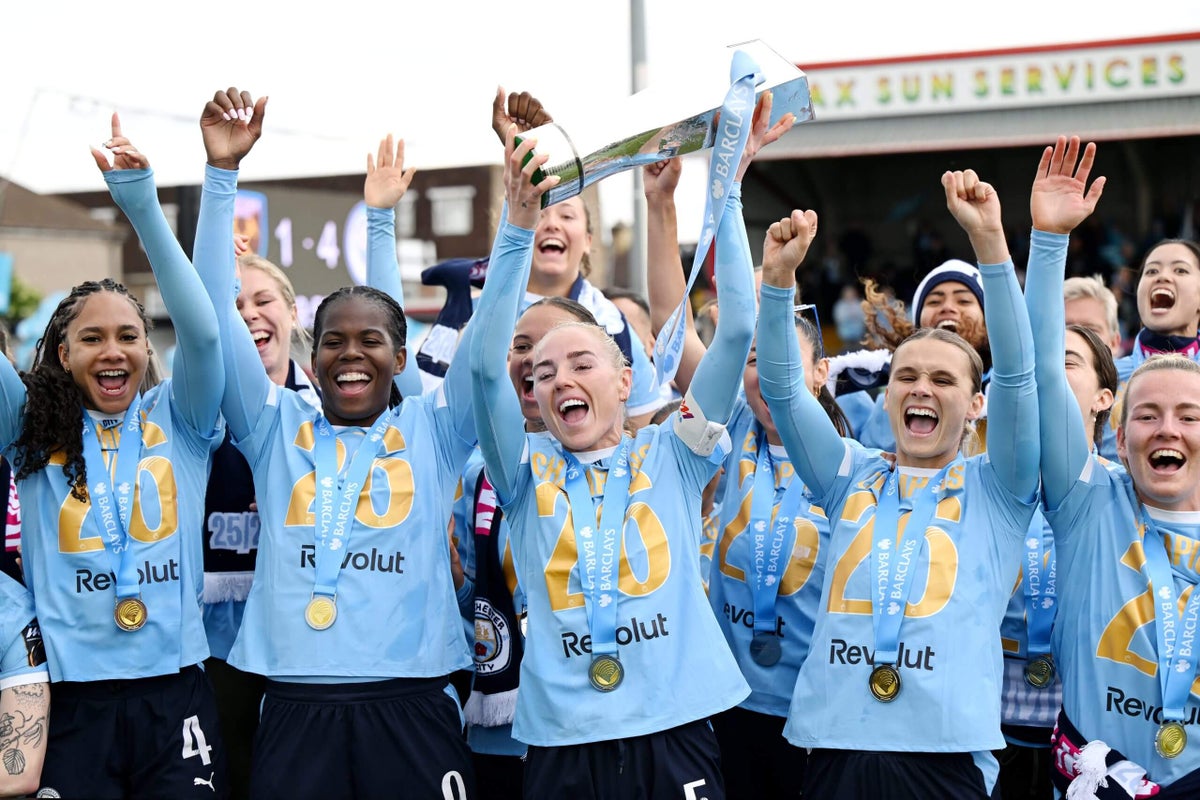
Meanwhile, Manchester City will begin their title defence at home to promoted side Birmingham City on Sunday, September 6.
An expansion of the top-flight WSL1 from 12 to 14 teams will see 50 more fixtures played across the season, which will end on the weekend of May 22-23, 2027 — only one month before the women’s World Cup in Brazil gets underway.
Kick-off times and broadcast picks in the UK have only been confirmed as far as the end of September — but notably, there are no midday Saturday kick-offs as yet. That slot was unpopular with many fans last season due to the difficulties away supporters faced with travelling in time for games, and the fact that many fixtures were played concurrently — reducing the ability to watch multiple games in a weekend.
“In response to feedback from fans and clubs, WSL Football has worked in collaboration with Sky Sports and the BBC to find more broadcast slots that balance broadcast windows with the need to drive match attendance,” a press release from the league read. “This season there will be greater flexibility with fixtures across game weekends with less matches kicking off at the same time.”
What are the opening weekend matchups?
Manchester United’s trip to London City is the only match on Friday night, kicking off at 7pm (all times BST/GMT). Chelsea will then host Aston Villa at Stamford Bridge at 12.30pm the next day.
Arsenal begin their campaign at Brighton & Hove Albion on Sunday, September 6 at 12.00, while Tottenham Hotspur will host West Ham United in a London derby at the same time.

New London City player Alexia Putellas is expected to be one of the stars of the new season (Jaime Reina / AFP via Getty Images)
Charlton Athletic host Liverpool for their first-ever WSL1 match at 2pm, as fellow promoted side Crystal Palace play Everton. The last of the three promoted teams, Birmingham City, face the toughest test as they travel to champions Manchester City in a 2.30pm kick-off.
Key matches and derby days
Match-ups between last season’s top four begin early. Manchester United host Chelsea in the second matchweek on September 13, before travelling to Arsenal on September 19. The first derby between Chelsea and Arsenal takes place at Stamford Bridge on September 27, with the reverse fixture at the Emirates currently set for March 28, 2027.
Holders Manchester City’s first heavyweight clash will come on October 4, when they host Arsenal — last season’s runners-up — at the Etihad Stadium. They will then travel to Chelsea on November 14.
The Manchester derbies between United and City are set for October 25 at United’s Progress with Unity Stadium, and February 14 at the Etihad. Liverpool will host Everton for a Merseyside derby at Anfield on September 27, before the reverse fixture at Goodison Park on March 28.
The calendar has not thrown up many direct clashes late in the campaign between last season’s top four. Arsenal’s trip to face Manchester United at Old Trafford on the penultimate weekend is the headline fixture. Games between the three newly promoted teams will also be finished by the end of March.
How will World Cup preparations impact the season?
Many players will see their international windows carrying more weight than usual as they look to seal their country’s place in Brazil, particularly over the autumn and winter breaks.
UEFA nations who have not yet qualified, including England, will face continental playoffs in the windows between October 5-13 and November 24-December 5. Concacaf teams will also compete for their spot at the Concacaf W Championship in that later window. The majority of places for African sides will be confirmed before the season begins, at the current Women’s Africa Cup of Nations.

Chelsea and England defender Lucy Bronze will be among the players eyeing the World Cup in Brazil next summer (Harriet Lander – The FA/The FA via Getty Images)
Most teams will therefore know if they have secured their place by the turn of the year; the last three spots will be decided in the final phase of the inter-confederation playoffs in February 2027.
The league finishes on May 23 and the World Cup kicks off on June 24 in Brazil, meaning a tight turnaround for players in the league travelling to the tournament.
At the 2023 World Cup, clubs in England employed more players selected for the tournament than any other nation (104). Chelsea, Arsenal, and Manchester City were the third, fourth, and fifth-best represented teams at the tournament, only behind Barcelona and OL Lyonnes (then Olympique Lyonnais).
What’s different this year?
As mentioned above, this is the first season since the WSL1 expanded to 14 teams, up from 12. Birmingham City and Crystal Palace were promoted automatically from the WSL2 after finishing first and second. Third-placed Charlton Athletic beat Leicester City, who finished bottom of the WSL, on penalties in a play-off to gain promotion and send Leicester down.
The lack of automatic relegation from the top flight was a one-off this year. Starting this season, the team that finishes bottom of the WSL1 will be automatically relegated and the winners of the WSL2 automatically promoted. A play-off will take place between the 13th-placed WSL1 side and second-placed WSL2 side to determine the final top-flight place.
>

Franco Baresi has died at the age of 66, with AC Milan saying their former captain’s “example and integrity will be forever etched into the club’s DNA”.
Baresi spent his entire 20-year playing career with the club from 1977 until he retired in 1997, winning six Serie A titles and three European Cups/Champions Leagues.
Regarded as one of the greatest defenders to play the game, Baresi captained Milan for 15 seasons, making 719 appearances and scoring 33 goals.
He was capped 81 times by Italy and was part of the squad which won the 1982 World Cup. He played in the 1994 final, which Italy lost to Brazil.
In 2020, Baresi became honorary vice-president of AC Milan, with the club retiring his number six shirt four years later.
Baresi had surgery in August 2025 to remove a lung nodule, and his last public appearance was at the San Siro Stadium for the Winter Olympics opening ceremony in February.
In a statement on X, AC Milan wrote: “Milan is in tears following the passing of Franco Baresi. His example and integrity will be forever etched into the club’s DNA, just as his iconic number 6 shirt is.”
>

Are FIFA and UEFA in a forever war?

Michael Jackson Boosts Sony Music Sales Amid Quiet Quarter For Studio

AIG Women’s Open LIVE! Latest scores, updates, highlights from second round as Charley Hull, Lottie Woad chase major win | Golf News
-

 movies2 months ago
Search For Canadian TV Actor Stewart McLean Now Homicide Investigation
-

 Fashion9 years ago
These ’90s fashion trends are making a comeback in 2017
-
Fashion9 years ago
According to Dior Couture, this taboo fashion accessory is back
-
Fashion9 years ago
Model Jocelyn Chew’s Instagram is the best vacation you’ve ever had
-
Fashion9 years ago
Your comprehensive guide to this fall’s biggest trends
-
Fashion9 years ago
9 Celebrities who have spoken out about being photoshopped
-
Fashion9 years ago
Emily Ratajkowski channels back-to-school style
-
Fashion9 years ago
A photo diary of the nightlife scene from LA To Ibiza