
Anime
Exploring the Character Dynamics Between Ritsu and the Band in BanG Dream! YUME∞MITA – Advertorial


It’s official! As of the sixth episode of BanG Dream! YUME∞MITA, Ritsu will be joining her childhood friend Arale and the other members of MewType in the band. It was a rocky road to get here, and as this is written there’s still plenty of anime left to go and lead to challenges ahead for the girls. Ritsu is, after all, leaving behind an extremely dangerous dynamic with her previous group Fairy Bouquet and chief series antagonist Viola. This can and will inform the conflict going forward, but it means that Ritsu has a whole new group of decidedly more accommodating associates. It also makes this stage in the story a good place to take stock of these characters, their personalities, and how they engage in connections with their cohorts—with their potential relationship dynamics with Ritsu a rich lens to perform this analysis through.

copyright ©BDP
Ritsu and Arale’s relationship is the obvious place to start. The pair have a pre-existing connection, and rekindling that friendship was what incited Ritsu to leave her distressing situation with Fairy Bouquet and wind up welcomed into MewType. The duo are inspirational to each other. Bonding over Magilulu and the songs therein are what led to both of them becoming performers together, putting both girls on the career trajectory that has once again reunited them. Ideally, coming back together would lead to each girl reembracing her role as the other’s muse.
However, YUME∞MITA is a story where things haven’t always been ideal for these girls. Ritsu and Arale had been kept apart by the machinations of Viola. That wedge the villain drew limited the communication between them, and both girls have been working to bridge that gap before arriving at this point. Ritsu couldn’t bring herself to tell Arale about Viola’s true nature for so long, even as she saw her friend suffering under the judgmental eyes of the public she had turned on her. Part of this was propped up by Arale putting on a brave face—not knowing that Viola had set her up and was also acting as Ritsu’s tormenter, Arale couldn’t bring herself to make her true anguish known. This boiled over in the fifth episode of the anime, which did ultimately result in the net good of Ritsu’s rescue. But it also speaks to the built-up communication gaps the childhood friends still need to get to work covering. A broken relationship can always be fixed, but like any repair job, it takes work. It means that even as Arale and Ritsu have had their heartfelt reunion, they still have a strong potential arc between them ahead in the story.

copyright ©BDP
Ritsu might be able to get some immediate assistance from the most supportive member of MewType, Nonoka. Ritsu has thus far had the least direct interaction with Nonoka compared to the other members of the band, but that hardly rules out any connective reading. Indeed, Nonoka’s nature makes her the easiest to analyze a dynamic with someone like Ritsu. Nonoka has already been all too happy to throw herself on the line in support of fellow members Arale and Miyako through their own tribulations. She’s like the caring big sister of the group, and seems perfectly happy to welcome a new member into the family. Nonoka also has a very practiced attitude when it comes to dealing with the issues brought on by online attention and fame. She’s unfazed by oppressive remarks from streaming commentators and even seems like she would bear the brunt of that frustration for the more sensitive members like Ritsu. This might be important in the group’s near future, as the antagonist behind Ritsu’s issues still has her machinations on the move.
Indeed, Ritsu might have had less direct interaction with Miyako so far, but the two of them now find themselves, if unknowingly, occupying pointedly parallel paths. With Ritsu out of her clutches, Viola has set her sights on Miyako to manipulate in order to inflict harm on MewType, and thus Arale and Ritsu themselves, as revenge. Miyako specifically isn’t exactly like Ritsu, save for both of them being driven by their dedication to their work—and perhaps that tunnel-vision focus is what makes it harder for them to pick up problematic points in the periphery. The real difference is that while Ritsu seemingly had herself bullied into Viola’s manipulations and coercion, Miyako got hit with a one-shot of charm aimed directly at her personal strike zone. Again, that lack of communication, particularly with Ritsu refraining from opening up about who Viola is and warning the others about her experiences, has created a broken bridge between her and another band-mate that could be exploited for drama moving forward.

copyright ©BDP
Speculatively, this does also mean that Ritsu and Miyako have something to connect over as this plot unfolds. Miyako barely has enough reason to trust Ritsu over anyone at this point, but Miyako herself is a seasoned expert in showing one face professionally to the public while hiding her true personality for her own purposes. She might have something to learn from the more earnest, trust-forward Ritsu. On the other hand, both girls having experience being manipulated by Viola—that’s something they could mutually bond over. The situation could also give the full MewType group a new, unified purpose in supporting each other. The possibilities that could spin out of these relationships really are endless!
It helps that Ritsu does already have prior experience bonding with MewType members and receiving assistance with her issues. Arale aside, one of Ritsu’s first intersections with one of the girls was with Yuno, whom she rescued from inadvertent malnutrition and, as a reward, received some salient relationship advice. This scene served as an early, revelatory moment for Yuno, who previously (and still does, to be sure) went out of her way to eschew connections with her band-mates—perhaps owing to her own issues with groups in the past. Despite this, Yuno helped put Ritsu on the right emotional track, crystalizing how important her relationship with Arale was to her. With the line “If you don’t want it to end, who cares about the facts?” touching Ritsu’s heart, it allowed her to believe that her connection to Arale hadn’t yet ended. All thanks to the surprisingly low-key advice of “the girl with the bone-in meat!”

copyright ©BDP
With the way these relationships and connections have cascaded, it’s arguable that Ritsu wouldn’t have been positioned to run off with Arale into the haven of MewType had she not crossed connective paths with Yuno that day, and Yuno herself would not have been out there had she not been drafted into working with the band in the first place. Yuno very noticeably was not a people person at this point, going so far as to turn to chatbots to write her messaging answers to her cohorts. Yet upon seeing Ritsu join the group and realizing who she was, she’s started to get a broader idea of the greater connective context between all these girls.
There are still walls of connective complications around these girls. As of the sixth episode, Ritsu has not formally joined the group in their virtual gatherings, and they haven’t fully opened up about the webs of circumstances that intertwine all of them. Miyako’s keeping her relationship with Viola a secret, after all, and that alone sets up several separate shoes that could drop on these budding connections between the new band members. However, the fact that they can be set up so tellingly between the established members and the new entry in Ritsu speaks to the relationship-based character writing and dynamics that have powered YUME∞MITA so far.

copyright ©BDP
The girls of MewType have had their own personalities defined and developed on display through the whole of the anime to this point. But being a band requires working in concert, and that’s why the connective dynamics between the characters is so much fun to speculate on in a series like YUME∞MITA. It’s been apparent already between characters like Arale and Miyako bonding over their own love of anime, manga, and limited-edition goods. And Nonoka’s dedication to her cohorts has both defined her and shown how she relates to others and her role as a performer. While Yuno has mostly been defined by her standoffish nature and not engaging as deeply with the other members of the band, that is itself a dynamic, and one that’s quickly thrown into relief by the interactions she’s already had with Ritsu. With Ritsu now officially joining the group, being able to assess the dynamics she has with all of them makes apparent how fully formed they’ve been made over the course of this anime.
As well, as any good group addition should, Ritsu shifts the established dynamic to show new sides of everyone—while her lingering threads tied to her past problems with Viola threaten to upend the group even more before all is said and done. Not all connections can be constructive, of course. But Ritsu arriving here and discovering a far more appreciative support network that can help each other through these impending issues demonstrates the power of positive relationships between performers. Plus it propels the broader theme of BanG Dream! as a whole: that being in a band with people you like is fun, positive, and worthwhile.
>
Anime
Even After Four Seasons, Miho Okasaki (Rimuru) and Megumi Toyoguchi (Raphael) Still Find Their Roles Challenging – All the News and Reviews from Anime Expo 2026


© Taiki Kawakami, Fuse, KODANSHA/“Ten-Sura” Project
Beloved isekai series, That Time I Got Reincarnated as a Slime, approaches its eighth year on air. The anime adaptation of Fuse‘s web novel started in 2018 and still welcomed a full house of eager fans during its Anime Expo 2026 panel. Currently, Rimuru is trying to create a space for humans and monsters to peacefully coexist, but faces an uphill battle with the Rozzo family and others. Betrayal, friendship, and epic demon battles still remain a core pillar to the series, and provide a spectacle that keeps fans coming back.
Voice actors Miho Okasaki (Rimuru) and Megumi Toyoguchi (Raphael) spoke to Anime News Network about their time together (so far) as the duo, and even shared a behind-the-scenes look into their own chemistry.
ANN: How would you describe Rimuru and Raphael’s relationship? And how has it evolved over the seasons?
MIHO OKASAKI: When (Rimuru) first encountered Raphael, they honestly had no idea what it was. Later on, it was revealed that Raphael was actually a skill. People may think of a skill as just a function especially as the way Raphael spoke was rather robotic as Great Sage. But over time, and through evolution, Raphael has become very human. Now, it feels like the two are just like inseparable partners. Raphael is the one that Rimuru relies on all the time. But, I think there’s something special to Rimuru about the fact that Raphael is a presence only they can sense. Even when they’re panicking on the inside, if Raphael gives them the answer, they can make it look like they figured it out themself. Even so, through all of that, they’ve built a real bond. Watching that relationship grow, and seeing that emotional connection deepen over time, is one of the things I really love about them.
MEGUMI TOYOGUCHI: As the story goes, the relationship between Rimuru and Raphael has deepened over time. Originally, Great Sage Raphael is a skill, so Raphael is not supposed to have changing emotions. So, I—or rather Raphael—may not be supposed to have any desire to support Rimuru, but I personally feel from the dialogue that the desire to support Rimuru has gradually grown stronger in Raphael.

© Taiki Kawakami, Fuse, KODANSHA/“Ten-Sura” Project
ANN: Similarly, have you both spoken to each other about Rimuru’s trust in Raphael, like at the end of Season 4, where Raphael smiled after Rimuru referred to Raphael as “partner?”
OKASAKI: Yeah, of course, Rimuru puts complete trust in Raphael. Raphael is always the one who guides Rimuru, whenever Rimuru is in trouble. That’s what makes Raphael truly irreplaceable, as Raphael sees from the perspective of Rimuru. That’s why I think Raphael is Rimuru’s one-and-only partner. The distance between them feels very comfortable. Rather than facing each other and talking, it feels more like they’re sitting side by side at the bar counter or walking side by side. They may not need to exchange a nod, but they share the same understanding, and I find that really comforting.
Not only with Raphael, but in general, we don’t usually discuss beforehand how we’re going to approach our performances during recording. In fact, ever since Raphael was Great Sage, we haven’t talked about how we’re going to play our scenes. But during the test recording, there are moments when I think, “Oh, so that’s how she is playing it!” It always makes me smile. That’s become one of the things I look forward to during recording; I feel there’s something special about not discussing it beforehand.
ANN: When the TV anime began, Raphael was basically an emotionless computer. However, after evolving, how do you feel Raphael has changed?
TOYOGUCHI: After evolving into Raphael, the biggest challenge was finding the right balance. Raphael had originally spoken like a computer, but as a little bit of emotion began to come through, it became difficult to figure out how much emotion I should bring into the performance. I’m still adjusting that balance. There was one recording session where the director and I talked beforehand about whether I could bring out a little more emotion. It was a scene where those feelings naturally came through, so I decided to lean into it a bit more. But in the end, I think I went a little too far. So even now, I’m still fine-tuning that balance.

© Taiki Kawakami, Fuse, KODANSHA/“Ten-Sura” Project
ANN: While usually happy and kind, in the battle against Falmuth, Rimuru killed 60,000 people—many more than Rimuru needed to in order to become a Demon Lord—just in the name of revenge. Do you feel that this makes Rimuru objectively a villain? Do you believe that Rimuru can ever be redeemed? Or do they even need to be?
OKASAKI: That is a difficult question. Whether someone is considered good or evil depends on the perspective from which you view them. I think that’s true not only in the world of That Time I Got Reincarnated as a Slime, but in the real world as well. It even makes me wonder whether forgiveness and being forgiven truly exist in the first place.Rimuru acts according to their own convictions, not out of prejudice.
Personally, I want to support them. They’re not the kind of person who acts simply to make themself look good. Rather, their decisions are driven by their desire to protect their friends and help the nation prosper. In that sense, I really hope people don’t end up hating them too much. Now that they have so many people depending on them, they may have to make choices like the one they made during Megiddo again. But I never thought that decision would come easily to them. I did find it frightening!
How do you go about subtly injecting emotion and sarcasm into your performance?
TOYOGUCHI: I think I probably have a tendency to overdo it. There were quite a few times during Season 4 when I felt I’d gone a little too far. As I mentioned earlier, I’m still working on making Raphael’s emotions feel subtle and natural. Because of the COVID-19 restrictions, we often had to record separately instead of together during Seasons 2 and part of Season 3. I don’t think I ever had to record completely by myself. But now we’re back to recording together and playing off one another.
Ideally, it’s best when we can perform together and play off each other. But even if Rimuru becomes very emotional, I can’t let myself follow them to that same level because Raphael has to stay much more restrained. So whenever I play Raphael, I’m constantly holding my emotions back. Holding them back is actually the hard part. During breaks, I tend to chat with everyone, so my energy naturally goes up. I try not to get too excited, but I always end up having so much fun that my energy rises anyway. So when recording starts, I spend the whole time bringing myself back down, telling myself, “Empty your mind. Empty your mind.”
ANN: Throughout the past four seasons, the audience has seen Rimuru grow from an easygoing personality to a proper leader. What helps you act as Rimuru when they show a mature side, like when Rimuru self-reflects at the end of the latest season?

© Taiki Kawakami, Fuse, KODANSHA/“Ten-Sura” Project
OKASAKI: Rimuru has certainly grown through everything they’ve experienced up to Season 4. But I also think that the parts of them that are thoughtful and love freedom were always there from the beginning. Depending on who they’re talking to, different sides of their personality are brought out, which changes the impression they leave on others as well. In the same way, as Rimuru goes through different situations, different aspects of their character come to the surface. I think it’s really about the resolve they have in each situation. So rather than deciding, “This is the kind of person Rimuru is,” based on a particular episode, I try to understand them from many different angles. When I’m standing in front of the microphone, though, I try to bring myself as close to Rimuru as possible.
Rather than observing them from a distance, it feels more like I’m letting Rimuru come through me. Because of that, there are times when it’s difficult to put into words exactly how I approached the performance. The final part of Season 4 was one of those moments. I’ve spent such a long time with Rimuru that now they come out quite naturally. Of course, if the director tells me, “That’s not quite Rimuru,” then I step back, look at the performance objectively, and think about what I can adjust to better convey the character. That’s when I started fine-tuning the performance. However, on the first take, it feels more like I’m letting Rimuru come through me.
ANN: I read that you gave some advice to Okasaki-san on the delivery of,「チョ待てよ」(Cho, matte yo!*) or Wait a second!, during the court scene where Rimuru and Kaijin are sentenced in season one? Were there other times you helped her?

© Taiki Kawakami, Fuse, KODANSHA/“Ten-Sura” Project
TOYOGUCHI: It’s so funny hearing, “Cho, matte yo!*” in the middle of an English question. I had completely forgotten about that line.
OKASAKI: First of all, I was familiar with the line “Cho, matte yo!* (Wait a second!)” that a Japanese actor, Takuya Kimura, delivered in several TV dramas. I never imagined that I’d actually have to perform it myself because KimuTaku (Kimura-san’s nickname) is a man and I’m a woman. When I started wondering how I should approach it, rather than waiting for someone to tell me exactly how to do it, I figured they were probably looking for a slightly exaggerated take on it. So I watched Takuya Kimura-san himself, then Hiroto-san—who’s famous for impersonating him—and finally Megumi-san (Toyoguchi), who’s especially good at capturing KimuTaku’s signature intensity in his eyes. Rather than teach me how to do it, Megumi-san demonstrated it for me. In the end, I blended all three influences together to create that moment.
*Note: “Cho, matte yo!” (“Hey, wait a second!”) became one of Takuya Kimura‘s well-known lines because of his distinctive way of saying it in several TV dramas. Today, it’s widely recognized as his signature phrase used in impersonations of him. Kimura even references his own famous line as Takayuki Yagami in SEGA‘s game, “Judgement.”
TOYOGUCHI: How did it come across in the English version? What was it like?
ANN: The English dub doesn’t translate the line and replaces it with, “Whoa, what just happened?”
TOYOGUCHI: Actually, when it comes to “Cho, matte yo!,” our director does it all the time. He’s probably the best at it.
OKASAKI: I was so nervous about performing it for the director that I asked Megumi-san for advice beforehand.
ANN: You originally started voicing Rimuru two years after your debut as a voice actor. Now that it’s been over eight years in this role, what are you excited to do as Rimuru?
OKASAKI: The story continues much further in the original novels. Although the anime is adapted from the manga, I think it will continue following the novel’s overall storyline. So my biggest challenge is to help bring everything Rimuru experiences to life through the anime. Just like this trip to Los Angeles in America, I’m sure being part of That Time I Got Reincarnated as a Slime will continue to bring me exciting new opportunities and challenges. As someone who considers herself a late bloomer, I’m grateful for every one of them. But above all, my greatest challenge—and something I feel I’ve been striving for all along—is to help bring Rimuru’s journey to life as they live through the story.
>
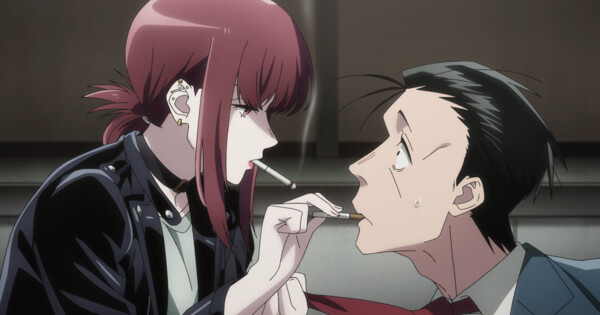

© Jinushi/SQUARE ENIX,Smoking Behind the Supermarket with You Production Committee
Smoking Behind the Supermarket with You is a show that lives or dies based on how cute and likable its leads are in a given episode, and I’m thrilled to say that Sasaki and Yamada/Tayama maintain their adorkable charms outside of the first three episodes of this season. I don’t even really care if they get together or not when this season wraps, if Sasaki ever figures out that these two cute girls are actually the same person, or any other long-term plot points the show has set up. I’m coming to Supermarket Smoking week after week for moments that make me blush and gags that make me smile, and this latest episode delivers both in spades!
The opening act of Smoking Behind the Supermarket with You‘s fourth episode focuses on Sasaki needing help figuring out his new smartphone after his old flip phone finally breaks. While I was initially worried that this episode would dredge into over-explored territory of “zoomer helps grandpa figure out their new phone,” what this episode actually does is much more entertaining and relatable. It’s clear pretty quickly that Sasaki’s tech illiteracy isn’t primarily motivated by his age, it’s instead a consequence of his anxieties over breaking this new device or looking foolish while using it. While still not necessarily a novel premise, this did resonate with me as someone who’s been meaning to switch my PC over to Linux for half a year now, but my own fear of wrecking a device I need for my personal and professional lives keeps stopping me.
The second act features Sasaki and Tayama reading a kind of personality quiz based on their preferred brand of cigarettes, with Sasaki petrified that he accidentally offended the young women when her insight ends with a crass sexual remark. Beyond featuring some good golden retriever boyfriend moments from Sasaki, this bit also further reinforces how meaningful this relationship and dynamic is to Tayama, as she fears that Sasaki accidentally discovered her deceit over the course of it. The inciting event of Sasaki not being able to tell that Tayama and Yamada are the same person rides right up to the limit of my suspension of disbelief for this kind of grounded show, and seeing Supermarket Smoking try to push that envelope is a lot of fun.
In the third act, the summer heat has arrived early with Yamada switching to her short-sleeved uniform and Tayama bearing her midriff while she and Sasaki are hanging out…with Sasaki making a bigger deal out of the former much to the young woman’s chagrin. It’s really cute seeing Tayama/Yamada get flustered as she tries and fails to get a sexually charged rise out of this incredibly innocent man, and to witness Sasaki’s earnestness loop around to throw this tease off of her game.
Is this the best episode of anime to air this week? Not by a mile, but it does hit exactly how I need it to after a day of running around and trying to do too much professionally. My serotonin levels are way up after watching this episode of Supermarket Smoking, and that means this show is more than meeting my expectations for it.
Rating:
Lucas DeRuyter is your one stop shop for smoking hot anime takes, and you can read the best of those by checking out his portfolio. You can also catch him filling a double shift as a columnist for ANN’s recurring This Week in Anime segment, where he shares his insights into that week’s news, trends, or special topics.
Smoking Behind the Supermarket with You is currently streaming on
Crunchyroll.
The views and opinions expressed in this article are solely those of the author(s) and do not necessarily represent the views of Anime News Network, its employees, owners, or sponsors.
>
Anime
Even After Four Seasons, Miho Okasaki (Rimuru) and Megumi Toyoguchi (Raphael) Still Find Their Roles Challenging – All the News and Reviews from Anime Expo 2026

© Taiki Kawakami, Fuse, KODANSHA/“Ten-Sura” Project
Beloved isekai series, That Time I Got Reincarnated as a Slime, approaches its eighth year on air. The anime adaptation of Fuse‘s web novel started in 2018 and still welcomed a full house of eager fans during its Anime Expo 2026 panel. Currently, Rimuru is trying to create a space for humans and monsters to peacefully coexist, but faces an uphill battle with the Rozzo family and others. Betrayal, friendship, and epic demon battles still remain a core pillar to the series, and provide a spectacle that keeps fans coming back.
Voice actors Miho Okasaki (Rimuru) and Megumi Toyoguchi (Raphael) spoke to Anime News Network about their time together (so far) as the duo, and even shared a behind-the-scenes look into their own chemistry.
ANN: How would you describe Rimuru and Raphael’s relationship? And how has it evolved over the seasons?
MIHO OKASAKI: When (Rimuru) first encountered Raphael, they honestly had no idea what it was. Later on, it was revealed that Raphael was actually a skill. People may think of a skill as just a function especially as the way Raphael spoke was rather robotic as Great Sage. But over time, and through evolution, Raphael has become very human. Now, it feels like the two are just like inseparable partners. Raphael is the one that Rimuru relies on all the time. But, I think there’s something special to Rimuru about the fact that Raphael is a presence only they can sense. Even when they’re panicking on the inside, if Raphael gives them the answer, they can make it look like they figured it out themself. Even so, through all of that, they’ve built a real bond. Watching that relationship grow, and seeing that emotional connection deepen over time, is one of the things I really love about them.
MEGUMI TOYOGUCHI: As the story goes, the relationship between Rimuru and Raphael has deepened over time. Originally, Great Sage Raphael is a skill, so Raphael is not supposed to have changing emotions. So, I—or rather Raphael—may not be supposed to have any desire to support Rimuru, but I personally feel from the dialogue that the desire to support Rimuru has gradually grown stronger in Raphael.
© Taiki Kawakami, Fuse, KODANSHA/“Ten-Sura” Project
ANN: Similarly, have you both spoken to each other about Rimuru’s trust in Raphael, like at the end of Season 4, where Raphael smiled after Rimuru referred to Raphael as “partner?”
OKASAKI: Yeah, of course, Rimuru puts complete trust in Raphael. Raphael is always the one who guides Rimuru, whenever Rimuru is in trouble. That’s what makes Raphael truly irreplaceable, as Raphael sees from the perspective of Rimuru. That’s why I think Raphael is Rimuru’s one-and-only partner. The distance between them feels very comfortable. Rather than facing each other and talking, it feels more like they’re sitting side by side at the bar counter or walking side by side. They may not need to exchange a nod, but they share the same understanding, and I find that really comforting.
Not only with Raphael, but in general, we don’t usually discuss beforehand how we’re going to approach our performances during recording. In fact, ever since Raphael was Great Sage, we haven’t talked about how we’re going to play our scenes. But during the test recording, there are moments when I think, “Oh, so that’s how she is playing it!” It always makes me smile. That’s become one of the things I look forward to during recording; I feel there’s something special about not discussing it beforehand.
ANN: When the TV anime began, Raphael was basically an emotionless computer. However, after evolving, how do you feel Raphael has changed?
TOYOGUCHI: After evolving into Raphael, the biggest challenge was finding the right balance. Raphael had originally spoken like a computer, but as a little bit of emotion began to come through, it became difficult to figure out how much emotion I should bring into the performance. I’m still adjusting that balance. There was one recording session where the director and I talked beforehand about whether I could bring out a little more emotion. It was a scene where those feelings naturally came through, so I decided to lean into it a bit more. But in the end, I think I went a little too far. So even now, I’m still fine-tuning that balance.
© Taiki Kawakami, Fuse, KODANSHA/“Ten-Sura” Project
ANN: While usually happy and kind, in the battle against Falmuth, Rimuru killed 60,000 people—many more than Rimuru needed to in order to become a Demon Lord—just in the name of revenge. Do you feel that this makes Rimuru objectively a villain? Do you believe that Rimuru can ever be redeemed? Or do they even need to be?
OKASAKI: That is a difficult question. Whether someone is considered good or evil depends on the perspective from which you view them. I think that’s true not only in the world of That Time I Got Reincarnated as a Slime, but in the real world as well. It even makes me wonder whether forgiveness and being forgiven truly exist in the first place.Rimuru acts according to their own convictions, not out of prejudice.
Personally, I want to support them. They’re not the kind of person who acts simply to make themself look good. Rather, their decisions are driven by their desire to protect their friends and help the nation prosper. In that sense, I really hope people don’t end up hating them too much. Now that they have so many people depending on them, they may have to make choices like the one they made during Megiddo again. But I never thought that decision would come easily to them. I did find it frightening!
How do you go about subtly injecting emotion and sarcasm into your performance?
TOYOGUCHI: I think I probably have a tendency to overdo it. There were quite a few times during Season 4 when I felt I’d gone a little too far. As I mentioned earlier, I’m still working on making Raphael’s emotions feel subtle and natural. Because of the COVID-19 restrictions, we often had to record separately instead of together during Seasons 2 and part of Season 3. I don’t think I ever had to record completely by myself. But now we’re back to recording together and playing off one another.
Ideally, it’s best when we can perform together and play off each other. But even if Rimuru becomes very emotional, I can’t let myself follow them to that same level because Raphael has to stay much more restrained. So whenever I play Raphael, I’m constantly holding my emotions back. Holding them back is actually the hard part. During breaks, I tend to chat with everyone, so my energy naturally goes up. I try not to get too excited, but I always end up having so much fun that my energy rises anyway. So when recording starts, I spend the whole time bringing myself back down, telling myself, “Empty your mind. Empty your mind.”
ANN: Throughout the past four seasons, the audience has seen Rimuru grow from an easygoing personality to a proper leader. What helps you act as Rimuru when they show a mature side, like when Rimuru self-reflects at the end of the latest season?
© Taiki Kawakami, Fuse, KODANSHA/“Ten-Sura” Project
OKASAKI: Rimuru has certainly grown through everything they’ve experienced up to Season 4. But I also think that the parts of them that are thoughtful and love freedom were always there from the beginning. Depending on who they’re talking to, different sides of their personality are brought out, which changes the impression they leave on others as well. In the same way, as Rimuru goes through different situations, different aspects of their character come to the surface. I think it’s really about the resolve they have in each situation. So rather than deciding, “This is the kind of person Rimuru is,” based on a particular episode, I try to understand them from many different angles. When I’m standing in front of the microphone, though, I try to bring myself as close to Rimuru as possible.
Rather than observing them from a distance, it feels more like I’m letting Rimuru come through me. Because of that, there are times when it’s difficult to put into words exactly how I approached the performance. The final part of Season 4 was one of those moments. I’ve spent such a long time with Rimuru that now they come out quite naturally. Of course, if the director tells me, “That’s not quite Rimuru,” then I step back, look at the performance objectively, and think about what I can adjust to better convey the character. That’s when I started fine-tuning the performance. However, on the first take, it feels more like I’m letting Rimuru come through me.
ANN: I read that you gave some advice to Okasaki-san on the delivery of,「チョ待てよ」(Cho, matte yo!*) or Wait a second!, during the court scene where Rimuru and Kaijin are sentenced in season one? Were there other times you helped her?
© Taiki Kawakami, Fuse, KODANSHA/“Ten-Sura” Project
TOYOGUCHI: It’s so funny hearing, “Cho, matte yo!*” in the middle of an English question. I had completely forgotten about that line.
OKASAKI: First of all, I was familiar with the line “Cho, matte yo!* (Wait a second!)” that a Japanese actor, Takuya Kimura, delivered in several TV dramas. I never imagined that I’d actually have to perform it myself because KimuTaku (Kimura-san’s nickname) is a man and I’m a woman. When I started wondering how I should approach it, rather than waiting for someone to tell me exactly how to do it, I figured they were probably looking for a slightly exaggerated take on it. So I watched Takuya Kimura-san himself, then Hiroto-san—who’s famous for impersonating him—and finally Megumi-san (Toyoguchi), who’s especially good at capturing KimuTaku’s signature intensity in his eyes. Rather than teach me how to do it, Megumi-san demonstrated it for me. In the end, I blended all three influences together to create that moment.
*Note: “Cho, matte yo!” (“Hey, wait a second!”) became one of Takuya Kimura‘s well-known lines because of his distinctive way of saying it in several TV dramas. Today, it’s widely recognized as his signature phrase used in impersonations of him. Kimura even references his own famous line as Takayuki Yagami in SEGA‘s game, “Judgement.”
TOYOGUCHI: How did it come across in the English version? What was it like?
ANN: The English dub doesn’t translate the line and replaces it with, “Whoa, what just happened?”
TOYOGUCHI: Actually, when it comes to “Cho, matte yo!,” our director does it all the time. He’s probably the best at it.
OKASAKI: I was so nervous about performing it for the director that I asked Megumi-san for advice beforehand.
ANN: You originally started voicing Rimuru two years after your debut as a voice actor. Now that it’s been over eight years in this role, what are you excited to do as Rimuru?
OKASAKI: The story continues much further in the original novels. Although the anime is adapted from the manga, I think it will continue following the novel’s overall storyline. So my biggest challenge is to help bring everything Rimuru experiences to life through the anime. Just like this trip to Los Angeles in America, I’m sure being part of That Time I Got Reincarnated as a Slime will continue to bring me exciting new opportunities and challenges. As someone who considers herself a late bloomer, I’m grateful for every one of them. But above all, my greatest challenge—and something I feel I’ve been striving for all along—is to help bring Rimuru’s journey to life as they live through the story.
>

Celtic reject Engels bid and confirm Johnston interest

Mike Mills Criterion Box Set Interview

Exploring the Character Dynamics Between Ritsu and the Band in BanG Dream! YUME∞MITA – Advertorial
-

 movies2 months ago
Search For Canadian TV Actor Stewart McLean Now Homicide Investigation
-

 Fashion9 years ago
These ’90s fashion trends are making a comeback in 2017
-
Fashion9 years ago
According to Dior Couture, this taboo fashion accessory is back
-
Fashion9 years ago
Model Jocelyn Chew’s Instagram is the best vacation you’ve ever had
-
Fashion9 years ago
Your comprehensive guide to this fall’s biggest trends
-
Fashion9 years ago
9 Celebrities who have spoken out about being photoshopped
-
Fashion9 years ago
Emily Ratajkowski channels back-to-school style
-
Fashion9 years ago
A photo diary of the nightlife scene from LA To Ibiza