
Tech
Lucid Motors just delayed its affordable EV. Now what?

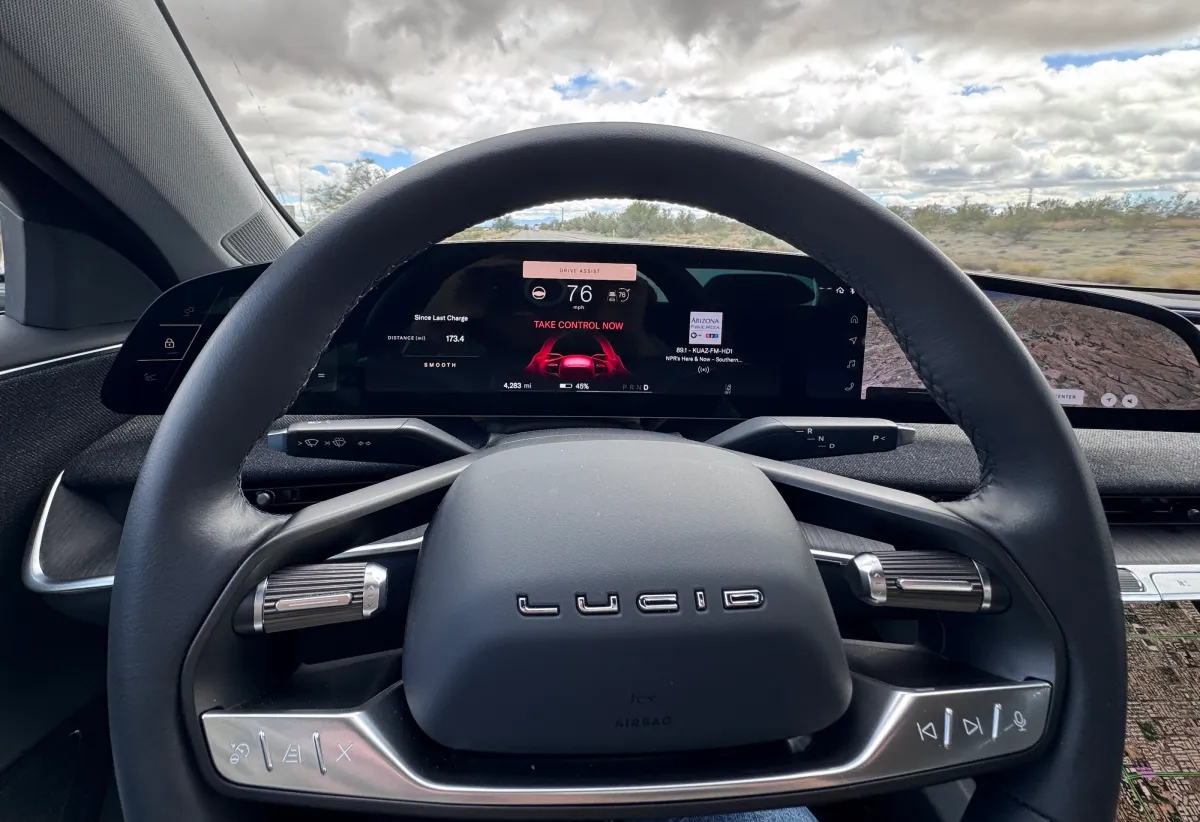
Lucid Motors was just months away from releasing its most affordable electric vehicle yet, a crossover SUV called the Cosmos that was supposed to start under $50,000. But this week, the company pushed the release of the Cosmos back by almost a full year to the second half of 2027, part of an effort by its new CEO to avoid the quality problems that Lucid has suffered with its existing EVs.
It’s the latest setback for the company, which has struggled to find more than a niche customer base for its expensive, but technologically impressive, vehicles. And it’s one that CEO Silvio Napoli presented as necessary for the company to survive.
“While there is no question that Lucid brought leading innovations and outstanding products to the market, we have disappointed on several fronts, and for far too long,” Napoli said this week. “We have not executed consistently. We missed commitments, launched products before they were ready, underinvested in service, responded too slowly to quality issues, and allowed complexity to slow decisions down.”
Napoli’s sober assessment, which he offered on the company’s second-quarter earnings call, helps explain why he has taken an axe to the company’s leadership structure and overall workforce.
Multiple executives have left since he officially took over on June 1, including Senior Vice President of Finance Gagan Dhingra, whose departure was disclosed at the bottom of the company’s second-quarter financial filing with the Securities and Exchange Commission (SEC) on Tuesday. Napoli has replaced those outgoing executives with an entirely new C-suite as he embarks on a cost-cutting mission aimed at achieving $1.4 billion in savings by the end of this year.
Napoli also cut 18% of Lucid’s overall workforce in June, following a 12% layoff earlier this year before he came on board. He canceled a second shift at Lucid’s factory in Arizona, citing lower demand for the company’s EVs — including its Gravity SUV, which has not taken off as the company expected despite being a more popular form factor than its first EV, the Air sedan.
The Cosmos had been seen by some as a light at the end of the tunnel. It’s supposed to be the first of several cars built on Lucid’s next-generation “mid-size” EV platform, which is smaller and cheaper to build. The much lower price tag is supposed to help Lucid attract more customers and reach higher sales volumes.
But Napoli seems worried that the upside of getting the Cosmos EV to market could be negated if Lucid doesn’t get the launch right.
Though he didn’t explicitly name the SUV, Napoli said on the call this week that he delayed Cosmos because he doesn’t want to run into the same kind of problems Lucid has had with previous vehicles, clearly referring to the Gravity.
The company has struggled with build quality and software issues on the Gravity. Things got so bad at one point that Napoli’s predecessor, interim CEO Marc Winterhoff, apologized to Lucid owners.
“We will not repeat the mistakes of the past by bringing a product to market before it is ready,” Napoli said on the call.
The decision to delay Cosmos will likely disappoint some customers who were hoping to buy one by the end of this year. But the delay, combined with the decision to lower production in Arizona, is also affecting Lucid’s supply base.
In the company’s quarterly filing with the SEC, it wrote that “lower production volumes or demand, or reductions in our projected production volumes, have negatively affected, and could continue to adversely affect, our relationships with existing suppliers, who may seek to increase pricing, assert contractual or other claims, or otherwise fail to perform or comply with contractual obligations.”
Napoli’s big “reset” of Lucid Motors means the company now has to tread water for another year until the Cosmos EV goes into production. The company said Tuesday that it has “sufficient liquidity runway well into 2027.” But it also warned Wall Street analysts that it is going to build and sell fewer vehicles this year than it had previously predicted. As a result, the company’s stock price plummeted more than 15% on Wednesday.
With Cosmos delayed, there will now be even more attention on Lucid’s planned robotaxi service with Uber and Nuro, which is supposed to launch by the end of this year. Napoli called it a “top priority and, indeed, a must-win project for Lucid” on Tuesday’s call.
As part of that collaboration, Uber has ordered 10,000 Gravity SUVs that will be retrofitted with autonomous vehicle tech from Nuro. Uber has also ordered 25,000 robotaxis based on Lucid’s mid-size platform, though those aren’t expected to enter production until late 2028.
Uber CEO Dara Khosrowshahi said on his company’s own earnings call Wednesday that Napoli is “taking some bold steps to go back to the fundamentals” at Lucid, and said he believed the restructuring is “necessary” and “positive.”
Khosrowshahi also pointed out that Lucid’s majority owner — Saudi Arabia’s Public Investment Fund — is a major investor in Uber, and said the Kingdom is “the definition of a long-term fundamental investor.”
“We think the combination of ourselves, Nuro, and the Public Investment Fund backing Lucid, along with the actions that Silvio is taking, are kind of the right formula for them to deliver on the commitments that we have on the books with them,” Khosrowshahi said.
When you purchase through links in our articles, we may earn a small commission. This doesn’t affect our editorial independence.
>

As part of a planned data center in Pecos County, Texas, Amazon is investing in an on-site power plant that could become the largest source of climate pollution in the United States, according to The New York Times.
The NYT says the plant would burn natural gas and is permitted to release 33 million tons of carbon dioxide per year — more than any other power plant in the U.S.
In a statement, an Amazon spokesperson confirmed that the data center will “be powered by new on-site generation that won’t raise electricity costs for Texas families.” (Data centers face growing political opposition for a number of reasons, including their effect on electricity costs.)
AI has already had a significant impact on Amazon’s carbon emissions, which it reported were up 16% last year — the wrong direction for a company that pledged to eliminate its carbon emissions by 2040. And that could get worse as Amazon and tech companies back the development of huge natural gas plants to support their power-hungry data centers.
The Amazon spokesperson said, “The world looks different now than when we co-founded the climate pledge,” while also claiming, “Our commitment hasn’t changed.”
>

NextSlide recently announced that it’s joining OpenAI, with the presentation startup’s team members now working on ChatGPT.
The NextSlide website currently displays a note from founder Ahmed Beshry describing the startup’s product as one “that could turn prompts, notes, documents, or research into a polished, editable presentation.”
The ultimate goal, Beshry said, was “to make visual communication more accessible and help more people express their ideas clearly.” So by joining OpenAI, the team will “continue pursuing that same mission: building AI products that help people create, communicate, and turn their ideas into meaningful work.”
The financial terms of the deal were not disclosed. In a note on LinkedIn, Beshry said the announcement is coming “a few months late,” as the acquisition took place “earlier this year.”
Beshry was previously a co-founder at Caper AI, a smart cart/cashier-less checkout startup acquired by Instacart in 2021.
>

X, the social media platform now owned by Elon Musk’s SpaceX, is shaking up how it pays influencers and creators.
In announcing the change, the company said it will be winding down its existing Revenue Sharing program and replacing it with something called Original Content Rewards. X will stop accepting new Revenue Sharing participants, while existing participants will continue earning money through September 7.
Then, starting on September 8, they’ll be able to apply for the new program. Participants will still need to subscribe to one of X’s Premium tiers, and there will be qualifying thresholds for follower count (500 verified followers) and impressions (500,000 Home Timeline impressions from verified users in 90 days), but it sounds like the big change is the emphasis on originality.
What counts as original content? X said it can include original reporting and analysis, photos and videos created by the poster, or memes and graphics they’ve designed themselves. Commentary also counts, but “if your content regularly incorporates material created by others, you’ll need to contribute meaningful original value for it to qualify under our original content guidelines.”
The company also included examples of posts that won’t count as original, such as those just copied over from another account, downloaded from one account and re-uploaded to your own, or reposting content “without meaningful transformation.”
This announcement follows repeated attempts by X to reform the Revenue Sharing program, for example reducing payments to aggregators and “clickbait” accounts in April. But these efforts have also prompted complaints from popular accounts profiting from the current system; Musk even reversed some of those changes (giving a creator’s local audience more weight when calculating payouts) after a backlash.
In a post about the new changes, X’s Allegra Jacchia wrote that the existing program “had reached a point where its incentives were misaligned.”
“Creators should be focused on bringing net new content to the platform instead of maximizing payouts,” she said. “We could have kept adding more rules and exceptions, but ultimately the better decision was to start fresh and build a program designed from day one to reward originality.”
Jacchia added that X be “continue refining the program, improving our models, and raising the bar over time.”
When you purchase through links in our articles, we may earn a small commission. This doesn’t affect our editorial independence.
>

National Bank Open: In-form Cam Norrie defeated by Arthur Fils in Montreal while Aryna Sabalenka suffers shock Canadian Open loss | Tennis News

Aryna Sabalenka and Cameron Norrie lose at Canadian Open

Huddersfield blitz Catalans in dominant home win
-

 movies3 months ago
Search For Canadian TV Actor Stewart McLean Now Homicide Investigation
-

 Fashion9 years ago
These ’90s fashion trends are making a comeback in 2017
-
Fashion9 years ago
According to Dior Couture, this taboo fashion accessory is back
-
Fashion9 years ago
Model Jocelyn Chew’s Instagram is the best vacation you’ve ever had
-
Fashion9 years ago
Your comprehensive guide to this fall’s biggest trends
-
Fashion9 years ago
Emily Ratajkowski channels back-to-school style
-
Fashion9 years ago
9 Celebrities who have spoken out about being photoshopped
-
Fashion9 years ago
A photo diary of the nightlife scene from LA To Ibiza