
Tech
UC San Diego CHARM Smart Ring Tracks Glucose Through Sweat

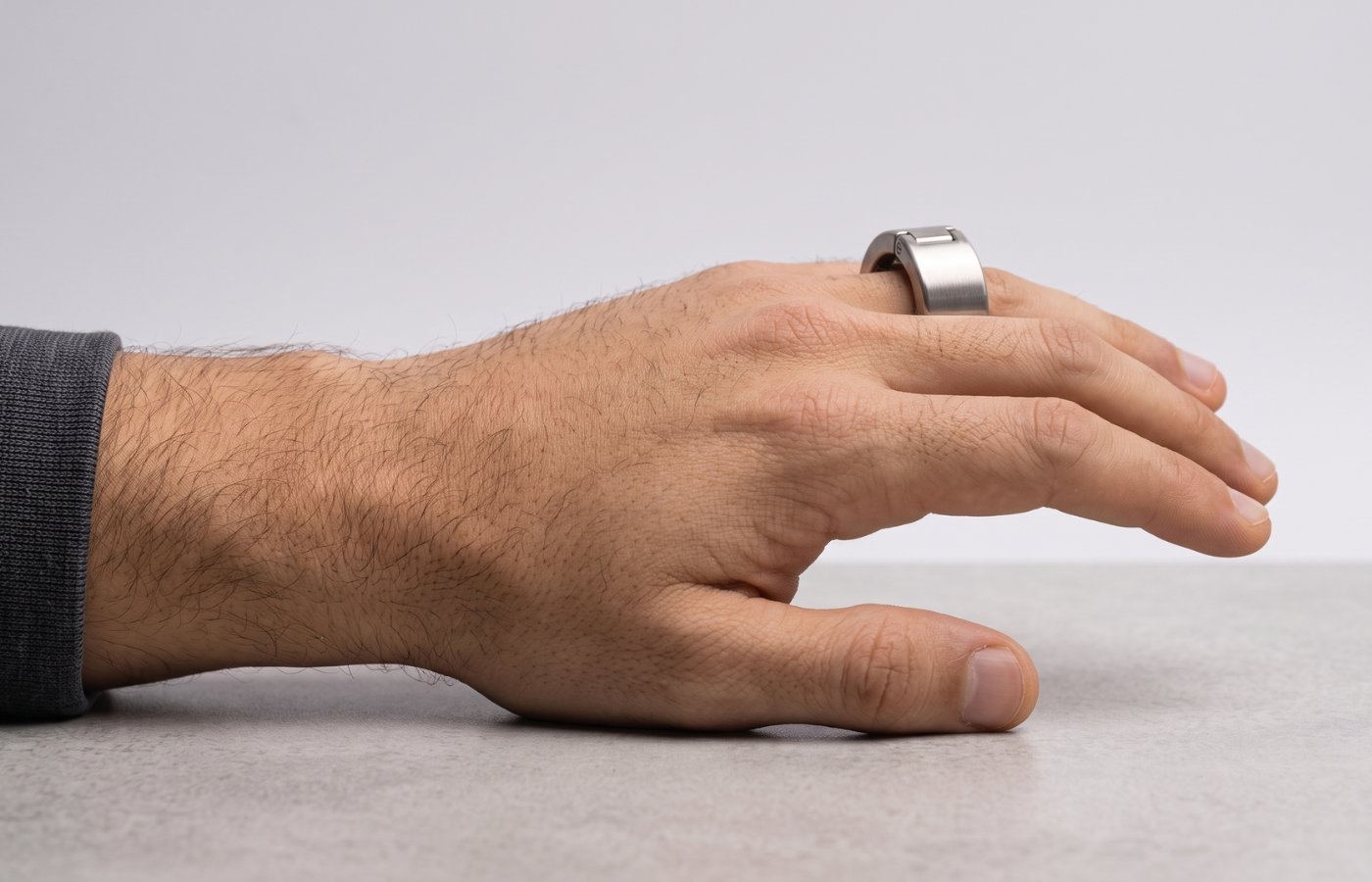
Glucose tracking may eventually be as simple as wearing a ring.
UC San Diego researchers have developed CHARM, a smart ring prototype that reads glucose from sweat collected at the finger. Early human testing compared its estimates with commercial CGMs and blood-glucose meters to see whether a finger-worn device could follow glucose changes throughout the day.
A ring could make glucose monitoring feel less intrusive and easier to fit into daily life if the technology proves reliable.
CHARM collects sweat without a workout
CHARM does not need you to work up a sweat. According to UC San Diego, a soft hydrogel inside the ring passively draws tiny amounts of fluid from the skin. A small channel carries the sweat across sensors that detect glucose.
Glucose in sweat is not the same as a blood-glucose reading. Researchers use personalized calibration to estimate corresponding blood-glucose levels, then CHARM sends the data wirelessly to a phone. People familiar with wearables for blood sugar tracking will recognize the app-connected setup.
Battery life reaches about 12 hours in the current prototype. Sensing hardware and wireless electronics fit inside the ring itself.
Early tests tracked commercial monitors closely
Researchers tested CHARM with healthy participants and people with type 1 diabetes, comparing its estimates with commercial CGMs and blood-glucose meters. Results published in Nature Communications showed that the ring captured the same meal-related rises and falls seen in the reference readings.
Some sweat-based readings lagged blood measurements by roughly 15 to 20 minutes in individual tests. Researchers also reported that personalized calibration settings remained relatively stable for about two months.
More health data fits into the same ring
CHARM can monitor ketones alongside glucose, with researchers also checking those readings against commercial blood measurements.
Sensors can be configured for lactate and uric acid. Vitamin C and alcohol are supported too, with up to four biomarkers monitored at once.
Consumer products currently take a different route. Oura Ring, for example, gets glucose data from Dexcom Stelo. Smartwatches used for glucose tracking generally display readings supplied by a compatible CGM. CHARM puts the sensing technology on the finger.
Everyday glucose tracking still has hurdles
A ring-based glucose sensor could appeal to someone tired of juggling multiple devices. People already getting blood sugar alerts on their smartwatch could benefit most if a ring reduces the gear and upkeep involved in daily monitoring.
If you are watching this category, focus on the basics before getting excited. Accuracy during fast glucose changes and calibration frequency come first. All-day battery life and water resistance will help determine whether a ring can stay on through normal routines.
Researchers still have work to do in those areas. Broader clinical testing and better water resistance remain priorities, and the prototype’s current battery life falls short of the multi-day wear people have come to expect from smart rings.
CHARM remains a research prototype and is not commercially available. FDA guidance says no smartwatch or smart ring has been authorized, cleared or approved to independently measure or estimate blood glucose without piercing the skin. Anyone relying on glucose readings for treatment decisions should continue using an FDA-authorized glucose monitor.
Read our breakdown of five smartwatch health alerts worth knowing across Apple, Samsung, Google, Garmin, and Huawei devices.
>

Fermi, the AI nuclear power firm, has named a new CEO more than three months after firing co-founder Toby Neugebauer from the top executive post.
Fermi said Wednesday it has hired Lee McIntire, an independent member of the company’s board who has held chief executive positions at CH2M Hill and TerraPower, the nuclear power startup founded by Bill Gates.
Fermi America, which was co-founded by former U.S. Energy Secretary Rick Perry, is developing an AI campus in Amarillo, Texas, called Project Matador that will eventually use nuclear reactors to power data centers.
The announcement, along with Monday’s news that it had signed TensorWave as its first binding customer lease for its Project Matador campus, provided a welcome boost to Fermi’s stock. (The stock is up nearly 23% since Monday.) The young company took a hit in April when Neugebauer and CFO Miles Everson were pushed out of the company. At the time, the company described the executive shakeup, along with other plans including a corporate headquarters in Dallas, as Fermi 2.0.
“Fermi’s next chapter is a construction and power delivery story, and we believe Lee is the ideal executive to lead Fermi through that process,” Marius Haas, Fermi’s chairman of the board, said in a statement. “The job now is to build on schedule, on budget, and safely. Lee has spent 40 years delivering exactly this kind of large, complex project. He also knows Fermi from the inside, having served on our board through our latest period of growth, and he brings a reputation for integrity that Fermi’s customers, employees, regulators, and neighbors can rely on.”
>
Tech
Some Claude users are mad that Anthropic’s new watermarks will catch them cheating at their jobs, classes

Anthropic recently made the decision to watermark Claude’s outputs — inserting invisible code into the chatbot’s editorial text that marks it as AI-generated.
Anthropic rolled out this new policy to satisfy the EU AI Act’s Transparency Code, which now requires tech companies to label content that has been AI-generated or edited in a manner identifiable to computer systems. Yet while European regulators may be happy, some AI users are decidedly not.
One need look no further than Reddit to find evidence of brewing discontent, though other posters on the site are not in agreement. One of the more histrionic posts I came across was from a user named visionode, whose account is notably only three weeks old. According to visionode, the new watermarking system is a draconian conspiracy designed to victimize innocent chatbot users worldwide.
Visionode’s basic argument appears to be that, while savvy Claude users may be able hide evidence of their AI usage by paraphrasing or otherwise cleaning their outputs through other AI services, the average user of Claude will be caught.
“Who will get caught? You. The student who used Claude to reorganize a paragraph. The journalist who asked the AI to summarize a two-hundred-page transcript. The writer who had creative block and asked for synonyms. Those guys come out of the process with a digital tattoo on their forehead.”
Far be it from me to undermine visionode’s outrage, but those are not the best examples. A journalist asking AI to summarize a two-hundred-page transcript is not going to be bothered by a watermark attached to that summary, unless they are copying and pasting the summary verbatim into their article — which is plainly unethical and shouldn’t be happening.
It is equally unethical for a student who copies and pastes Claude’s output into an essay after asking it to “reorganize a paragraph.”
Other Redditors were also not particularly supportive of the poster’s outrage.
“Get a load of this guy,” one poster merely commented.
Another asked the OP to take “a deep breath.”
Visionode wasn’t the only one complaining. Another unhappy camper called the watermarks “unethical” and “disgusting” and argued that by using Claude, they had done the lion’s share of the work. In their view, the chatbot was merely a “tool” that had facilitated their arduous labor.
“I gave the instructions, context, decisions, and countless refinements, claude was the tool. If Claude starts watermarking the code or anything else it generates, what exactly is it claiming credit for?” the poster asked.
Again, other users dogpiled onto the critic.
“It’s not claiming credit though,” one user shot back. “It’s about being able to detect AI generated outputs because of the risks AI generated outputs can cause in various situations.”
“Bro couldn’t even complain about Claude without using Claude to write it,” another quipped.
Some critics have steered clear of the victimhood narrative and made slightly more nuanced arguments against Anthropic’s new policy.
For instance, one poster complained of a general hypocrisy in watermarking an editorial product that was, itself, generated by hoovering up other people’s work. “I think it’s a very sinister direction to take,” said the user. “I don’t use Claude to write anything but having an AI that watermarks your work is terrifyingly ironic given how many of the frontier models came by their training data.”
In general, however, users have tended to support the watermarking system as a sensible way to track material that was generated by algorithm. “There is literally no good argument for why this isn’t a good idea,” a user on another thread said. “The only reason you wouldn’t want this is to lie to people.”
When you purchase through links in our articles, we may earn a small commission. This doesn’t affect our editorial independence.
>

High above the Earth, a new generation of robots designed to keep satellites working longer is replacing its predecessor — quite literally.
This week, a spacecraft built and operated by Northrop Grumman called a Mission Extension Vehicle (MEV) unplugged from a communications satellite operated by the Australian firm Optus. For more than a year, the MEV spacecraft has been stuck to the back of the Optus satellite, keeping it in the right place in space so it can continue its mission.
Now, the satellite life-extension spacecraft is leaving to make room for its replacement. In July, four new Northrop spacecraft launched into orbit on a SpaceX Falcon 9 rocket. One is called the Mission Robotic Vehicle, a powerful satellite equipped with two advanced robotic arms that was developed by DARPA, the U.S. military research organization. The other three are called Mission Extension Pods, or MEPs, smaller, simpler satellites that are essentially modular propulsion systems.
Those four spacecraft are currently headed for targets around 27,000 miles above the Earth. In 2027, the MRV will use its robotic arms to attach one of the MEP pods to the Optus satellite, which should keep it in orbit for years to come.
The satellites that provide communications or scan the planet with various sensors only last for so long. They typically fail when they run out of fuel to stay in the right place, not because their computers and transceivers stop working. The Optus satellite was launched in 2009, and designed for a 15-year lifespan. If all goes well with the MEV, the satellite could fly — and generate revenue — for another six years.
Now, cheaper launch costs and lower-cost space components are making spacecraft repair missions a reality.
The goal is “a paradigm shift where we can see space as sustainable, with a more resilient architecture and infrastructure base where we can do things like spacecraft repairs, life extension, or even upgrades and maintenance of satellites,” according to Northrop’s director of logistics and servicing Cassie Wong.
There are two MEVs in orbit right now, launched in 2019 and 2020, which have provided 10 years of life extension to three customers, including two different Intelsat spacecraft and the Optus satellite. MEV-1 will wait in a parking orbit for another customer, while MEV-2 is currently attached to its Intelsat customer until 2030.
The Mission Robotic Vehicle, or MRV, represents an evolution of the business model. Satellite operators buy and own the MEPs, which are permanently attached to their spacecraft. That frees up the MRV to service more vehicles, creating a cheaper offering.
The offering requires some serious technology chops. The vehicles need to autonomously approach one another and dock safely, not a simple task when both are moving at velocities of thousands of miles an hour. The MEVs use a docking probe to plug in and hang onto satellite thruster nozzles. Meanwhile, the MRVs will need to carefully attach the MEPs using their robotic arms.
Unlike most satellites, the MRV is designed to be refueled in orbit — in part, a proof of concept for the kind of capabilities other satellites will need if this kind of in-orbit servicing becomes a norm. Right now, the extra cost and weight of such adaptations keeps spacecraft operators from investing in them.
Indeed, the current trend in satellites is flying lots of cheap, effectively replaceable spacecraft in low orbits, as Starlink and Amazon LEO do. On the other hand, spacecraft keep getting bigger, and there are plenty of expensive, large satellites in orbit that could benefit from life extension. Wong hopes that the MRV will take on other missions in the future, adding new components to satellites as well as adjusting their orbits.
That’s likely to include defense customers, given the number of expensive satellites it owns in high orbits, and DARPA’s involvement in developing the MRV’s arms. Indeed, the U.S. Space Force has previously characterized a Chinese servicing spacecraft with robotic arms as a weapon, since it could theoretically grapple and degrade a rival satellite. Northrop says that its vehicles are focused on servicing missions.
The vehicle could also be used in LEO, Wong says, to extend the life with valuable assets there. The startup Katalyst Space is attempting a similar mission to extend the life of a NASA space telescope after malfunctions left its vehicle tumbling last month. The company has a fix in place and hopes to complete the mission.
When you purchase through links in our articles, we may earn a small commission. This doesn’t affect our editorial independence.
>

Jayden Daniels sparkles and Washington’s D shines: Commanders-Dolphins joint practice report

Jeremy Strong Emailed Mark Zuckerberg About ‘The Social Reckoning’

Tottenham reach agreement with Atletico Madrid over €40m Cristian Romero transfer
-

 movies3 months ago
Search For Canadian TV Actor Stewart McLean Now Homicide Investigation
-

 Fashion9 years ago
These ’90s fashion trends are making a comeback in 2017
-
Fashion9 years ago
According to Dior Couture, this taboo fashion accessory is back
-
Fashion9 years ago
Model Jocelyn Chew’s Instagram is the best vacation you’ve ever had
-
Fashion9 years ago
Your comprehensive guide to this fall’s biggest trends
-
Fashion9 years ago
Emily Ratajkowski channels back-to-school style
-
Fashion9 years ago
9 Celebrities who have spoken out about being photoshopped
-
Fashion9 years ago
A photo diary of the nightlife scene from LA To Ibiza