
Sports
James Trafford looks right at home in Leeds’ goal. His debut was worth the wait

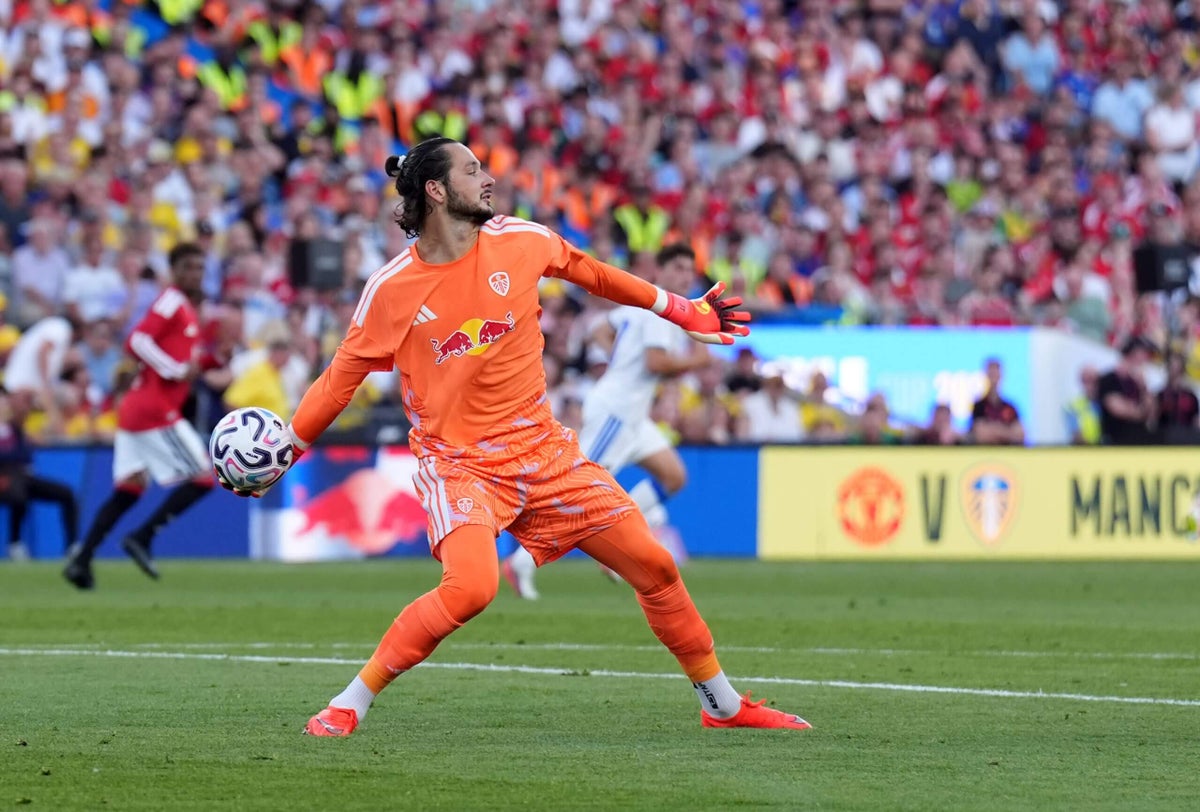
Where will James Trafford keep his Boyle Sports Cup 2026 man-of-the-match award?
The trophy is a made-up gimmick for a gambling company, which holds no status in football, but the individual gong can at least be a fond reminder of Trafford’s first 45 minutes with Leeds United.
It may still be in the Croke Park dressing room. Perhaps it will become a doorstop at his home? Something for the windowsill in his downstairs toilet, maybe? Wherever he chooses, there are a great many footballers who have had worse debuts than Trafford’s.
It’s not the trophy Trafford moved to Elland Road for, but it is an acknowledgement of how well he played in one half to prove he was better than any of the other 41 players in Dublin on Wednesday night. He did not even need to save a Manchester United penalty or two in the shootout, which eventually decided this 1-1 contest.
There is an understandable clamour to see club-record signings in the flesh at the earliest opportunity. The Leeds fans on Croke Park’s Hill 16 behind Trafford’s goal would have been delighted to see him on just his second day in the job.
Goalkeepers rely far less on their fitness than their outfield team-mates, but with only one session behind him after a delayed start to pre-season, his debut was far from a certainty in Dublin. Manager Daniel Farke, speaking to reporters, including The Athletic, post-match, acknowledged the medical department held its breath on Trafford’s dive into the deep end.
“(It was) good for him to fire up on the enthusiasm of being a new signing,” he said. “I was a bit unsure in the beginning because he’s just with us since yesterday (Tuesday).
“He just had the first training session yesterday and a light activation session this morning, but he was so desperate to play. We just have two games and need the connection.
“(The) medical department was really concerned about whether we should do this. But I took over the responsibility, and once a top-class player wants to play football, I don’t stand in the way too much. The first half was good for his confidence.”
The England international will get fitter and play better from this point, but even in a friendly, there were several notes of encouragement. Trafford’s confidence is what stood out at first.
The 23-year-old has not got to where he is in the game without self-belief. From early in the match, despite virtually no time in training to build a connection with the centre-backs, Trafford was comfortable venturing far out of his penalty area.
While Sebastiaan Bornauw was staying wide on the right of the back three, Trafford came out to split Tarik Muharemovic and Jaka Bijol, offering them a passing option. There were even a few early exchanges where he stood with the ball at his feet, 10 yards outside his area, baiting the opposition press and drawing boos from Manchester United supporters.
This confidence was seen in the vocal role he was happy to take on. Not only was his advanced position helping for passing angles, but it also gave him a better vantage point from which to bark instructions at his team-mates. Dictating play on day two.
There were signs of nascent leadership in Trafford. He barely knows any of his team-mates, but on what was a difficult evening for youngster Rhys Chadwick, Trafford made a point of patting the makeshift wing-back when he put a good tackle in on Amad.
Even when more than half the team was celebrating Brenden Aaronson’s equaliser with him, Trafford was taking that opportunity to pass on feedback to Bornauw and Ao Tanaka. His gestures suggested he was asking them to do something better as the team was building out from the back.
There was the vision and technique needed for a pass or two on show, too. In the eighth minute, he struck a beautiful long pass deep into the opposition half and found Chadwick on a sixpence. Then, in the 24th minute, as Aaronson went looking for a counter-attack, Trafford threw the ball into the opposition half, finding the American perfectly.
Critically, there were good saves from Trafford as well. The other stuff is welcome, and necessary in the modern game, but his job is to keep the ball out of the net.
Diogo Dalot had the game’s first chance of note. Trafford saw his drilled effort all the way and patted it down before gathering at the second opportunity. There was a better one six minutes later, as the Leeds No 1 had to get down quickly to his left to deny Joshua Zirkzee from 17 yards.
Ten minutes later it was Trafford’s fingertips keeping Bryan Mbeumo out. He would later be beaten by the Cameroonian, who crashed a shot off the bar which Trafford could not get hands on.
“Everyone could see why we signed him,” said Farke. “He’s not in full fitness, but he looked sharp and quick and had a good presence on the pitch and was good with his feet.
“We are all happy to have him. It’s good he came through the game without an injury. He has the first 45 minutes under his belt.
“We’ll use the next few days to work further with him and then, hopefully, he can prove, when the real stuff starts, what a big signing for us he could be.”
>
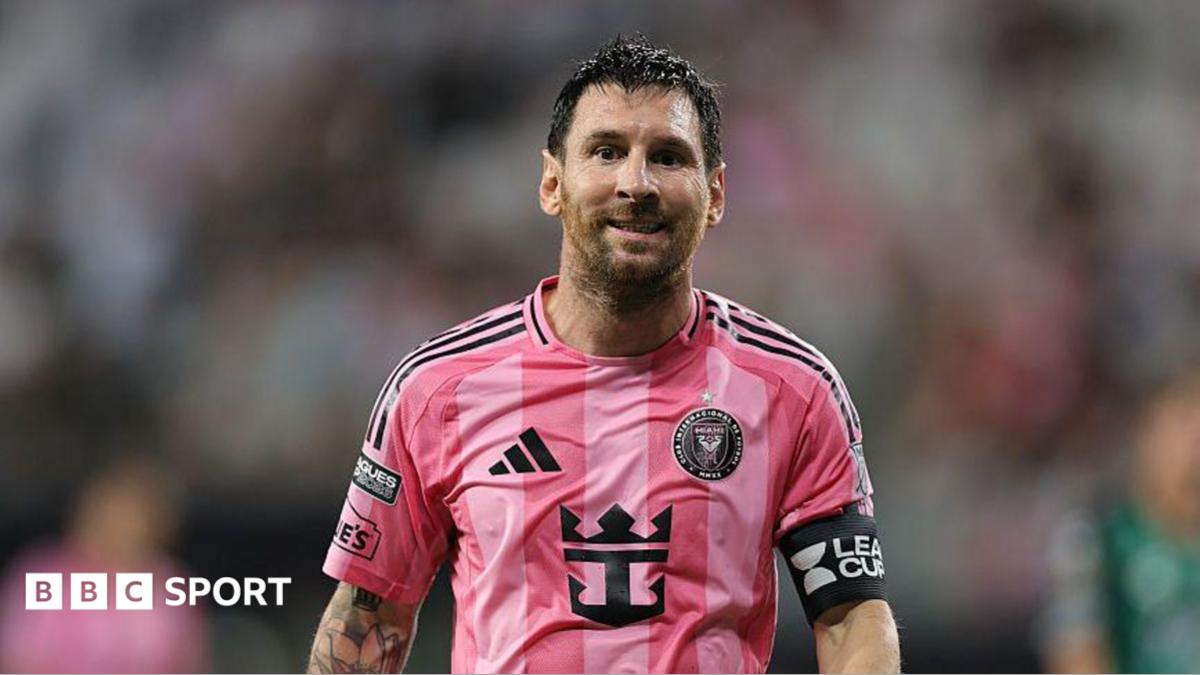
Messi was absent for Miami’s 2-1 loss to Monterrey in the Leagues Cup on Saturday but made himself available to coach Guillermo Hoyos for the must-win game against Mexican side Leon.
It is the first time Miami have been knocked out in the opening phase of the competition since the Leagues Cup was expanded in 2023 – the year Messi arrived and they lifted the trophy.
Jorge was Messi’s agent since he was 14, watching him become one of the sport’s greatest ever players and at his side when he captained his country to World Cup glory in 2022.
Argentina reached the final of this summer’s tournament but were beaten 1-0 by Spain in extra time. Messi wrote that his father urged him “to play in one last World Cup” despite his health deteriorating.
Miami midfielder Yannick Bright, who scored his side’s second goal against Leon, called Messi’s return “incredible”, adding he and other team-mates just wanted to support their captain.
“I wasn’t expecting it,” Bright said. “It shows how much he cares. When I saw he was here, all I was thinking about was to give my 150% for him.
“It’s a tough situation. We try to stay close to him and support him as much as we can, but it’s a lot.”
Leon coach Javier Gandolfi said Messi “is human being that is different to the rest”.
He added: “Today he demonstrated once more what he’s made of.”
>
There are moments in football that are sudden and instantly compelling. You can feel it.
They are both intangible and tangible; an act of controversy, a stunning goal or striking individualism.
But there is also a rarefied category: The new kid on the block making an unexpected announcement to the world. Enter Brian Madjo.
The 17-year-old’s performance in Aston Villa’s 2-1 Super Cup defeat against Paris Saint-Germain was captivating for several reasons.
His talent is evident, but on his competitive debut for Villa he dominated arguably the best centre-back duo in world football. He’s as close as the modern game can get to an overnight star, making what happened on Wednesday so compelling.
These days it is seldom seen, with scouting resource and social media so prevalent, for the majority to be so unaware of the next young talent. Nothing and no one seems to spring up in football anymore. Yet, Madjo has just done that, all 6ft 4ins of him.
At 17 years and 212 days, he is the youngest player to feature in the Super Cup. It is not hyperbole to say Madjo — born in London to Cameroonian parents but who grew up in Luxembourg — could and should have scored four or five goals in the first half alone in what was his first taste of competitive football of any kind since December.
The banner Villa fans held aloft before kick-off read ‘Unleash the Lions’. In playing their teenage striker, few outside of the club’s immediate orbit had heard or seen before, Villa had done as much.
The England youth international headed wide and then over from John McGinn’s first two crosses, having been unmarked. He also, unfortunately, ceded possession to PSG’s counter-press, contributing to Khvicha Kvaratskhelia’s thunderous strike taking the lead.
Madjo then strode into the left channel, PSG’s central defenders scrambling back, only to end up curling his effort wide.
None of these potentially confidence-sapping passages fazed Madjo. Even with the missed chances, Madjo kept finding opportunities to score.

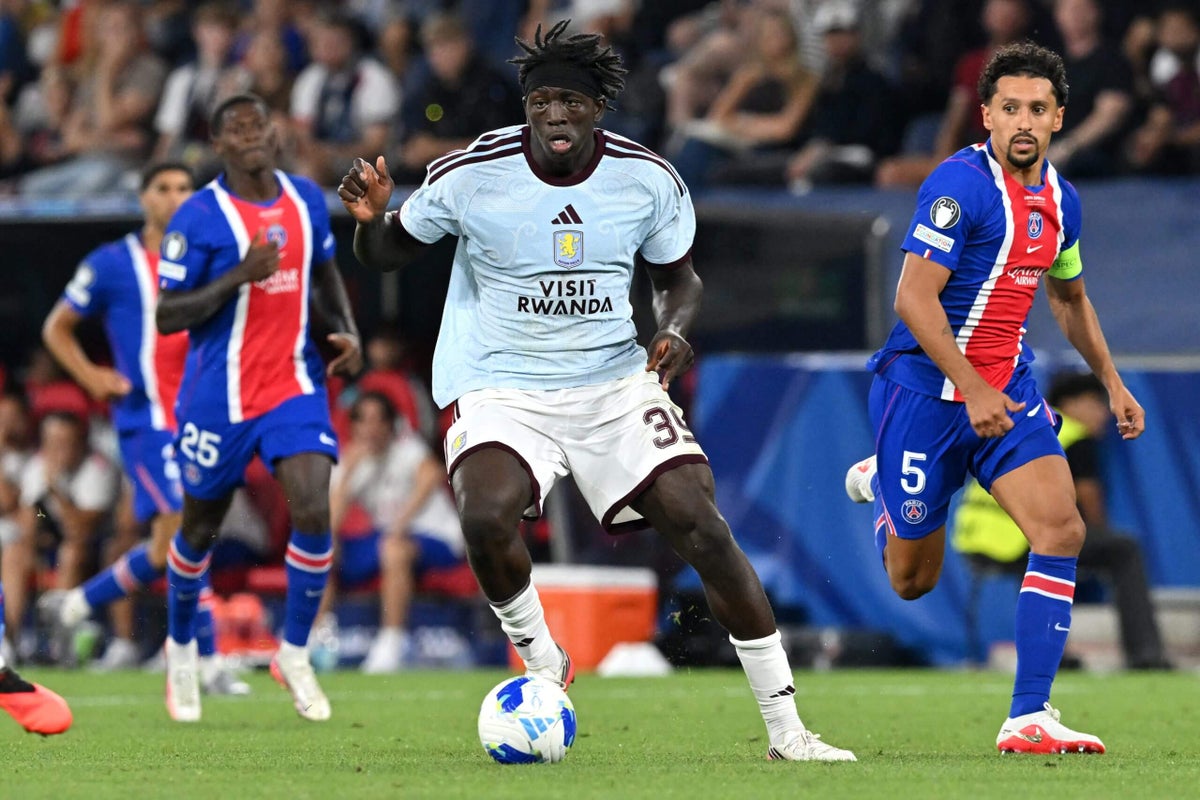
Brian Madjo was born in London to Cameroonian parents and grew up in Luxembourg (Kerstin Joensson / AFP via Getty Images)
Madjo initially peeled onto Marquinhos, captain for Brazil and PSG, from Villa goalkeeper Marco Bizot’s first long kick. An indication of Madjo’s physicality and danger, Marquinhos and his partner Willian Pacho, the bigger man, switched, with the latter marking the forward. Later on in the half, Marquinhos was tentative when Madjo was running at him, hesitating before wisdom decided against competing for a bouncing ball.
He has been described as a “physical monster” by club sources, but to contest and comprehensively dominate the defensive axis which formed the backbone of successive Champions League victories was stunning. Intoxicating, even. Madjo’s fourth effort left Pacho crashing to the floor as he hit the post.
PSG full-backs kept high and left their central defenders two-against-two. Madjo, therefore, was duelling against a single defender, sometimes two. Nothing seemed to stop him. This way of operating is not unfamiliar to PSG, yet in the first half especially, it seemed laced with risk every time Madjo marauded forward, ably supported by McGinn, George Hemmings and Emiliano Buendia.
One recruitment source at a leading Premier League side believed Villa took a gamble on signing Madjo, though equally acknowledged that if he could develop into a reliable goalscorer, he would prove supremely effective. His first half profligacy, at odds with his attacking threat, exemplified that notion.
At the fifth time of asking, what felt inevitable arrived. A third exquisite McGinn cross found Madjo at the back post. In defiance of Pacho’s tight hold, Madjo shrugged the Ecuador international, escaping behind and emphatically volleying into the roof of the net.

Brian Madjo celebrates scoring against PSG (EXPA/ Johann Groder / APA / AFP via Getty Images)
“I want to watch young players and watch them progressively,” said Emery in his post-match press conference. “Brian scored two goals against Walsall, one like today. He played because he was in pre-season showing his capacity to work in our idea. It’s not just scoring goals; it’s his defending, commitment, discipline.”
For those who had watched Madjo before, playing for FC Metz in Ligue 1, there have been examples of the teenager embracing battling against older players. One observer close to Villa’s dressing room previously remarked on being struck by a 16-year-old Madjo, noting how aggressive and strong he was against Lyon central defender Moussa Niakhate, a now 30-year-old who played every minute for Senegal at the recent World Cup.
Villa signed Madjo for £10million in January from FC Metz. He represented a first-team recruitment acquisition, and not under the umbrella of the emerging talent department — typically for players 19 or below. However, he could not play any competitive matches of any kind, at any level.
Article 19 within FIFA’s regulations prohibits international transfers of players under that age and this applied to Madjo, despite being born in Enfield, England.
Madjo would score in training matches and was impressing several team-mates and coaching staff. Sufficiently so that the manager wanted to include him in matchday squads throughout the second half of the season. Emery’s desire to blood Madjo early was ultimately reflected in picking him to start ahead of Tammy Abraham, who the club are willing to listen to offers for, in Salzburg.
Villa were aware FIFA could reject Madjo’s registration at first, although sources close to the situation stated that the club’s lawyers were still confident such a ruling would be overturned on appeal, even if it took longer than hoped, much to the irritation of senior figures. The verdict from the Court of Arbitration for Sport (CAS) came on August 4, eight days before the final, with Villa’s appeal upheld.
Villa sources were thrilled for a teenager who had become a hugely popular figure around the club and seemingly now among supporters. When the teams were read over the speakers before kick-off, Emery and Madjo received the loudest cheers.
Such attention and admiration will only elevate to new, unseen levels following a night where Madjo broke out into the wider footballing public.
>
One name eclipsed all when Arsenal’s starting line-up was read out ahead of their final pre-season friendly against Como.
The decibel levels rose noticeably as ‘Number 49, Myles Lewis-Skelly’ was read among their other starters.
The 19-year-old academy graduate has been at the centre of transfer speculation this week as Manchester United and Chelsea’s interest in the England intenational has resurfaced, but rather than turn on a teenager who wants to stay at his boyhood club, those inside the Emirates Stadium tried to do what he has done since he broke into their first team: connect.
Every club loves academy players, but Lewis-Skelly’s status among Arsenal fans was set before he had even kicked a ball for Mikel Arteta’s side.
He entered Arsenal folklore back in September 2024, receiving a booking for running behind Arsenal’s goal to communicate with David Raya 30 minutes before he came on for his first-team debut away to Manchester City.
After full time, a then-17-year-old Lewis-Skelly was at the centre of the action as Erling Haaland began a war of words with anyone he could see affiliated with Arsenal, including Arteta. From that moment, Arsenal fans have been bonded to the player they repurposed their famous ’49, 49, Undefeated’ chant for.
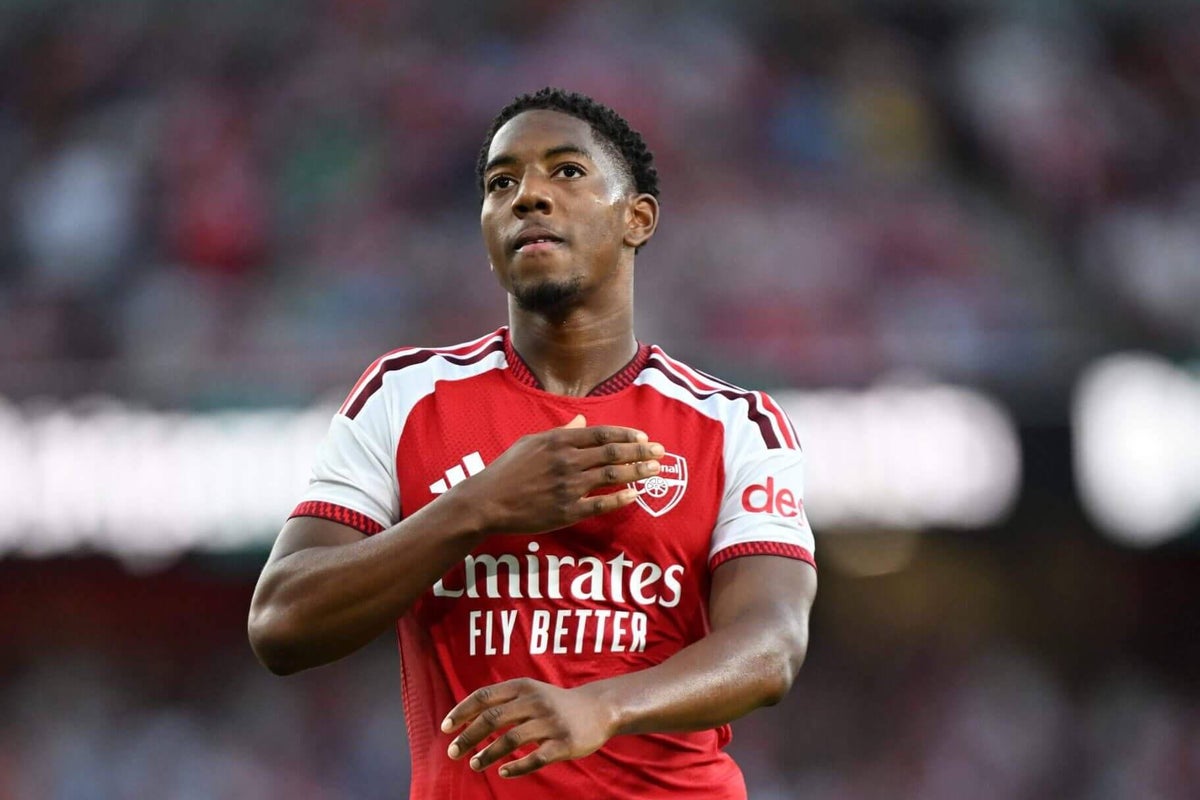
So, in the midst of all the commotion surrounding him this week, it was fitting that Lewis-Skelly was the one to put Arsenal 1-0 up against Como. The finish was calm, and came after good pressing from himself and Viktor Gyokeres, but the celebration that followed was what mattered.
Some have interpreted him clasping his hands together before forming a love heart aimed towards the fans as an apology, but in person, it felt like anything but.
First of all, there is nothing Lewis-Skelly would have to apologise for. Secondly, it was a moment in which he was able to reciprocate the love shown to him less than half an hour earlier and show where his heart was in that moment.

(Stuart MacFarlane/Arsenal FC via Getty Images)

(Stuart MacFarlane/Arsenal FC via Getty Images)
“He’s a very emotional player,” Arteta said when asked about the celebration post-match. “Remember when he did the gestures on the pitch (the Haaland celebration when he scored in Arsenal’s next meeting with Manchester City after his debut — a 5-1 home win).
“I’m not going to talk about any speculation. If there is speculation about our players, it’s a good sign. It means we attract attention and they’re doing a good job.”
The final part of that statement is true in Lewis-Skelly’s case.
After spending most of last season fighting an uphill battle to play at left-back, his late midfield inclusion midfield in May reinvigorated Arsenal with the energy they needed to leave City in their wake during the title race, and take Paris Saint-Germain all the way in the Champions League final.
At the time, Arteta said: “It’s been a process of understanding him (Lewis-Skelly) better. Him understanding a lot of the standards that are required when you play or don’t play that much at this level. To understand the reason why you play or not as well.”
Since then, the teenager has started all of Arsenal’s pre-season games in midfield with regular starters away due to their international commitments during the summer. Arteta feels Lewis-Skelly has been “really consistent” throughout this pre-season and that momentum has carried from game to game.
Away in Girona, it was his pass that sparked the attack for Kai Havertz’s opener (assisted by Max Dowman). At home against Como, he started well with a trademark dribble through midfield to win a foul before some nice interplay with Eberechi Eze further upfield.
By the time he had celebrated his goal, sections of the stands had started singing his chant while others brought out renditions of ‘He’s one of our own’. And aside from how good Lewis-Skelly is at football, that aspect of this situation is arguably the most important.
While there will always be clamour and excitement over new signings, the feeling across a club when a child can progress through the ranks and become a man that identifies with the thousands that watch him in the stadium is unquantifiable. Lewis-Skelly’s character, summed up when he quipped “They called us bottlers, and now we’re holding the bottles” after it was confirmed Arsenal were Premier League champions, only helps to illustrate the authenticity of his connection with those who watch him.
Add that his pinned post on Instagram is still the picture of him with the Premier League trophy captioned with the jibe ‘Pure Profit’ and it is clear to see where his head has been for months.
The need for characters like this to maintain and strengthen bonds between what happens on the pitch, in the stands, online and everywhere in between cannot be overstated.
Lewis-Skelly and Ethan Nwaneri were the two players who brought life to Arsenal’s 2024-25 season in their breakthrough campaigns. Before that, Arsenal had not experienced a moment like that since the joint rise of Bukayo Saka and Emile Smith-Rowe between 2019 and 2021.
Since then, Arteta has admitted that the inclusion of Smith Rowe in the 2020-21 season played a vital role in allowing the fans and the team to click. Lewis-Skelly is a different type of personality, but has done similar since his first Premier League booking.
Over time, it seems like transfer windows have become more about cynical decisions made by the head. Clubs have parted ways with players they invested years into as the bottom lines have become all the more important.
Cole Palmer has previously spoken about not wanting to leave Manchester City in the summer window he joined Chelsea, while Elliot Anderson’s £35million 2024 move from Newcastle United to Nottingham Forest came to help the north-east side meet Profitability and Sustainability Rules (PSR) despite his and Eddie Howe’s desire for him to stay at the club he joined aged eight.
At some point, the heart has to intervene for the soul of the clubs, which is often nurtured by those who come all the way through the ranks.
After all, as Lewis-Skelly gestured to those at the Emirates, home is where the heart is.
>

Lionel Messi makes substitute appearance for Inter Miami after death of his father

James Trafford looks right at home in Leeds’ goal. His debut was worth the wait

Compelling and unexpected. Aston Villa’s Brian Madjo announces himself to the world
-

 movies3 months ago
Search For Canadian TV Actor Stewart McLean Now Homicide Investigation
-

 Fashion9 years ago
These ’90s fashion trends are making a comeback in 2017
-
Fashion9 years ago
According to Dior Couture, this taboo fashion accessory is back
-
Fashion9 years ago
Model Jocelyn Chew’s Instagram is the best vacation you’ve ever had
-
Fashion9 years ago
Your comprehensive guide to this fall’s biggest trends
-
Fashion9 years ago
Emily Ratajkowski channels back-to-school style
-
Fashion9 years ago
9 Celebrities who have spoken out about being photoshopped
-
Fashion9 years ago
A photo diary of the nightlife scene from LA To Ibiza