
Sports
Fantasy Premier League: The best planning tools out there, from price trackers to AI assistants

Planning is the key to a successful Fantasy Premier League season. To fail to plan is to plan to fail.
Thankfully, there is a wide range of resources out there these days to support you in the mission to win your FPL leagues.
Some of these may be familiar already but as you prepare for the 2026-27 season, which starts on Friday, it can’t hurt to review the planning tools available, through the game’s official website and also via third parties, that you should be aware of.
The fixture ticker
The most crucial piece of information that fantasy managers have available at the start of the season is the fixture list, with form almost irrelevant before the Gameweek One deadline.
Planning for the matches coming up is key, with the official Fantasy Premier League website and app, using the Fixture Difficulty Rating (FDR) charts, a very good starting point.
For this season, on the “Pick Team” tab, you can now view your team by FDR, with each player’s club’s next three upcoming fixtures given a colour-coded difficulty value on the Premier League’s scale from one to five.
Rotating pairs — those squad members that you continually swap between your bench and your starting line-up depending on the difficulty of their individual fixture — can come to the fore when looking at the calendar, which is particularly helpful for picking your fourth and fifth defenders in a gameweek.
For example, rotating a Manchester United and Brighton defender across the first six gameweeks would give you a fixture list of Hull, Ipswich, Leeds, Coventry, Fulham and Sunderland.
It’s important to study the wider football calendar too, noting the extended international break following Gameweek Five, where there are going to be back-to-back weekends without any Premier League action.
Brighton have a UEFA Conference League qualifying play-off on the Thursdays either side of Gameweek One, while the Carabao Cup’s second round also sits in the midweek after Gameweek One for those Premier League sides not involved in Europe this season.
There’s a free midweek following Gameweek Two but then the ones after Gameweeks Three and Four contain the Carabao Cup’s third round, where the European-qualified clubs come in, plus the opening nights of league-phase play for the Champions League and Europa League.
The price-change tracker
While fantasy prices are locked before the Gameweek One deadline, they then fluctuate up and down during the season relative to action in the game’s transfer market.
The exact mechanics behind price changes have always been a mystery but, for this season, Fantasy Premier League has added a new tool to help you.
It will use official FPL data to track the transfer activity for each player, giving some indication of whose prices will likely rise and fall each day at midnight UK time. The formula itself won’t be revealed but a player’s status will be defined as “very likely to rise”, “likely to rise”, “likely to drop” and “very likely to drop”, negating the need to rely on third parties to try to predict this information.
Remember that a player can rise or fall in price by up to £0.3million each gameweek and a status message will report the likelihood of a change on all individual profiles.
The watchlist
There’s plenty of planning that can be done on the FPL website itself, and I find the “watchlist” feature particularly useful when drafting an initial squad or during a wildcard window.
You can click on players’ profiles and add them to your watchlist, so you can have a good look through and use this information to come up with a definitive shortlist.
I’d aim to initially go through each Premier League team’s squad and add any players of interest to your watchlist, and keep it updated regularly to ensure you make sensible fantasy decisions.
Aim to have around 50 players here, then filter the overall pool by your watchlist on the transfers tab to give you just those you’ve handpicked, which will reduce the noise of the wider options and help prevent any biases creeping in.
A set-piece takers’ list
Another key element of fantasy planning is to do your research on clubs’ set-piece takers — I’ll be covering this in another article as part of your FPL pre-season content in preparation for Gameweek One.
The Premier League actually cultivates its own list of set-piece takers, which is part of The Scout advice section on the FPL website. This section lists each team’s penalty takers, and those on their direct free kicks, corners and/or indirect free kicks, all of which has the potential to provide an important source of fantasy points.
Some of these lists are more contentious than others, and of course, the rest of the summer transfer window and player availability week to week will have some impact, and so it can only be used as a rough guide.
Notes are added when there are inconsistencies from game to game, and there are some instances that suit a left-footed player compared to a right-footed one.
AI transfer tools
It feels like AI is taking over the world sometimes, so it should come as no surprise that it has infiltrated the FPL space too, like it or loathe it!
There are AI tools that can literally manage your team for you every single gameweek, and it’s up to managers whether they want to rely on this solely or just use it to sense-check their decisions. For me, they can provide reassurance, or a second opinion.
One such example is Fantasy Football Hub, where you can get your team rated for free by AI in seconds ahead of Gameweek One, simply by uploading a screenshot.
From there, you’re then given AI transfer recommendations to improve your squad, planning and optimising your line-ups for any given gameweek and recommending the best captaincy pick.
They even run a team from Gameweek One, which begins with the AI-recommended team and takes the recommended transfer each week. In its three seasons playing the game, it has recorded two top-100,000 finishes and a top one per cent career average — a better record than my own!
Market odds
Another sound source for fantasy managers is market odds, giving the ability to measure the strength of a fixture, forecast the number of goals or the likelihood of a clean sheet.
One such example of this, optimised for FPL, is the website fpljoe.com, which takes bookmaker totals and handicap markets for Gameweek One to provide projected goals and clean-sheet odds, updating constantly as the market fluctuates.
FPL Joe’s data predicts that Manchester City will be the top goalscorers over the opening six gameweeks, followed by Arsenal and Liverpool.
Arsenal have the best projected goals and clean-sheet odds for Gameweek One when they take on promoted Coventry at home, with City primed for goals against visitors Bournemouth and Manchester United heavy favourites for a clean sheet way to promoted Hull.
These odds are robust and give a very convincing guide when making FPL selections, and they can also help guide captaincy decisions from gameweek to gameweek, as well as ensuring you own the right premium players at the right time.
Statistics
Delving into the data on player form is a crucial analytical tool when it comes to forward planning, with metrics including expected goals, expected assists and expected goal involvements now built into the FPL website itself. I also like to get an overview on goal-threat data, such as shots on target and big chances, which can often help you predict when a player’s form is likely to explode.
When it comes to creativity, the key passes and big chances created metrics are useful indicators of whether a spate of assists is sustainable, as well as numbers on corners and free kicks taken.
Form and fixtures are the two most helpful data points in FPL and having the underlying statistics available to pit them against each other leads to top-draw fantasy decision-making.
There are several football data websites out there, with theanalyst.com and fotmob.com being fine choices.
Expert content
Among the most valuable sources of information out there is the advice of top-quality fantasy managers, with a wealth of opinion widely available on many content streams.
YouTube plays host to some of the best in the business, including Andy Mears (Let’s Talk FPL), who finished 588th in the world in 2025-26 and Harry Daniels (FPL Harry), who managed five consecutive top-10k finishes between 2022 and 2025.
You’ll also find my advice and content on my YouTube channel, where I’ll be running a team managed by a group of 100 FPL experts, who have a minimum of two top-10k finishes or five top-100k finishes between them.
The experts-led side managed a top-10,000 finish in its 2023-24 debut season, backing that up with a 55k finish last time, placing it within the top 0.4 per cent of fantasy managers.
Ahead of the Gameweek One deadline, I’ll be collating the final drafts of this pool of 100 experts to build a team for Gameweek One that represents their picks.
>
Arsenal could hardly have asked for a more convincing start. They arrived at the Principality Stadium as Premier League champions, dispatched Manchester City 3-0 and played with the authority their new status demands.
For Mikel Arteta, that is unlikely to be enough. Winning the title has answered the question that haunted Arsenal for the previous three seasons, but posed another: How do you improve a team that is already winning?
It is a challenge Arteta will relish. He is determined to exploit every margin, and leave no stone unturned in his search for improvement. Some of that can be done on the training pitch — the sweeping changes in Arsenal’s performance and medical departments speak to the manager’s rapacious hunger for progress.
There are other ways to improve. Shortly before kick-off, Arteta spoke to TNT Sports about his expectations for the coming season.
“We recognise the big margins that we have to be much better as a team, and much better individually. And then that has to be supported by the ambition of the club, which is there. Unquestionable.”
The final part of his answer appears to allude towards the transfer market. This performance — albeit against an underwhelming City — was a reminder of the strength of Arsenal’s existing squad. Despite the failure to land marquee signings such as Vinicius Junior or Morgan Rogers, Arsenal have an impressive array of depth, experience and quality.
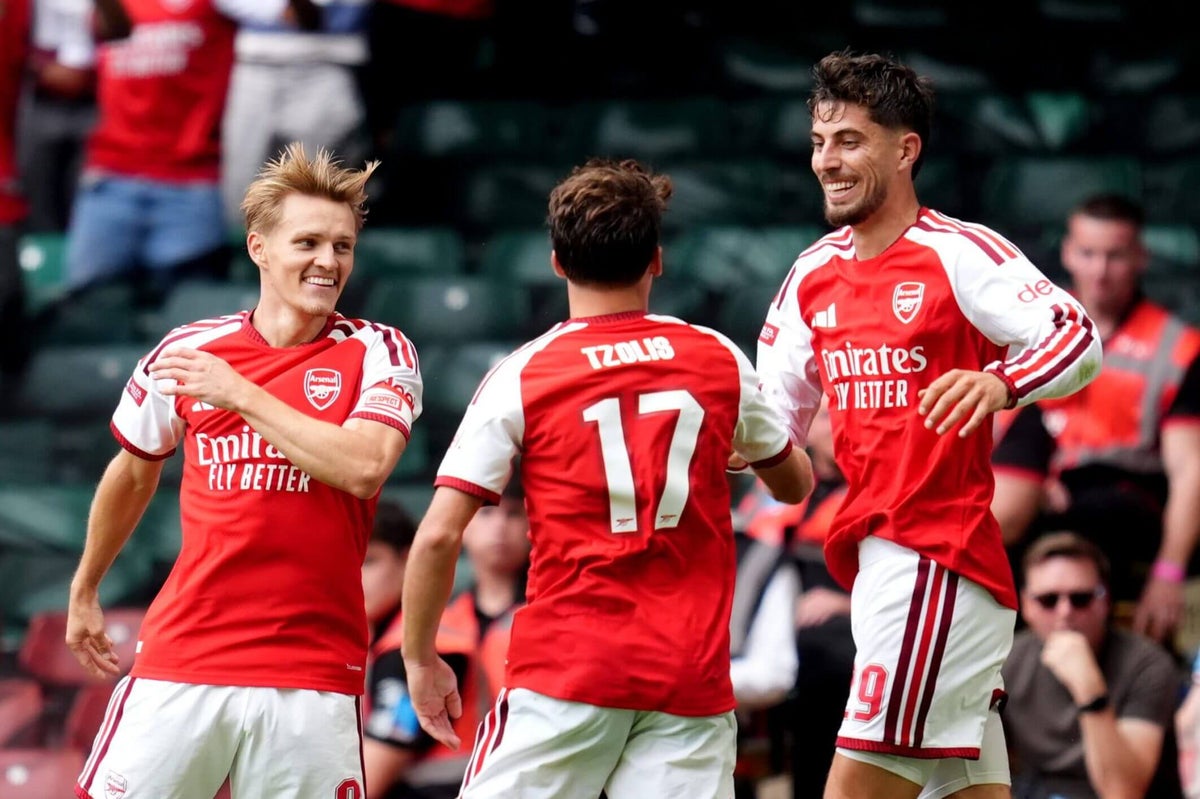
Two summer signings made an immediate impression in Cardiff. Bruno Guimaraes slotted seamlessly into the Arsenal midfield, playing 45 combative minutes before making way for Declan Rice — illustrative of the embarrassment of midfield riches at Arteta’s disposal. Christos Tzolis, the Greek international signed from Club Brugge, created goals for Kai Havertz and Martin Odegaard.

Martin Odegaard was particularly impressive (David Price/Arsenal FC via Getty Images)
But there is still work to do before September 1’s transfer deadline.
The substitutes’ bench told that story, both in terms of outgoings and incomings. For all the talk of Arsenal needing a new forward, in terms of pure numbers they are well-stocked for attacking players — Ethan Nwaneri, Gabriel Martinelli, Gabriel Jesus, Fabio Vieira and Reiss Nelson all failed to make the team sheet.
In his post-match press conference, Arteta insisted the omissions were solely due to “technical decisions” — but Arsenal are considering offers for all of those players ahead of the transfer deadline.
Nwaneri and Martinelli were with the squad in Cardiff. As Arsenal celebrated at full time, centre-back Gabriel encouraged his compatriot to join him for photos with the trophy. Martinelli declined. His omission from the squad does not augur well for his Arsenal future.
If Arteta has a surfeit of attacking options, it’s a different situation at the back. With William Saliba and Jurrien Timber sidelined, Arsenal had just one defender (Piero Hincapie) among the nine substitutes.
“We know that there are certain areas that, through injuries, we are weaker and we need to strengthen,” said Arteta. “We are trying to do that; we’ve been trying to do that for weeks. If there is the right opportunity and the club is able to do it, we will do it.”
Arsenal’s primary defensive target has been Ezri Konsa, but Aston Villa are holding firm on their £60million valuation. That has led Arsenal to consider other options, such as Bayer Leverkusen’s Jarell Quansah.
With the start of the Premier League now just days away, a defensive signing may be considered the more pressing priority.

Arsenal hold an interest in Aston Villa’s Ezri Konsa (Getty Images)
Arteta will be encouraged that Arsenal’s attack looked enlivened by the performances of Havertz and especially Odegaard, who capped an outstanding performance with an audacious goal. The Arsenal captain received a pass from Tzolis and dummied not once but twice before slotting past Gianluigi Donnarumma.
Arsenal would still benefit from an attacking addition. Their issue is clearly not one of quantity, but quality — an elite forward would undoubtedly elevate their game.
Landing a player like Vinicius Jr might have transformed Arsenal’s attacking threat. But Arteta will be equally eager to preserve the defensive foundations that took them to the title. Arteta wants to raise the ceiling but secure the floor. Every summer, Arteta impresses upon the club the need to maximise their window for improvement. The club have little more than two weeks to deliver.
Arsenal attack the final part of the window from a position of strength. They have continuity, consistency, and — after this resounding victory — confidence.
Many are content to dismiss the Community Shield as a friendly — and City’s startling lack of intensity suggested they regarded it as such. Arteta, however, has repeatedly referred to this fixture as “a final”. He believes winning is a habit — one he is keen to see become ingrained at Arsenal.
As Enzo Maresca gave his post-match press conference, the sound of DJ Khaled’s All I Do Is Win could be heard blaring from the Arsenal dressing room. It seems the team are ready to embrace their new ideology of dominance.
“We know what we are,” sang the Arsenal fans. In a Premier League where so many of their rivals are coming to grips with a new identity, that could be Arsenal’s biggest advantage.
>

Welcome to our Who am I? game.
The rules are simple. Each day there’s a new footballer and the challenge is to guess who they are in as few attempts as possible.
After each wrong guess you unlock a new clue. The fewer clues you need to get the right answer, the more points you score.
Three is a good score, four or five points is exceptional.
So take part and return for more tomorrow.
Today’s player and clues set by BBC Sport’s Flora Snelson.
After more quizzes? Go to our dedicated Football Quizzes and Sports Quizzes pages and sign up for notifications to get the latest quizzes sent straight to your device.
>
“The concept was really, really strong,” said Higgins, now chairman of League of Ireland side Sligo Rovers.
“Jack Charlton’s Irish team was in his heyday, and coming off Italia ’90 and USA ’94, you’d have had a mini-international side playing in Dublin every other week.
“I believe it would have transformed soccer on the island, but they [the FAI] were looking down too narrow a pipe.
“And look at what’s happened since – rugby and the GAA have eaten our lunch and they get the money for TV and sponsorship.
“Soccer just didn’t have the vision to do something transformative.”
In the end, it was a moot point. After 18 months of talks, the line to Hammam went dead. Calls went unanswered, correspondence unreturned.
Higgins, who still has the unsigned contract among his files, was walking through an airport the next year when he looked up at a television screen to see news that Hammam had sold 80% of the club to Bjorn Rune Gjelsten and Kjell Inge Rokke for £26m, more than four times their own bid.
A shopping centre now sits where the Premier League stadium was to be built.
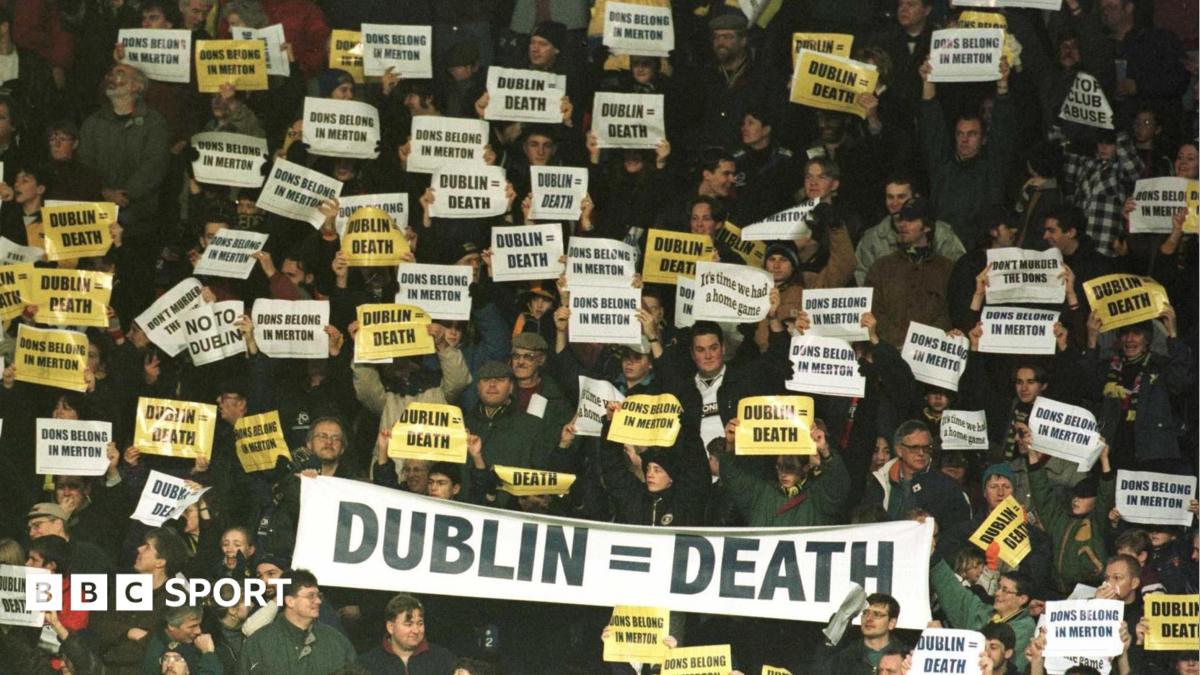
Dublin would not get its team, but nor would Wimbledon keep theirs with the club ultimately moved to Milton Keynes in 2004.
In the community left behind, AFC Wimbledon were born, starting life in the ninth tier of English football that same year with Heller among four co-founders.
Three decades on from those first murmurs of a move to Dublin, the reclaimed club are a League One side and since returned to their spiritual home of Plough Lane.
“You talk about the FA Cup, league finishes, cup semi-finals, but for me what they’ve done, that’s the biggest achievement in the history of the football club,” said Cunningham.
“To be knocked for six, to go careening down the leagues, and come back, it’s a success every time they take the pitch. Good luck to them.
“The Dublin thing? It’s a bit of nostalgia now, maybe a bit of sadness at a missed opportunity.
“People would be laughing now but it’s something that would have worked, no doubt about it. Absolutely, people would have rowed in behind it.”
>

Fatal Fury City of the Wolves Game’s Trailer Previews DLC Character Duck King – News

Arsenal prowess shows they’re not lacking attacking threat, but defensive cover still needed

Prime Video Sets Global Launch Date For ‘Babita Singh Reporting’
-

 movies3 months ago
Search For Canadian TV Actor Stewart McLean Now Homicide Investigation
-

 Fashion9 years ago
These ’90s fashion trends are making a comeback in 2017
-
Fashion9 years ago
According to Dior Couture, this taboo fashion accessory is back
-
Fashion9 years ago
Model Jocelyn Chew’s Instagram is the best vacation you’ve ever had
-
Fashion9 years ago
Emily Ratajkowski channels back-to-school style
-
Fashion9 years ago
9 Celebrities who have spoken out about being photoshopped
-
Fashion9 years ago
Your comprehensive guide to this fall’s biggest trends
-
Fashion9 years ago
A photo diary of the nightlife scene from LA To Ibiza