The Jets seem to have an injury scare just about every summer. Sometimes — like with Alijah Vera-Tucker last year, or Mekhi Becton in 2023 — the scare turns into a full-blown horror show. Both suffered season-ending injuries before the regular season kicked off. Last year, Justin Fields went down early in training camp, but it turned out to be just a dislocated toe.
The Jets have dealt with their share of injuries in camp already. Two highly-drafted rookies (Kenyon Sadiq, D’Angelo Ponds) have been out. A few key defensive players (T’Vondre Sweat, Joe Ossai) missed most of camp before returning this week. Cornerback Nahshon Wright and running back Isaiah Davis have been out for a couple weeks. All of those players are expected to be back at some point before Week 1.
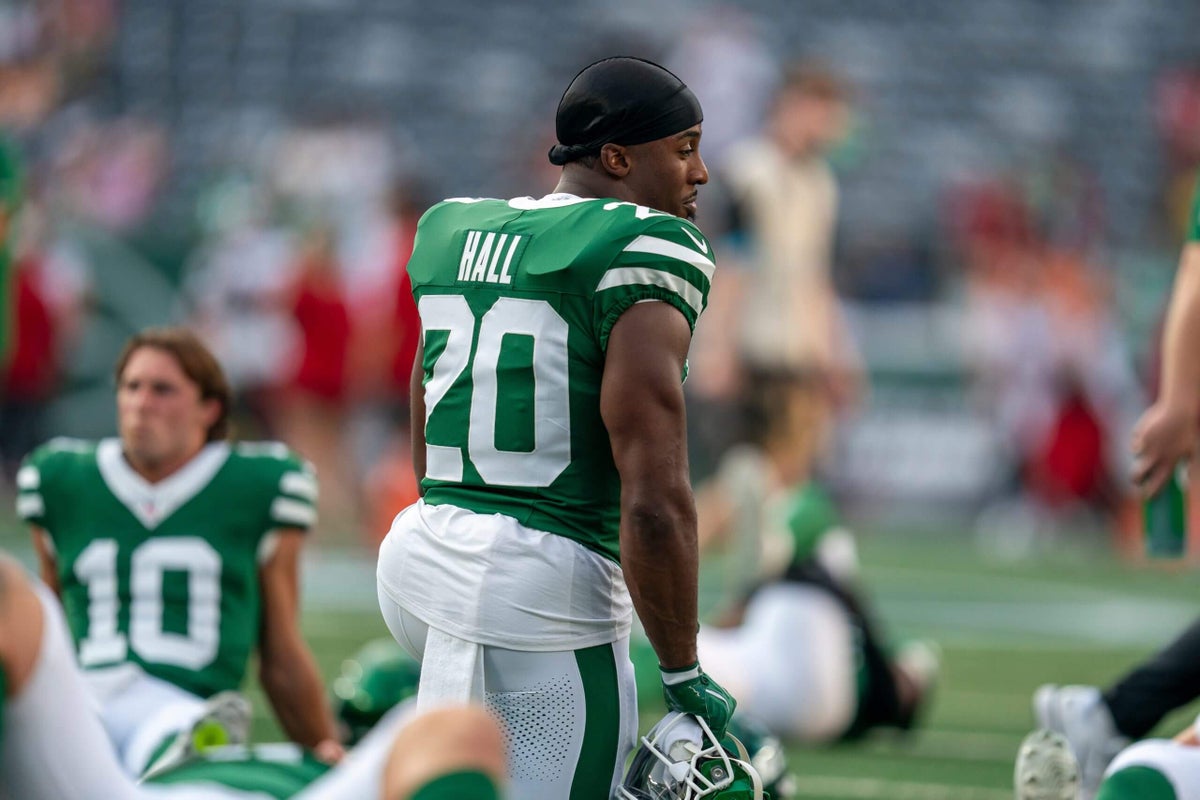
But the first big scare of camp came on Monday, when running back Breece Hall went down, untouched, after making a reception during team drills. Hall walked off with trainers, who examined his right leg, and after practice head coach Aaron Glenn described it as a groin strain. Glenn said he “didn’t think it was a big deal” but Hall was going in for imaging to find out more.
How Cade Klubnik is proving he’s worthy of being the Jets second QB
Zack Rosenblatt
The exact length of time Hall will be out is yet to be determined, but as of early afternoon Monday it appears the Jets have avoided something serious.
Hall is unquestionably one of the Jets’ most important players, which got me thinking: Which players can the Jets least afford to lose to injury? Here are the eight:
1) LB Demario Davis
Most teams would list a quarterback here. Maybe it’s not ideal that a 37-year-old linebacker tops this list but that’s how important Davis is to the defensive operation and everything Glenn wants to do as the defensive play-caller. Jamien Sherwood was out of his depth last year wearing the green dot, a role that required him to relay play-calls, and make sure his teammates are lined up properly and aware of what the offense is showing.
He was ultimately misplaced as the defensive quarterback and missed the mentorship and guidance of C.J. Mosley, who played a crucial role in Sherwood’s development before his breakout 2024 season. Davis replaces what was missing when Mosley retired, and Davis looks like a better player now than Mosley was at the end too, coming off a season in which he was widely graded as one of the NFL’s best linebackers, especially against the run.
Beyond Davis’s importance to the infrastructure of the defense, inside linebacker is as thin as any position on the Jets’ roster. If Davis goes down, Sherwood would likely get the green dot again — though perhaps Minkah Fitzpatrick would be a candidate — and the top backup options currently on the team are Kiko Mauigoa, Marcelino McCrary-Ball and Mykal Walker, the latter two primarily here for special-teams purposes.
A positive sign: Davis has been one of the NFL’s best ironmen for the last decade-plus. In his NFL career, including two other stints with the Jets, he’s played in 227 of 229 possible games while playing at least 90 percent of the snaps in all but four seasons. He’s played at least 97 percent of snaps in six seasons straight.
2) WR Garrett Wilson
On paper, this is the most talented group of wide receivers the Jets have had in a few years. After Wilson, the Jets have Adonai Mitchell, who has had a stellar summer and flashed some serious potential both with the Colts and in a half-season with the Jets. The Jets drafted Omar Cooper Jr. in the first round and Isaiah Williams emerged this summer as someone worthy of starting in the slot.
Yet, none of those three players have any track record of consistent production in the NFL, and the Jets’ passing offense revolves around their most talented player. Wilson not only draws attention but can find ways to make plays even when he’s draped in coverage. Talent-wise, he can be a Top-10 receiver — he’s produced throughout his NFL career despite inconsistent performance at quarterback (and that’s being kind). Remove Wilson from the fray and Mitchell needs to perform as a No. 1 wide receiver, and Cooper needs to show he’s ready to contribute immediately — which he hasn’t quite done yet.
The Jets clearly have better depth at this position than some others on this list, but Wilson is also leaps and bounds above these other receivers in terms of talent. His absence would both limit the offense, and change the way opposing defenses prepare to face the Jets.
3) QB Geno Smith
Whatever you think of Smith and his capabilities coming off a bad season in Las Vegas, he is quite clearly the Jets’ best quarterback and the only one on the roster that has proven capable of holding down a starting job for an extended stretch. The Jets have gotten the full Smith experience during training camp; there are days when he looks perfect (during one practice he completed every pass in team drills), and days where things just aren’t working (like in the joint practices with the Buccaneers). A sore ankle kept him out of the preseason opener and he was seen walking gingerly at practice on Monday.
Rookie Cade Klubnik flashed intriguing poise and potential against Tampa but is far from ready for NFL action. Unless the Jets go out and get a veteran quarterback at some point between now and the start of the season, they — like most teams — would be in trouble if the starter goes down.
4) RB Breece Hall
Hall is banged up and backup Isaiah Davis (knee) has been out for a couple weeks, leaving the Braelon Allen, Kene Nwangwu and undrafted rookies Chip Trayanum and Sam Scott in the Jets’ running backs room. Nwangwu is primarily a returner. Maybe general manager Darren Mougey will add someone after roster cuts at the end of camp (or before then) but for now this is the group they’re rolling with.
Allen has had a nice summer, including an impressive 31-yard touchdown run on Friday night, but he missed most of last season with an injury and has only averaged 3.7 yards per carry in 21 NFL games. Glenn speaks about both Allen and Davis as starting-caliber running backs but ideally the Jets won’t have to find out if that’s the case.
The Jets paid Hall $43.5 million for a reason: They’ve largely built the offense around his ability to take on a significant workload both as a runner and pass-catcher. He has a level of burst, agility and athleticism that would make it challenging to replace his production, though not impossible if Allen can live up to his potential.
5) OT Armand Membou, and 6) OT Olu Fashanu
I put Membou and Fashanu together for a couple reasons. First, Membou is the Jets’ best (or at least most talented) offensive lineman, and losing him would be particularly detrimental to the running game, where he thrived as a rookie. He’s been one of the Jets’ best players at any position this summer.
Though if Membou were to go down, the Jets at least have an experienced backup in Chukwuma Okorafor (60 career starts) to step in at right tackle. Okorafor, though, has almost exclusively played right tackle in the NFL. If Fashanu went down, the Jets would either be playing Okorafor out of position or bumping up fifth-year OT Max Mitchell to the left tackle spot.
Fashanu has had his ups and downs in camp but overall is a solid offensive tackle with the potential to improve. It would be a big downgrade from Fashanu to any of these backups.
7) S Minkah Fitzpatrick
The 29-year-old has a case for being the best Jets player in training camp. He’s been all over the field, forcing turnovers or coming close to it on a consistent basis. He flashed what he could mean to the defense during Friday’s preseason game. The Jets sent him on a blitz early on, and he lined up all over the field, even as a pseudo-linebacker at one point. He can play in the nickel and the back end, and he’s held in extremely high regard by his teammates.
Dane Belton has had a nice camp too but he’s better suited as the Jets’ No. 2 safety than the one at the top of the depth chart if Fitzpatrick were to miss any time. The Jets saw what it looks like when Andre Cisco was the No. 1 safety last year. Malachi Moore — the 2025 fourth-round pick — was getting snaps with the third-team defense on Friday night.
Fitzpatrick’s presence raises the ceiling of the defense — his absence would significantly lower that ceiling, not to mention the floor.
8) OLB David Bailey
Yes, the rookie is already this important, mostly because he looks like the best edge rusher on the roster already and the only pass rusher who will really drive any sort of fear into the opposition. Will McDonald certainly has talent but he has struggled with consistency during his career, and even this summer. Bailey showed against the Bucs that he’s already drawing enough attention that it should make life easier for McDonald on the other side.
It helps that the Jets have a couple of solid veterans in Kingsley Enagbare and Joe Ossai, but both have struggled to stay healthy this summer themselves. Bailey is the key to unlocking the pass-rushing potential of Glenn’s defense.
Also considered: P Austin McNamara, WR/PR Isaiah Williams, G Joe Tippmann, C Josh Myers, LB Jamien Sherwood