
Tech
Daniel Ek’s body-scanning startup Neko Health opens first US office, in New York

Neko Health’s promised U.S. expansion arrives on September 24, when the health-scanning startup opens its first American office. It will be located in SoHo, Manhattan’s home of luxury shopping, at 300 Lafayette Street.
Neko was founded by Spotify co-founder and CEO Daniel Ek and Hjalmar Nilsonne, who serves as Neko’s CEO. The company says that more than 25,000 New Yorkers have joined a waitlist.
As we previously reported, Neko Health has developed proprietary body-scanning technology, which it pairs with bloodwork and data from fitness devices to assess a person’s health. Currently, the startup has locations in the U.K. and Sweden. When it raised a $700 million Series C last month, it said that 100,000 people already had scans.
Neko is among a growing number of health scanning companies created by tech founders or backed by VCs. For instance, Midjourney, the AI lab best known for its AI image and video creation model and website, is also creating a body scanner, which it plans to integrate into a spa experience. It plans to open in San Francisco in 2027. Tony Robbins and Peter Diamandis also have a longevity company called Fountain Life that does scans and health assessments. Function Health, co-founded by well-known wellness podcaster Dr. Mark Hyman, offers blood testing, and it added body scans after acquiring the startup Ezra. Function just took on a $450 million loan from General Catalyst’s Customer Value Fund, where companies repay the money via profit-sharing arrangements.
>
Companies are still grappling with exactly how software development should work in the AI area, but one early answer is the so-called software factory. Essentially an agent loop that’s built around the traditional stages of software development, the software factory approach has become a popular way for companies to remake their engineering organizations for the AI era.
Now, a system from Warp could make that transition a lot easier. On Tuesday, the AI coding company introduced Warp Factories, a new system designed to make building and operating AI software factories as easy as possible.
Operating as an infrastructure layer, Warp Factories gives companies a simple environment for deploying agents and a roadmap for how to use them.
To be clear, many companies are already having success with the factory model without any help from Warp. Stripe has been particularly public about its technical progress, developing a “minions” system to automate development within its own codebase. Ramp has made similar progress, developing a background agent that can monitor its own code after it is deployed.

As Warp CEO Zack Lloyd sees it, the target market for Warp Factories will be smaller companies without the resources to develop a system from the ground up.
“[If you look at] things like running your agents in the cloud and steering those agents as they run, or bringing the work that they’re doing into your local environment, or setting up memory that goes across those agents, or setting up evals that go across those agents — it’s actually a huge infrastructure undertaking to do this right,” Lloyd told TechCrunch.
In Warp Factories, the architecture is already built out of the box, with many of the most difficult decisions already made. Warp’s system is based on the standard phases of software development (triage, specification, implementation, review, and verification) but the agentic approach means any of those steps can be automated.
Users can choose their own coding model and harnesses as necessary; the system works as well with Codex as Claude Code. It also integrates with ticketing systems like Linear and Jira, and messaging systems like Slack and Teams, in an effort to plug in seamlessly to existing workflows.
Beyond just shipping code, Warp Factories will also give managers the tools to track how well the factory is performing. With all the agents running in the same environment, it’s easy to compare performance metrics for different configurations, and to keep an eye on the overall token spend. Warp Factory also allows for self-improvement loops to optimize the overall system, automating management of the process itself.
Even so, Warp Factories is not built to completely replace software engineers — just give them an easier way to collaborate with the new agentic workforce. In Lloyd’s own experience, there are still a lot of tasks that require a human at the wheel.
“We automate like 30% of our tasks, 30 to 35% on a weekly basis,” Lloyd told TechCrunch, “and as models improve, as the context improves, as the harness improves, I think that that number is going to go up over time.”
When you purchase through links in our articles, we may earn a small commission. This doesn’t affect our editorial independence.
>
After numerous lawsuits over AI chatbots’ lack of safety measures, leading to teens’ suicides and other mental health concerns, OpenAI on Monday announced the launch of ChatGPT for Teens. The new product promises to include additional safety measures, as well as the educational crisis of ChatGPT-assisted cheating in schools.
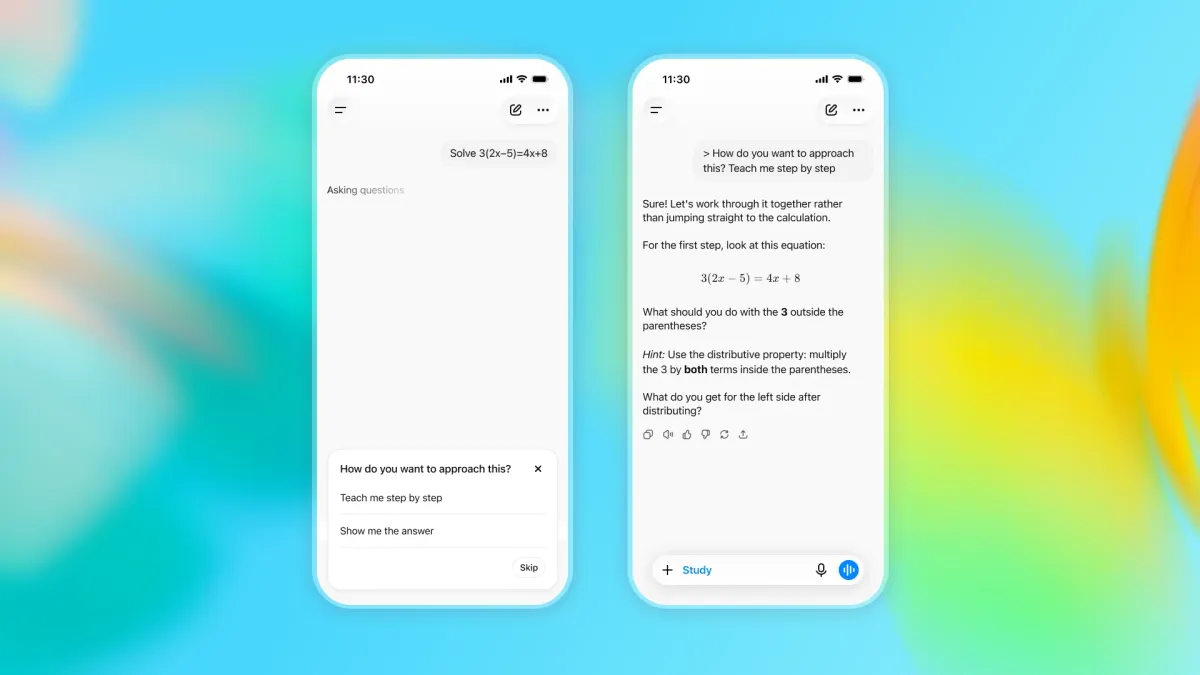
On the educational side, ChatGPT for Teens introduces a new Study Mode feature and other tools designed to encourage teen users to engage their curiosity and work through problems, not just get quick answers.
As OpenAI explains in a blog post, the Study Mode option will give teens guiding questions and step-by-step support to help them understand the material. Meanwhile, the teen experience will also include homework reminders that appear when a teen appears to be trying to cheat, instead of understanding the material. The AI chatbot will then push the teen to use Study Mode instead.
The app will also support quizzes and learning visualizations, and controls that allow parents or guardians to decide when Study Mode is enabled by default, the company says.
Still, it’s not clear how difficult it will be for teens to escape these new systems if they decide not to cooperate. Teens are incredibly adept at working around parental controls and other attempts to lock down digital experiences. Until ChatGPT’s teen mode can be put to more strenuous tests, it’s unclear how difficult it will be to work around these safety measures in reality.

OpenAI says app-appropriate protections will be on by default in ChatGPT for Teens, which are designed to reduce exposure to harmful or developmentally inappropriate content. These measures are based on OpenAI’s Under-18 Principles in our Model Spec, which the company claims to be informed by “developmental science and guidance from experts.”
Parents will also be able to use the family tools and parental controls previously introduced to manage settings, receive safety notifications, and set Quiet Hours, among other things.
OpenAI announced a partnership with CodeAI to help teens learn more about AI, including how it works, how to direct it or question it, and how to use it. In the classroom, OpenAI already offers ChatGPT for Teachers to help provide schools with institution-managed access to AI and support.
When you purchase through links in our articles, we may earn a small commission. This doesn’t affect our editorial independence.
>
Perplexity spent the past year running one of the biggest AI growth experiments, giving its premium service away to customers of Indian telecom giant Airtel. Now, as the earliest of those free subscriptions expire, the results are starting to emerge, offering an early test of whether bundling paid AI services can create lasting users and revenue after the giveaway ends.
In July 2025, Perplexity partnered with Airtel, India’s second biggest telecom operator, to offer a free 12-month Perplexity Pro subscription, normally worth about $200, to the Indian carrier’s 360 million customers. New redemptions ended on January 16. However, because subscribers retained Pro for a year from activation, the earliest users began reaching the end of their free access last month and had to opt out of auto-renewal if they did not want to be charged.
Perplexity’s AI giveaway had an immediate impact, as it saw 5.9 million app downloads in India in July 2025, according to data Sensor Tower shared with TechCrunch. That was up 625% from the previous month and more downloads in a single month than the 5.4 million Perplexity had accumulated during the entire first half of the year.
This momentum was not limited to the launch month of the Perplexity offer but persisted well beyond it. Perplexity recorded 56 million downloads during the seven months that the offer was available to new users, more than nine times the preceding seven-month period, Sensor Tower estimated. Monthly active users more than doubled to 8.9 million in July and eventually peaked at 22 million in October.

India has long been a massive market for downloads for global technology companies, thanks to its vast population, more than a billion internet subscribers, and relatively low mobile data costs. The country is the world’s second-largest smartphone market after China — with over 700 million users — and has similarly emerged as a major source of users for generative AI services. That scale has, however, proved considerably harder to translate into revenue.
Specifically for AI companies willing to subsidize access in pursuit of scale, India’s market dynamics have made it an attractive testing ground. Anthropic, Google, OpenAI, and others have increasingly chased Indian consumers with India-specific, lower-cost plans, free access, and distribution partnerships, aiming to eventually translate them into paying customers.
However, once the window to claim the free Airtel subscription closed in January, Perplexity’s downloads fell sharply. Sensor Tower estimates Perplexity was downloaded 3.3 million times in India between February and July, down more than 90% from the preceding six months.
What came after the download boom?
The users Perplexity had acquired did not disappear quite so quickly. Monthly active users, which peaked at about 22 million in October, stood at nearly 14 million in July — down 37% from that high but still more than five times the about 2.6 million monthly users Perplexity averaged in the first half of 2025, per Sensor Tower.
“While the time-sensitive nature of this promotion would naturally lead to a decline in adoption after the offer period, ongoing usage has remained resilient,” Abe Yousef, senior insights analyst at Sensor Tower, told TechCrunch. Perplexity, he added, has “significantly more users” in India than it did in the six months before the promotion.

More strikingly, Perplexity’s drop in downloads has not been accompanied by a decline in spending. Sensor Tower estimates that Perplexity’s in-app purchase and subscription revenue in India between February and mid-August rose about 60% from the period when the Airtel offer was available to new users, despite downloads declined.
That trend has continued even as the earliest Airtel subscribers have started losing their free Perplexity Pro access. From around July 18 through August 12, Perplexity’s average daily in-app purchase revenue in India, per Sensor Tower, was 9% higher than during the preceding 30 days and 27% above the average for the first half of 2026.
The increase gives us an early indication that some users may be willing to pay after getting accustomed to the premium service for free. But of course, it does not confirm that Airtel users themselves are deliberately converting into paying subscribers.
The free subscriptions were set to auto-renew, requiring users who did not want to continue to cancel their service before the renewal date to avoid being charged. This makes it possible that some of the increase reflects users who did not cancel in time rather than those who actively chose to pay. Sensor Tower cannot distinguish between those scenarios or separate former Airtel subscribers from other paying customers.
Appfigures, another app intelligence firm, also found that the Airtel deal dramatically changed Perplexity’s trajectory in India. The data Appfigures shared with TechCrunch indicates the initial growth was specific to Perplexity rather than simply reflecting growing appetite for AI apps overall.
“I compared Perplexity’s downloads to ChatGPT and Claude to ensure it wasn’t more appetite for AI, and it wasn’t,” Appfigures co-founder and CEO Ariel Michaeli told TechCrunch.
In the week before the Airtel offer launched, Perplexity averaged about 11,200 downloads a day in India, per Appfigures. That jumped twentyfold to nearly 223,000 a day during the first week of the offer’s launch and continued climbing, hitting an average of about 305,000 a day between mid-September and mid-October. To compare, downloads of OpenAI’s ChatGPT and Anthropic’s Claude remained broadly stable.
Appfigures also sees signals that Perplexity emerged from the giveaway with a bigger business in India, even though the promotional download boom disappeared. Perplexity’s monthly net mobile revenue in the country, per Appfigures, grew from about $34,000 in January 2025 to $70,000 in December and reached $156,000 in July 2026. The AI company generated an estimated $878,000 in India in the first seven months of 2026, up 16% from all of 2025.
Michaeli cautioned against attributing all of that growth to Airtel users becoming paying customers. The enormous visibility generated by the promotion, he noted, may also have attracted paying users who were never part of the giveaway.
Perplexity’s experiment has since become part of a much broader wager by AI companies in India. In August 2025, OpenAI made its lower-priced ChatGPT Go plan free for a year in the country. Google also followed Perplexity with a deal to offer its AI Pro subscription free for 18 months to eligible Reliance Jio users.
That makes Perplexity an early test of whether the strategy can work. Its Airtel deal began months before the similar moves by OpenAI and Google. This also means that Perplexity users are among the first large cohort in India to reach the point where free premium AI turns into a product they may have to pay for.
India has already emerged as the world’s largest market for generative AI app downloads but remains difficult to monetize. AI companies have been willing to trade near-term revenue for users in this price-conscious market, striving to eventually turn that scale and habit into paying customers.
That said, the data cannot yet show how many of Perplexity’s newly acquired users will willingly pay once their free year runs out. That test will play out over the coming months as later cohorts of Airtel users reach their renewal dates.
Perplexity did not respond to a request for comment.
When you purchase through links in our articles, we may earn a small commission. This doesn’t affect our editorial independence.
>

‘Elle’ Star Jacob Moskovitz To Play Marlon Brando In Chicago Presentation Of ‘Kowalski’

K-Drama Llama – This Week in Anime

Pete Crow-Armstrong lets his mind wander during games. He might be onto something
-

 movies3 months ago
Search For Canadian TV Actor Stewart McLean Now Homicide Investigation
-

 Fashion9 years ago
These ’90s fashion trends are making a comeback in 2017
-
Fashion9 years ago
According to Dior Couture, this taboo fashion accessory is back
-
Fashion9 years ago
Model Jocelyn Chew’s Instagram is the best vacation you’ve ever had
-
Fashion9 years ago
Emily Ratajkowski channels back-to-school style
-
Fashion9 years ago
9 Celebrities who have spoken out about being photoshopped
-
Fashion9 years ago
Your comprehensive guide to this fall’s biggest trends
-
Fashion9 years ago
A photo diary of the nightlife scene from LA To Ibiza