
Entertainment
‘Insidious: Out of the Further’ Review: Time to Kill This Franchise?

Un-scary and uninspired, the creaky sixth entry in the “Insidious” series will make you want to send this franchise to the realm of the dead. The permanently dead. The best thing I can say for Jacob Chase’s crack at Blumhouse-Atomic Monster lore titled “Insidious: Out of the Further,” another soporific retread of the horror movie as grief metaphor, is that it doesn’t require you to do any homework.
This fifth sequel to 2011’s James Wan-directed “Insidious,” perennially viral because of its Darth Maul-like poster child known as the Lipstick-Faced Demon, jumpstarts the franchise’s backstory with new characters and grindingly by-the-numbers obstacles. Take a nap, look at your phone, order another bev, because endless exposition requires scarce attention. Personally, I’ve come and gone from the series about the collision of a purgatorial spirit world with our mortal one, which has proven sizably profitable for Blumhouse relative to its budgets despite patchy receipts from critics.


Here, British actress Amelia Eve (“The Haunting of Bly Manor“) stars as a what-else-but traumatized dental hygienist who is being stalked by the otherworldly ghouls of the Further — a kind of limbo holding cell where demons and restless ghosts convene — due to her apparent psychic ability to traffic objects and beings from one plane to the other.
Despite a coughed-up effort at mythology refresh to hopefully welcome newer audiences into the franchise’s long-running fray, “Insidious: Out of the Further” winds up another gumbo of cliches and tropes drowned in overexplanation: astral planes, material planes, mothers and daughters, cross-generational trauma, white facepowder, hypnotism, mediums, sunken places, hags, red doors, gravelly distorted voices, peeled fingernails, more hags, rictus grins, old people, grief, and mercilessly constant jump scares. Chase seems more fascinated by extreme close-ups of toweringly bad gingivitis and gooey-sticky plaque formations on dental implants than by narrative ingenuity, especially when one of Gemma’s (Eve) patients at the Second Smile clinic happens to be a ghastly dispatch from the Further itself.
This sixth entry indeed takes us further into the Further, where a limp-haired Marilyn Manson-type entity called Cyrus Lam has its eyes on Gemma in the present day. But the movie begins in Pittsburgh, 1999, when young latchkey kid Gemma (Charli Penton) arrives home from school to her emotional absentee mother Ingrid (Laura Gordon). Visible signs of body-hijacking mental illness drive Ingrid to a grisly suicide in the bathroom that her daughter is forced to witness.
A quarter of a century later — but only a few weeks after the events of 2023’s Patrick Wilson-starring “Insidious: The Red Door,” as we’ll later learn courtesy of a certain loony clairvoyant — and single-mom Gemma has a nine-year-old daughter of her own, Maya (Island Austin). She’s also got a superhot copy boyfriend (“Nope” breakout Brandon Perea) whom Gemma keeps at a remove, uneasy and unready to welcome a new man into Maya’s life. (It’s heavily implied the small girl never knew her father; same went for the young Gemma.)
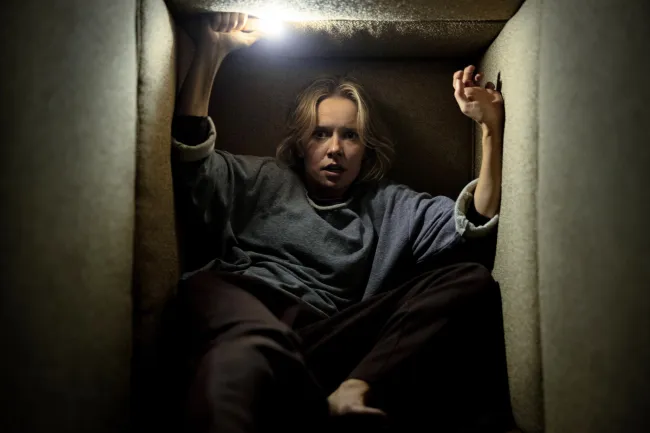
Increasingly, ominous presentiments start to appear before Gemma, like a visibly dead-looking old-timey family of three with mirthlessly toothy grins pasted across their pallid faces, jarringly out of place in a contemporary suburb but observed mostly with a “huh.” Or a flashlight Gemma hasn’t seen since she was a little girl. Or a spiked talisman that could prove a conduit between our world and the land of the Further. One nifty sequence in a movie almost perversely lacking in them: Gemma crawls into one of Maya’s world-famous pillow forts, only to end up contorting herself through a liminal space of endless couch cushions to evade a Further-sent elderly demon. But does this sequence only work because it harks back to the very recent chills and thrills of Kane Parsons’ empty-spaces-as-existential-horror movie “Backrooms“?
Whatever’s going on, a sleepless, nerve-fried Gemma surmises through ramblings that concern her boyfriend that it has something to do with her mother. Someone who might have the answers is fan-favorite franchise staple Elise (Lin Shaye), a medium who commutes between both worlds, here via the body of a tattoo artist (Maisie Richardson-Sellers) endowed with paranormal gifts. Gemma’s ability to teleport objects from the Material Plane to the Further — such as a burned-out TV set playing images of Cyrus Lam vaguely overseeing some kind of occult ritual sacrifice — may also extend to transporting entities. And to closing for good the Red Door that is so perilously open right now, allowing demons to come and go from Gemma’s dream and waking states.

Gemma’s increasing frailty and the newfound demands of being a spiritist courier now tasked with the most important job of all provide star Eve a fine enough base to play. That’s despite a screenplay also written by Chase (the writer/director of the dull mommy-daughter thriller “Come Play“) that prioritizes jump scares coming at you from the screen rather than three-dimensional human beings. And jump scares are abundant throughout “Out of the Further,” in place of any psychological complexity beyond ambiguous brushes with how we try to organize our grief around past traumas seeping into the fabric of our present.
Gemma’s astral-projecting capabilities, as an overwritten script leaps lumpily throughout timelines to explicate, were likely inherited from Ingrid, who maybe wasn’t actually mentally disturbed and in serious need of a wellness check but instead was being haunted by the classic troupe of “Insidious” villains: Spirit Halloween-grade, “Carnival of Souls”-like specters in dusty evening wear, caught dead in a fancy party that never stopped. And if Gemma caught her mother’s psychic disease, what does that mean for little Maya?
A late-August release date for a horror title is typically the kiss of death, a summer dumping ground only occasionally revitalized by movies like 1999’s “The Sixth Sense” — whose, for millennials anyway, childhood-scarring shot of a bathrobe-clad ghost with slit wrists gets a lazy shout-out here. No need to reiterate how much the stakes of the horror genre have been upped this year, so much that “Insidious: Out of the Further” needs to seriously justify itself for being so bad. The function of the jump scare, which is I know I know integral to the genre’s machinations, has changed, too: Its purpose now is to get people in the audience to look up from their smartphones, especially helpful if you’re sitting in an Alamo Drafthouse. Perhaps the jump scares here also helped shake the filmmakers out of their lethargy in post-production. Something to live for, something to do.
There’s also the issue of the dank-blue, drained-of-all-life filter painted over the film‘s coverage shots, here overseen by cinematographer Dave Garbett. That Amelia Eve’s breakout credit came courtesy of a Mike Flanagan joint disappointingly reminds of how much the filmmaker/TV creator’s signature aesthetic — often underlit to the point of incoherence, and ever a steely gray-blue to convey an uncanny inner awfulness — now defines the genre’s visual palette in 2026. If everything is already imbued with the pallor of the dead from the start, then nothing is scary or unexpected.
Direly, dreadfully boring, “Insidious: Out of the Further” has money on the brain. So do most things, but this time, it’s way too conspicuous and underserving of the epochal year Blumhouse-Atomic Monster is having between “Backrooms” and “Obsession.” And the comparisons will only stop when the slop stops being poured.
Grade: D
Sony releases “Insidious: Out of the Further” in theaters starting Friday, August 21.
>
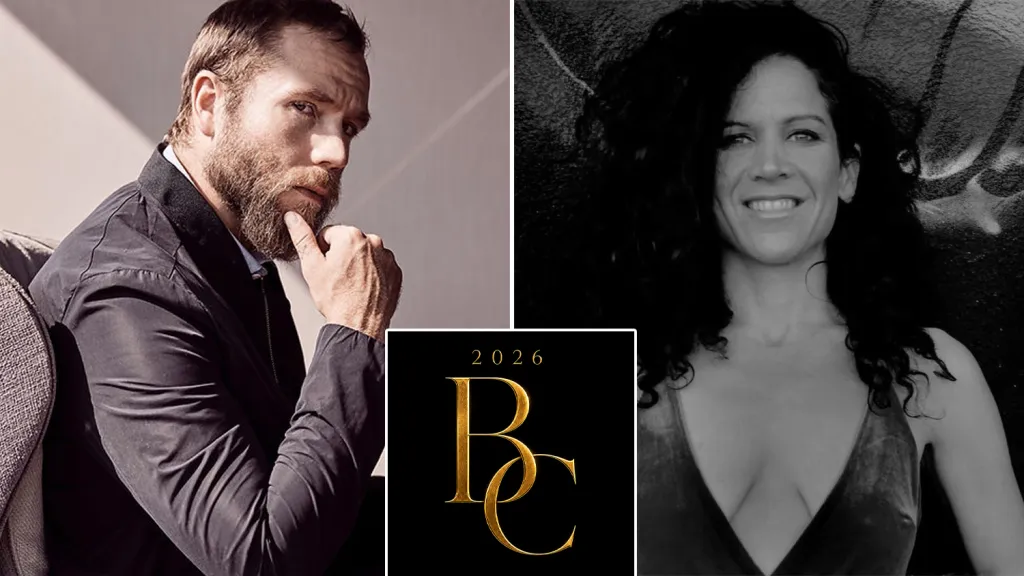
EXCLUSIVE: Mark Webber and Jennifer DeLia have partnered to launch Beyond Culture, an artist-led production banner, unveiling their initial slate.
Beyond Culture is billed as a company integrating film, art, music, technology and experience, which will champion uncompromising voices and stories that expand consciousness, provoke convention and transcend mediums. Built around a model that prioritizes creative ownership and greater financial control for artists, the company takes inspiration from the original United Artists, founded by Charlie Chaplin, Mary Pickford, Douglas Fairbanks and D.W. Griffith in 1919 to give artists greater autonomy over their work.
The founding partners will celebrate the launch with a panel, live performance and reception taking place as part of the Speakers’ Summit Series at the 2026 Toronto Film Festival.
Beyond Culture launches with a slate that includes Webber’s Figments of Freedom, executive produced by global recording artist Sia; DeLia’s Mary Pickford: Love Wild, produced by DeLia, Jack Cook, Julie Pacino and Nitsa Benchetrit; documentary series Painting in the Dark; and the company’s namesake series, Beyond Culture.
In Figments of Freedom, written, directed by and starring Webber, a Marine goes AWOL, burns his life to ash, and vanishes into America’s fractured heart. Haunted by war and chasing ghosts of himself, he drifts through a divided nation that might be the only mirror left to find himself. Currently in post, the film also stars Afia Fields, Eugenia Yuan and Winona LaDuke.
Mary Pickford: Love Wild is DeLia’s surrealist exploration of the life of pioneering actress, producer and United Artists co-founder Pickford. Sophie Kennedy Clark plays the title role, starring alongside Cary Elwes, Scott Haze, Balthazar Getty, Summer Phoenix, Fran Kranz, Mike Sirow, Adam Fergus, Luke Arnold, Allie McDonald, Jeroen van Koningsbrugge, Brionne Davis, Jane Stiles, Josephine de La Baume, Heath Freeman, and singer Angela McCluskey as Mary’s mother, Charlotte Pickford.
The Pickford project was shot by DP Dan Kneece, whose career included collaborations with David Lynch and Quentin Tarantino. Kneece passed away unexpectedly just five weeks after completing additional photography on the film; Freeman and McCluskey also passed away before its completion. Following a creative pause, the film has now entered its final stage of post-production.
Docuseries Painting in the Dark follows muralist Joel Bergner, aka Joel Artista, CEO and co-founder of Artolution, whose large-scale collaborative works span more than 30 countries across five continents. From refugee camps to prisons and underserved communities around the world, Artista uses collaborative art-making as a force for connection, expression and social transformation.
Beyond Culture is also currently developing a namesake series — a reality-documentary hybrid that takes artists and cultural figures beyond persona and into radical self-exploration. The inaugural journey, produced by Brody Baker and shot by Cameron Dunbar, follows Orange Is the New Black actor Taryn Manning alongside hosts DeLia and Taylor Olandt through a spiritual marathon of healing practices. Through tantra, breath, mantra and sweat, layers of identity are stripped away, revealing the human being beneath the public perception.
DeLia and Webber bring decades of combined experience across film, art and culture to their new company.
A director, producer and actor, DeLia’s credits include the films Billy Bates, Abracadabra and Aligned, as well as the Off-Broadway production Phoenix, starring Julia Stiles and James Wirt. She has also directed music videos for artists including Dr. John, Bobby Rush and Amadou & Mariam, created live experiences at Cannes, Berlin, TIFF, Sundance and New York Fashion Week, and founded Sovereignty Fest.
DeLia observed, “Artists are often asked to surrender some part of their vision in order to participate in the machinery around it. Beyond Culture is about imagining a different relationship between art and commerce, one where creators can remain sovereign, take meaningful risks and create work that has cultural and commercial power without losing the thing that made it alive in the first place.”
Webber, whose acting credits span more than 40 films, has worked with filmmakers including Jim Jarmusch, Todd Solondz, Lynn Shelton, Thomas Vinterberg, Lars von Trier, Edgar Wright and Gus Van Sant. As a writer-director, his films have screened at SXSW, Sundance and Tribeca.
“For me, the most meaningful work has always come from protecting the human impulse behind it,” Webber said. “Beyond Culture creates a space where artists can experiment, collaborate and create from a place of truth, rather than reverse-engineering their creativity around what a system thinks it knows how to sell.”
DeLia and Webber first collaborated on Webber’s feature directorial debut, Explicit Ills, with DeLia helping secure the film’s financing. The film went on to win the Audience Award for Narrative Feature and Best Cinematography at SXSW in 2008.
Beyond Culture’s launch event at TIFF will feature artists and collaborators from across its slate, including Senegalese-American singer Marieme, who will also perform. Additional participants include Eugenia Kuzmina (Noon), voice actor Karen Strassman, For Love filmmaker Matt Smiley, Narcos: Mexico actor Brionne Davis, Bergner, Olandt, Webber and DeLia.
>
In 2008, “The X-Files: I Want to Believe” was released theatrically, six years after the series came to an end and a whopping 10 years since the last movie, 1998’s excellent “The X-Files: Fight the Future,” came out.
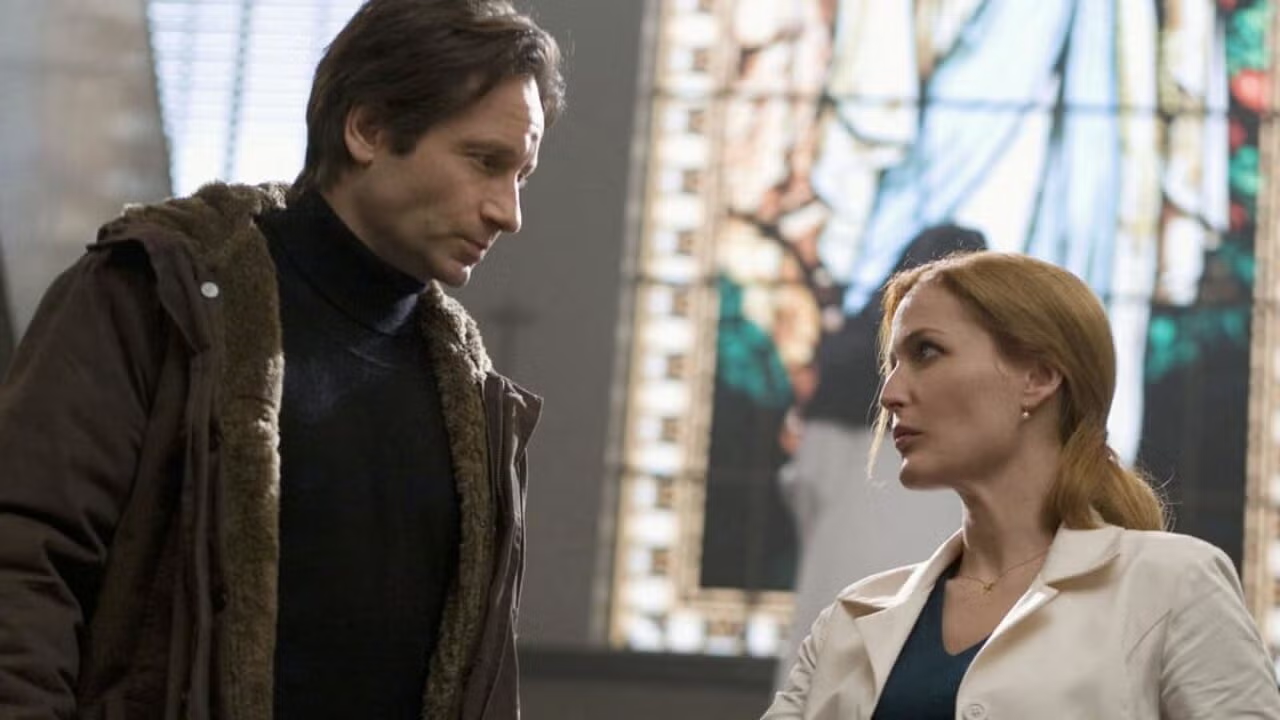
Meant as the first in a series of standalone theatrical “X-Files” entries, the movie saw Dana Scully (Gillian Anderson), now a doctor working for a Catholic hospital and Fox Mulder (David Duchovny), a disgraced recluse living in a cabin alone (Unabomber beard and all), drawn back into a mystery involving a pedophilic priest with psychic abilities and a mad doctor practicing fringe science. (It’s a lot.)
Unfortunately, “The X-Files: I Want to Believe,” beset by iffy plotting and a distinct lack of thrills, had the misfortune of being released a week after Christopher Nolan’s cultural phenomenon “The Dark Knight.” The new “X-Files” quickly sank, making $68 million worldwide on a budget of $30 million, and grounded the once lucrative franchise for nearly 10 more years.
But now “The X-Files: I Want to Believe” is back, in a new director’s cut supervised by director and co-writer Chris Carter, the creator of the original series. This new iteration, dubbed “The X-Files: I Want to Believe – Vrach Frankenshteyn,” is now available on Hulu. Running a svelte 98 minutes, compared to the original release’s 104 minutes, what was once an unnecessarily baggy mystery has become tighter, more contained and more ruthlessly bloody.
By removing the extraneous bits, “I Want to Believe” has finally become what it always set out to be – a killer standalone “X-Files” episode, free of unneeded mythology and instead focused on being as efficient and unsettling as it possibly can be.
Carter said that the process of making “I Want to Believe” truly began back in 2007, when he was asked to make a new “X-Files” movie by 20th Century Fox executives “for a price.” “It was roughly a third of the budget of the original, ‘Fight the Future,’ so we really set out to make a good standalone ‘X-Files’ story, and along the way, that idea hit some rocky road,” Carter explained to TheWrap ahead of the release of the new version on Hulu.
Some of that “rocky road” included a grueling, low-budget shoot in snowy Vancouver, where much of the original show was shot (until, after “Fight the Future,” the production was moved to balmy Los Angeles) – a “forbidding environment,” according to Carter. “I tell people that I went through nine pair of shoes, I could not find a pair that would keep my feet warm,” Carter said. “Just appreciate that my feet are always frozen directing this movie.”
Rumors persisted that the movie was rushed into production to avoid an upcoming writers’ strike, which Carter denied. He said they didn’t know there was going to be a writers’ strike and were already in shooting when the strike happened. “Because we were already in production, we were given the ability to work and not have to man the picket lines,” said Carter.
But the rockiest patch of road was saved for after the shoot was completed. That’s when Carter showed an initial cut of the movie to a group of Fox executives – the same executives who had finally commissioned the movie just a year earlier.
In short, Carter said, “I got reamed.”
“The X-Files: I Want to Believe” that Carter had delivered was not acceptable to the studio. “It was not the PG-13 movie that they had imagined. It was much darker and scarier. And I think the words they used were torture porn,” Carter said. The executives compared his cut of the movie to something like “Saw” or “Hostel.” (David Edelstein, critic for New York Magazine, coined the phrase “torture porn” in a 2006 piece. It was very much a part of the cultural conversation at the time.)

Carter described the situation as “disappointing.” He went back to his original cut and began reshaping the movie; he jettisoned elements and sequences that the executives deemed too intense and would have earned him a harsher R rating. When he re-submitted the movie to the Motion Picture Association of America, responsible for issuing ratings, they still found it to be too much. “They said, ‘This isn’t a PG-13 movie.’ We had to cut it back even further,” Carter said.
For him, “The X-Files: I Want to Believe” took on a different shape entirely. “It became a Mulder and Scully relationship movie that happened to have an element of an X-File in it,” Carter said, still sounding defeated. He felt at the times that the executives “really didn’t know ‘The X-Files.’ They knew it was a success, and they knew we had done well with the first movie,” Carter said.
He remembered that he and co-writer and producer Frank Spotnitz were in London on the promotional tour for “I Want to Believe” when they got a call from a Fox executive, telling Carter and Spotnitz that Fox wasn’t going to advertise the film. “They were simply going to rely on word of mouth from fans,” Carter said. “And so they jettisoned the movie, and I felt like they had jettisoned something that was never the movie I intended to make. It was disappointing on that level too.”
While an extended cut of the movie came out on home video that reinstated four additional minutes, it still wasn’t what Carter had initially envisioned. That version remained – in true “X-Files” fashion – just out of reach. Something to believe in. Carter didn’t lose hope, exactly, but he wasn’t sure that his original vision would ever be restored.
Years later, Carter would be having a conversation with Steve Asbell, president of production at 20th Century Studios, about another project entirely. But at the end of the conversation, Carter casually asked him, “Would you ever consider doing a director’s cut?” To which Asbell replied, “Yeah, let’s talk about it.”
“Not only did we talk about it, these guys, bless their hearts, they got behind it,” Carter said. He was given a small budget and two editors, who worked to get “I Want to Believe” back to the place that Carter thought it should be. “I set about fine tuning the material that I had to work with,” Carter said. “We laid heavily into the darkness and took a way a little of the romance, which I felt like I had shoehorned in there to please the original executives.”

In 2025, while appearing on David Duchovny’s “Fail Better” podcast, Carter revealed that he had just gotten the go-ahead to start working on an updated version of “I Want to Believe.” “That’s awesome,” Duchovny replied.
And Carter had very specific goals for what he wanted to achieve with this new cut.
According to Carter, “we had gotten our fill of [the relationship] in the reboot seasons.” In the original version of “I Want to Believe,” Carter said, “the fact that they’re in bed together is played as a big reveal – aha! Now it had a different storytelling quality.” He also wanted to up the horror, to keep in line with his initial vision of the project.
“We set out to make a Frankenstein movie originally, and I love that Frankenstein story so much. I love Mary Shelley’s book. I love the movies,” Carter said. He remembered reading a story about a doctor who had transplanted the head of a monkey onto another monkey. At the time he thought to himself, This is “X-Files” territory. And it’s a “Frankenstein” story. He visited the doctor in Cleveland, Ohio.
“He sat with me and kindly and took me through what it would take to transplant this monkey head. The transplant was successful but it was short-lived. The monkey ended up dying,” Carter said.
Not that the concerns around longevity have lessened in the past 20 years.
“People are talking now about living forever. They’re talking about life-maxxing, looks-maxxing. All the tech bros think if they do the right things, they can, in fact, live forever,” Carter said. “And certainly, you have to consider transplanting your head onto a younger body a way to live forever. I think the story has relevance in a way right now than it didn’t quite back way back when.”
One of the odder trims to the movie is the removal of a George W. Bush joke from the original version, with Mulder looking at the then-president’s portrait while the spooky “X-Files” theme from Mark Snow gingerly plays over the moment. “It didn’t feel relevant in 2026,” Carter said.

And while there are currently no plans for a physical media version of this new iteration of “X-Files: I Want to Believe,” it’s something that Carter wants. “My DVD player is waiting for it,” he said. (The season sets of “X-Files” on Blu-ray are currently out of print.)
It does feel like “The X-Files” is having a moment.
Just a couple of weeks ago, LEGO released an elaborate “X-Files” set. (If you ordered early enough, you were treated to an additional little set of Scully in the morgue, ready to perform an autopsy.) A rebooted series, this time from Ryan Coogler, is in the works that seems to maintain the continuity of the original series, with stars Danielle Deadwyler and Himesh Patel playing two new agents assigned to the X-Files. And there’s also just the continued cultural conversation and fascination with UFOs, which the government has more or less admitted to actually being real. (The August 7 Time Magazine cover story was titled “America Is Finally Taking Extraterrestrials Seriously.”)
In 2021, Carter was even asked by The New York Times to write an editorial for the paper. The resulting piece, “I Created ‘The X-Files.’ Here’s Why I’m Skeptical of the New U.F.O. Report.,” was a thoughtful, emotional piece about how the conspiracy theories of the show have now been dismayingly (and dangerously) adopted by Americans with an axe to grind. And how even as the government releases more documents pertaining to the existence of life outside our own, Carter remains unsure. “Ordered up by a bipartisan group of legislators during the Trump administration, the interim report revealed nothing conclusive about U.F.O.s or their extraterrestrial origins. And the portions that remain classified will only fuel more conspiracy theories,” Carter wrote.
Still, Carter is impressed (and surprised) at the series’ continued longevity.
“That the show is relevant over 30 years later is a mind-blower,” Carter said.
Not that he’s done with the series, either. During filming of the 11th season, Gillian Anderson had remarked that it would be the last time she would put on the wig. Carter was dismayed by this (he called it a “disappointment”), as was Duchovny. (Duchovny spoke to Anderson about this on an episode of his “Fail Better” podcast from earlier this year.)
“If you remember the reveal at the end of season 11, is that she’s pregnant, and I have somewhere that I want to take that revelation – a bigger story, maybe the biggest story to tell, and I’d like to do that in either a movie or a series. But you know what? I don’t want to do anything to get in the way of Coogler’s vision,” Carter said.
But he’s not sitting idle. Carter has what he described as “a horror fable fantasy odyssey” that he made independently in Vancouver recently called “Queens for a Day” that has a political angle (he said he hopes to have it out “before the midterms”). “I know ‘X-Files’ fans are going to love it,” Carter said.
And while he is not involved in the Coogler reboot of the show, besides little bits that he hears from friends on the production in Vancouver (“secret spy tidbits about what he’s doing”), Carter is extremely excited to watch it and could not be more supportive. “I’m like everyone else. I’m going to sit down and with a bowl of popcorn and watch his series,” Carter said.
We wondered why, with all the interest around “The X-Files” currently, two of Carter’s other shows – “Millennium,” his tricky, shape-shifting series killer series that starred Lance Henriksen and was eventually revealed to take place in the same universe as “The X-Files,” and “The Lone Gunmen,” the “X-Files” spinoff series centered around the three goofball conspiracy theorists that would occasionally help Mulder and Scully on their cases, were unavailable on home video or streaming. Carter said that both are filled with “music that needs to be licensed that is very expensive.”
“It’s really not any about anything other than the cost,” said Carter.
Because the only thing scarier than mad scientists, government conspiracies or the threat of alien abduction is royalty payments. But hey, the truth is out there.
“The X-Files: I Want to Believe – Vrach Frankenshteyn” is on Hulu now.

>
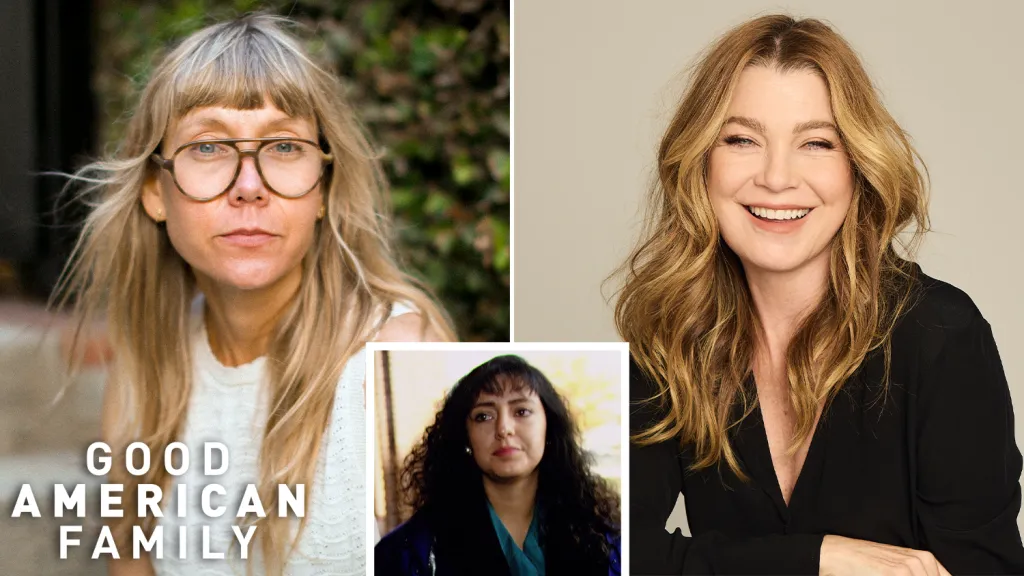
EXCLUSIVE: Good American Family is becoming an anthology — Hulu has greenlighted a limited series about Lorena Bobbitt as its second installment. It comes from the same team, led by creator, writer and executive producer Katie Robbins and executive producer Ellen Pompeo.
Shortly after the Good American Family finale aired on April 30, 2025, Pompeo and Robbins started to discuss ideas for expanding the limited series into an anthology, with Lorena Bobbitt quickly emerging as a subject of a followup installment under the Good American Family banner. By June, the project was heating up for a green light.
The cases of Ukrainian-born girl with dwarfism Natalia Grace, which was covered in the original Good American Family, and of Lorena Bobbitt share some similarities — both feature smilingly ordinary families, both tell stories with bizarre elements that made headlines around the world and stayed in the tabloids for months, and both involve two sides with contradicting accounts of the events.
Per Season 2’s official logline, it is Inspired by the ripped-from-the-headlines story of Lorena and John Bobbitt, a Virginia couple who incited a media circus that treated trauma as entertainment, launched a thousand dirty jokes, and ignited a gender war.
In 1993, Lorena severed John’s penis and drove around with it for awhile before throwing it out and calling the police. She explained her actions as triggered by systemic abuse — psychological, physical and sexual — she had allegedly suffered at the hands of her husband.
The infamous incident was the subject of the 2020 I Was Lorena Bobbitt, part of Lifetime’s Ripped from the Headlines TV movie franchise, which was narrated and executive produced by Lorena Bobbitt, with Dani Montalvo portraying her and Luke Humphrey playing John Bobbitt. There was also the 2019 Amazon true crime docu-series Lorena, produced by Jordan Peele, which features interviews with both Lorena and John.
Pompeo and Laura Holstein executive produce under their Calamity Jane banner, alongside Andrew Stearn who also served as EP on the original Good American Family. Pompeo, who played the adoptive mom in Season 1, is not expected to act in the second installment.
Since its March 2025 launch, Good American Family has amassed more than 140M hours streamed globally on Hulu and Disney+.
This marks the second Hulu green light for Robbins and Pompeo this summer; they also have dramedy Chicks starring Pompeo, which received a pilot order in June. Both Good American Family and Chicks are produced by 20th Television, part of Disney Television Studios, which signed Robbins into an overall deal earlier this summer and where Calamity Jane is based.
Robbins also created Apple TV and A24’s dark comedy Sunny, starring Rashida Jones and was a writer-producer on Showtime’s The Affair. She is repped by UTA, Aaron Kogan Management, and Jonathan Shikora of Lichter, Grossman, Nichols.
Pompeo stars in and executive produces ABC’s venerable medical drama Grey’s Anatomy, which is headed into its 23rd season. She also executive produced spinoff series Station 19 and is an executive producer on the upcoming offshoot set in West Texas, which will premiere in midseason 2027. Pompeo is repped by CAA, Linden Entertainment and Hansen Jacobson.
>

Jennifer DeLia & Mark Webber Launch Beyond Culture Banner (EXCLUSIVE)

England v Pakistan First Test: Salman Ali Agha and Muhammad Rizwan are dismissed in back-to-back balls by Josh Tongue

OnePlus Price Hike in India: 5 Phones Get Costlier
-

 movies3 months ago
Search For Canadian TV Actor Stewart McLean Now Homicide Investigation
-

 Fashion9 years ago
These ’90s fashion trends are making a comeback in 2017
-
Fashion9 years ago
According to Dior Couture, this taboo fashion accessory is back
-
Fashion9 years ago
Model Jocelyn Chew’s Instagram is the best vacation you’ve ever had
-
Fashion9 years ago
Emily Ratajkowski channels back-to-school style
-
Fashion9 years ago
9 Celebrities who have spoken out about being photoshopped
-
Fashion9 years ago
Your comprehensive guide to this fall’s biggest trends
-
Fashion9 years ago
A photo diary of the nightlife scene from LA To Ibiza