
Tech
Patreon launches 30 new creator features, including short-form Clips and revamped discovery

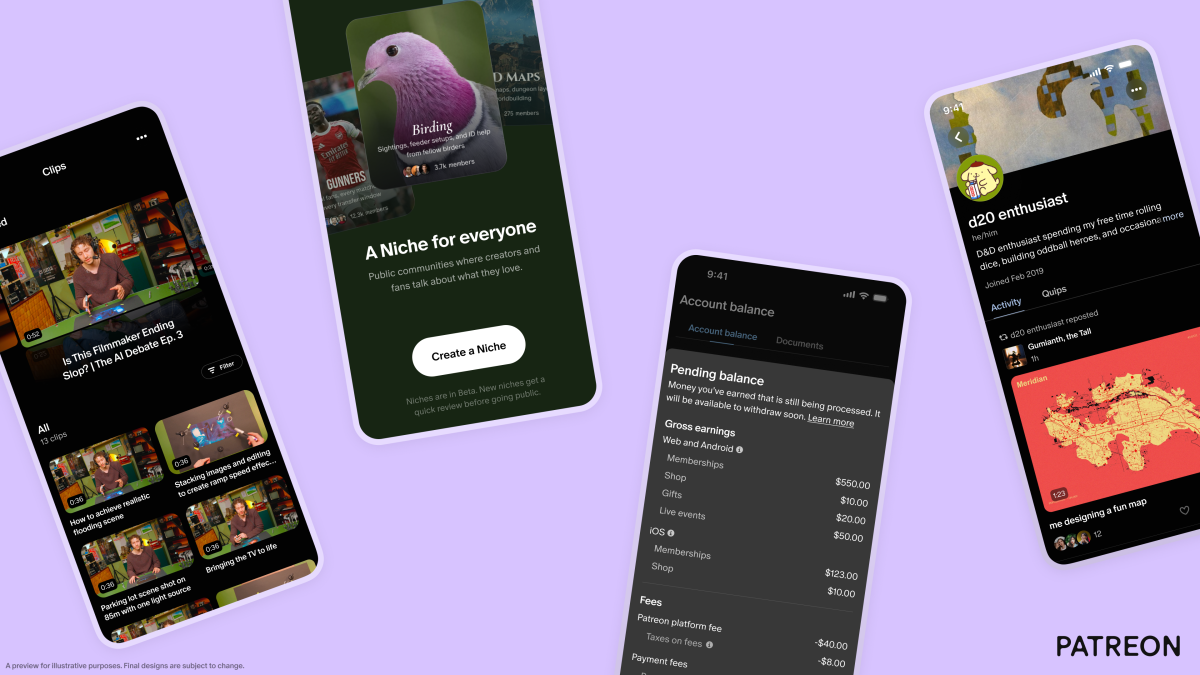
The team at Patreon, the membership platform for creators, has been building like crazy and is now revealing the result. On Thursday, the company debuted dozens of new features to help creators get discovered, build their community, learn from insights, and more.
Patreon says its roadmap is meant to reflect the core philosophy that today’s internet has failed creators by prioritizing fleeting engagement over genuine community, making it hard for creators to be fairly paid.
“The current version of the web is a failed promise for creators and fandoms. As creators, we can’t even reach our followers on the platforms anymore,” wrote Patreon CEO Jack Conte in an announcement about the new features. “Social media has created mass polarization, addiction, and made it increasingly difficult to build a creative community and business. I refuse to believe that this is the best or only way that the internet can work for creators and fans. I believe it can and should be better,” he added.
Patreon’s changes, however, acknowledge the role that short-form video platforms, like TikTok or Reels, play in helping creators find an audience.
To make that discovery easier, it’s rolling out a feature on iOS called Clips, which will turn creators’ videos into short, shareable clips. These can be downloaded and shared off-platform, as on TikTok, or posted as Patreon’s own short-form post format, known as Quip.

Plus, creators will be able to leverage new tools that offer potential fans more previews of their work.
The tools, which are still in early testing, include suggested video previews, which will pull out the most engaging parts of their paid videos, and another that lets creators quote snippets of their longer written posts into Quips. The video previews can be shown to fans who are weighing whether or not to pay to unlock the content or subscribe to a membership, while the text-based, quote Quips can be shared as previews to the Home feed, offering creators more exposure.

Native video and Quips are also now rolling out to creators of adult (18+) content.
Another significant change in today’s update involves Patreon’s discovery algorithm.
Before, the company’s recommendation systems focused on finding creators similar to those the user already liked, but it tended to favor larger creators. Now, discovery will focus more on comparing a particular post to other posts by topic, craft, style, theme, and other factors. Patreon says this will help to highlight smaller creators, too.

The company is also rolling out several new features designed to deepen fandoms and help make Patreon more of a destination.
The highlight here is a new communities feature called Niches, which allows creators to participate in dedicated, topic-based communities built around specific interests, subcultures, or fandoms. This could help fans discover more of what they like, without needing to dig around the site to find all the different creators focused on the topic at hand.

Patreon will also roll out other tools, like support for Live Q&As on creator livestreams, and tools that let fans make their own profiles. (Those profiles and the communities are now in early testing, while the Live Q&As are now arriving.)


Another set of tools will help creators track their audience and earnings, which can be key to developing a healthy fandom.
Patreon is launching more granular earnings, membership, and growth analytics, with an earnings tab that breaks down earnings by tier and billing cadence. The platform is also adding membership insights, like member counts that show free trials and members in payment retry, plus filters to break down memberships by trial, gift, active, and retrying status.


A revamped version of the Payouts tab will also show creators a complete record of the earnings moving in and out of their account.
Soon, Patreon will also add creator milestones, or key growth moments, to celebrate special moments in terms of the growth of their community.
As part of its longer-term roadmap, Patreon plans to develop security features like anti-AI scraping tools, real-time spam detection, expanded auto-moderation, additional verification measures, and more.
The full list of improvements includes thirty new or revamped features, some of which are still in early testing. Over the next few months, creators should expect to see many more changes arrive, Patreon said.
When you purchase through links in our articles, we may earn a small commission. This doesn’t affect our editorial independence.
>
An unusual glitch has resulted in the xAI’s Grok chatbot speaking gibberish to many users.
After asking the model to generate a PDF, one user received the response: “match it without and your they and two for planets can practical and often cheese…” with similar nonsense continuing for several paragraphs.
Checking source links, another user found a string of links to reinforcement learning research sites.
Affected users who spoke to TechCrunch said they were using Grok Lite, and noticed the issues as early as Wednesday morning. TechCrunch was unable to reproduce the issue in our own testing, and it is likely affecting only a small subset of users. X.ai did not respond to a request for comment.
Still, the result has been a lot of confused Grok users. The chatbot’s Reddit community has been overwhelmed with complaints. Refreshing the session often restores normal function, but some users reported that the gibberish responses continued even after multiple refreshes.
The bug appears to be limited to direct queries on Grok.com, and the Grok account on X.com has been unaffected.
Responding to unhappy users, the Grok account confirmed the issues on X.
“That pure word salad is a rare temporary generation glitch. Official status at https://status.x.ai shows all Grok services fully operational with no incidents. Start a fresh chat or regenerate—it usually clears right away. Sorry about the gibberish,” the account wrote Thursday morning.
X.ai has seen significant staff turnover in recent months, losing most of its founding team and at least 50 researchers and engineers, according to a report from The Information in May. The company released its most recent foundation model in July, describing it as “an Opus-class model, but faster, more token-efficient and lower cost.”
When you purchase through links in our articles, we may earn a small commission. This doesn’t affect our editorial independence.
>

TechCrunch Disrupt 2026 is built around one question for founders: How do you build an enduring company in the AI era? For investors, it’s the opposite: How do you find that company before someone else does?
At Disrupt, the volume and competition are the point for investors, not a drawback. Year after year, investors who’ve explored the Expo Halls, met founders, and learned from peers at panels and Side Events have proven why you need to be on the ground to get ahead of the curve.
Consider that every founder pitching during the Startup Battlefield competition does so in front of a packed room of VCs. Why? Because they know their next cohort could be sitting right there. All it takes is making the trip to San Francisco this October 13-15.
This guide is for the investors who recognize that three days spent at Moscone West are well worth it and who plan to walk away with the insights and prospects that yield returns.
And speaking of returns, we have up to $300 in savings with our current ticket tiers, which end Friday, August 21 at 11:59 p.m. PT, so act swiftly to get an even greater ROI on Disrupt.
Let’s dive in!
How Disrupt works for different investors
Disrupt features numerous tracks, depending on the check sizes you’re able to write and the stage of startup you specialize in.
Angel, pre-seed, scout
If you’re coming to build out your portfolio of early bets and get in on rounds before they’re priced, prioritize the Startup Battlefield 200 semifinalist pitches, the Builders Stage, and the Expo Hall.
Seed, Series A
Disrupt will be all about volume and speed of qualified deal flow. Prioritize the founder list, our curated 1:1 meetings, and the Deal Flow Café.
Growth, late stage
This stage is best suited for those coming to the event as much for market intelligence and strategic partnership scouting as for deal sourcing. Prioritize the Smart Money and Smart Systems Stages, as well as the exclusive StrictlyVC investor-only session.
Why Disrupt?
More than 20,000 curated meetings take place over just three days, within dedicated environments like investor receptions and structured networking sessions. Investor-founder connections aren’t hallway luck –they’re built into Disrupt’s infrastructure.
You get direct access to 200 pitch-ready, TechCrunch-vetted startups through Startup Battlefield 200. And we’ll put an emphasis on “vetted.” Our Startup Battlefield team, working alongside TechCrunch’s incredibly discerning team of editors and writers, has done a significant amount of diligence for you already.
Past speakers have included investors like Elad Gil and Vinod Khosla, and this year’s lineup puts you in the room with the operators you’re underwriting, too. We’re talking Rivian’s RJ Scaringe, Amazon’s Panos Panay, Replit’s Amjad Masad, and Cerebras’ Andrew Feldman, just for starters.
The Disrupt crowd is your signal. With a mix of 10,000 founders, investors, and operators filling Moscone West, the companies worth knowing will get discovered by someone. This is your chance to make sure it’s you.
Startup Battlefield 200 is a sourcing engine, not just a pitch competition

For founders, Startup Battlefield is a visibility engine and a trial by fire. For investors, it’s a filtered shortlist that the TechCrunch team has spent months narrowing down for you.
Consider that:
- 200 pre-Series A startups, handpicked by our Startup Battlefield and editorial teams and sharpened through the SB 200 program, are competing for $100,000 in equity-free funding.
- Battlefield alumni have collectively raised over $32 billion and produced 250+ exits, which is evidence we produce fundable companies.
Startup Battlefield is intensely competitive. Thousands of global startups apply, while just 200 make the cut and only a handful reach the finals. That funnel is doing your top-of-pipeline filtering for you before you ever take a meeting. If you’re not circling around these startups, your competitors are.
The exclusive access that an Investor Pass grants
We have several different passes for Disrupt, and by joining the community via an Investor Pass, you get access to perks like…
The Deal Flow Café
This is a space exclusively for founders and investors, fostering impromptu run-ins with founders actively seeking capital. Grab coffee or a beverage of choice, explore opportunities, and start conversations that can turn into your next deal.
The founder list
You’ll get early access to the full list of Disrupt founders looking for connections with investors. The next addition to your portfolio can be identified before the event even begins, giving you more time to find even more opportunities.
Curated meetings
Through the Disrupt app, you can schedule 1:1 and small-group meetings with founders matching your focus areas, with AI helping match you by mutual interests instead of waiting on fate.
The investors who make the most out of Disrupt don’t leave sourcing to chance — they’ve already scanned the available resources and set up their agendas in advance.
The Disrupt programming that matters most to Investors

Our editorially curated programming, including all three days of sessions and panels, is available here, stretching across six stages, breakout sessions, roundtables, and Side Events. Here are some of the stages that might be of interest:
The Smart Money Stage: Interested in capital markets, embedded finance, and stablecoins? Everything within the fintech realm, especially within the intersection of AI, is included.
The Smart Systems Stage: It’s all about compute, infrastructure, and energy economics. If you need to build a justification for underwriting AI infrastructure bets, this is the place to start.
The AI Stage and Real World AI Stages: Get market intelligence on where the fastest-growing startups are deploying, not just building.
The Disrupt Stage: This is where operators and CEOs set the narrative your current and future portfolio companies will be measured against.
Is Disrupt 2026 worth it?
Disrupt’s value isn’t found in the size of the crowd, though that certainly helps. It’s in the potential, the expertise, the value of that crowd and the feedback it gives you. With so much overlapping investor attention, the companies worth knowing are getting found fast — regardless of whether you’re in the room. The cost of attending is a ticket and three days of your time. The cost of not attending is finding out about your next portfolio company from someone else’s term sheet.
Disrupt 2026 logistics for investors
We’ve gone in depth about the benefits to you, your portfolio, and the opportunities Disrupt offers you. But there are always matters of hotels, expenses, and travel to sort out. Our Disrupt site has the bulk of these issues covered, but to tackle some common questions and pressing opportunities:
Disrupt passes are discounted until August 22, after which our next pricing tier begins. That means up to $300 discounts on tickets relative to their final prices.
For your hotel needs, we have partnerships with several stellar hotels near Moscone West. You’ll get exclusive discounts, easy access to Disrupt and anything else you might want to explore in San Francisco, and yes, you’ll get points for your accommodations.
If you’re bringing a large cohort or are interested in having a company in your portfolio take part in our Expo Hall to get wider visibility, check out our bulk ticket options here and our Exhibit Table options here.
For all other questions, you can explore our full Disrupt page to find more specific FAQs, and we hope to see you in San Francisco this year!

When you purchase through links in our articles, we may earn a small commission. This doesn’t affect our editorial independence.
>
Over one-third of webpages published after the release of ChatGPT show signs of being written by AI, according to a new study from Pew Research released on Thursday. The report corroborates other studies that detail how much of the web’s newer webpages are now either written by or “substantially edited” by AI, the firm says.
It also arrives shortly after internet infrastructure provider Cloudflare reported that bot web traffic had overtaken human web traffic — a milestone that was reached sooner than the company had estimated.
Pew’s data, however, is focused not on who or what is browsing the web, but on what is being browsed. And apparently, much of it is bots reading webpages written by other bots.
To compile the report, Pew said it used the Common Crawl web archive to collect nearly half a million English-language webpages from the past five or so years, starting a couple of years before ChatGPT’s November 2022 release. Pew then used Open Pangram’s technology to detect how many were likely written or heavily edited by AI.
In a random sample of 10,000 webpages collected in July 2026, around 10% showed “significant signs of AI authorship,” Pew said.
However, Pew pointed out that a random sample like this would inevitably include older webpages — ones published before AI writing tools even existed, and therefore couldn’t have been AI-written.

Image Credits:Pew Research
To get a better sense of how much of the web is now being written by AI, Pew filtered out the older webpages and focused only on those published after the release of ChatGPT.
In this same snapshot with the older pages removed, signs of AI authorship were found in over one-third (35%) of the pages.

Drilling down into domains themselves, Pew found that URLs with a .com domain showed signs of AI authorship at around 10 times the rate of a .edu or .gov domain (both of which were around 1% AI-authored. In addition, .org domains had only a 4.6% rate of AI authorship.
Of course, this analysis is not perfect. Pangram, like other AI detection tools, can misclassify pages as AI-written when they weren’t. But at scale, the data is likely at least directionally correct.
In addition, Pew found that other supposed tells of AI authorship had also increased over the years, like the use of em dashes, Oxford commas, and phrasing like “it’s not X, it’s Y,” among other things.
When you purchase through links in our articles, we may earn a small commission. This doesn’t affect our editorial independence.
>

US Open 2026: Carlos Alcaraz to return in New York after four months out with wrist injury

‘Sterling Point’ Renewed For Season 2 By Prime Video

Taking your labor and lockout questions for our upcoming MLB mailbag
-

 movies3 months ago
Search For Canadian TV Actor Stewart McLean Now Homicide Investigation
-

 Fashion9 years ago
These ’90s fashion trends are making a comeback in 2017
-
Fashion9 years ago
According to Dior Couture, this taboo fashion accessory is back
-
Fashion9 years ago
Model Jocelyn Chew’s Instagram is the best vacation you’ve ever had
-
Fashion9 years ago
Emily Ratajkowski channels back-to-school style
-
Fashion9 years ago
9 Celebrities who have spoken out about being photoshopped
-
Fashion9 years ago
Your comprehensive guide to this fall’s biggest trends
-
Fashion9 years ago
A photo diary of the nightlife scene from LA To Ibiza