
Sports
Brussels Stephex Masters: Piergiorgio Bucci’s remarkable second act

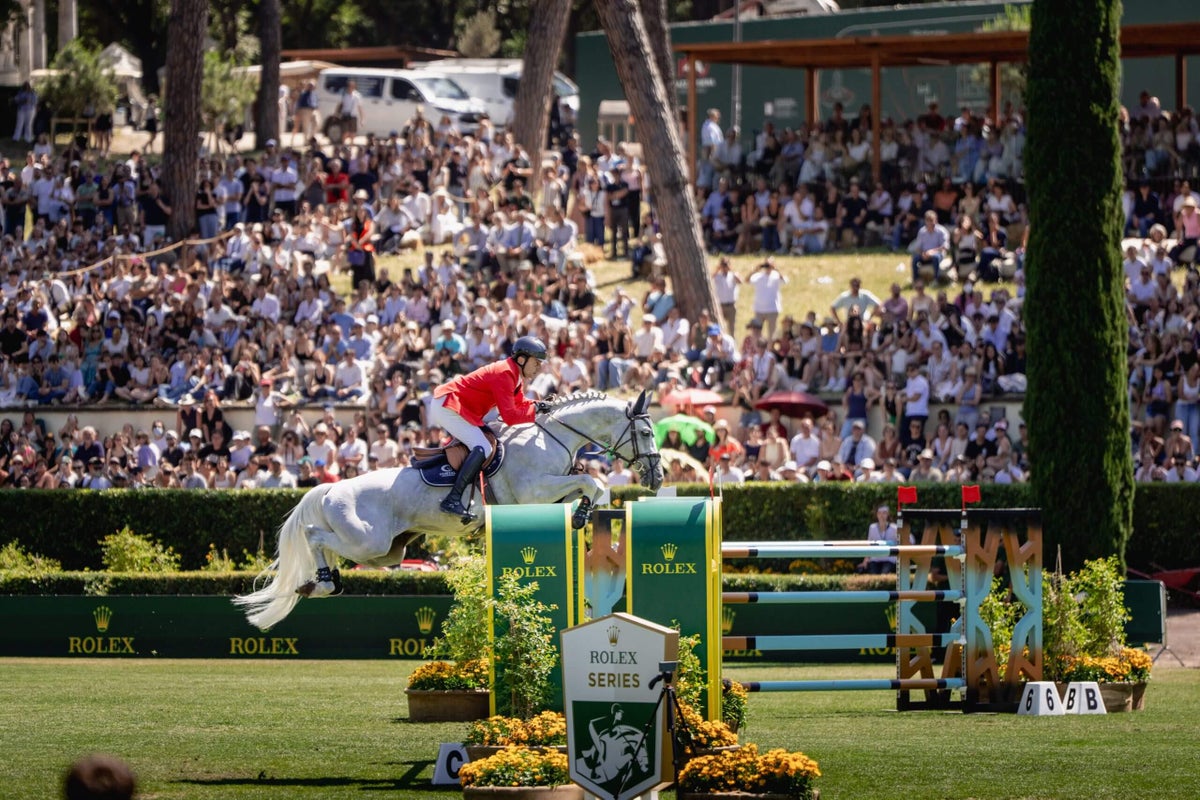
Piergiorgio Bucci remembers vividly his first visit to the Piazza di Siena in Rome. His uncle had taken him to watch the Nations Cup. Bucci, then a young boy from outside Milan, watched the riders and horses as if he were witnessing something from another world.
“I still remember every jump I saw, every rider I saw,” he said.
Decades later, he was the rider winning in the arena.
Bucci rode Palietter vd N.Ranch to victory in May in the feature class at the Rolex Grand Prix at the CSIO Piazza di Siena in Rome, the same show he had first visited as a boy, long before he had horses, the experience or even the proper equipment to imagine himself competing there.
Even now, months after the victory, Bucci sometimes wakes up and asks himself whether it really happened.
“Did I really win the Grand Prix in Rome? Was that a dream or did it actually happen?” he said. “And I have to think to myself, yes, that happened. It was just incredible.”
That victory was the crowning moment of an extraordinary 2026 season. Bucci, at 51, is in peak form and competing at a level at which youth, reflexes and fearlessness are often treated as prerequisites. His season began with a Global Champions Tour grand prix victory in Mexico, followed by another strong performance on the same tour in Miami, and continued with Rome, where Palietter gave him the sort of win that a rider can easily spend an entire career pursuing.
Bucci said he wasn’t surprised to now be winning so frequently at this level because he finally has horses capable of matching what he has always believed he could do.
“I know I have super horses,” he said. “And I know that I can do it.”
Bucci once again impressed at the World Championships last week and he so nearly won a medal. Hantano had jumped clear over four rounds, but agonisingly that run of clears came to an end at the very last fence in the fifth and final round of jumping. It cost him a silver medal, and they finished fourth.
Next stop this week is the Brussels Stephex Masters, where Bucci will ride Hantano in the Rolex Grand Prix.
Bucci has spent much of the year thinking not merely about producing results but about timing them — when to jump, when to rest, and when to leave a horse alone. The key to success is to arrive at a competition with a horse that is fresh and confident. Bucci knows exactly how much responsibility rests with the rider, too.
“I need to ride really good,” he said. “If I do that, my horses can be really competitive.”
With Hantano, he followed a deliberate programme designed around the World Championships. He increased the horse’s workload earlier in the year, jumped at La Baule — where they won — and Rotterdam, and then gave him time to recover.
“I spent a lot of hours, to try to understand what could be the best approach to the World Championships,” Bucci said. “Its absolutely the goal of the year.”

Bucci won the feature class at the Rolex Grand Prix at the CSIO Piazza di Siena in Rome. (Rolex Series)
Bucci’s career did not begin with an obvious route into elite show jumping. His family did not ride. There was no established jumping tradition in his hometown. Bucci simply loved horses.
“I was born with it,” he said. “Like a kid that loves cats or dogs.”
As a child, he played with plastic horses. He watched Western movies, not necessarily because he cared about cowboys or the films themselves, but because they contained what he wanted to see: horses and people riding them. Then, when Bucci was 12 years old, a trekking centre opened near his hometown.
Bucci went there and quickly discovered that enthusiasm could be exchanged for access. The owner noticed his passion for horses and asked him to help around the stable. He mucked out, he cleaned, he helped with whatever needed doing and, in return, he was given opportunities to ride.
“I took clients out on long rides and loved it,” Bucci said.
The horses available to him were not made for jumping, but Bucci and his friends at the trekking centre started to teach them how to jump.
“We had no idea what we were doing and we were jumping in Western saddles, which isn’t normal,” said Bucci. “We taught ourselves.”
They then bought English saddles, experimented and kept jumping, but there wasn’t any immediate success.
Bucci spent two years at the very first level of competition.
“It was very bad,” he said. “But I was really stubborn.”
Stubbornness would become one of the defining characteristics of his career. He kept going and eventually he reached the highest levels of the sport in Italy, winning Nations Cup competitions and major grand prix classes. In 2009, he and the Italian team won a silver medal at the European Championships, yet success brought its own frustration and Bucci felt stuck.
“I wanted to become one of the best show jumpers in the world,” he said. “And I had to think about what should I do to become one of them.”
His answer was to leave Italy. He moved to the Netherlands, where he would spend the next 16 years. Bucci wanted to immerse himself in the centre of the international show jumping world. He reasoned that if he wanted to compete with the best, he needed to live among them.
“I could see a handful of the top 10 show jumpers in the world a few days a week at competitions and in training,” Bucci said. “I think you can learn so much from watching the best in the world every week. I watched warm-ups, how horses were handled and trained. Plus, I met breeders, dealers and riders who would become friends.”
The Netherlands gave Bucci the proximity to excellence he had been seeking but, over time, another feeling developed: he missed home.
He missed the weather, the food, the restaurants, the people and the habits accumulated over a lifetime. Bucci had left Italy in his mid-30s, old enough to understand that a country can become part of a person in ways that are difficult to replace.
“I think it’s a culture, the habits,” he said. “When you live in a country for so many years, it’s very difficult to lose those habits.”
The decision to return was partly practical, too. Bucci believed that an Italian sponsor or investor might be more inclined to support an Italian rider competing under the same flag.
He returned in 2026 to just outside Milan, believing that he had taken what he needed from his Dutch experience.
Bucci is reluctant to attribute his results this year entirely to the move home. He calls the timing a coincidence, but he acknowledges that his mood is different.
“I feel every day more fulfilled,” he said.
And what about his two extraordinary horses, Palietter vd N.Ranch and Hantano?
“I knew when I saw a video of him and smiled, knowing that he was my type of horse, and when I first rode him, the feeling was straight away amazing,” he said.
He felt that he was sitting on an athlete — a horse with the talent to compete at the very highest level.
Palietter and Hantano, however, are profoundly different. Both are exceptionally careful and powerful, but Hantano has a more complicated jumping technique. He can twist his body and jump in an unusual way, making Bucci’s accuracy as a rider critical.
“If I ride Hantano perfect, he jumps only clear rounds,” Bucci said. “But there is little room for error.”
Palietter is more athletic and, Bucci believes, more forgiving when the rider takes a risk. That does not mean the horse is infallible, nor does Bucci consider himself to be.
In London recently, while competing in the Global Champions Tour grand prix, he had the first fence down after failing to be sufficiently accurate.
“My horse deserved to jump clear,” he said. “It was my mistake.”
That willingness to accept responsibility is central to Bucci’s philosophy. He does not believe he needs to prove himself to other riders, critics or spectators and he only wants to do the right thing by his horses.
“I never thought I need to prove anything to anyone — only myself,” he said.
There is still plenty he wants to prove though.
He will take Palietter to the Brussels Masters. Brussels offers a different atmosphere from Rome and La Baule, two of the sport’s historic destinations. Bucci admires the modern show’s scale, organization and ambition, describing it as a festival of show jumping, with world-class facilities, footing, hospitality and stabling.
Bucci does not feel fundamentally different from the rider he was at 30. In some respects, he believes he is in a better place. He takes greater care of his body now and no longer smokes. The greatest advantage, he says, is experience.
“I am more smart,” he said. “Before, I was just not thinking enough. Now I think more.”
But once the decision is made, the old Bucci remains.
“When it comes having to fight in the arena to win, I really enjoy that,” he said.
That is perhaps the simplest explanation for why, after so many years and so many miles, he is still here.
>
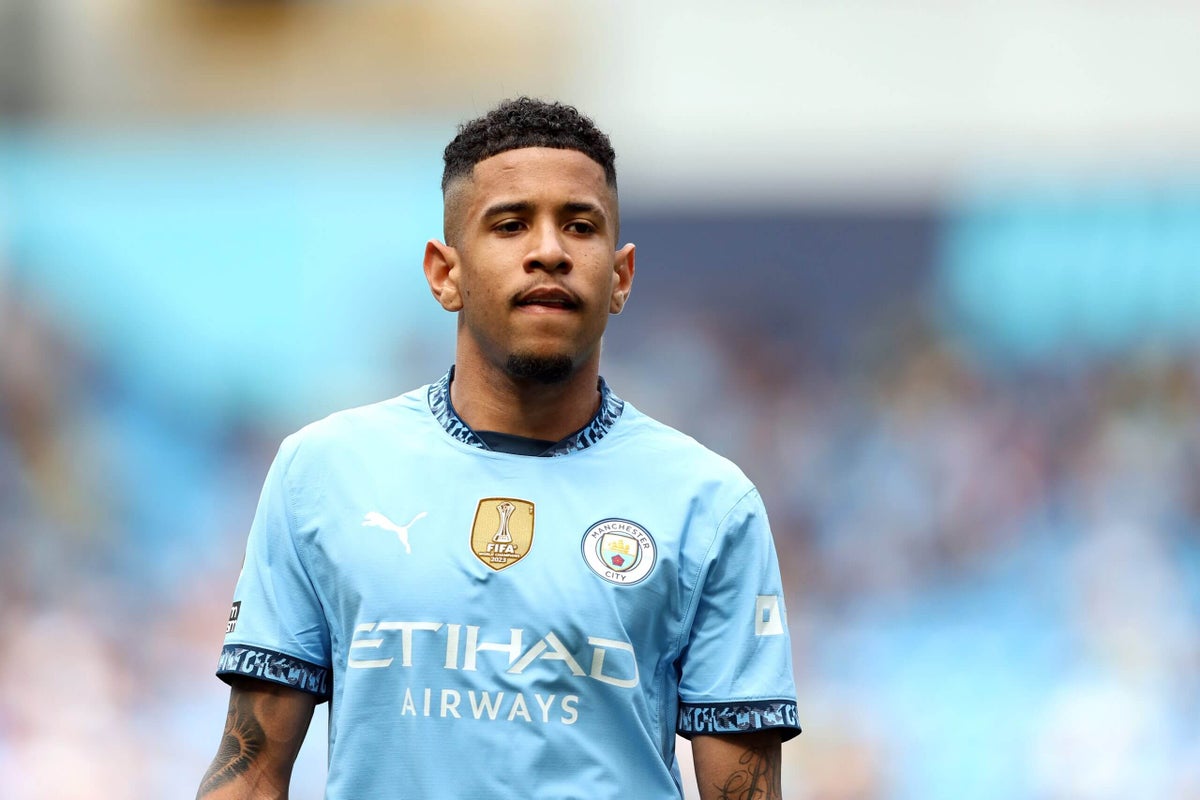
Talented young Brazilian wingers rarely come cheap, but the £85million ($116m) package Tottenham Hotspur agreed with Manchester City to sign Savio (formerly known as Savinho) feels overinflated.
The 22-year-old dazzled in his first few appearances after joining City from French side Troyes in 2024 (having impressed on loan at Girona in 2023-24), but then faded fast, recording just two goals across 53 league appearances for the club.
It was obvious to anyone watching Spurs’ 3-0 opening-day demolition away to Brentford that they were in dire need of attacking reinforcements, but given Savio’s meagre output, has that desperation allowed the market to take advantage?
Even as recently as yesterday evening, eyebrows were raised when Nottingham Forest agreed a club record transfer to bring Liam Delap (Premier League goals last season: one) from Stamford Bridge to Chelsea.
Whether Spurs have overpaid for Savio is a tricky question to answer, given there is no clear consensus on exactly how footballers should be valued. It is an intractable equation combining factors such as a player’s age, current contract length, past performance, potential (which Spurs are clearly placing greater weight on) and marketability.
Not that the complexity has put people off trying to solve the unsolvable. German website Transfermarkt is the best-known resource for wide-scale estimates of players’ “market values”. Using these estimates, The Athletic compared the market value of every Premier League transfer since 2012 with the fee paid, to get a broad-brush sense of which deals represented the biggest overpayments.
Note that, for scalability, we used the fees listed by Transfermarkt rather than those reported by The Athletic. Transfermarkt lists Savio’s purchase price as £75.4million, similar to the initial £75million upfront fee reported by The Athletic, but short of the potential overall £85million package.
On that basis, Savio’s fee represents a £45.3million premium on his estimated market value of £30.1million, the fifth-largest amount above market value in the dataset. The table below lists the top 20, and like any table of transfers, it is a mixed bag of successes and failures.

Enzo Fernandez sits top of the pile, with Transfermarkt estimating that Chelsea coughed up almost £60million more than he was worth when they signed him from Benfica in early 2023. In hindsight, Chelsea appear to have valued the Argentine correctly and would expect to recoup their investment if he leaves before the window shuts, with Manchester City strongly linked with a move.
The two names below Fernandez, though, Kepa Arrizabalaga and Antony, are perhaps the biggest examples of Premier League transfer extravagance. Both flopped — at Chelsea and Manchester United respectively — with their fees widely viewed as excessive even at the time.

Antony challenges Kepa Arrizabalaga, in a possibly overvalued moment (Robin Jones/Getty Images)
By contrast, Virgil van Dijk’s £72.8million move from Southampton to Liverpool rounds out the top five, a deal that became one of the all-time Premier League bargains, with the imperious Dutch centre-back transforming a previously leaky Liverpool defence.
Savio is joined on the list by two other deals from this summer’s window: new team-mate Mateus Fernandes, signed from West Ham for £85.1million, and Morgan Rogers, who Chelsea bought from Aston Villa for £118.7million. Chelsea and Tottenham top the overall Premier League spending this summer, at £342million and £305million respectively, although Transfermarkt believes Spurs have registered the bigger overspend at £135million compared with Chelsea’s £85million.

In defence of Spurs’ apparent overspending, Transfermarkt’s market values rely on crowdsourced guesstimates rather than any sophisticated modelling.
That said, transfer economics, with its spiralling inflation and state-owned clubs, defy rational logic anyway, and Transfermarkt’s back-of-the-envelope approach is surprisingly accurate. Its estimates tend to err on the side of caution: roughly two-thirds of the transfers fees examined were completed above the recorded market value, but the histogram below shows that the estimates generally sit fairly close to these fees.

Another point of mitigation for Spurs is that a deal looking good value when it’s completed is no guarantee of success. Below is the flip side of our earlier chart: the top 20 transfers based on how much the fee fell below market value. Erling Haaland leads the way, but the Norwegian is something of an exception: the forward had a release clause at Borussia Dortmund that sat far below what everyone knew the fearsome striker was worth, allowing City to prise away a player valued at £129million for considerably less.

Outside of Haaland, the list contains few unqualified successes, despite the deep discounts they appeared to represent at the point of purchase. As it happens, Savio is the only player to appear on both lists, embodying the unreliable nature of transfer valuations. He had been considered a steal when City signed him from Troyes for £21.5million, now his move to Spurs ranks among the most exorbitant.
Ultimately, the value of a transfer is in the eye of the beholder. To a neutral onlooker, Savio’s fee, when weighed against his limited impact in the Premier League, is among the more puzzling in recent memory.
But scouts, coaches and executives perform deep due diligence before sanctioning such outlays, and there will be harder-to-measure factors at play here: whether that is his natural fit for De Zerbi’s style or underlying data that suggests there is a far more devastating player waiting to be unleashed.
>

“It’s a dog-eat-dog world,” says Robbie Stockdale.
The lead coach of Newcastle United’s under-21s team is a veteran defender of the Premier League and EFL and an experienced coach. His messages to Newcastle youngsters offer empathy but with a clear dose of realism.
This summer, academy graduates have had valuable pre-season training time and friendly minutes with the senior squad, yet Newcastle have also invested £120million ($163.7m) in four players aged 20 or under. As exciting as David Hopkinson’s “Newcastle United 2.0” vision is, the criticism levelled by some fans is that spending heavily on youngsters potentially blocks the academy pathway.
“The step from under-21s into any first team is the hardest one these lads will ever take,” Stockdale says. “I would see it as a challenge if the first team brought in a player in my position. Can I be better than that player? But making that step up to an elite Premier League environment is very tough. We need to prepare them properly for that.”
Stockdale is not the only one who is candid about the landscape.
“You have to be at that level,” Steve Harper, Newcastle’s academy director, says. “If there were players ready now for that opportunity within the academy, we wouldn’t need to sign those players. When we’re paying multiple-million pounds for 20-year-olds, you need to realise the expectations are that you need to be ready earlier. You can’t waste a day. It’s a message we consistently repeat.

Stockdale says academy players must aim to be better than those signed for the first team (Michelle Mercer/Getty Images)
“But 12 to 18 months is a long time in football and we have to make sure the players we have coming through are ready by then. That’s our role. The academy is more important than ever and the financial rules certainly play a part of dictating that.”
Following a summer of reset and upheaval at first-team level, this is where the club’s academy fits into “Newcastle United 2.0”.
At Whitley Park, Newcastle’s under-21s trudge off on Monday night having lost their opening Premier League 2 match of the season. They took the lead through Vakhtang Salia, an exciting 18-year-old striker, and showed real moments of quality in attack. But Tottenham are worthy winners in the end.
“We were really good for half an hour,” Stockdale says afterwards. “Realistically some of the boys have barely played games throughout pre-season due to the first team’s needs. We’ll get stronger.”
This is Stockdale’s first full season in charge — he took interim control in January when Adam Lawrence left, before being given the job permanently in March — and the aim is for the 46-year-old to provide stability following a period of coach churn.
He has barely had a pre-season with his players due to the first-team requirements — Stockdale also coached the senior group at times — and the under-21s only played two friendlies. He also expects his group of players to be regularly depleted throughout the campaign so that the youngsters can augment the first-team squad.
“If we go down to the nuts and bolts of it, there’s only one team that has to win — the first team,” Stockdale says. “That has a knock-on effect whereby the under-21s support the first team. Very rarely do I know my team until 24 hours before a game, sometimes on the day.
“We all want to win matches, but there’s a bigger picture. If we get a player making his first-team debut, that’s a massive win for the academy. Sometimes the first team need 11 of my players, so we’re training with just six bodies. But the net effect is far more positive because we’re getting players over for the manager to see regularly.
“I see my team as a vehicle to drop each player off at the destination they’re going to end up, whether that’s in our first team or the EFL.”
Regardless, there is a subtle difference between having a winning-at-all-costs mentality and instilling “winning behaviours”, as they term it within the academy, into players.
“Under-21s football is not just about winning, but (Stockdale) brings that,” says Dylan Charlton, the 20-year-old left-back who featured regularly during pre-season. “He wants us to win. His message is essentially, ‘Why would you want to play if you’re not trying to win?’ On a personal level, you have to impress every game. You never know who’s watching.”
Over the past 18 months, Sean Neave, the forward, and Leo Shahar, the right-back, have trained almost full-time with the first team. During pre-season, several under-21s received senior exposure and the hope is Matthias Jaissle’s positive public messages about the academy are matched in practice.
“I definitely think there’s a pathway, especially with the new manager — if you’re capable,” says Henry Johnson, the 18-year-old defender who made friendly appearances at the Mestalla and St James’. “The manager is willing to take the chance on younger lads. Then it’s just over to us.”
Harper is keen to impress upon Jaissle which academy players have real potential. “I’ve purposely kept out of the way because he has such a hectic schedule,” Harper says. “But I’m looking forward to getting in front of him and talking about who we think our real emerging-talent players are.”

Vakhtang Salia, left, celebrates scoring against Tottenham on Monday evening (Michelle Mercer/Getty Images)
“We work hard to get the boys ready for an opportunity and, when it comes, it’s up to them. Hopefully the seed has been planted so that if and when they’re called upon, whether for the West Brom game (in the League Cup on Wednesday) or FA Cup ties, they’ve made a good impression.
“Somebody once said to me, ‘You can wait 10 years for an opportunity in football and blow it in 10 seconds.’ Fortunately, our lads haven’t.”
The significant transfer outlay has not been reserved solely for the first team, however. Newcastle are investing heavily in youth, from home and abroad, and Harper describes the youth department as “a big old beast” now.
Johan Martinez, an Ecuadorian winger, will join from Independiente del Valle once he turns 18 next May, while Ousmane Diabate, the 18-year-old midfielder, is set to sign from Genclerbirligi but remain in Turkey for the season. Multiple domestic signings have also been made, with Kyran Thompson, a 16-year-old attacker, arriving from Arsenal, while right-back Kyle Healy-Matthews, also 16, joined from West Ham.
“Some of the ‘superpowers’ have had a 10- or 12-year headstart on us,” says Harper. “We’re in the outside lane, flying down the motorway to catch up, but they’re not pulling into a service station and waiting for us to catch them. In five years, we’ve made massive progress.”
Some supporters may disapprove of youth-level signings, suggesting they block the path for local lads. But Stockdale insists he will always push for a “Newcastle United thread running through” my team.
Newcastle’s under-14s side who won the cup last season were made up wholly of players from the area.
“The primary existence of the academy is to give local boys the best possible opportunity,” Harper says. “We only recruit where we saw a gap in our local pathway. If we had a really talented left-sided No 8 at a certain age, we wouldn’t go and get another in the year above. The focus would be on the development pathway for that youngster.”
Progress is rarely linear with player development, while the definition of ‘success’ at this level is nuanced.
When presenting to ownership at Matfen Hall in April, Harper showed a graphic of the progress of the under-18s over five seasons, with third place in 2025-26 their best finishing position.
“Where it started from was them finishing bottom… And Lewis Miley came out of that team,” says Harper. “You can finish third, everyone says, ‘Well done’, but the ultimate judgement is which players are moving into our first-team squad or moving on for a return on their investment.”

Lewis Miley has already played in over 50 Premier League matches (Stu Forster/Getty Images)
Alongside the under-14s’ triumph, the under-15s won the Premier League International Tournament, showing the age-group-wide talent pools Newcastle now possess. “Those accolades are great, but our focus remains on the individual players and not team prizes,” Harper says.
Lewis Miley is an exception, mind. Newcastle recognise that leap from under-21s to the Premier League is astronomical, so they are refining their ‘talent management’ programme. Anthony Munda has joined League Two Swindon Town on loan and others will head out , too.
“There aren’t many Mileys who go straight through,” Harper says. “It’s getting harder to produce Premier League players; it’s a big ask to be ready for our first team. If not, we want to develop players to a level where we get a return and then reinvest.”
Neave and Shahar — plus Park Seung-soo, the winger, and Miodrag Pivas, the defender — are the primary contenders for loans, as long as Jaissle does not require them to stick around.
Sending players of that calibre out will negatively affect the under-21s’ results yet, as Harper stresses, “Everybody in the academy wants Sean Neave to be playing senior football.”
“There’s probably another half a dozen players attracting interest for loans — and I think we send them,” Stockdale says. “If Sean was playing for the under-21s every week, scoring, we’d have a much stronger team. Sean going weakens us, but it’s best for his development.
“That opens up opportunities for the next batch of young players in the 21s, so some games might be really difficult for us, but everyone is bought into the strategy. In two years’ time, those younger players will be better for it. The long-term benefits far outweigh the short-term pain.
“Ultimately the goal is to get players in the first team. If we can tick that box, get some debuts, we’d all be sat here thinking, ‘That’s a successful season’. I’m not going to be happy if we don’t win matches, but there’s a bigger picture.”
The Athletic sat down with Peter Ramage in March to discuss the inner-workings of the loans department, which is essential for ensuring players get temporary moves at the opportune moment. Shola Ameobi, the former loans coordinator, has subsequently shifted across to head of corporate affairs and Ramage has stepped up to head the newly titled ‘talent management’ department.
Paul Dummett, the former left-back, is Ramage’s deputy and the idea for the repurposing, which is largely the brainchild of Jack Ross, the head of football strategy, is to bridge the gap between playing in the academy and making the most into first-team football, be that on Tyneside or elsewhere. Loans are still a crucial part of what is now a more holistic, 360-degree approach.
To the outside observer, results are what matter. Inside the academy, producing players is their principal purpose — one which has only become more fundamental in the “Newcastle United 2.0” era.
“Individual player progress,” Harper says, when he is asked to define “success” for the under-21s this season. “We don’t want to lose football games, but if the under-21s are top of the league, we aren’t stretching the players enough. We are light on numbers and big on opportunities here for a reason.”
>
There is beauty in simplicity.
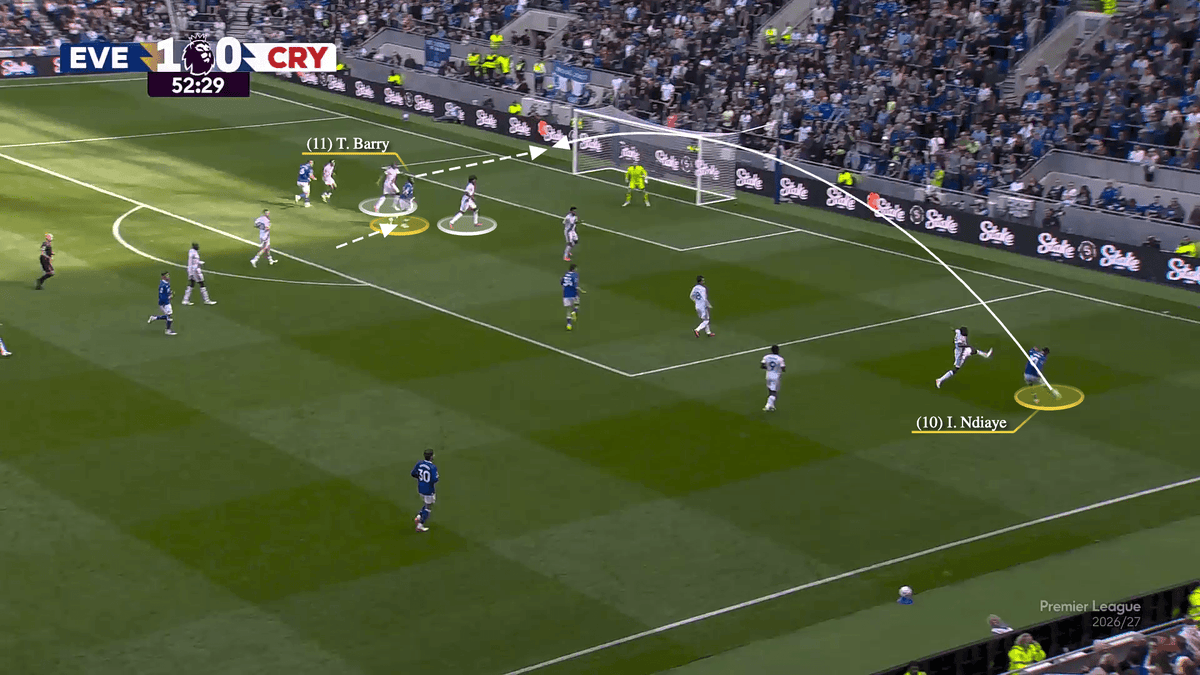
Everton’s second goal in their opening day win over Crystal Palace proved that. A quick free kick, a stunning cross and a header home, with a slight deflection, from your No 9 — in this case Thierno Barry, to complete a 2-0 victory.
David Moyes was full of praise for it and the timing of Barry’s 53rd-minute goal was crucial, as it halted any momentum Palace had from the first half.
The Everton manager lauded Iliman Ndiaye’s cross and Barry’s movement in the post-match press conference. “We are trying to get more balls in the box,” Moyes told the club’s official channel after the game. “We are trying to get Thierno in the right positions as often as we can. Thankfully, we did.”
However, Everton’s back-post threat was a key part of their attack in the Premier League last season and Moyes clearly wants to build on it.
In the lead-up to Barry’s goal, new midfield signing Hayden Hackney, who has joined from Middlesbrough in the Championship, played the quick free kick to Ndiaye down the right, with Barry positioned in front of Palace’s central centre-back, Chris Richards.
The Everton centre-forward holds his position as Ndiaye creates a crossing angle, and makes the run towards the back post when the Senegal winger is connecting with the ball.
The beauty of Ndiaye’s cross is only matched by the timing of Barry’s movement, which does not give Richards or Jaydee Canvot any clues until the ball is in the air.

Barry and Beto’s movement inside the penalty area plays a big role in Everton’s threat at the back post, even if they are not the goalscorers.
In this example, from the 2-0 victory against Brighton & Hove Albion last August, Barry’s movement momentarily frees Ndiaye at the back post.
Initially, Maxim De Cuyper is marking the winger and Lewis Dunk is keeping an eye on Barry, as Jack Grealish is attacking the other wing.
When Grealish dribbles past right-back Mats Wieffer, Everton’s centre-forward moves inside, grabbing De Cuyper’s attention, which is enough for Ndiaye to attack the back post and score from his team-mate’s cross.

In other situations, the No 10 and wingers’ movement creates the space for Everton’s centre-forward.
Here, in the 2-1 defeat against Liverpool in April, Dwight McNeil, Kiernan Dewsbury-Hall and Ndiaye are in each other’s positions.
When Idrissa Gueye’s pass to Vitalii Mykolenko entices Curtis Jones to press the left-back, Dewsbury-Hall and McNeil spot the space behind Ibrahima Konate and attack it.
Mykolenko then finds Dewsbury-Hall, while McNeil’s run forces Virgil van Dijk to move across, isolating Beto against Andy Robertson at the back post.
Everton’s attacking midfielder then capitalises on Beto’s positional advantage by playing the ball across goal for the striker to score.

The type of run which McNeil, who left for Palace this summer, made in that match against Liverpool is one that has been synonymous with Dewsbury-Hall since his move to Everton from Chelsea last summer.
As seen in the illustration below, Dewsbury-Hall makes the bulk of his underlapping runs in the left half-space to support Everton’s attack from wide areas.
This type of run forces the opponent’s centre-backs to move across, and as a result, creates more space at the back post. It allows Dewsbury-Hall to receive the ball in dangerous positions from where he can find a back-post runner.

In this example, from the 3-2 victory against Wolverhampton Wanderers, Dewsbury-Hall plays the ball to Grealish as Ndiaye is adjusting his position to be a threat at the back post.
Everton’s attacking midfielder then attacks the space between Wolves’ right wing-back and centre-back, and Grealish finds his run. This forces Emmanuel Agbadou and Toti Gomes to move across, creating space for Ndiaye at the back post.
Dewsbury-Hall then plays the ball across goal, and Everton’s right winger scores from close range.

Since the beginning of last season, Everton have been one of the best teams in the Premier League in terms of creating back-post chances in open play. Only Manchester United (eight) and Chelsea (13) have scored more back-post goals than Everton (seven) during that period.
Meanwhile, they have accumulated the second-highest expected goals (xG) from back-post chances (8.8) in the Premier League since 2025-26.

Everton’s focus on attacking the wide areas and creating chances at the back post plays to the strengths of their individuals: Beto and Barry’s movement inside the penalty area is smart, Dewsbury-Hall thrives on underlapping runs in the left half-space, Ndiaye’s dribbling ability can create small crossing angles and Brennan Johnson, who came the other way in the swap deal with McNeil, is the ultimate back-post attacker.
In addition, the timing of their movements inside the penalty area and their crossing ability make their back-post threat harder to stop, even if the opponents know what is coming.
Everton’s continued back-post threat may prove to be vital if they are to reach their targets this season.
>

Savio’s £85m Spurs move and what constitutes value in a modern Premier League transfer

If Newcastle focus on signing young players, what will happen to those in the academy?

Brussels Stephex Masters: Piergiorgio Bucci’s remarkable second act
-

 movies3 months ago
Search For Canadian TV Actor Stewart McLean Now Homicide Investigation
-

 Fashion9 years ago
These ’90s fashion trends are making a comeback in 2017
-
Fashion9 years ago
According to Dior Couture, this taboo fashion accessory is back
-
Fashion9 years ago
Model Jocelyn Chew’s Instagram is the best vacation you’ve ever had
-
Fashion9 years ago
Emily Ratajkowski channels back-to-school style
-
Fashion9 years ago
9 Celebrities who have spoken out about being photoshopped
-
Fashion9 years ago
Your comprehensive guide to this fall’s biggest trends
-

 Anime3 months ago
Rurouni Kenshin: Hokkaido Arc Manga Takes 1-Issue Break – News