Connect with us

Sports

Braves’ Ha-Seong Kim walks off Dodgers with first hit MLB hit since June 3

Published

on

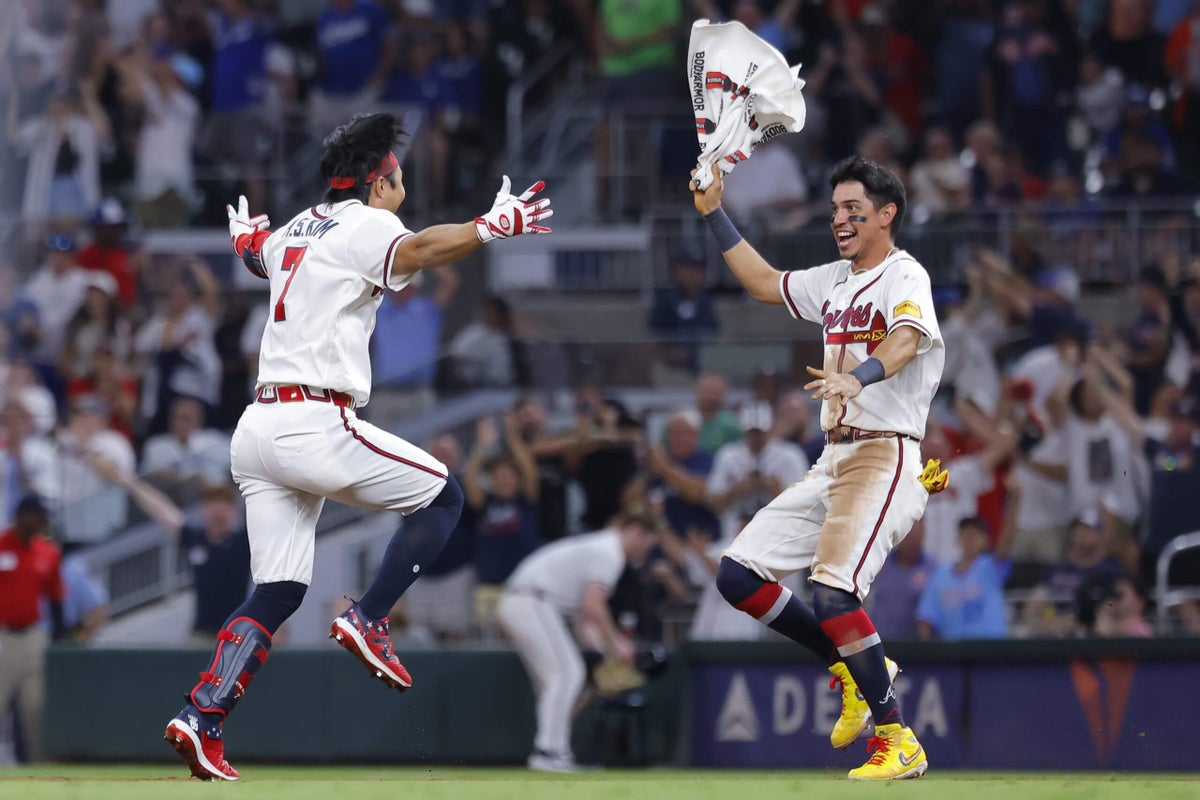
Ha-Seong Kim #7 of the Atlanta Braves reacts with Mauricio Dubon #14 following a walk off single during the ninth inning against the Los Angeles Dodgers at Truist Park.

Ha-Seong Kim’s walk off hit gave the Braves their second comeback victory over the Dodgers. Todd Kirkland / Getty Images

Looking to gain ground in the National League playoff picture, the Atlanta Braves turned to an unlikely candidate to upend the Los Angeles Dodgers in the bottom of the ninth inning Wednesday night.

With two out and the game-winning run on second base, Braves manager Walt Weiss turned to his bench and elected to pinch-hit Ha-Seong Kim, owner of an .066 average, with just five hits over 76 plate appearances this season. Kim would face Dodgers reliever Tanner Scott, who leads the team with 19 saves and became the de facto closer this season for Los Angeles due to Edwin Díaz’s multiple injuries.

Kim quickly got ahead of Scott, who misfired three straight four-seamers to fall behind 3-0. But Scott battled back, pumping in a fastball for a called strike one before Kim fouled off a second heater for a full count. Kim fouled off two more, before connecting on Scott’s eighth straight fastball. His sharp single to left was more than enough to allow the speedy Lane Thomas to score from second base, walking the Braves off 6-5 and securing a key series victory over the back-to-back champions.

The Braves came into the series trailing the Dodgers by 3 1/2 games in the National League standings. They’ve now made up two games in two days thanks to back-to-back late-inning comebacks. That it was Kim who was the hero Wednesday night was nothing short of shocking. Injuries have marred his season. Kim’s last base hit in the majors came June 3 vs. the Toronto Blue Jays. He was 0-for his last 27 coming into his pinch-hit appearance.

The Braves (78-55) will look to sweep the Dodgers in a showdown of the aces Thursday, with Chris Sale tabbed to take on Yoshinobu Yamamoto.

Connections: Sports Edition Logo

Connections: Sports Edition Logo

Connections: Sports Edition

Spot the pattern. Connect the terms

Find the hidden link between sports terms

>

Continue Reading

Sports

Caroline Dubois is the world champion who split from her coach and family – and has ‘no regrets’

Published

on

Caroline Dubois may be living in Los Angeles, but do not speak to her about Californian glitz.

“I don’t know if it’s just me or how my mindset is when it comes to camp, but I am an hour away from the beach and I’ve been once for a training day,” says the British world champion lightweight, speaking via a video call.

“I’m about a half-hour away from Beverly Hills as well, but I’ve not seen that yet. I’ve been here six weeks and it is train, home to rest, back to the gym to train, home to rest again. I watch films, some boxing, read. That’s as exciting as it gets.”

Dubois has good reason to be focused. On Saturday, she defends her WBC and WBO titles against American Amelia Moore on Jake Paul’s Most Valuable Promotions (MVP) card in Birmingham, England — her first fight since a surprise split from her long-time coach Shane McGuigan, who guided her from amateur standout to becoming a unified world champion with 13 wins and one draw. She is now trained by American Manny Robles, a switch that caused ripples of shock throughout women’s boxing.

Why do it?

“I’m not going to get into the reasons too much,” Dubois says. “I think the more important thing is that, one, the training has been so different. Sparring has been really high level. And everything that I’ve been wanting and I’ve been looking for, you know, I’ve been ticking those boxes.

“People have been saying, ‘Usually people leave coaches after they’ve lost or after something bad happened.’ And I just think, ‘You know, I ain’t going to wait for that.’ If I feel like I need something, I’m going to go out there and get it. I don’t need to wait to mess up to make a decision that is already sitting in my head.

“The most important thing is to continue to develop, not just as an athlete, but as a person. I feel like I’m doing that, I’m very happy.”

Caroline Dubois has split from her former coach Shane McGuigan (Richard Pelham/Getty Images)

Dubois’ split with McGuigan was all the more surprising given he had been a constant in her life during a period of personal turbulence. In 2024, Caroline, one of her brothers and one of her sisters (she comes from a family of 11 children) effectively split from the rest of their family after a breakdown in relations with their father, Stan (who also goes by the name Dave).

Another of Dubois’ brothers, Daniel, is a heavyweight world champion in his own right, having also been schooled under Stan’s strict, boxing-focused lifestyle which Caroline has previously called “overbearing”. Daniel was also coached by McGuigan at the time, but he moved from the gym under his father’s instruction and Caroline stayed put. The siblings are not on speaking terms.

It feels like a lot for anyone to cope with, let alone a fighter in her early 20s trying to make her way in a notoriously unforgiving profession. Yet Dubois exudes positivity and self-belief, perhaps not surprisingly given this is the same fighter who, as a nine-year-old, tucked her hair into a cap and pretended to be a boy called ‘Colin’ so she could train at a males-only gym in London.

“The worst position to be in at the end of your life is if you’ve got a million regrets,” she says. “You don’t want to be like, ‘The reason why I’m not happy or satisfied with my career is because of this person or that person’.

“With my family situation, obviously it’s very personal and very complicated, but I look at the decision and, again, no regrets, a hundred per cent accountability.

Caroline Dubois with her brother Daniel in 2019 (James Chance/Getty Images)

“To live the life you want to live, you do have to make sacrifices. And these are some of the sacrifices that I make and not just myself, but my brother and my sister as well. And I’m just proud of our journey together and what we’ve achieved. And it is only just the start.”

Dubois has had no shortage of role models as she seeks to carve her own path in boxing. One of them is Claressa Shields, the multi-weight U.S. world champion who Dubois believes shows young women they can speak up and be confident in themselves.

Shields, 31, came from humble beginnings in Flint, Michigan, to win back-to-back Olympic golds and then world professional titles in five different weight classes. She’s outspoken, brash and labels herself as ‘GWOAT’ – the Greatest Woman of All Time.

Dubois watched Shields’ last fight from her training base in L.A. as she beat Kaye Scott in front of a packed State Farm Arena in Atlanta. Shields is a big fan of Dubois and has attended her fights before.

“Claressa Shields has been one of my biggest inspirations for a very long time and I’ll always be vocal about that,” said Dubois. “What she’s done, where she’s come from, especially, that has inspired me on another level.

“I’m just so proud of her. I was watching the card, of course, and seeing the arena slowly fill up, seeing the crowd just get time for a walkout, her energy… for a woman to do that, an American woman, a woman of colour, I’m just in awe. She’s a legend and has always been very supportive of me. She messages me, checks on how I’m doing.

“She gives me good advice to promote yourself. People are so afraid in the UK to be a little bit outspoken, to come off confident. They’re very afraid of that.

“When you see someone like Claressa, who has been so successful, it lets you know that you can be confident. You can talk your s—. If you believe it, you can say it. Proclaim it before it happens. Speak it into existence. Claressa is the number one for that.”

Caroline Dubois shows off her world title belts with Claressa Shields (Richard Pelham/Getty Images)

Shields is 31, so may not be going anywhere anytime soon, but another superstar is leaving the firmament in the form of Katie Taylor. The Irish fighter is retiring following her September 5 bout against France’s Flora Pili in front of 82,000 fans in Dublin’s Croke Park.

There will be a void left by Taylor, while Puerto Rican Amanda Serrano, who had three epic bouts with Taylor, is also at the end of her career after her 50th victory recently.

Dubois, who features on the undercard of American Mikaela Mayer against England’s Chantelle Cameron in a WBO and WBC super-welterweight bout this weekend, feels the women’s sport needs more than one star to carry it forward.

“The aim is to become undisputed, to be involved in the biggest fights, the biggest nights, the biggest moments possible in women’s boxing,” she said. “I want to be a face, a trendsetter and pushing it.

“But I feel like there can be multiple faces. There doesn’t need to be one unanimous face. It’s a terrible thing when there is, because it means that the sport is dead.

“Look at the men’s sport — there’s loads of different stars. Women’s boxing needs to be that. I want to be a part of it.”

>

Continue Reading

Sports

Pakistan, Mohammad Amir and what should have been

Published

on

There was just enough familiarity to stir sensory memories.

The same slender figure as in 2010. The same rapid, slightly shuffling run-up that looks a little incongruous for such a tall man. The same tight gather, unfurling into a whipped left-arm delivery. The same lean away to the right, which looks like it should completely unbalance him but doesn’t.

Some things were different here, in 2026. The bowling was not quite as quick. The swing not as violent. The hair shorter. The physique more developed. The features more mature — a man now rather than a boy in a man’s body.

But the thing that really remained in the Hundred final, a couple of weeks ago at Lord’s, was a sense of what might have been. What should have been.

Mohammad Amir has enjoyed a good cricket career. He won 36 Test caps and made 123 white-ball appearances for Pakistan. He won the 2009 Twenty20 World Cup and the 2017 Champions Trophy. He has spent much of the last decade on the franchise cricket circuit, making a nice living playing. He has taken 266 first-class wickets at a terrific average of 22.63.

He could have been one of the greats, though, had he not been caught spot-fixing during a Test match when he was just 18. Had he not been banned from all cricket for over four years, and not spent 82 days in prison.

He came back, picked again by Pakistan in 2016, his ban served. He played another 22 Tests after his return and was pretty good. But having lost those four years, he was no longer the astonishing force of his early career, the hurricane of a fast bowler that blew England and Australia away while he was still a teenager. He could have been leading this Pakistan attack today, as they return to Lord’s for the second Test.

If only he had not lost those four years.


It is almost exactly 16 years since one version of Amir’s career died.

The morning of Thursday, August 26, 2010, was rainy, but the weather had cleared by the early afternoon when Amir ran in to bowl the third over of England’s innings, captain Alastair Cook, the batter.

The first delivery was called a no-ball. Usually, when a bowler oversteps his mark, it is by an inch or so. This one was closer to a foot. At first, perhaps because of a collective naivety, there was surprise that he had erred by so much but surely this was just a mistake, a young bowler who had made a misjudgment.

But an air of unease hung around, especially when he did it again the next day. By that point, England were in trouble, 52-5, with Amir responsible for most of that damage, having taken four wickets for zero runs, laying waste to England’s top order.

Mohammad Amir, left, after taking the wicket of Kevin Pietersen at Lord’s in 2010 (Clive Rose/Getty Images)

After a short chat with his captain, Salman Butt, Amir bowled another no ball on the third delivery of the 19th over. Again, it was huge. This time, there was more chat, more brows furrowed.

By Saturday, rumours began that a newspaper story was brewing, one that would implicate some Pakistan players in illicit dealings, maybe even match-fixing. “Please don’t let it be the kid,” said former England captain Nasser Hussain.

It was the kid. A story in the News of the World, a now-defunct Sunday newspaper, revealed that Butt had been caught in a sting operation by the notorious investigative journalist Mazher Mahmood and had taken money to ensure that no balls were bowled at predetermined points of the game.

The theory was that knowing the timing of those no balls would allow gamblers to place bets and profit, which is, needless to say, illegal. It turned out not to be match-fixing, but spot-fixing — the distortion of discrete events that were unlikely to impact the final result of the game.

Butt, along with agent and bookmaker Mazhar Majeed, recruited Amir and his fellow opening bowler Mohammad Asif. Amir later claimed he had refused to take part in the scheme twice, but was pressured into it. He said he didn’t even touch the £1,500 he had been given by Majeed, money that was later found by police in the safe of his hotel room.

After the game, which England came back to win convincingly, the scandal hung thick in the air. A fantastically awkward scene presented itself when Giles Clarke, the famously pompous chairman of the ECB, refused to shake Amir’s hand as he handed over his medal and novelty-sized cheque for £4,000, reward for being named Pakistan’s player of the series.

Giles Clarke awkwardly hands Mohammad Amir his player of the series award in 2010 (Anthony Devlin/PA Images via Getty Images)

On Sky Sports, Michael Holding was on the verge of tears. “An 18-year-old with that sort of talent, for him to be getting involved in this,” he said, voice trembling. “I’m absolutely sure he didn’t go looking for anything. Someone has dragged him into this. And it’s so sad.”

Holding was devastated because the game he loved had been perverted — and he knew what was to come.

Butt, Asif and Amir were quickly banned by the International Cricket Council: Butt for 10 years with five suspended, Asif for seven years with two suspended and Amir for five years. They were later all jailed for 30 months, 12 months and six months respectively for gambling offences.

Amir was released halfway through his sentence, but served all but six months of his ban from cricket.


It is possible, because those initial salvos were so brief, to misremember and exaggerate how good Amir was, to romanticise an incredible talent lost to the game.

Amir tried to play it down, years later, claiming that his early brilliance was a product of circumstance rather than necessarily his own genius. “That year everyone swung the ball,” he told Cricket Monthly in 2020. “The wickets, the overhead conditions.”

But the Lord’s Test was his 14th, and during it he took his 50th wicket at the age of 18 years and 136 days, making him the youngest to reach that mark. Cricinfo praised his “fighting attitude, his perseverance, his knack of reading batters’ grey areas”. He made batters old enough to be his father look like fools: he dismissed Andrew Strauss and Ricky Ponting four times, Mike Hussey three.

He was breathtakingly good, unplayable at times, particularly in helpful English conditions as his swinging deliveries fizzed at batters like tracer bullets. For a teenager, his mastery was remarkable. At the time, it was difficult to think of anyone who had been so good, so young.

Mohammad Amir burst onto the Test scene as a teenager (Anthony Devlin/PA Images via Getty Images)

“He was incredibly special,” says Mickey Arthur, coach of Pakistan from 2016 when Amir returned, and a man the bowler has cited as one of the key influences on his post-suspension career.

The question is inevitable: how good could he have been were it not for his ban?

“He’d be one of the all-time greats,” says Arthur. “He would have been up there in terms of Test wickets. Around that period of time, he would have been in the top three fast bowlers in world cricket.”

The four and a half years he missed, between the ages of 18 and 22, are crucial for any bowler’s development. Not peak years, but the time when many discover what sort of cricketer they are, and what they are going to be. Amir spent those years unable to play the sort of cricket that could have developed him further.

“People have to understand that age, rhythm… I had played consistently then and had a rhythm about my bowling, a confidence,” Amir told Cricket Monthly.

His return caused a stir. When he was picked for the Pakistan ODI team at the end of 2015, captain Azhar Ali and batter Mohammad Hafeez initially refused to join up with the squad, uncomfortable with his presence, although both later recanted and played.

When he was recalled to the Test team, ironically playing his first game back at Lord’s against England in May 2016, he was barracked from the terraces, tedious bores shouting, “No ball!” every time he bowled.

“When he came back, it was almost starting all over again,” says Arthur. “He had to learn to match the intensity, the tempo, the skill (he had before). The toll it took on him was huge. And yet what I saw was I saw a focused guy who just took it in his stride, and ultimately now he’s got the best out of himself.”


Amir seems contented with his lot now.

He views his years away as a blessing in some respects, largely because without them, he would not have met his wife, Narjis, who was part of his legal team. She is British, which allowed him to compete as a ‘home’ player in county cricket and the Hundred this year. The couple have three children and live in England.

Amir credits her with helping him return to cricket after his ban. “I’m the luckiest one that I have her in my life. She always tries to guide me,” he told Wisden this year. “For me, in 2010, everything was done, finished. When I came back in 2015, I was starting from zero. The five years were the toughest time in my life.”

Arthur isn’t far behind Narjis for influence on his career. “Him and I connected,” Arthur says. “You connect with a certain number of people in your coaching career. Once I connected with him and I heard exactly what had happened, I had absolutely no reservation (about picking him again). I saw a guy who just wanted to play, represent his country, and fulfil his potential.

“I’d like to think I gave him security. Hopefully, I was kind of a safety net for him, someone he could talk to about a lot of stuff.”

Amir rebuilt his career into something that the top one per cent of professional cricketers would be delighted with. From where he was, carrying around the stigma he had, it is extraordinary that he came back at all.

He retired from Test cricket in 2019, and then from all international cricket twice — first in 2020 and finally in 2024 — and now travels the world, as many cricketers do, playing for various franchises. He was one of the top bowlers at the Hundred this year, with his Trent Rockets side coming close to winning the whole thing. He has still got ‘it’, or at least a version of ‘it’, even if this ‘it’ isn’t quite the same ‘it’ as it was when he was 18.

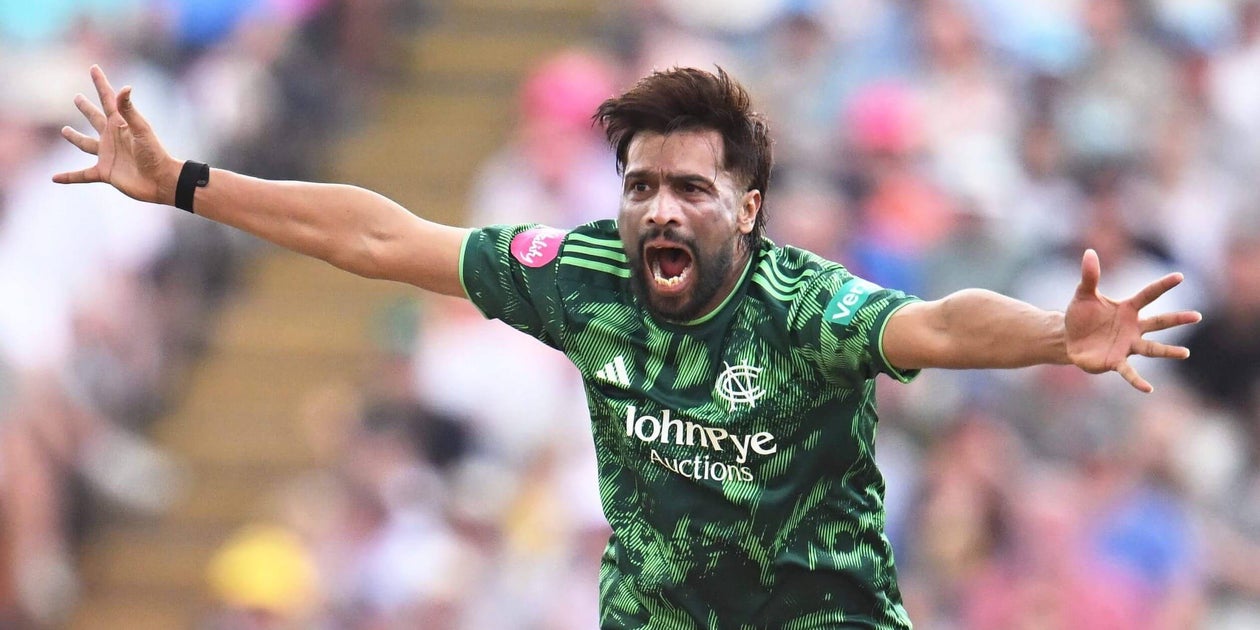
Mohammad Amir helped Trent Rockets make The Hundred final this summer (Gareth Copley/Getty Images)

“His skill is incredible,” says Arthur. “He’s still got that skill now. Sure, he’s refined it a little bit. He doesn’t have the pace he had. But in terms of his execution of what he wants to do, he’s magnificent.”

In our contemplation of the alternative reality where there was no spot-fixing, and Amir did not miss those four years and went on to have one of the all-time careers, perhaps we are guilty — not of overstating Amir’s pre-ban brilliance, but of assuming he would continue to be that good in the long term, of thinking it was sustainable.

Sport is littered with examples of athletes who peaked early and then could not live up to those standards. Cricket in Pakistan has a reputation for being chaotic, so even if he continued his otherworldly greatness, there is no guarantee his career arc would have been a steady ascension to the top.

But watching Pakistan’s flaying by England in the first Test at Headingley last week, and watching the 34-year-old Amir still bowl to a high level in the Hundred, and thinking back to just how exhilarating he was at 18, it is impossible not to feel slightly sad. Not to picture him still leading their attack in 2026, with 100 Tests and 500 wickets to his name. Not to think of what might have been. What should have been.

>

Continue Reading

Sports

Fantasy Premier League: How Gameweek One hammered home the importance of DEFCON points

Published

on

Fantasy Premier League returned with a bang last weekend and served up a firm reminder of the power of ‘DEFCON’ (or defensive contributions) as this scoring system begins its second season in the game.

Any managers who are stuck in their old ways really should take note of this recent metric in order to keep pace with their rivals.

So, what did we learn regarding the new guard of defensive contribution contenders in the opening gameweek of the season?


Midfielders

Brentford newcomer Mamadou Sangare (£5.6m) was one of four players scoring defensive contribution points who made the Gameweek One team of the week.

He had long been tipped a sound FPL contender since his arrival from Lens in the summer transfer window for a club-record £41.1million.

The Malian midfielder averaged 14.2 defensive contributions per 90 last season in Ligue 1 and was wisely tipped as the new Elliot Anderson for FPL this season. Even Brentford themselves tipped their new midfielder to be a “DEFCON” monster.

His 12 defensive contribution actions in Gameweek One ranked him sixth among all midfielders and crucially, they came in a 75-minute performance.

Many had him down as a DEFCON midfielder with little else to offer, but Sangare has shown that he can play box-to-box, notching two assists in Saturday’s 3-0 win against Tottenham Hotspur, highlighting his multiple routes to points.

I expect him to disrupt Dango Ouattara (£6.5m) and Kevin Schade (£6.0m) to become the best Brentford midfielder to own this season, with Ouattara producing two shots and two key passes in that Spurs win.

Schade had a leading tally of five shots in the box in this fixture and was unlucky to come away without a goal involvement, having won the penalty that Igor Thiago (£8.0m) failed to convert.

Sangare began as a big differential in the game, in just 3.3 per cent of sides but has now experienced one of first price rises of the campaign, with nearly 300,000 new owners for Gameweek Two at the time of writing.

Sangare isn’t the only differential among the leading midfielders for defensive contributions in Gameweek One.

Of the 12 midfielders to hit the 12 DECON actions for two additional points, all but one were less than 5% owned, with the exception being Everton’s Iliman Ndiaye (£6.0m), who sits in 16% of sides.

I made a late switch away from Ndiaye among fears he may depart the club in this summer transfer window, and he duly punished me with an assist, defensive contribution points, a clean sheet and a bonus point for a nine-point return.

Everton winger Iliman Ndiaye

The attack-minded Iliman Ndiaye achieved a DEFCON bonus (Lewis Storey/Getty Images)

Everton’s Harrison Armstrong (£5.0m) and Leeds United’s Anton Stach (£6.0m) were the highest returners, with 16 defensive contribution actions apiece.

Stach also scored the only goal in his team’s 1-0 win away at Nottingham Forest, coming away with a 13-point return and could be one to watch.

Interestingly, he still took a share of set pieces despite the arrival of Harry Wilson (£6.5m) in the summer transfer window.

The only midfielder who netted defensive contribution points in Gameweek One priced over £6.0million was Liverpool’s Cody Gakpo (£7.0m), who got on the score sheet in a 2-2 draw away at Newcastle United.

If he can remain fit and unchallenged on Liverpool’s left, then he could become an interesting fantasy asset after a solid all-round performance.

He led the way for shots among all players in Gameweek One, with six, while he also made three key passes. However, team-mate Dominik Szoboszlai (£7.5m) is a tempting prospect at just £0.5 million more. Plus, he’s on penalties.

Defenders

Nineteen defenders managed to hit their 10-point defensive contribution threshold in Gameweek One, with the standout performance coming at Hull City, given their clean sheet in their win against Manchester United.

John Egan (£4.0m) now looks to be the best DEFCON pick among the promoted teams, who are all priced at the base cost of £4.0 million. He managed 21 contributions in that game, leaving him on eight points.

But it was his team-mate Nobel Mendy (£4.0m) who made the team of the week since he also got on the score sheet before being substituted in the 64th minute with a thigh injury.

Among the other promoted players, Dara O’Shea (£4.0m) ranked second for defensive contributions (18) at Ipswich Town, despite playing at right-back, and Coventry City’s Bobby Thomas (£4.0m) who faces Hull City next, with 10.

Virgil van Dijk (£6.5 million) was the only defender over 10% owned who notched defensive contribution points, adding to the 15 occasions that he registered the two point bonus in 2025-26.

There were some other premium defensive picks who also delivered, including Tottenham newcomer Marcos Senesi (£6.0m) and Chelsea summer signing Maxence Lacroix (£6.0m), who also got an assist.

Chelsea defender Maxence Lacroix pumps his fists after his team's win over Fulham

Maxence Lacroix was a popular pick for DEFCON points last season – and picked up where he left off with Chelsea (Ryan Pierse/Getty Images)

Brentford’s Kristoffer Ajer (£4.5m) hit a clean sheet and defensive contribution points against Spurs for an eight-point return in my team and could be good enough to keep out Sepp van den Berg (£5.0m) when he returns from injury.

I’m very interested in the Leeds United defence following a deserved clean sheet in their opening game away at Nottingham Forest, with James Justin (£4.5m) and Jaka Bijol (£5.0m) both earning the defensive contribution bonus.

The reinforcements of James Trafford (£5.0m) between the sticks and new signing Tarik Muharemovic (£5.0m) in the heart of their defence could prove vital in an upturn of Leeds’ defensive form. Bijol could well be the headline pick.

It’s important to bear in mind that we do only have one gameweek of data though and the landscape could look very different in the next few weeks while the summer transfer window remains open, but the value of a good DEFCON magnet cannot be understated.

>

Continue Reading

Trending

Copyright © 2017 Zox News Theme. Theme by MVP Themes, powered by WordPress.