Read UAE Team Emirates’ press release ahead of the 2019 Vuelta a España and you’d have no idea what a watershed moment it was to prove for cycling.
A 45-second video announcing the team’s eight-man squad, set to a progressive trance track that has just over 6,000 plays on Spotify and a mere 56 on YouTube, put Fabio Aru, winner of the 2015 Vuelta, front and centre.
“For the general classification there will be Fabio Aru, whose condition has grown a lot and approaches the Vuelta with great concentration and determination,” the team’s sports manager, Joxean Matxin, said. Colombian sprinter Fernando Gaviria was also singled out, who, Matxin said, “we know can do well there.”
The penultimate rider presented in the video was a baby-faced 20-year-old by the name of Tadej Pogačar. Rather understating his prodigiousness, he was described as just “talented”.
At least Matxin went on to add that Pogačar was selected for his maiden Grand Tour “after proving that he is not only a contender for the future but for the present also.”
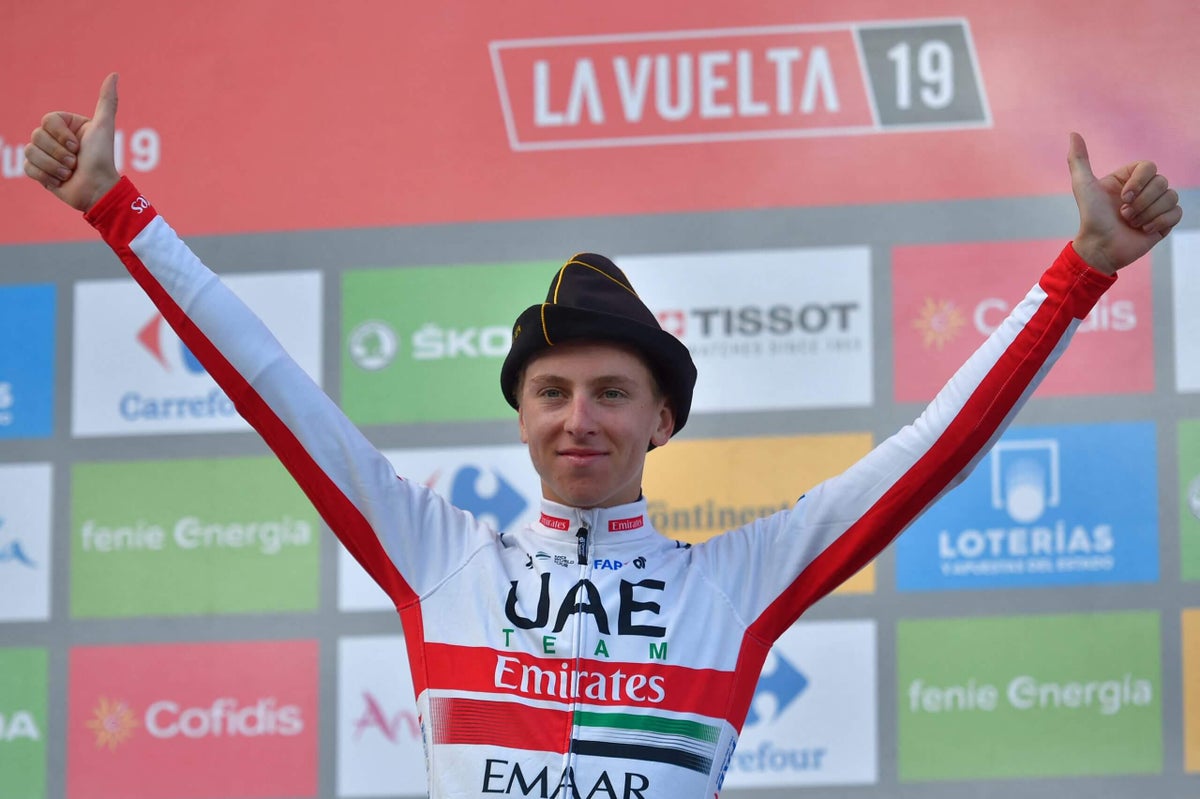
It was the only on-the-money prediction in the communiqué. Aru would go home on stage 13 and Gaviria would only contest one bunch sprint. Pogačar would ride to third overall, claim three stage victories and win the jersey for best young rider.
“We knew he was a talent, and we knew he would have a good result at the Vuelta, but honestly, probably nobody expected that he could find himself on the podium at the end,” Marco Marcato, Pogačar’s 2019 Vuelta teammate and his 2026 Vuelta sports director, tells The Athletic.
The title of the line-up video’s soundtrack? “You don’t know.”
A wonderfully prescient title. For no one knew that it was to be the start of the Tadej Pogačar dynasty.
Well, not-quite no one. The signs had been there for a while.

Pogačar celebrates after winning stage 20 of the 2019 Vuelta from a solo attack, something that would become familiar in the 2020s (OSCAR DEL POZO/AFP via Getty Images)
The young Slovenian won the 2018 Tour de l’Avenir, the U23 race to win if a rider wishes to signpost future greatness. He didn’t take long to settle into professional life, either: at his second race for UAE, February’s Volta ao Algarve, he won the queen stage and the overall title.
A few months later, at the last-ever edition of the Tour of California, he was victorious on Mount Baldy to set up his second GC triumph. UAE had a future superstar among their ranks.
“Already from the first test they had predicted that he had values much higher than average,” his teammate at the time Valerio Conti tells The Athletic. “I raced with him for the first time at the Volta ao Algarve and on that occasion he immediately showed that he was a gem.”

Former Pogačar teammates Valerio Conti (centre) and Marco Marcato (right) pictured at during the 2019 Giro d’Italia (LUK BENIES/AFP via Getty Images)
At the 2019 Vuelta, Primož Roglič was desperate to make up for relinquishing his Giro d’Italia lead a few months before. Movistar arrived with two former Grand Tour winners — Nairo Quintana and Alejandro Valverde — whose complex hierarchy promised and provided the usual internal drama, while Aru and Miguel Ángel López were also among the contenders.
Conti was one of a few backing Pogačar to muscle his way to the front. “He didn’t have huge expectations, being a boy who needed to be looked after and helped to gradually grow,” the Italian says. “But I knew he could aim for the podium, even before the Vuelta.”
It was day five when UAE’s pecking order was reordered. On the climb to the ski station of Javalambre — a snowball’s throw away from Valdelinares, where Pogačar defended his red jersey on yesterday’s stage — Aru went backwards and his young teammate finished seventh. UAE were now racing for the 20-year-old Grand Tour debutant.
Four days later, on a brutal 94km stage in Andorra that packed in 3,300m of climbing, Pogačar announced himself to the world, launching an attack with 2.9km to go, vanishing out of sight and into the storm clouds. It was to be his first of 38 Grand Tour stage wins and counting. “He didn’t wait long to show his great value,” Conti summarises.
Carlton Kirby, the Eurosport commentator, encapsulated how little was known about him, pronouncing his name as “Pog-a-car”. Narrators have since had seven years to perfect how to pronounce the ‘č’.
The win in Andorra was followed by shipping 1:29 to Roglič in a 36.2km time trial in Pau — how Pogačar would reverse fortunes 12 months later at the Tour de France — but on stage 13 he won again, taming the savage gradients of Los Machucos in Cantabria, and beating Roglič in a two-up sprint. Speaking in slower, less-polished English than nowadays, Pogačar beamed: “It was an incredible day for me.” But asked if he could win the Vuelta, he said: “I don’t think so. I think Primož is holding on to the red jersey really good.”
Among his teammates, Pogačar was showing no signs of nerves. “I remember that he always knew how to handle moments of stress,” Conti says. His leadership skills, very much still in their infancy, left a mark on Conti. “His humility always provided opportunities for constructive discussion,” he says. “He appreciated and followed the tactics of the sports directors.”
“He was a young guy who liked to listen and learn from others — he was always quiet, not speaking too much,” remembers Marcato. “But whenever he spoke, it was always to make a really good point. You immediately understood he had something more than the others, and he had respect from the older riders.”
“He didn’t feel the pressure. He had respect for his rivals and people around him, but he had confidence in himself and his potential. But it’s true that even for him it was a bit surprising what he was doing.”
Marcato, 15 years Pogačar’s senior, was rooming with the Slovenian for the near-four weeks. “Some guys who you room with don’t have respect and video call people with the speaker on, forgetting that there’s someone else next to them who wants to sleep,” Marcato says. “But Tadej wasn’t like that — if he was watching something he’d always have his earphones in. He cares about his teammates and staff.”
That selflessness was no more evident than in the third week, when Pogačar was closing in on securing a historic podium spot. “It was the last few days, we could see the finish, and the first thing I did when we arrived at the hotel was to turn off the air-conditioning because we know it can cause flu and I didn’t want him to get sick,” Marcato says.
“He said to me, ‘No, Marco, it’s OK, you do what you want; I’ll adapt’. Of course, I was older, I wanted air-conditioning! He cared more about how I was feeling than his performance. That really stuck with me.”
The Covid pandemic put an end to team leaders having roommates, a protocol that hasn’t been reversed. Marcato, therefore, remains the only rider to have ever been Pogačar’s roommate at a Grand Tour. It’s not known if Pogačar still prefers the air-con on or off.
“I hope he could learn from me and I could give him some advice as a roommate. Everything was new to him – moving around the peloton, racing these races,” Marcato says. “I like to think I gave him some good info.”

Primož Roglič won the 2019 Vuelta but a year later Pogačar would turn the tables in the Tour de France (ANDER GILLENEA / AFP via Getty Images)
Embodying how raw and inexperienced he was — he was riding like a textbook mercurial talent with extraordinary performances followed by time losses — Pogačar ceded a minute to his GC rivals on stage 18, dropping back to fifth. It was the seventh time in the race he had given up notable time to Roglič.
But then on stage 20 he delivered his career-first long-range masterpiece. With 38.7km to go in the mountains to the west of Madrid on the penultimate day, Pogačar attacked on the Puerto de Peña Negra.
On the first showing of the same movie we’ve since seen repeated dozens of times, Marcato was watching along in the team bus, having crashed out of the race a day earlier. “In the team meeting, the sports director said, ‘Tadej, you’re young, you’ve got nothing to lose. If you feel it, go for it. Try to have fun’.
“I stood up and said, ‘Yes, OK, but riders like Roglič and Valverde have really great palmares and it’s a risk’. But he attacked alone with 40km, something we didn’t often see in cycling back then. But that’s Tadej: his secret is when he’s on the bike he wants to have fun.”
The youngster had a lead of 1:35 after only a few kilometres and maintained that same advantage all the way to the finish line. He had his third stage victory, two more than overall race winner Roglič, and made sure of a third place finish.
It was the first introduction to the new era of bold, aggressive cycling, marked by audacious, previously unthinkable attacks, an epoch that has Pogačar’s fingerprints all over it. At the time, however, as Marcato pointed out, cycling wasn’t used to such spectacles. The architect wasn’t either.
“I will need a few days to understand what I did,” he said, only days before he turned 21. “I never imagined I would be in this position three weeks ago. It feels incredible.”

Pogačar on the final podium alongside Roglič and Alejandro Valverde (OSCAR DEL POZO/AFP via Getty Images)
While UAE were celebrating the coming of age of the neo-pro Slovenian who was reported to be on an annual wage of €80,000 — he’s now on €8.4m, before bonuses and additional sponsorship deals are factored in — there was another side of the coin.
UAE had gone into the race betting on Aru. “We were super happy for Tadej, but we expected Fabio to be our leader for the Vuelta,” Marcato says. “Suddenly he wasn’t performing like we expected, so it was a strange situation: our initial leader wasn’t so good, but then we discovered a new talent.”
Conti says: “2019 was a turning point for UAE.” It also signalled what was to come from Pogačar. “That Vuelta made him believe in his great potential,” Conti adds.
Seven years later, on stage four of the 2026 Vuelta, Pogačar returned to Andorra, the scene of his first great victory. The result was the same. The only difference was this time he attacked with a trademark 50km solo breakaway and won by a mammoth 2:39.
“I have such beautiful memories from the first time in Andorra,” Pogačar smiled after his latest extravaganza. “It was really, really beautiful, and it’s one of my favourite moments of the career. I will never forget that day.”
Back then he was an unknown quantity; now it’s increasingly accepted he’s superseded Eddy Merckx as the greatest bike rider of all time.
“We can say that he was a talented guy like some other talents, but, let’s be honest, he was a nobody,” Marcato says. “Now we see him making history all of the time, but he’s still the same Tadej. He’s always kept the same behaviour, the same mentality. But that Vuelta made him realise he could be a great champion.”