
Tech
TechCrunch Disrupt 2026’s new Real World AI Stage features Nvidia, robots, and extinct animals


At our past TechCrunch Disrupt events, AI has taken center stage, both throughout our programming and in a stage of its own. This year, the technology, implications, and players are so rapidly developing and widespread that we’re expanding the single AI stage into two!
The AI Stage will continue as you’d expect, with a rundown of sessions and speakers available for review right here. But the Real World AI Stage is brand-new for TechCrunch Disrupt 2026.
On this stage, we’ll be focusing on that intersection between the digital and physical, and all the ways we’ll continue to see a blending of the two, as autonomous hardware goes beyond self-driving cars and enters public spaces, battlefields, our homes, and even potentially helps extinct species reenter Earth.
It’s a packed lineup featuring speakers from Shield AI, Colossal Biosciences, FieldAI, Foxglove, and more still to come. You can join in on all the excitement October 13 to 15 at San Francisco’s Moscone West, so register to attend right here.
But in the meantime, here’s the breakdown of our Real World AI Stage lineup:
Robots Are Waiting for Their ChatGPT Moment. Here Is What Is Standing in the Way
Large language models had the internet. Self-driving cars have millions of hours of road data. Robots have neither. That data gap is the single biggest reason most experts believe general-purpose robotic intelligence is still years away, despite the breakthroughs happening everywhere else in AI. A new wave of startups is racing to close it, building the data pipelines, simulation environments, and foundation models that could trigger the same capability explosion we saw with LLMs. This session asks the hard question: what does the ChatGPT moment for physical AI actually require, and how close are we really?
With Les Karpas, Head of Physical AI, Nvidia
Building AI Systems When Failure Is Not an Option
When AI enters the physical world, the consequences of failure change. A mistake could lead to a grounded aircraft, a vehicle crash, or a compromised mission.
In this session, leaders who are building autonomous vehicles, defense technologies, and industrial systems will talk about one of the toughest questions that every hard tech founder must face: How do you know when your system is ready to be safely deployed?
We’ll dig into how founders can create a safety culture, test and validate AI, navigate regulatory hurdles, and build companies that can earn trust when the stakes are high.
With Nate Michael, CTO, Shield AI
Can We Engineer Nature’s Comeback?
Ben Lamm has built one of the most controversial companies in tech by turning de-extinction from science fiction into a billion-dollar business. In this fireside chat, the Colossal Biosciences CEO will discuss the technologies used to revive extinct species, the role AI plays in modern biology, and the growing debate over whether engineering nature is a conservation breakthrough or a distraction from protecting what’s already here.
With Ben Lamm, CEO, Colossal Biosciences
Operating at the Edge: How AI Works When the Cloud Doesn’t
The most valuable AI deployments in the world operate where the cloud can’t reach. And building for them requires a different technological playbook.
This session brings together leaders from defense, space, and industrial AI who will share how they have tackled the challenge of making AI work at the edge — where latency matters, connectivity is limited, and failure isn’t an option. Expect practical lessons on architectural principles, design decisions, and trade-offs that make AI-centric systems work in the real world.
With Dr. Ali Agha, CEO and founder of FieldAI; Michelle Lee, CEO and founder, Medra; and Aidan Madigan-Curtis, partner, Eclipse Ventures
From Prototype to Production: Can it scale in reality?
A prototype that works is not a product. A product that ships is not a scaled business. The gap between each of those stages is where most deep tech startups die. Founders might have the right team and tech, but they fail to understand what it takes to bring a prototype into production and eventually scale to higher, profitable volumes.
This session brings together founders who have crossed that gap in space hardware, humanoid robotics, and autonomous systems. They’ll share what they got wrong, what they’d do earlier, and what the prototype-to-production journey looks like when supply chains and manufacturing realities replace lab conditions.
With John Mackey, CEO, co-founder, MBRYONICS; Boris Sofman, co-founder and CEO, Bedrock Robotics; and Adrian Macneil, CEO, Foxglove
There’s plenty more in store for you at Disrupt 2026 — after all, that’s just one stage’s worth of programming! For a sense of what else you’ll get to access, we’ve also announced the:
- Disrupt Stage, featuring top speakers from Replit, Amazon, Tether, and more.
- AI Stage, digging into the security gaps and business model shifts AI is forcing on every SaaS company.
- Smart Money Stage, covering stablecoins, instant payments, and AI’s role in financial trust.
- Smart Systems Stage, tackling the fusion breakthroughs and grid strain powering AI’s next decade.
- Builders Stage, where founders and investors get tactical about raising, hiring, and scaling.
Be part of Disrupt 2026 in San Francisco from October 13–15, where more than 10,000 startup, tech, and VC leaders come together for three days of insights, Startup Battlefield, unparalleled networking, and access to every stage and the exhibition floor.
When you purchase through links in our articles, we may earn a small commission. This doesn’t affect our editorial independence.
>
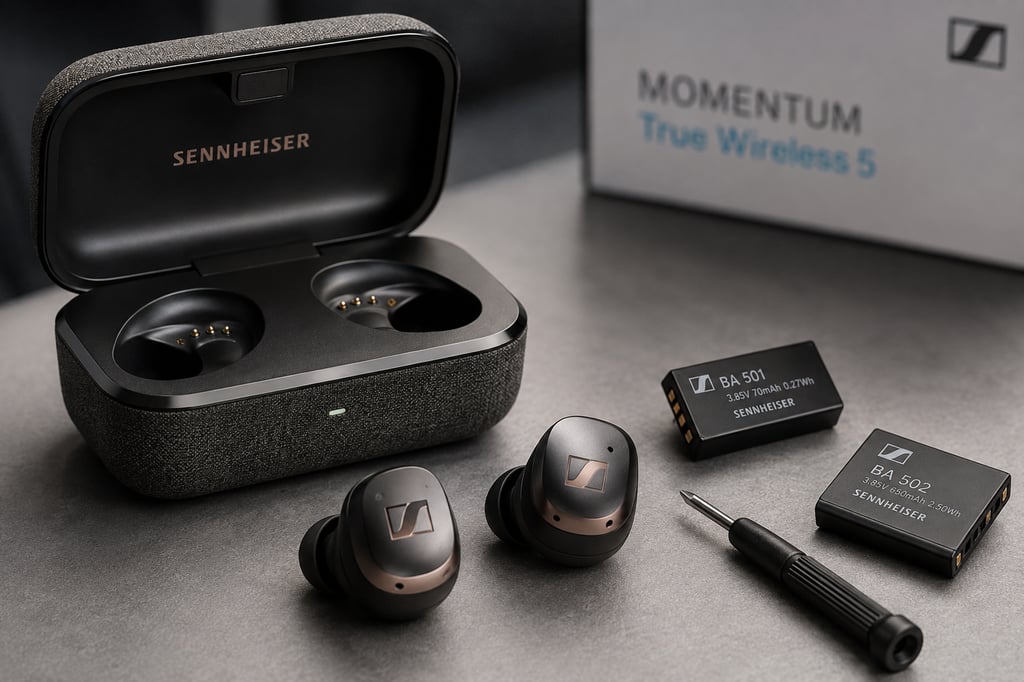
Sennheiser’s Momentum True Wireless 5 tackles one of the biggest weaknesses of premium earbuds: batteries that eventually wear out but cannot easily be replaced.
Both earbuds and the charging case use batteries owners can swap themselves with a small screwdriver.
The earbuds cost $299.95 and begin shipping September 3. That matches the US launch price of the Momentum True Wireless 4, so Sennheiser is adding repairability without raising the starting price.
| Feature | Momentum True Wireless 5 |
|---|---|
| Price | $299.95 |
| Battery | 12 hours; 40 hours with case |
| Replacement | Earbuds and case; Phillips PH000 |
| Connectivity | Bluetooth 6.0; aptX Lossless |
| Durability | IP54 |
Replaceable batteries are the biggest change
According to Sennheiser, owners can open the earbuds and charging case with a standard Phillips PH000 screwdriver. The company identifies the replacement parts as the BA 501, sold as a pair of earbud batteries, and the BA 502 for the charging case.
That makes the Momentum True Wireless 5 unusual among premium true wireless earbuds. The approach also follows a broader push toward repairable hardware, where easier battery and component replacement can extend how long a device remains useful.
There are still two important unknowns. Sennheiser has not published replacement-battery pricing, and its support documentation says the BA 501 and BA 502 will initially be available in the EU and selected countries. Buyers elsewhere should confirm local parts availability before treating self-repair as a guaranteed long-term option.
Sennheiser says the earbuds are covered by its warranty program, but its current support material does not specifically explain whether replacing the batteries yourself changes that coverage.
Battery life, audio, and what else changes
Sennheiser rates the earbuds for up to 12 hours of playback on one charge and up to 40 hours using the Qi-enabled charging case. An eight-minute quick charge provides up to one additional hour, while a full charge takes about 1.5 hours.
The previous Momentum True Wireless 4 was rated for up to 7.5 hours per charge and 30 hours with its case. For context, the current AirPods Pro 3 and Galaxy Buds4 Pro are both priced around $249 and carry shorter manufacturer battery ratings with active noise cancellation enabled, although testing conditions differ between brands.
Audio hardware centers on Sennheiser’s 7mm TrueResponse dynamic driver, with support for high-resolution playback up to 24-bit/96kHz, aptX Lossless, and Dolby Atmos-optimized head tracking. The Smart Control Plus app adds an eight-band EQ and Sound Personalization.
Connectivity moves to Bluetooth 6.0, and Sennheiser says a selectable robust mode is designed to improve stability in crowded wireless environments. The earbuds also carry an IP54 rating for dust, sweat, and splashes.
Calls use four microphones per earbud, including a voice accelerometer, alongside AI-powered voice isolation. Sennheiser has also redesigned its adaptive noise cancellation, added automatic anti-wind adjustment, and changed the fit based on data gathered from thousands of ear models.
Other earbuds are taking different routes to stand out. Sony’s LinkBuds Clip prioritizes an open-ear design and long total battery life, while Sennheiser is betting that owners will value being able to keep the same hardware running after its original batteries degrade.
For buyers considering the Momentum True Wireless 5, the key question is less whether the batteries are replaceable and more how practical that repair will be. Sennheiser has confirmed the parts and the DIY process, but replacement pricing and wider regional availability will determine how useful the feature becomes over several years.
Also read: Plaud One uses AI earbuds and a 4G-connected case to record, summarize, and act on conversations without relying on a nearby smartphone.
>
The Builders Stage is returning to TechCrunch Disrupt 2026, bringing together founders, startup operators, and investors for practical conversations on what it takes to build and scale successful companies.
Hear from startup and venture leaders shaping the tech ecosystem, including Grant Lee, CEO and co-founder of Gamma; Leah Solivan, founder and general partner at Precedent.vc; Robby Stein, VP of Product at Google; and more. Through candid conversations and real-world case studies, speakers will share actionable insights on fundraising, hiring, go-to-market strategy, AI, and the operational decisions that fuel startup growth.
Join more than 10,000 founders, investors, startup operators, and technology leaders at Moscone Center in San Francisco on October 13-15. Register today and save before our next ticket price increase.

Built for founders who are ready to scale
Building a startup is one thing. Building a company that can scale is another challenge entirely. The Builders Stage is one of six industry-focused stages at Disrupt 2026, dedicated to helping founders navigate the challenges of growth, from raising capital and hiring top talent to building go-to-market engines and preparing for the jump from seed to Series A.
Every session delivers practical strategies you can put to work immediately, plus opportunities to engage directly with speakers during live Q&A. Secure your pass to Disrupt 2026 today and save up to $330 before rates increase.

Without further ado, here’s your first look at the Builders Stage agenda, with more speakers and sessions to be announced as we get closer to the event.
Builders Stage agenda
How to Win When You’re Not Building AI
With Shan Shan, Investment Manager, Baillie Gifford; and Yuri Sagalov, Managing Director at General Catalyst
AI may dominate the world of venture, but many enduring companies won’t be those that sell AI models or agents. This session is for founders competing for attention in an AI-obsessed market. Panelists break down what actually matters now: efficient growth, retention, revenue quality, and disciplined execution, and why fundamentals, not hype, still build breakout businesses.
What Happens When OpenAI Ships Your Roadmap
With Michel Tricot, CEO and Co-founder, Airbyte; Rob Toews, Partner, Radical Ventures; and Linda Tong, CEO, Webflow
Nearly all AI founders have the same worry these days: What if OpenAI or Anthropic launches a product that competes with mine? Even strong products are at risk of becoming features of the larger players. This session explores where defensibility exists and what founders can do if they do face competition from rapidly evolving AI giants.
Building the Next Generation of AI Giants
With Jas Khaira, Global Head, Blackstone N1
AI startups are scaling faster, and demanding more capital, than any generation before them. Jas Khaira, Global Head of Blackstone N1, shares what separates enduring companies from early momentum, how founders should think about capital as they scale, and what Blackstone looks for when backing the next generation of category-defining businesses.
Competing for AI Talent: Pay, Equity, and Retention
With Matt Birnbaum, Founder, Wylder.co, Ioana Hreninciuc, Runware, Atli Thorkelsson, VP, Talent Network, Redpoint Ventures
The growth of AI startups has made hiring and retention more difficult for every tech company. From competing for AI talent to navigating secondary sales, founders are rethinking the human infrastructure of their startups. As incentives and employee expectations rapidly evolve, this session explores how companies are adapting compensation, culture, and team-building strategies to attract and retain top talent in a fundamentally changed market.
Winning Pre-Seed Without a Product
With Puneet Agarwal, Managing Partner, True Ventures; Austin Clements, Managing Partner, Slauson and Co; and Sandhya Venkatachalam, Founder and Managing Partner, Axiom Partners
Founders are increasingly expected to compete for capital before they even have a product. At the pre-seed stage, investors are betting on story, conviction, and founder-market fit. This session breaks down how to build credibility before revenue exists so investors will cut that first check.
From MVP to Billions of Users: How Product Decisions Must Change at Scale
With Robby Stein, VP, Product, Google
The instincts that win when building your first minimum viable product can break you at a billion-user scale. In this fireside, Robby Stein shares how product decision-making changes when every update impacts billions of users. Hear how teams balance speed with trust and innovation with reliability at one of the world’s largest product organizations.
Hiring When AI Is a Co-Founder
With Josh Reeves, CEO and Co-founder, Gusto; more speakers to be announced
Early-stage companies are no longer just building with AI; they’re hiring it. As AI agents take on engineering, support, and operations, the definition of an early team is being rewritten. This session explores how founders decide what humans should own versus what gets delegated to AI, and how high-growth startups are building hybrid teams without losing speed, accountability, or culture.
Rebuilding Consumer Products for the AI Era
With Maria Angelidou-Smith, CPO, Reddit
AI isn’t just adding features, it’s forcing product teams to rethink how people search, discover, communicate, travel, and make decisions. Leaders from Reddit, Square and Uber discuss how they’re redesigning products used by millions, what users actually want from AI, and where product leaders should resist the temptation to automate everything.
M&A Is Now an Early-Stage Strategy
With Karl Alomar, Managing Partner, M13 and Lindsey Mignano, Founder, Mignano Law Group
The smartest founders today aren’t just building for IPOs; they’re also building with possible acquisitions in mind from day one. As exits shift and capital tightens, understanding M&A early has become a competitive advantage. This session breaks down how founders can create the possibility of such an option through product strategy and partnerships. It delves into how big-dollar startup outcomes actually happen, even for small companies.
The Series A in 2027
Jahanvi Sardana, Partner, Index Ventures; Shailendra Singh, Managing Director, Peak XV; and Janelle Teng Wade, Partner, Bessemer Venture Partners
Series A is getting harder, with VCs growing more demanding. For founders planning to raise in the next one to two years, this session breaks down what “fundable” will actually mean in 2027. Hear how top investors are redefining the metrics, teams, and traction that matter now, what outdated fundraising playbooks no longer work, and how companies can separate from the pack in the next funding cycle.
The 90-Day GTM: Why $0–$10M ARR Is the New Baseline (and How to Actually Get There)
With Ryan Meadows, Chief Revenue Officer, Lovable; and Tomasz Tunguz, General Partner and Founder, Theory Ventures; Ben Broca, Founder, Polsia
The definition of traction has changed. What once took years is now expected in months, and $0 to $10 million ARR is increasingly becoming the new early-stage baseline. This session breaks down how AI-enabled execution, faster distribution, and shifting investor expectations are compressing GTM timelines, and the tactical levers founders need in the first 90 days to accelerate revenue and stand out fast.
The Real Tokenmaxxing: How the Best AI Companies Navigate a Multi-Model World
With Mo Jomaa, Partner, Capital G; and Zuzanna Stamirowska, CEO and Co-founder, Pathway; more speakers to be announced
The frontier is moving faster than any single model can keep up with, and the teams building the most successful AI products are increasingly orchestrating across many models rather than betting on just one. This panel brings together founders and operators at the center of that shift to discuss how they evaluate new models, manage cost and reliability at scale, and architect products that can evolve as quickly as the underlying technology.
Revealing AI Disruptors 60: What Can AI Do Next?
With Shay Grinfield, Greenfield Partners
The AI conversation is shifting from what models can say to what they can actually do. Agents are navigating the open web and completing work, AI systems are taking on increasingly ambitious research, intelligent machines are beginning to operate beyond the screen, and a new infrastructure layer is emerging to make all of this possible at scale.
Greenfield Partners’ Shay Grinfeld sits down with founders building across these emerging areas to separate what’s real today from what’s coming next, and explore where the biggest new opportunities are taking shape. The conversation will culminate in the reveal of Greenfield Partners’ 2026 AI Disruptors 60, spotlighting the companies Greenfield and TechCrunch believe are pushing AI into new territory.
PMF Red Flags: How to Tell If You Really Have It
With Rajeev Dham, Managing Director, Sapphire Ventures; and Rahul Vohra, Founder and Head of Superhuman Mail; more speakers to be announced
In an AI hype cycle, product-market fit signals are easier to fake and harder to trust. Founders are mistaking early excitement, usage spikes, and pilot wins for durable traction. This session breaks down what false PMF actually looks like, how investors and operators separate real retention from hype-driven adoption, and the signals that indicate whether a company has true pull or just temporary momentum.
The Zero-to-1K Playbook: How to Get Your First 1,000 Customers Without a Marketing Budget
With Grant Lee, CEO and Co-founder, Gamma; Leah Solivan, Founder and General Partner, Precedent.vc; and Elia Wallen, Founder and CEO, Engine
Early customer acquisition is not about marketing spend; it’s about founder-led distribution and relentless execution. Most startups at zero to one do not have budget, brand, or scale, only urgency and creativity. This session breaks down how founders are landing their first customers through community building, product-led growth, founder-led sales, strategic outbound, and word-of-mouth momentum.
Yes, It’s Hard to Be a Founder: An Honest Conversation
With Nell Daly, Co-founder and Managing Partner, Revenge Capital; David H. Rosmarin, Associate Professor, Harvard Medical School; and Jack Withinshaw, Co-founder and Chief Commercial Officer, Airspeeder
Company building is as psychologically demanding as it is strategic, and most founder narratives understate that reality. In this candid conversation, founders and mental performance experts unpack the hidden costs of high-growth environments, from burnout and decision fatigue to the identity strain of sustained pressure, and share the systems, habits, and mental frameworks that help leaders endure and perform at a high level.
So You’ve Got a Hit Product. How Does Your Company Do It Again?
With Filip Kaliszan, CEO and Co-founder, Verkada; and Aaron Jacobson, Partner, New Enterprise Associates; Maddi Holman, General Partner, Daring Ventures
Most startups stall out because they build a single great product instead of a repeatable multi-product engine. Join a venture capitalist and two founders as they reveal the precise operational playbook for capital allocation, systemizing internal innovation, and engineering a compounding “Second Act” before the core product’s growth curve flattens.
Hiring, Compensation and Culture in the Most Competitive Market Ever
With Matt Birnbaum, Founder, Wylder.co; and Atli Thorkelsson, VP, Talent Network, Redpoint Ventures; more speakers to be announced
No question about it, the growth of AI startups has made hiring and retention for all tech companies more difficult. From competing for AI talent to secondary sales, founders are rethinking the human infrastructure of their startups. As hiring, incentives, and employee expectations rapidly evolve, this session explores how companies are adapting compensation, culture, and team-building strategies to attract and retain top talent in a fundamentally changed startup environment.
How to Create Viral Growth and Capitalize on It
With Zach Yadegari, Founder, Cal AI
Startups can go from zero to viral overnight, but sustaining that momentum is a completely different challenge. In this fireside, Zach Yadegari shares how Cal AI navigated rapid growth, product pressure, and the realities of building in a distribution-driven market. Hear the lessons behind turning breakout attention into durable retention and long-term company building.
The High-Conviction Filter: What We Learned From the Battlefield
With Alexa von Tobel, Inspired Capital; and Chi-Hua Chien, Co-founder and Managing Partner, Goodwater Capital; more speakers to be announced
What separates the breakout companies from the rest at TechCrunch Disrupt 2026? In this candid debrief, Startup Battlefield judges unpack the trends and founder qualities that stood out in real time, from shifting investor expectations to the narratives that resonated most this year. The conversation will also explore how startup storytelling is evolving and what happens after the spotlight, including the realities of maintaining momentum and surviving the critical 12 months after a major launch, funding round, or Startup Battlefield appearance.
Ask the Investors
With Stacy Brown-Philpot, Founder & Managing Partner at Cherryrock Capital; Chi-Hua Chien, Co-founder & Managing Partner, Goodwater Capital; Dayna Grayson, Construct Capital; Carter Reum, Co-founder and Managing Partner, M13; Alexa Von Tobel, Inspired Capital
What makes an investor say yes? In this audience-led Q&A, the Startup Battlefield finals judges take your toughest questions on what separates a fundable startup from the rest: team, traction, market opportunity, pitch delivery, red flags, and more. Come ready to ask and get candid answers straight from the investors making the decisions.
Join the conversations and make the connections at Disrupt
If you’re ready to build smarter, scale faster, and learn from the leaders shaping the future of startups, secure your pass to TechCrunch Disrupt 2026 today.

When you purchase through links in our articles, we may earn a small commission. This doesn’t affect our editorial independence.
>

Palo Alto Networks paid $500 million in cash and stock to acquire Console, a two-year-old startup that uses AI agents to automate routine IT help desk tasks, according to two people with knowledge of the deal.
The companies officially announced the acquisition on Tuesday but didn’t reveal terms of the deal. Since its founding in 2024, Console has raised $29 million across two rounds: a $6.2 million seed led by Thrive Capital and a $23 million Series A co-led by DST Global and Thrive.
Before the sale, Console was valued at $157 million, according to PitchBook, delivering a rapid return for investors including SV Angel, Abstract Ventures, and notably Palo Alto Networks CEO Nikesh Arora, who participated as an angel investor. Palo Alto Networks declined to comment.
The cybersecurity giant said that it will integrate Console into Cortex, its platform that uses AI to automatically detect and neutralize threats. Console’s agentic functionality will allow security teams to investigate and resolve alerts using natural language, giving Cortex “the arms and legs to deliver autonomous security outcomes across the entire enterprise,” as Arora described in a statement.
Console was founded by Andrei Serban, coming shortly after his previous startup — a code-security platform Fuzzbuzz— was acquired by Rippling. The startup, whose customers included Ramp, Flock Safety, and Scale AI, automated tasks like password resets, granted access to apps like Figma and Miro, and performed routine troubleshooting without direct human involvement.
As a startup, Console competed primarily with Serval, another ServiceNow challenger that hit a $1 billion valuation after raising a $75 million Series B round led by Sequoia last December. Serval started as an AI tech support tool and quickly expanded to provide AI assistance for human resources, legal, and finance departments. Console’s acquisition leaves Serval as the category-leader-to-watch among startups automating IT service management, one investor, who is not a backer of Serval, told TechCrunch.
Console is Palo Alto Networks’ seventh acquisition in 2026, according to PitchBook. Other VC-backed companies scooped up by the cybersecurity behemoth this year include Greylock and Lux Capital-backed observability platform Chronosphere, at a valuation of $3.35 billion, and Koi, a cyber startup backed by Battery and Team8, for $400 million.
When you purchase through links in our articles, we may earn a small commission. This doesn’t affect our editorial independence.
>

Nippon Sangoku Anime Gets Sequel – News

Folarin Balogun and the extraordinary chain of events that led to his transfer collapsing

Scott Feinberg’s 2027 Oscar Predictions: First Read of the Race
-

 movies3 months ago
Search For Canadian TV Actor Stewart McLean Now Homicide Investigation
-

 Fashion9 years ago
These ’90s fashion trends are making a comeback in 2017
-
Fashion9 years ago
According to Dior Couture, this taboo fashion accessory is back
-
Fashion9 years ago
Model Jocelyn Chew’s Instagram is the best vacation you’ve ever had
-
Fashion9 years ago
Emily Ratajkowski channels back-to-school style
-
Fashion9 years ago
9 Celebrities who have spoken out about being photoshopped
-

 Anime3 months ago
Rurouni Kenshin: Hokkaido Arc Manga Takes 1-Issue Break – News
-
Fashion9 years ago
Your comprehensive guide to this fall’s biggest trends