
Sports
Gianni Infantino latest: FIFA accuses UEFA of launching a ‘smear campaign’ after legal cases filed in American courts | Football News


FIFA has accused European football’s governing body of launching a “smear campaign” against Gianni Infantino in a challenge to legal action over the aborted attempt to sell part of the World Cup to private investors.
UEFA has filed legal cases in American courts seeking evidence relating to the controversial venture and warned it is considering launching criminal proceedings against Mr Infantino in Switzerland where FIFA has its headquarters.
FIFA has now filed a response in a New York court, saying: “While these applications are styled as legal pleadings with captions and docket numbers, they are little more than press releases in further support of UEFA’s smear campaign against FIFA and its leadership.”
UEFA is trying to oust Mr Infantino from power with a resignation or in the FIFA presidential election in March.
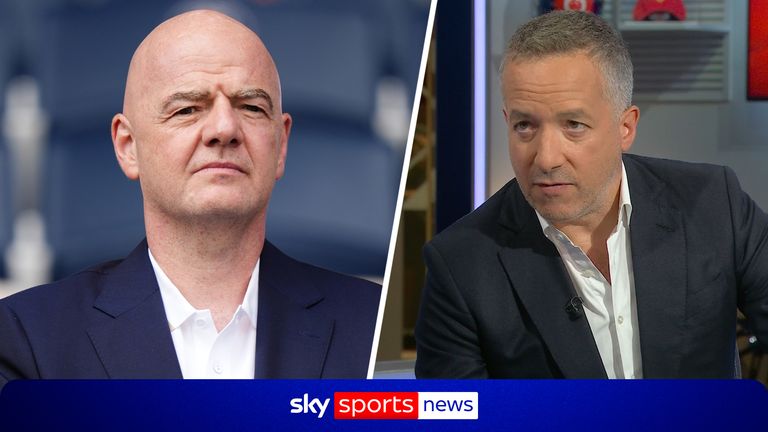
Sky Sports News chief correspondent Kaveh Solhekol gives the latest on Gianni Infantino and whether he can continue as the president of FIFA
FIFA’s lawyers say: “UEFA’s application suffers from a fundamental defect: UEFA seeks discovery in aid of a foreign criminal proceeding that does not exist and that UEFA admittedly lacks the authority to initiate.”
There is a defence of the attempt to launch the $20bn World Cup subsidiary, which Mr Infantino’s senior adviser, Carlos Cordeiro, called a “bad deal” for football when quitting the role in a statement to Sky News.
Sky News previously revealed there were already plans in June to start to receive up to $4.2bn from private investors in October.
But FIFA’s legal filing claims it was “only a proposal” that had to be approved by member associations and the ruling council.
FIFA claims UEFA was acting out of self-interest to protect its own competitions and that any disputes should be handled within football not the courts.
“Rather than participate in that democratic process, UEFA issued a press release – the beginning of a weeks-long smear campaign against FIFA and its leadership,” the document filed in the Southern District of New York court states.
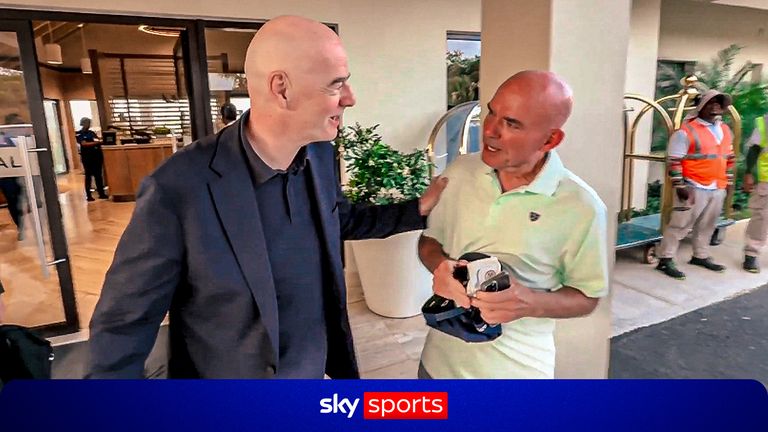
Sky News put questions to FIFA’s president in the Dominican Republic after his World Cup sell-off plan was abandoned following a backlash from a number of confederations, including UEFA
“UEFA’s economic motivation was to prevent smaller countries from having the financial strength to compete with the European elite.
“If soccer is strengthened in the developing world, global competition increases, which ultimately reduces UEFA’s market power and provides more competition for its flagship tournaments.
“By raising funds to allow some of FIFA’s smaller member associations to better develop soccer, FIFA Forward Enterprice (FFE) would lead to more players from those nations choosing to represent their countries of origin and playing in their home leagues rather than playing abroad.”
Sky Sports News has been told the feeling at UEFA is that if there is nothing to worry about, then why not disclose the documents. It is understood the process could be shortened by disclosing documents relating to FFE plans.
>

Ricky Ponting, the former Australia cricket captain, has an idea to help turbocharge the popularity of his sport in the United States.
“If I was bringing it here wholly and solely to sell and promote the game, I wouldn’t call it cricket,” Ponting begins. “It’d just be rebranded as T20 (Twenty20 cricket) only. Leave the cricket thing aside. As soon as young people hear cricket in parts of the world where they’re not brought up on the game, they think about it being a long, drawn-out, five-day game, and it’s not that.”
His pitch would speak directly to American sports and entertainment culture. “I would compare it to baseball as much as I could and give kids that chance to understand you’re hitting 15 sixes per game in a game of T20 cricket, but you are hitting less than one home run a game in the game of baseball.”
T20 is the short-form version of the sport, in which teams are permitted 20 overs to score as many runs as possible, limiting the event to around three hours and aimed at capturing new fans by being more aggressive and exhilarating for viewers. Ponting has coached in Major League Cricket (MLC), the United States’ T20 league, with the Washington Freedom for the past two years.

The United States were co-hosts of the 2024 World Cup (Timothy A Clary/AFP via Getty Images)
Cricket, long perceived by many in the U.S. as an English relic, has made a series of attempts to gatecrash the highly lucrative American sports market.
In 2004, the Pro Cricket League arrived and disappeared in one season despite attempting to simplify the game by using five-ball rather than six-ball overs (a trick subsequently adopted in England’s The Hundred). Other start-up leagues and exhibition series have come and gone, briefly luring the passionate diasporas of India, Pakistan, Bangladesh, Australia and the Caribbean nations, but lacking the investment and infrastructure to succeed.
The past couple of years have provided encouragement. In 2024, the U.S. co-hosted the T20 World Cup with the West Indies, culminating in a spectacular sell-out between Pakistan and India at Eisenhower Park in Nassau County on Long Island, where tickets resold for thousands of dollars. It also turned out America rather likes an upstart sport when the U.S. win at it, so the unexpected win against Pakistan also triggered a surge of interest.
The T20 format will also feature at the 2028 Los Angeles Olympic Games, marking cricket’s return to the Games after a 128-year absence. This will also benefit from the construction of a 10,000-capacity cricket-specific stadium in Pomona, California, which will become the home of MLC’s Los Angeles Knight Riders.
MLC has been a mixed bag: more of a six-week tournament than a conventional season-long league, it is played only in California and Texas because not all teams have home venues. But there are serious investors involved, including Satya Nadella, Microsoft’s CEO, and Shantanu Narayen, Adobe’s CEO.
The Indian Ambani family has bought the New York team. The 49ers Enterprises, the investment arm of the NFL’s San Francisco 49ers, has also bought into one of two more teams who will increase the league to eight sides in the coming years. Ponting, whose Washington team included Australian vice-captain Steve Smith, sees further room for improvement.
“One of the reasons I got involved in MLC at the start was because I wanted to be here in the U.S. and be part of the growth, and it’s just been a little slower than I would have liked,” Ponting, 51, tells The Athletic. “I don’t think they’ve been active enough in getting out there and promoting it at the grassroots level.
“There are more kids we can get involved at a young age and we can start poaching some kids away from baseball to play T20. That’s where it’s got to go if we want the game to really grow quickly here in the U.S., tapping into the entertainment package that T20 provides.
“If you compare it to a game of baseball, they’re similar lengths of time, but you’ve got so much more happening in T20 cricket than baseball.”
As a self-described “traditionalist”, does Ponting shudder at all when he says the sport would be helped by shedding its name to promote itself in the U.S.? ” Not in a market like this, where you’re trying to have a sport emerge and break through,” Ponting says. “I’ve got no worry about that at all.
“I love the game of Test match cricket. I played a lot more Test cricket than I played T20, but I’m working a lot on the T20 game now.”
He does not rule out Test cricket eventually taking off in the U.S. market but acknowledges “it will be a slow burn” and other formats of the game are “easier to sell” than a five-day game of cricket.

Ricky Ponting won the one-day international World Cup three times (Sean Garnsworthy/Getty Images)
Ponting, a winner of three ICC World Cups, spoke to The Athletic near Bryant Park in Manhattan, where he was promoting his role as an investor and ambassador with Century Cricket, which will soon open a flagship technology-based experience in New York City.
The idea involves indoor, tech-led cricket nets where batters can practise and track their performance, while also receiving virtual tutorials from Ponting. Participants will also have every ball recorded to help talent identification.
Access to the centre will be app-based and similar to a gym membership, open 24 hours and subject to weekly or monthly payments. Joel Hamilton, co-founder of Century, said pricing has yet to be determined and will vary by location. “The middle of Sixth Avenue is a completely different commercial model than what it is in Jersey or Texas or even in Bangalore,” he says.
He sees the immersive experience as a way to engage audiences, not entirely dissimilar to golf simulator concepts. “I’ve noticed with junior cricket… my son’s going through it all now, and the frustrating thing as a batsman is the level of bowling is at the point where you’re limited to face 20 balls-a-game, and you might only get 10 of those that actually pitch on the wicket that you can hit.
“Well you’ve got something like this: you can go there for your hour, programme the session exactly the way you want it, and can guarantee the technology’s going to serve up exactly what you want.”

Ricky Ponting in his pomp batting against England back in 2001 (Adrian Murrell/ALLSPORT)
Ponting, one of the great batsmen of his generation, scored more than 13,000 Test runs for Australia between 1995 and 2012 — a tally beaten by only Sachin Tendulkar and Joe Root — which means he is always keeping a close eye on the national team’s progress. After drawing the August Test series against Bangladesh, Ponting called for changes on host broadcaster Channel 7.
“It’s inevitable that they have to make some changes to the batting group,” he says. “The bowling group is outstanding and maybe, organically, those guys moving out of the team will happen by itself. They’re all about the same age — Mitchell Starc is 36 and Nathan Lyon 38. They’ve got 20 Test matches coming up until the end of the World Test Championship cycle again.
“They have Test matches in South Africa in October — they need to make some changes at the top of the order, which I said they should have made before the Bangladesh series, to give some guys some experience there, so you’re not debuting guys over in South Africa. I would go really young because this team needs regeneration and it needs it now.
“I don’t think you can afford to wait another 18 months to get through this cycle before you start to bring them in. Marnus Labuschagne is the one that’s spoken about. It has been two and a half years since he made a Test 100. His average is 23 over that period. He’s the one that I’d be moving on.
“They made the change with Matt Renshaw to open the batting and they probably need to think about things now that Cameron Green is back and batting well and as the all-rounder they might need to think about Beau Webster’s role in the team too. (They need) two or three changes at least at the batting line-up and the bowlers will be managed and rotated in and out of the team.”

Ricky Ponting has been critical of the Australian top order (Nick Wilson/Getty Images)
A little bizarrely, Ponting recently went global in unexpected circumstances, when his name was used as a pun after a village cricket match in northern England went viral.
The game took place in the North Yorkshire and South Durham league’s Division Two game between Saltburn Cricket Club Second XI and Norton Cricket Club. Internet scrutiny of match footage revealed that a Saltburn fielder, standing at slip next to the wicketkeeper, clicked his fingers just as the ball went past the edge of the bat, giving the impression there had been contact and deceiving the umpire into calling the batsmen out of the game.
The fielder became known as ‘Clicky Ponting’, a play on the former Australian cricketer’s name rather than a reference to his character.
“I saw the headline and I thought, ‘What’s this all about?’” Ponting says through a laugh. “Then I clicked on the video and watched it. I got 50 calls probably from different journalists wanting me to talk about it, and I just let it go. I didn’t want to give it any more fuel than it needed, and it went away pretty quickly. I took it as a pun. I didn’t take any more out of it than that.
“It probably wasn’t nice having your name associated with someone who was deliberately cheating, but that’s why I didn’t want to talk about it. I’ll let that one through to the keeper.”
>

Editor’s note: This story is part of The Athletic’s coverage of SailGP, an international sailing competition that has been likened to Formula 1 on water. Follow SailGP here.
With Diego Botín and his crew flying high in the SailGP Championship, it’s easy to forget things didn’t always come so easy to the Spaniards.
Ahead of this weekend’s Spain Sail Grand Prix on home waters, Los Gallos are second overall in the standings after two event wins this season, comfortably ahead of Sweden in third and bettered only by Tom Slingsby and the Australian ‘Flying Roos’ who are enjoying an incredible run of form.
But in 2023, the team was in disarray. Having finished last in Season 3, they were in need of a drastic change or else there was a risk the team would be chopped from the league altogether.
A year later, Los Gallos battled their way to overall victory in Season 4 in a stunning turnaround and have continued to be among the championship’s leading teams ever since.
To understand how Los Gallos pulled off the most impressive upturn in the short history of SailGP, The Athletic interviewed three people who were instrumental in the Spanish revolution: wing trimmer Florian “Flo” Trittel, team CEO Tony Alquézar, and performance coach Hamish Willcox.
They describe a transformation that had less to do with new technology, or a sudden influx of talent, than with a deliberate, sometimes uncomfortable, process of rebuilding trust, identity and belief.
It’s easy to forget, watching Los Gallos race in 2026, just how close the Spanish team came to disappearing altogether.
“We had a coach, a few sailors, and a shore team who didn’t necessarily want to leave the team, and on the corporate side there was a lot of people on sick leave,” Alquézar, who joined as CEO just two weeks before the start of Season 4, recalls. “We really didn’t have much of a structure.”
Willcox, who since early 2022 had been working closely with Botín and Trittel as their coach leading up to their 49er Olympic campaign for Paris 2024, was brought in during that same period of turmoil, after SailGP CEO Russell Coutts decided Botín needed to move from flight controller to the driver’s position, i.e. the captain of the ship.
Coutts is entitled to an opinion because at that point the Spanish were one of a number of teams who were centrally funded by the league, which was launched with the considerable financial support of Larry Ellison, the Oracle software billionaire who co-founded SailGP with Coutts in 2019.
“The team was in real disarray,” Willcox said, with a lot of disgruntlement caused by the removal of the previous driver, Olympic bronze medallist Jordi Xammar, from the boat. “There were quite a few people who disagreed with the change and were sort of in mutiny at Jordi’s departure. So the team was in a real state.”
Willcox found a very low-tech but effective way of gauging the state of the Spanish team. “I did a little survey of all of the other SailGP teams because I knew somebody in every team. And I asked them their opinion of our team, what they thought were the strengths and weaknesses, looking at us from the outside. People are very open to passing information, especially when you’re last in the league.”
What Willcox found inside the team was a delicate matter: resentment over pay disparities and a string of small grievances that had curdled into low-grade distrust. Willcox’s fix was disarmingly simple — that everyone be paid the same daily rate.
He remembers telling the group that no one was doing the job for the daily rate. “So, what if we all just paid ourselves the same daily rate, put that behind us, and focused on winning the prize money instead?” The proposal landed well, and became an important early building block.
From there, Willcox pushed the team toward a flatter structure than the traditional sailing hierarchy, in which a star helmsman and a handful of senior crew dominate decision-making. The team ran an unusual exercise: sitting down and asking themselves, sailor by sailor, position by position, whether any individual or crew on a rival boat genuinely intimidated them.
“We went through team by team, analyzing the helmsman, the flight controller, the whole crew, comparing ourselves man-to-man, and none of them intimidated us,” Willcox said. “Not one.”
The exercise, he believes, reset the team’s internal sense of its own worth.

Los Gallos finished last in the 2023 SailGP championship but went on to win the title in 2024. (Ricardo Pinto for SailGP)
Alquézar, arriving into this environment from a career that spanned two America’s Cup campaigns, as well as a number of Bahrain-backed investments in other sports, soccer club boardrooms, and Formula 1, brought an outsider’s eye to a sport he admits he knew little about. What struck him first was the culture.
“What I saw when I joined the team was an incredible group of people. I’d never seen that kind of humility in a team before, not in other sports,” he said. But he also sensed something unresolved beneath the surface. “You’d go in and see good friends, everything seemed fine on the surface, but something was wrong, and I couldn’t quite work out what.”
To address it, the team brought in a mental-performance coach, an old friend of Alquézar’s, to help bring to the surface any underlying tensions that the group hadn’t fully acknowledged. The result, Alquézar said, was a culture the team now calls ‘radical transparency,’ in which anyone, from the shore crew to Alquézar himself, can flag a problem directly.
“Even I get told, ‘Tony, I don’t think this is right,’ and that’s fine,” he said. “It’s about taking that message the right way.”
Willcox found similar language in a book that shaped much of his thinking during that period, “Belonging” by Owen Eastwood. The book’s central idea is that a team needs both a collective identity bigger than any individual, and sufficient space for each person to understand their own motivation.
He adapted the book’s principles specifically for the Spanish squad. It was around this time, born partly from an in-joke among the sailors, that the team’s new name emerged: Los Gallos, which means The Roosters in Spanish. “This idea of a collective identity, aiming for something bigger than ourselves individually,” Willcox said.
Even with a rebuilt culture, the team faced SailGP’s most severe constraint: almost no time to train.
Unlike an Olympic campaign, where sailors spend hundreds of hours every year refining technique on the water, SailGP teams get only a handful of days between events. Trittel said that scarcity forced Los Gallos to get unusually disciplined about what happens off the water.
“We had a lot of meetings, we always reviewed video of ourselves and of the opposition, between events, during an event, between days. That’s really the toolkit we have for training right now,” he said, describing deliberately separate technical and tactical conversations, breaking down maneuvers, straight-line speed, and starts into granular discussions.
However, what Trittel said isn’t so different to what the other SailGP teams are aiming to achieve off the water. There must be more to it than that.
What Trittel believes ultimately separates Los Gallos from the rest isn’t a training method at all, but chemistry and friendships built over years, both on the F50 and off it. He points to his own long sailing history with Botín, forged in the 49er class, as a direct competitive advantage.
“I can sense what he wants sometimes because we have a history of sailing together on other boats,” he said. Trittel compares the dynamic to that of New Zealand’s Olympic gold medalists Peter Burling and Blair Tuke, who were also coached by Willcox for more than a decade.
“There are many moments, especially in the driver-wing trimmer relationship, where you need excellent alignment on certain decisions,” he said. “Decisions that have to be made in a fraction of a second, with no time to discuss them in the moment.

Spain’s turnaround in form in recent seasons has been remarkable. (Jon Buckle for SailGP)
After the big changes of 2023, initial progress came unevenly. Willcox recalls the team’s expectations being kept deliberately low even as results began to turn.
An early Season 4 win in Los Angeles gave the team its first real jolt of confidence, though gaps remained everywhere. What Los Gallos had learned to do by then, Willcox said, was “identify the gaps and go after the easy wins.” These included starts, mark-room decisions and, above all, the ability to fight back through the fleet after a poor start, something which has become a hallmark of the Spanish in more recent years.
The Season 4 title, when it came in San Francisco, arrived almost by accident. Los Gallos scraped into the three-boat final on the last race of the qualifying rounds thanks to an error by the French, while New Zealand and Australia, the dominant teams all season, sailed defensively, content simply to have already secured their spot.
“Humans perform best when their backs are against the wall,” Willcox said.
In the winner-takes-all final itself, a well-timed split at the bottom gate gave Los Gallos the gap they needed to hold on and win. “Not a single person on the boat felt we’d deserved it,” Willcox said. “We’d been given an opportunity and we took it.”

Spain SailGP Team, helmed by Diego Botin, celebrate after winning the SailGP Season 4 Grand Final. (Adam Warner for SailGP)
If the Season 4 win was surprising, what followed was almost harder to believe.
Three weeks after the Grand Final, Botín and Trittel arrived in Paris to compete for Olympic gold in the 49er class, physically and emotionally drained from the SailGP campaign. Willcox, who traveled with them, said the exhaustion was real, but that competing across disciplines had, paradoxically, helped.
His prescription in the gap between the two events was blunt: total rest. “Just completely decompress from SailGP,” he told them. “Stay in bed until you feel the need to get up.”
The approach paid off.
After a shaky final day of fleet racing threatened to derail their campaign, Botín and Trittel composed themselves through some horribly light and fluky conditions on the Bay of Marseille and delivered a masterclass to win Olympic gold when the heat was on.
Since then, Los Gallos have kept building rather than resting on the title. Alquézar has overseen the team’s growth from roughly a dozen staff to nearly 20, backed by new ownership from Quantum Pacific and the arrival of coaches Simone Salvà and Vicky Travascio.
The core lesson, though, hasn’t changed since those uneasy days of dismantling and rebuilding the team. Everyone on the team has bought into the need for mutual trust, transparency, shared identity, to form the foundations from which results will follow.
“A lot of people talk to us about building a winning culture, and there’s a lot wrapped up in that,” Alquézar said. “We’re trying to build our own culture, and we’re still working on it. We haven’t fully delivered it yet, and maybe we never will exactly the way we imagine; it’s more of a north star that we’re always working toward.”
Of course, it’s easy to sing when you’re winning but Alquézar knows the team’s current run of form won’t last forever.
“I’m sure we’ll make mistakes, and things won’t always go our way, but that’s the process, like in life. It’s not if things will go wrong, it’s when. At which point the question is how we stick together and continue to give our best.”
The Spain Sail Grand Prix takes place in Valencia on September 5 and 6 from 7.30 a.m ET (12.30 BST). Viewers in the U.S. can watch on CBS Sports Network, while those in the UK can watch live on TNT Sports. For more information on how to watch wherever you are in the world, click here.
>

As Nottingham Forest continue to evolve in the Premier League, the place of their unconventional captain is consistently in doubt. Ryan Yates is used to this.
Whenever a new manager arrives at the City Ground — Oliver Glasner is the ninth Yates will have played under since his first league start in February 2019 — questions arise as to how he will slot into the new system and direction. Glasner’s arrival in place of Vitor Pereira is no different.
Midfielders in the Austrian’s setup tend to be progressive and quick with their passing while maintaining sensible defensive positioning to cover for advancing wing-backs.
The 28-year-old fits the mold defensively but, in possession, Yates, who became club captain in August 2024, is hardly Adam Wharton.
Despite selling Elliot Anderson to Manchester City for £116million this summer, Forest still have a wealth of options in the centre of the pitch.
With James McAtee emerging as a viable replacement, and Austria international Xaver Schlager arriving from RB Leipzig on a free transfer, Yates’ playing time appears limited.
But for Forest managers, there is no alternative but to use the only player left from the squad who won promotion in 2022.
Owner Evangelos Marinakis values and maintains the club’s record of having a homegrown player in every matchday squad since 1941.
Zach Abbott (who has now been loaned out to Southampton) is the only other regular first-team player able to maintain it in recent seasons — the 20-year-old defender appeared 13 times last season and occupied the bench for the eight matchday squads Yates missed out on last season with a hamstring strain.
Yates is a fan favourite not simply because of his homegrown status, but because of his acquired role as a disruptor off the bench, making 35 appearances last season despite only starting 10 matches in all competitions.
And for the 2026-27 season, Glasner has found the answer for Yates’ continued involvement — in the middle of defence.
On Thursday, he said on playing Yates in defence in pre-season: “If you watched our games, Ryan Yates played twice in the middle of the back three.
“He is used to playing in the No 6 and the difference between 4-3-3 and 3-4-3 is just that you drop the No 6 five yards. That is why he is used to playing this position, particularly in the buildup. Sometimes the six will drop between the two centre-backs. It is not rocket science.”
Could his positional switch work?
Yates made five appearances across pre-season, the last two of which were 45-minute stints at the heart of a back three.
Nikola Milenkovic, the 28-year-old Serbia centre-back, is first choice, but based on how the central figure in a Glasner back three operates, Yates’ attributes would provide competition.
During his time as Crystal Palace manager, Maxence Lacroix’s confidence in possession was a cornerstone of their approach as the central man.
The France international, who signed for Chelsea for £52m this summer, was consistently available and comfortable on the ball.
In this clip from Palace’s trip to Manchester City in May, Lacroix received the ball after distributing it three times, looking for a pass into midfield on each occasion but moving the ball on quickly, eventually allowing his team to advance down the right.
Yates’ ability to be decisive and accurate when operating in midfield is questionable, but his background in that role means he would be more comfortable with the pitch ahead of him, looking for passing lanes either side and into the middle.
Yates displayed this playing in defence against Bayer Leverkusen in a pre-season friendly. The match was clearly at a slower tempo but he did not look out of place in the role.
Milenkovic’s passing map from last season shows that, as expected given he operated on the right of a duo in a back four, he favoured passing out to the right wing.

The key thing here is his passing range. Many of his passes were long or diagonal, or short and sideways, especially from positions in the middle, with Anderson or Ibrahim Sangare dropping deep to receive the ball rather than Milenkovic finding them.
In contrast, Lacroix is comfortable passing both ways and feeding middle-distance passes into the centre of the field, plus his longer passes land more precisely than Milenkovic.

The pair both have similar numbers at retaining possession, but Lacroix did so while passing into more high-risk areas, and this is where Yates’ experience as a midfielder could make the experiment viable.
Yates has an ability to drive into space and progress the ball, another clear strength Lacroix exudes and Milenkovic comes up short.
The Athletic’s pizza chart below compares Lacroix with centre-backs across Europe’s top-five leagues using a range of metrics. Lacroix ranks highly for carry progression (77th percentile) and front-footed defending (69th percentile), a measure of how often a defender looks to win the ball through tackles and interceptions.

Yates’ aggressive and high-energy playing style would follow him to centre-back too, and more closely replicate Lacroix’s approach.

And we have seen a move like this before. Conor Coady was converted from a holding midfielder to the central figure in a back three when future Forest manager Nuno Espirito Santo arrived at Wolverhampton Wanderers in 2017, as he implemented a 3-4-3 system.
The ex-England international went on to miss just one league match over the next five seasons, and his natural confidence and range on the ball saw him become the predominant deep-lying playmaker in Nuno’s side.
Adding Yates to the group of defenders would add a new profile, plus hardened Premier League experience.
The case against
Not having Milenkovic in the middle would raise eyebrows from an out-and-out defensive standpoint.
While not being a front-footed defender, one of Milenkovic’s biggest strengths is snuffling out danger in and around the penalty area and choosing the right time to engage attackers.
Yates would not have a natural eye for danger in that position, having only been deployed as a centre-back eight times during his Forest career, the last in December 2023 against Manchester United.
Milenkovic’s main asset is his aerial dominance, and while their aerial duels won per 90 minutes last season were almost identical (Milenkovic 3.79, Yates 3.91), the 6ft 5in defender offers an irreplaceable base at the heart of defence.
The key here, though, is not for Yates to replace Milenkovic, but to offer genuine competition and to give Glasner a more varied tactical approach, ensuring his continued involvement has a purpose beyond sentiment.
Additional contributor: Conor O’Neill
>

JD Vance Laughs Off Idea That Fox News’ Maria Bartiromo Could Be Next Press Secretary

‘Sekai Saikou no Ansatsusha, Isekai Kizoku ni Tensei suru Season 2’ Reveals Additional Cast, New Staff, First Promo for Winter 2027

How would Ricky Ponting sell cricket to the United States? ‘Don’t call it cricket’
-

 movies3 months ago
Search For Canadian TV Actor Stewart McLean Now Homicide Investigation
-

 Fashion9 years ago
These ’90s fashion trends are making a comeback in 2017
-
Fashion9 years ago
According to Dior Couture, this taboo fashion accessory is back
-
Fashion9 years ago
Model Jocelyn Chew’s Instagram is the best vacation you’ve ever had
-
Fashion9 years ago
Emily Ratajkowski channels back-to-school style
-
Fashion9 years ago
9 Celebrities who have spoken out about being photoshopped
-

 Anime3 months ago
Rurouni Kenshin: Hokkaido Arc Manga Takes 1-Issue Break – News
-
Fashion9 years ago
Your comprehensive guide to this fall’s biggest trends