
Entertainment
This September, ‘Remember Me’: The Robert Pattinson Romance About 9/11


On Friday nights, IndieWire After Dark honors fringe cinema in the streaming age with midnight movies from any moment in film history.
First, the BAIT: a weird genre pick, and why we’re exploring its specific niche right now. Then, the BITE: a spoiler-filled answer to the all-important question, “Is this old cult film actually worth recommending?”
The Bait: Spoiler Alert! Robert Pattinson Dies in 9/11
The reason After Dark is covering 2010’s “Remember Me” is technically a gigantic spoiler, but it’s also the only thing that anyone even remotely remembers (pun not intended) about Allen Coulter’s romantic drama. On its surface and for about 90 percent of its runtime, “Remember Me” is a very straightforward and not particularly memorable story about boy meets girl. He’s depressed after his brother’s suicide — and has daddy issues! She’s traumatized after witnessing her mother’s murder — and has daddy issues! Can these two crazy kids make it work?


Should the film end on the scene where Ally (Emilie de Ravin) and Tyler (Robert Pattinson) say I love you, “Remember Me” would most likely go down in history as an early career footnote in Pattinson’s trajectory from “Twilight” star and teen romantic lead to exciting indie cinema weirdo. But instead, as Tyler’s younger sister Caroline (Ruby Jerins) sits down for homeroom, the final scene of “Remember Me” pans over to reveal the date “September 11, 2001” scrawled on her teacher’s chalkboard.
The scene cuts to Tyler, waiting in his dad’s office for a meeting, looking out the window, as the camera slowly zooms out to reveal he is high within (wait for it) the World Trade Center. The rest is, especially at the time of the film’s release on March 12, 2010, very recent history.

Contrary to certain social media claims made today, “Remember Me” doesn’t entirely keep its audience in the dark before its sudden lurch into tragedy. The film starts with a prologue set in 1991, the Twin Towers are very prominent in the background of the train station where Ally’s mother (played in a deliriously random cameo by Martha Plimpton) gets shot in a robbery, and it’s explicitly mentioned that 10 years have passed when the film picks up with Ally and Tyler meeting as angsty NYU students.
Scenes where the two take a Labor Day trip together, or Tyler sees “American Pie 2” (which, yes, was released the summer before 9/11), further narrow the gap in which their big city romance could occur, and make the whiplash of its tremendously dark ending just a smidge easier to predict. But regardless of any foreshadowing, the gambit “Remember Me” pulls in telling a small-scale story about family issues and young love abruptly colliding with mass-casualty tragedy was, at best, polarizing — and, at worst, widely derided when the film hit audiences. (Again, no pun intended!)

New York Times critic Manohla Dargis called it a “shamelessly exploitative end.” And in a generally positive review, Roger Ebert wrote that, “The movie tries to borrow profound meaning, but succeeds only in upstaging itself so overwhelmingly that its characters become irrelevant.” A more withering take came from Elizabeth Weitzman in the New York Daily News, who said, “There’s no shame in exploring tragedy through art. But exploiting it to make your very ordinary movie feel more important? That’s another story.”
The film didn’t necessarily face any mainstream backlash beyond critics: it grossed a respectable $56 million on a $16 million budget, and won Pattinson a Teen Choice Award (he was hilariously also nominated for a Nickelodeon Kids Choice Award… seriously). As the years went on, the sheer force of the film’s tragic ending overshadowed everything else about it, and it now mostly resurfaces annually as “that film where Robert Pattinson dies in 9/11.”

On the internet, the anniversary of the 9/11 attacks often sees posts about “Remember Me” go viral on platforms like X and Bluesky. Or, scrolling through TikTok, you can find reaction videos of creators showing their unsuspecting friends the film’s conclusions and recording their reactions to the final scene. Letterboxd reviews mocking the ending often pull thousands of likes, and always prompt questions that ultimately boil down to, “What the hell were these filmmakers thinking?”
Coulter, whose directorial debut “Hollywoodland” was well-received, has only worked in TV since. Screenwriter Will Fetters went onto co-write 2018’s “A Star is Born,” and explained in an interview shortly after the release of “Remember Me” that its story was partially based on his own experiences as a young man living in New York City around the time of the attacks. The intention was not to pull the rug out from underneath the audience, but to capture the sudden emotion people like Fetters really experienced.
“I had some personal tragedy in my life and this broader event occurred and it dovetailed what I experienced as a young man into the same kind of anger and sadness that follows, and this story, this script, was a way to kind of work it out,” Fetters told ComingSoon.net. “I don’t get why we’re exploitive for making a really small movie that essentially deals with the emotion of the day.”

The disgust is understandable, but nowadays, people are far more likely to laugh at “Remember Me” than anything else. 25 years after that fated date, 9/11 is for good or for bad one of the internet’s favorite memes, and you don’t have to look hard to find absurdist riffing on the events with real success.
This desensitization can be chalked up to many things. Some have pointed toward Gen Z growing older and having never experienced the attack as anything but history. Others say the culture has now largely moved on to the War on Terror that consumed the U.S. for more than two decades afterwards. There’s also plenty to be said for the way 9/11 continues to be weaponized in bad faith to fuel Islamaphobia. Whatever the root cause, perspective on that catastrophic moment is different now — and in 2026, “Remember Me’s” pivot from gentle romantic drama to world-shaking tragedy is pretty funny.

I was only 2 years old when 9/11 happened; at the time, my family lived in New York City. Growing up in nearby Long Island, where my parents moved partially due to fear of what would happen next, the attacks felt like a distant but ever-present part of my life. My schools had yearly remembrance ceremonies, and the stories of what my parents and their friends were doing that day were constant.
But having come of age essentially in an ecosystem defined by the terrorist attacks rather than disrupted by them, I know very little emotionally about what that day was like, and how it felt to feel the world flip on its head within a single morning. Ali, what do you think? Is “Remember Me” and its ending exploitative, laughable, or is there something poignant to be found in its whiplash? —Wilson Chapman

The Bite: Never Forget… Never Forgive.
OK, I know that’s not really the takeaway from “Remember Me” — or the anniversary of 9/11. But I do hold something of a grudge against Coulter’s 2010 indie film, if only because my memory of truly enjoying it at the time feels so ridiculous in hindsight. Growing up in Washington, D.C., I was 5 years old the day the Twin Towers fell in 2001. Terrorists simultaneously targeted the Pentagon, sending my father into a the nation’s capital to report on one of the gravest days in U.S. history. Meanwhile, my mother was busy picking my sister and I up from our local elementary school during the only real “code blue” we ever had.
My memories of “Remember Me” are, uh, different.
A repeat selection in the string of indie film trailers I watched habitually back then (it’s cut really well, watch it!), I remember basking in the idea of this film for months — but for the life of me cannot now recall the first time I actually watched it. Whatever Coulter and Fetters’ intentions, I can’t in good conscience tell you I was ever legitimately devastated by this movie.
I am, however, 100 percent confident I could find you a photo of the haircut I got after specifically using Emilie de Ravin’s Ally as a reference with my hairstylist. (Note: I wasn’t blonde then, but my mother even pulled out an old dress of hers that I wore obsessively because it matched the scene in which Ally and Tyler go to meet his dad.)

As a 14-year-old girl growing up in Maryland, I was obsessed with the fast-talking low-budget august movies that played at my beloved Bethesda Row. From “Juno” to “500 Days of Summer,” snappy dialogue anchored many of my favorite dramedies — and, despite not being much of a “Twilight” fan, I distinctly remember obsessing over Pattinson’s cadence in the “Remember Me” promo. In fact, rewatching it with Wilson today, I can practically recite the damn thing: a nostalgic feat for which I am both slightly proud and deeply, horribly, unfathomably ashamed.
If you want the honest truth, this movie is, was, and probably always will be an abysmal idea. There is conceivably a world in which a “9/11 rom-com” actually works for some modern audiences. (Hey, the sex purge kind of worked, right?) But the extraordinarily ambitious narrative deepening that’s attempted in the final minutes here (and in the same year as Nolan’s “Inception,” no less!) land… awkwardly, to say the least. The result is a repertory pick that isn’t nearly as fun in the topical sense as you’d hope.
Still, Pattinson, who was just starting to crack out of his commercial shell at the time, makes the most of lines that I, for whatever reason, know by heart in 2026. Even with Tyler showing objective signs of anger management issues (look, it takes a lot to look like a hot-head standing next to James Bond and the closeted guy from “American Beauty”), he’s a charming and seedy slacker you’re sad to see go. More than anything, the problem lies in the execution — as an absolutely catastrophic event effectively ejects Coulter and Fetters’ main character from his own story and into the abyss of early 2000s political turmoil.

Other films have handled the shocking deaths of romantic leads with more grace — Anne Hathaway riding her bike in front of a certain semi-truck in 2011 comes to mind — even while doing objectively less to ensure that they’re understood. I believe “Remember Me” was made with good intentions. I also believe it is remembered for failing to fulfill those intentions, and that Pattinson’s chemistry with de Ravin is really the only thing that saves it. (Separately, I’m mostly confident this would pair well as a double-feature with “The Drama”? Investigation pending.)
Before writing my response to this week’s After Dark, I learned today would be Wilson’s last at IndieWire. The irony of his final byline being this particular film is not lost on either of us. But with more than three years of friendship and professional history on the record (fun fact: I was his manager once!), I’m confident a September won’t go by that one of us doesn’t text the other, “Remember me?” —Alison Foreman
Read more installments of After Dark, IndieWire’s midnight movie club:
>
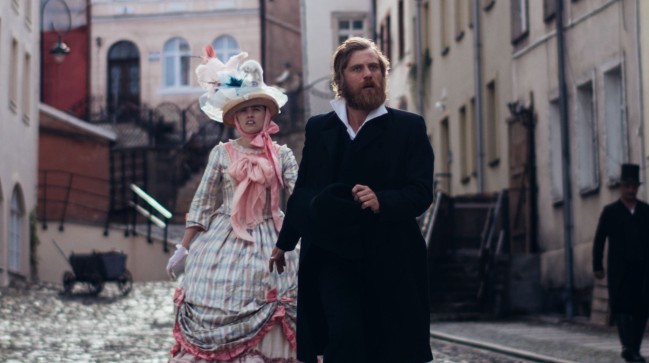
Broadly speaking, great works of Russian literature have a tendency to combine painfully austere themes with strangely rich imaginations. That rapturous clash, filtered through the paranoia of a guilt-driven crime thriller, helped make Fyodor Dostoevsky’s serialized 1866 novel “Crime and Punishment” a global sensation. But at the start of “The Idiot(s)” — Małgorzata Szumowska and Michał Englert’s semi-surreal account of the Russian author’s disastrous European honeymoon — success sends Dostoevsky (Johnny Flynn) into a fit of writer’s block that threatens to doom him and his new wife, Anna (Aimee Lou Wood).
At least as their marriage is presented here, the Dostoevskys probably shouldn’t stay together quite as long as they do. And even packaged as a multilingual fantasy, draped in some of the most outrageously lush production design choices this side of Joe Wright’s “Anna Karenina,” the making of “The Idiot” is nearly as frustrating to watch on film as it must have been to put on the page.

Szumowska and Englert make that misery work for them, to a point. Their ambitious film begins as the newlyweds arrive in Baden, where Fyodor’s fame attracts fellow travelers — including rival Russian novelist Ivan Turgenev (Christian Friedel). The suspense that draws these particular elitists toward the Dostoevskys is the same tension that made “Crime and Punishment” magnetic for contemporary audiences, and “The Idiot(s)” echoes the queasy allure of watching someone rationalize his way toward disaster.
Fyodor, meanwhile, struggles to transform his inner turmoil into the literal “Idiot,” an intimidating totem that eventually became a dense exploration of the writer’s views on innocence, jealousy, romance, and goodness. He proves as antagonistic as his fiction in “The Idiot(s),” repeatedly gambling away what little money he and Anna have while his wife scrambles to keep them solvent.
“Pain and suffering purify the soul,” he contends, as the titular idiots submit themselves for an unfathomable amount of both across an ultimately punishing two hours. Fantasies from the perspectives of husband and wife interrupt that decline, forming an almost circus-like pattern of mutual destruction. As Anna covers for Fyodor’s addiction and increasingly unstable professional behavior, her devotion starts to look poisonous for them both.
Visions of executing her husband dance through her head with wonderful humor throughout. Still, she stays — and Wood punctuates her best scenes by swinging wildly in tone alongside the script. Grounded in tragedy and yet evoking a consistent sense of wonder, the lady of the house looks less like a mirror for her husband than a magnifying glass held over his genius and grotesquerie. (“Tell me I’m a bad Russian,” he coos in one of many bizarre kink scenes exploring the intimate side of the Dostoevskys’ relationship.)
Opposite her, Flynn does some of his best work when he is positively rotting in Fyodor’s existential anguish. At a gathering with other artists, a seemingly playful party game culminates in an excruciating monologue about child abuse. And to Flynn’s credit, Fyodor is profoundly hateable. That’s plainly the point, but Anna’s love for him provides “The Idiot(s)” with its most poignant tether to reality.
Of course, it’s not a straightforward historical account. The screenplay — credited to Szumowska, Englert, Kasper Bajon, and Bríd Arnstein — draws from Andrew D. Kaufman’s biography “The Gambler Wife,” as well as Anna’s diaries, memoirs, correspondence, and other historical research. The real Anna first worked for Dostoevsky as a stenographer who helped him complete “The Gambler” in 26 days. She did not officially co-write “The Idiot,” but she lived through its creation while managing Fyodor’s gambling, debts, epilepsy, and precarious career. Their first child also died during these years abroad.
That distinction matters because “The Idiot(s)” knowingly mixes biography with manifestations of imagination. Vicky Krieps is a particular scene-stealer as the mysterious Natasha F, a spectral variation on “The Idiot” heroine Nastasya Filippovna who barely needs to speak to haunt the starring lovers’ marriage. That device makes this sideways biopic a particularly rewarding companion piece for devotees of the novel, but it also demands a daunting amount of prior knowledge.
Viewers unfamiliar with Dostoevsky may struggle to determine which women, flirtations, and betrayals belong to history — and which come from his fiction or are the original work of Szumowska and Englert entirely. That factual slipperiness might matter less if the psychology connected more deeply. But “The Idiot(s)” explores the novel’s themes without directly adapting or fully contextualizing them, leaving the intellectual exercise richer than many of the experience’s actual rewards.
The dizzying experience of imagining “The Idiot” will always exceed any attempt to render its spirit onscreen; this film never finds a substitute for the novel’s enormous interiority. That said, the surfaces are immaculate with Englert, serving as both co-director and cinematographer, moving through the Dostoevskys’ decline with astonishing care. Ewa Mroczkowska’s production design also turns dewy embankments, decadent interiors, and sunrises over cemeteries into visions of storybook-like decay.
There is no question that these years of suffering are, in their own way, beautiful. But the love enduring at their center feels so profoundly misguided that even this extravagant tribute, arriving more than 150 years later, cannot entirely defend it.
Grade: C+
“The Idiot(s)” premiered at the 2026 Telluride Film Festival.
Want to stay up to date on IndieWire’s film reviews and critical thoughts? Subscribe here to our newsletter, In Review by David Ehrlich, in which our Chief Film Critic and Head Reviews Editor rounds up the best new reviews and streaming picks along with some exclusive musings — all only available to subscribers.
>

As she finishes transcribing what will become one of her husband’s most enduring masterpieces, Anna Dostoevskaya (Aimee Lou Wood) cannot contain her excitement: “This is our best novel yet!” She quickly corrects herself, of course — “I mean, your best novel” — but by then, we understand she had it right the first time.
Sure, those might be Fyodor’s words on the page, and his name on the cover. But as Malgorzata Szumowska and Michal Englert’s shrewd, playful The Idiot(s) reminds us, not even singular geniuses really do it all alone. If the film ultimately overstays its welcome, it’s hard to fault it for wanting to let this unsung companion luxuriate, for once, in the spotlight.
The Idiot(s)
The Bottom Line
Sharp and fun, even if it overstays its welcome.
Venue: Telluride Film Festival
Cast: Aimee Lou Wood, Johnny Flynn, Vicky Krieps, Christian Freidel
Directors: Malgorzata Szumowska, Michal Englert
Screenwriters: Malgorzata Szumowska, Michal Englert, Kasper Bajon, Brid Arnstein
2 hours
As Anna, Wood projects both unpolished brightness and an impressive force of will; it’s a mesmerizing combination that keeps the character from ever feeling like a mere victim of her circumstances, even as her life takes the harsh turns of, well, a Russian novel. If anything, the character’s initial introduction calls to mind Wood’s earlier breakout role on The White Lotus. Here as there, she’s the sweetly enthusiastic romantic partner to a grumpy older dude who seems determined to hate the new country they’re visiting from the moment he sets foot on it.
It’s just that in this case, her S.O. is not some revenge-driven man of mystery but a writer drowning in debt and stymied by writer’s block. But The Idiot(s) makes clear right away that it isn’t interested in the usual serious biopic clichés about serious men doing serious things. This Fyodor, played by Johnny Flynn as a comically exasperating combination of buffoonish confidence, abject self-pity and childish petulance, is first seen glowering at a woman peeling hard-boiled eggs on the train, a fantastically overwrought classical soundtrack underlining the unreasonable intensity of his moods.
He says things like “Tolstoy’s gonna shit himself” (of the novel he, Fyodor, is definitely for sure gonna start writing any day now) and “Kick me in the face” (to Anna, as part of a kinky foot-fetish debasement ritual). It’s not that the filmmakers doubt his talent as an author — the caption to that aforementioned opener, “9 a.m., the last days of November, during the thaw,” is the first of multiple affectionate nods to Dostoevsky’s The Idiot — so much as they recognize that reverence for a person’s work need not necessarily translate to admiration for his personality.
The couple have arrived in Germany ostensibly so Fyodor can work on his next project. The creatively tortured, easily distracted Fyodor, quicky sets about doing anything but. When he’s not out partying with the very upper-crust literati he claims to disdain, including rival scribe Ivan Turgenev (Christian Friedel) and his coquettish girlfriend (Vicky Krieps, alluring but underused), he’s blowing all his money at the roulette table. When he is at home, he oscillates between drunken glee and utter despair. Whenever Anna sneaks a peek at his notebooks, she finds either blank pages or doodles of naked women, not a word of The Idiot in sight.
It would all be very depressing for poor Anna, were it not for the fact that The Idiot(s) does its best to keep the phrase “poor Anna” from entering your mind for as long as it can. For one thing, the film is too busy having fun to let itself stew in misery. It’s stuffed with mischievous anachronisms like a 19th-century performance of “Take On Me,” the A-Ha hit whose pleading lyrics could double Fyodor’s entreaty to a fed-up Anna. And it delights in outrageous rococo details, like a restaurant dessert that’s essentially chocolate mousse being squeezed out the anus of a porcelain dog.
More crucially, the screenplay, by Szumowska, Englert, Kasper Bajon and Brid Arnstein, paints Anna not as some passive observer to Fyodor’s bad behavior but an active (albeit only fitfully successful) guardrail against it. As her husband gives himself over to his worst impulses, it’s Anna who nudges him to work, who tries to get the bills paid, who even, as things get dire, secretly writes and submits pages on his behalf to mollify his angry publisher. While Anna may not always be in control of her own fate, there’s never any doubt she’s in possession of her own agency.
True, she’s making the choices she does in part because she has few others: Living in a foreign land without even enough cash for a train ticket home, Anna would have a tough time leaving Fyodor even if she’d wanted to. But, The Idiot(s) makes it clear, she doesn’t especially want to.
Anna loves Fyodor truly and stubbornly, and he loves her back in his own inconsistent and imperfect way. Key to the film’s portrait of their marriage is the frisky chemistry that courses between them when they’re holding hands in bed or engaging in silly dirty talk about hard-boiled eggs. For all the relationship’s intolerable flaws and harrowing lows, it’s not without true affection.
Anna’s indulgence for his antics is another thing, however. As the situation deteriorates to the point that Anna’s pawning off her chamber pots and eating scraps off the streets, it becomes harder and harder for us as viewers to forgive his sins. Perhaps that’s why The Idiot(s) gives over large chunks of its bleaker second half to absurd dream sequences.
But arriving as they do in the umpteenth iteration of the same repetitive cycle (Fyodor losing his money, begging Anna for more, losing it all again and then some), these sequences land not only as unnecessary drags on an already puffy run time but as an uncharacteristic failure of confidence. We don’t require a clip of Fyodor fleeing from a boulder-sized roulette ball to tell us he’s being crushed by his gambling addiction when we’ve already seen that he is; we don’t need to see him plead against charges of chauvinism before a guillotine when we know exactly how poorly he treats Anna.
Then again, if the clunky pacing of the film’s latter chapters remind us of anything, it’s how long Anna toiled to help bring The Idiot into the world. Compared to all those long years, what’s a few extra minutes of sitting and watching her struggles on a screen? “Every Russian writer should have a wife like you,” Ivan marvels at one point, moved by Anna’s strenuous efforts to help her ungrateful and oblivious husband. What The Idiot(s) impishly suggests, by demonstrating all the invisible but essential labor Anna’s poured into his books, is that a lot of them probably already did.
>

Ben McKenzie admitted that he’d be open to signing onto a revival of “The O.C.,” but noted it would have to be under “the right circumstances.”
The actor, who played troubled teen Ryan Atwood on all four seasons of the Fox drama between 2003 and 2007, weighed in on the possibility of a revival during a recent appearance on Sydney radio station KIIS 1065.
After the interviewer pitched that McKenzie should return as “one of the dads,” referencing Peter Gallagher’s Sandy Cohen role, he revealed that he didn’t know if there were ever “serious talks” about a revival, but that he’d “be up for it.”
“Sure. Why not?” McKenzie said. “Yeah, I think so, under the right circumstances. It was a great show. We had a great time. I learned a lot. I was so young, we were all young.”

When the radio host declared that she wanted to see McKenzie the lead of an “O.C.” revival, he matched her passion and responded: “Let’s make it happen!”
Elsewhere in the interview, McKenzie admitted that he showed his 10-year-old Frances the pilot episode – a decision he went on to regret.
“I forgot that in the pilot, there is binge drinking, cigarette smoking, cocaine and a threesome,” he shared. “Of course, my 10-year-old loved it and wanted to watch more.”
Watch his comments below.
While McKenzie made it clear he’s open to participating in a revival project, he currently has his hands full, promoting his documentary film, “Everyone Is Lying to You for Money,” guest starring on his wife Morena Baccarin’s police procedural “Sheriff Country” and raising three kids.
In addition to “The O.C.,” McKenzie is known for his work on the crime drama “Southland,” the superhero drama “Gotham” and the Academy Award-nominated film “Junebug.”

>

Nottingham Forest squad audit: From Diomande to Delap, Glasner has plenty of options

‘The Idiot(s)’ Review: Johnny Flynn, Aimee Lou Wood Suffer Rapturously

How Lucas Bergvall ended up staying at Spurs despite Forest and Newcastle bids
-

 movies4 months ago
Search For Canadian TV Actor Stewart McLean Now Homicide Investigation
-

 Fashion9 years ago
These ’90s fashion trends are making a comeback in 2017
-
Fashion9 years ago
According to Dior Couture, this taboo fashion accessory is back
-
Fashion9 years ago
Model Jocelyn Chew’s Instagram is the best vacation you’ve ever had
-
Fashion9 years ago
Emily Ratajkowski channels back-to-school style
-
Fashion9 years ago
9 Celebrities who have spoken out about being photoshopped
-

 Anime3 months ago
Rurouni Kenshin: Hokkaido Arc Manga Takes 1-Issue Break – News
-

 Anime2 months ago
HIDIVE to Stream English Dubs for The World Is Dancing, The Forsaken Saintess and Her Foodie Roadtrip in Another World, The Dangers in My Heart: The Movie Anime – News