
Anime
Final Fantasy VII Revelation and Beyond: An Interview with Director Naoki Hamaguchi – Tokyo Game Show 2026


We’re now seven months out from the release of the final game in the Final Fantasy VII Remake trilogy, Final Fantasy VII Revelation. This week, I was able to meet up with the game’s director, Naoki Hamaguchi, at Tokyo Game Show 2026. There, we talked at length about the lessons learned from the previous two titles, how things will change in Revelation, and the delicate dance of putting a new twist on one of the most beloved games of all time. We even touched on the choice to incorporate aspects of the Compilation of Final Fantasy VII into the trilogy and what’s next for Final Fantasy VII beyond Revelation.
What do you feel was the biggest problem with Remake and/or Rebirth and how do you fix that problem with Revelation?
Naoki Hamaguchi: So just to clarify, there weren’t really “problems” with Remake or Rebirth, but we are definitely scaling things up from Rebirth and Remake [for Revelation]. For Remake, it was more story-driven than anything else, similar to previous Final Fantasy titles. With Rebirth, it was a story-focus-meets-open-world kind of framework. That’s what we were going for with Rebirth.
But with Rebirth there have been comments that there was possibly too much to do in the open world—that with the scale of this world, we didn’t need to fill it with content and things to do. So for [Revelation], the scale is still very large and there’s still lots of things to do, but we have made it easier to play.
Based on what you’ve heard from fans, what is the most hated mini-game across Remake and Rebirth?
Hamaguchi: There are a lot of mini-games—and many different styles of mini-games—and I think every player has their own personal preference. It’s an RPG, so the characters are moving around the environment in a really specific way—they’re not walking around in action-combaty ways.
For example, there was the Moogle House mini-game. But people who wanted to focus on the action, didn’t really want to step away from the action elements and do that.
However, for people who are interested, the Moogle Houses are returning for Revelation. But, as for the Moogles, they have since quit their jobs as Moogle merchants and they’re now trying their hand at being on stage—making a little idol group.
Anyway, since a lot of people didn’t really like that Moogle mini-game, that was definitely one thing we wanted to change and so we’ve made it more accessible—and hopefully more people like the Moogles!
Despite Rebirth‘s popularity, only 2.6% of PS5 players have the platinum trophy. As one of the players who has it, I know exactly why this is: the final three VR boss gauntlets that require you to not only play perfectly for nearly 30 minutes but also get very lucky to beat them. Why did you make this so time consuming and unforgiving (especially compared to Remake and INTERmission)? Have you eased up on this for Revelation?
Hamaguchi: For Rebirth‘s platinum trophy—well, for Rebirth in general—there’s so much to do. There’s so much content. We wanted to make people go through all this content and perfect it. It’s kind of by design that that would make it difficult.
So I don’t want to call it a mistake in judgment or anything but we also didn’t expect so many people to want the platinum trophy. I think that was what we underestimated here. Battle director Teruki Endo also saw [the fan reaction] and was like, “Oh, no! I feel bad—I have regrets.”
In comparison, for Revelation, the platinum trophy will be easier to get. In terms of how difficult it will be, we’re expecting twenty percent of players or maybe even more than that to be able to obtain it.
We have a lot of interesting stuff for [the brutal and legendary VR Combat Simulator] battles as well. For example, obviously there are three person battles, but in each set of fights you’ll only be able to use each character once—so it’ll be interesting to see how people go about that. It’s not just about the amount of battles that there are but the battles themselves that are going to be enjoyable. I think that’s one thing that we’ve learned from Rebirth: to make the battles themselves enjoyable rather than just challenging.

© SQUARE ENIX
The Final Fantasy VII Remake trilogy has always seemed to be about fighting fate—fighting back against the story of the original Final Fantasy VII—as much as fighting Sephiroth. How did this idea come about and how has it evolved over the course of making the three games?
Hamaguchi: The fan base is really entrenched in this series. And so we had to be very careful about how we approached the story. We knew we had to be very respectful of the original version, which is so beloved by so many people. That’s the basis where we started from.
So there is an element of fighting against what was already perceived, but the core is still there that would make people who are fans of the original see, “Oh, this is the same story. The same beats are happening here.”
I think with all of these games, it’s about allowing the players to imagine what’s going to happen next. There are subtle changes that are happening like with Zack and all those other elements. It’s always about getting fans to imagine what’s coming next.
Were there ever any serious discussions about having Aerith live beyond Rebirth—or was the plan always to have Cloud and the others lose to fate?
Hamaguchi:Of course, there are many ways to look at the ending of Rebirth, and I think that is up to every fan [which way they look at it], so I’m not going to speak on the truth of what actually happens.
For Revelation—for all of the titles—the story was decided long ago that we haven’t decided to change anything really. However, for that one specific scene, we decided to take a different track from the original by providing different camera angles, different approaches, different ways the characters saw that scene—and allow fans to draw their own conclusions about it.
Zack’s story always felt complete to me with Crisis Core. It’s the story of a man who dreamed of becoming a hero, becomes disillusioned with heroes over his adventure, but actually becomes one in death by saving Cloud. What is the theme or message you want to convey to players through Zack’s new story in the Remake trilogy?
Hamaguchi: There are two reasons really that we’re adding more Zack and fleshing him out more. Zack obviously appeared in the original but he wasn’t really fleshed out as a character. But in the Remake series, he’s integral to who Cloud is as a character—as a person—and so we knew that people who didn’t play Crisis Core needed to understand who Zack was in order to fully understand who Cloud is. Because of this, we knew he needed a bigger role—to have an important role—in the games.
His other role in the Remake series is to help players understand where the original and the Remake series diverge. He kind of shepherds the players understanding of that concept—of how things are changing. We knew that we needed someone to instruct players about how things are changing and so we did that through gameplay elements with Zack.
How did the decision to include elements from Dirge of Cerberus come about and will these continue throughout Revelation as well?
Hamaguchi: We wanted to incorporate not just Dirge of Cerberus, but all of the [Compilation of Final Fantasy VII] titles really. We started that with Yuffie and the Deep Ground Soldiers [in Episode INTERmission].
In all three titles, we really tried to incorporate as much as possible. But with Revelation specifically, we definitely added connections to Advent Children, Before Crisis, Crisis Core, Dirge of Cerberus—all the parts of the Compilation of Final Fantasy VII. This was something we definitely wanted to include in Revelation, and I think it’s going to be interesting for players to experience this.
If you wanted to do a fourth Remake game, you could easily cover the events of Advent Children and/or Dirge of Cerberus. And then there’s the fact that Dirge of Cerberus ends on a cliffhanger (that we’ve been waiting 20 years to be resolved) if you wanted to do a fifth. What are your thoughts on the future for the Final Fantasy VII remakes? Do you feel that it can continue on or do you feel that it should just kind of stop with the conclusion of this game?
Hamaguchi: At this time, Revelation is the conclusion of the series—and there’s a reason for that.
At the moment we don’t really have plans for the future of Final Fantasy VII necessarily, but we’re not leaving anything on the table for this final installment. We don’t want any of the developers thinking, like, “Oh, I wish I would’ve done that,” and then, “Oh, shoot, should’ve done that too,” and save it for the next title or anything like that. We want to do it all here and now.
With that in mind, maybe after the game comes out, depending on fan reaction, maybe there will be something, but at the moment we’re really aiming to just complete the series with a satisfying ending that fans will love.
A Vincent DLC and a Sephiroth DLC have been announced for Revelation. If Revelation ends so conclusively, do neither of these DLC take place after the main story?
Hamaguchi: So for the DLCs, it’s not necessarily going to replace any part of the original story or the ending of Revelation. The DLCs are like Episode INTERmission—how we dove deeper into Yuffie and her character. That DLC shows a portion of the story that you don’t see in the original game or in the remake series, but you get to learn more about the characters.
So there’s obviously been a lot of fan theories with the Final Fantasy Remake trilogy. My favorite fan theory surrounds Sephiroth at the Edge of Creation. Because he uses “Ore” instead of “Watashi” as his personal pronoun, there are people who are certain that this means that Sephiroth at the Edge of Creation and normal Sephiroth are different characters. Was this an intentional thing, the difference in pronouns? Or was this an accident that has kind of spun off into something uncontrolled?
Hamaguchi: To be perfectly honest, I don’t think I should discuss that here. However, in Revelation, we’re definitely going to dive deeper into who Sephiroth is and about his character. We want you to kind of feel it out and see what’s going on with him. I think you’ll be able to figure it out.
>
Anime
The Otome Heroine’s Fight for Survival Anime’s Teaser Unveils Staff, Cast, July 2027 Debut – News

The staff for the anime of author Biyori Harunohi and illustrator Yu Hitaki‘s The Otome Heroine’s Fight for Survival (Otome Game no Heroine de Saikyō Survival) light novels unveiled an English-subtitled teaser promotional video and visual for the anime on Tuesday. The teaser announces the anime’s main staff, its first cast member, as well as its July 2027 television premiere.

©春の日びより・TO ブックス/乙サバ製作委員会
Fūka Izumi plays protagonist Alicia.

©春の日びより・TO ブックス/乙サバ製作委員会
Noriyoshi Sasaki (Ojisan to Marshmallow, Joshi Kausei, Holmes of Kyoto) is directing the anime at Studio Clutch and Seven. Tōko Machida (Lucky Star, The IDOLM@STER, My Master Has No Tail) is in charge of series scripts, and Hiroyuki Miseki is designing the characters. Kohta Yamamoto, Shun Narita, and Yūki Furuhashi are composing the music.

© Biyori Harunohi, Yu Hitaki, TO Books
J-Novel Club licensed the light novels, as well as Kobato Wakasa‘s manga adaptation. The company describes the story:
Orphaned by a monster attack on her village, young Alicia spends three horrid years in an orphanage before finally running away. When she flees, however, Alicia has a violent encounter with an older woman hell-bent on killing her. During their tussle, she comes into contact with a strange crystal that bestows upon her a wealth of knowledge, transforming her from an innocent child into a cool and calculated planner.
Now aware that she was meant to be the protagonist of an otome game and disgusted with her supposed fate, Alicia decides to take matters into her own hands and become strong—by any means necessary. Using her newfound knowledge, and with some help from a stranger she meets in the woods, she learns to survive by herself in a world far too harsh and unforgiving for a girl her age. Ready or not, she’s determined to carve her own path.
Harunohi debuted the story on the Shōsetsuka ni Narō website in March 2019. The light novel version launched in April 2021, and the 11th novel volume shipped in Japan on June 15. J-Novel Club released the sixth novel volume on March 13.
Wakasa launched the manga adaptation Otome Game no Heroine de Saikyō Survival @COMIC in August 2021 on Comic Corona. The manga’s ninth compiled book volume will ship in Japan on October 15. J-Novel Club released the seventh manga volume on August 12.
Source: Press release
Disclosure: Kadokawa World Entertainment (KWE), a wholly owned subsidiary of Kadokawa Corporation, is the majority owner of Anime News Network, LLC. Yen Press, BookWalker Global, and J-Novel Club are subsidiaries of KWE.
>
Anime
The Fledgling Demon Lord’s Starter Shop Anime’s 2nd Teaser Reveals More Cast, January Debut – News

The official website for the television anime of Makoto Morishita‘s The Fledgling Demon Lord’s Starter Shop (Sudachi no Maōjō) manga presented on Tuesday the anime’s second teaser promotional video, key visual, additional cast member, and January 2027 premiere on the Tokyo MX, MBS, BS11, and other channels.

©森下真・講談社/「すだちの魔王城」製作委員会
The anime’s staff also presented a new character visual. The visual features two characters with previously announced cast members Reiji Kawashima as Murabito or Villager (center in image below) and Rumi Ōkubo as Mao (left). It also features Ash (right), the hero (voiced by Yōhei Azakami) who once defeated the demon lord and saved the world.

©森下真・講談社/「すだちの魔王城」製作委員会

©森下真・講談社/「すだちの魔王城」製作委員会
Kodansha‘s K MANGA service releases the manga in English and describes the story:
After the hero defeated the demon lord, the world is finally at peace… leaving the young Villager of Beginnerville in a bind! Without a demon lord to defeat, people have no need for potions and items…leaving Villager’s item shop, The Nest, empty and lifeless. At this rate, Villager might have to close The Nest…! But then suddenly a mysterious girl appears and everything changes…
Jun Taira is directing the anime at project No.9. Keiichirō Ōchi (Adachi and Shimamura, The Angel Next Door Spoils Me Rotten, Once Upon a Witch’s Death) is in charge of series scripts, and Katsuyuki Sato (Hokkaido Gals Are Super Adorable!, Plus-Sized Elf, My Friend’s Little Sister Has It In for Me!) is designing the characters.
Additional staff members incluide:
Morishita launched the manga in Kodansha‘s Monthly Shonen Magazine in October 2021. Kodansha will ship the 14th compiled book volume on October 16.
Morishita launched the IM: The Great Priest Imhotep manga in Square Enix‘s Shonen Gangan magazine in January 2015 after first publishing a one-shot. Square Enix published the 11th and final volume in September 2018. Yen Press licensed the manga and released the 11th volume in English in February 2019.
Sources: The Fledgling Demon Lord’s Starter Shop anime’s website, Comic Natalie
>

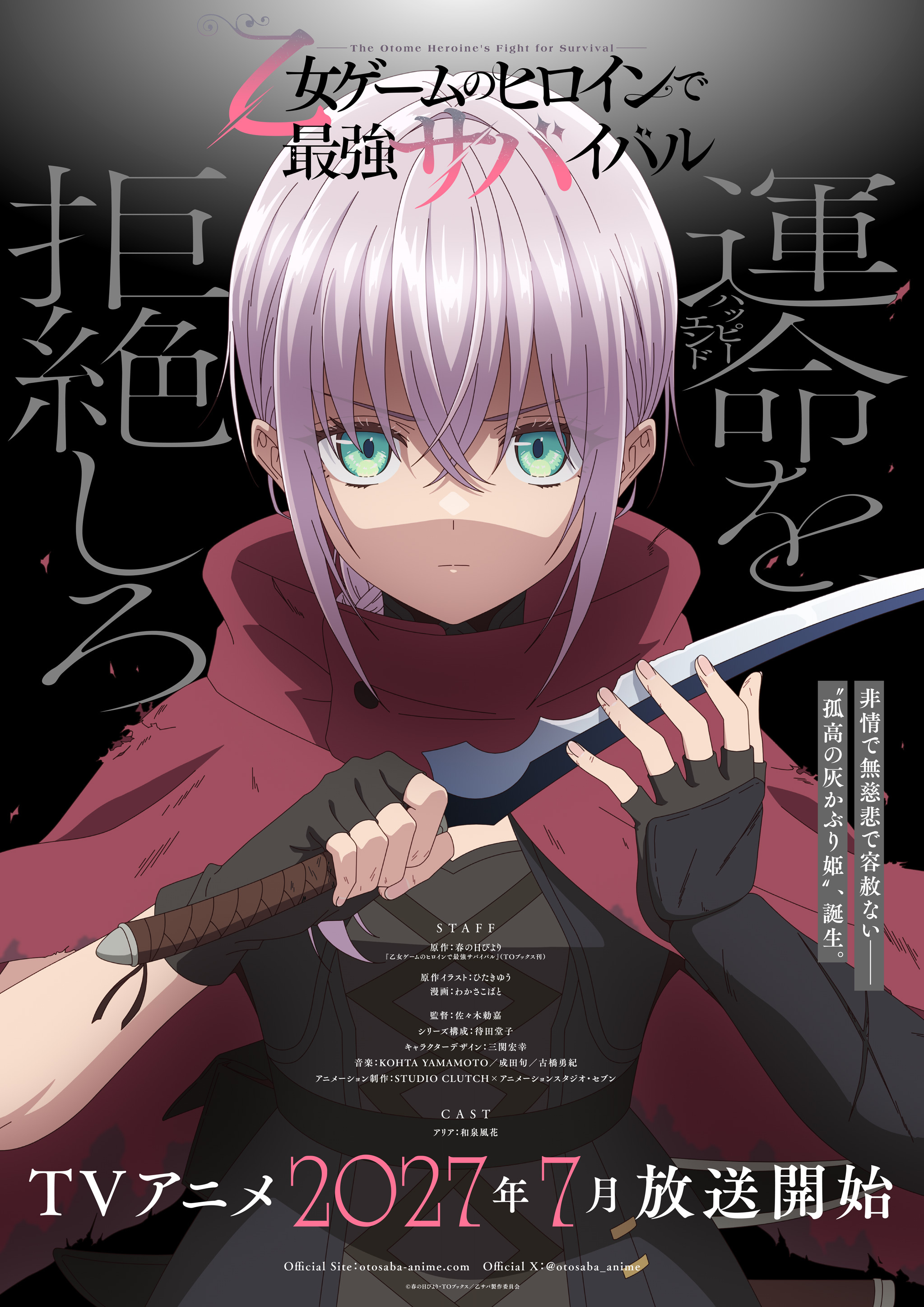 Production company Slow Curve opened an official website for the Otome Game no Heroine de Saikyou Survival (The Otome Heroine’s Fight for Survival) anime project on Tuesday, revealing the main staff, lead cast, a teaser visual (pictured), special promo, and its television format. The anime series adapting Biyori Harunohi‘s adventure fantasy light novel is scheduled to premiere in July 2027.
Voice actress Fuuka Izumi (Mahou Shoujo ni Akogarete, Shikanoko Nokonoko Koshitantan) is starring as the protagonist Alia (Alicia Melrose).
Staff
Director: Noriyoshi Sasaki (Kyoto Teramachi Sanjou no Holmes)
Series Composition: Touko Machida (Loop 7-kaime no Akuyaku Reijou wa, Moto Tekikoku de Jiyuu Kimama na Hanayome Seikatsu wo Mankitsu suru)
Character Design: Hiroyuki Miseki (Tadaima, Ojamasaremasu! assistant chief animation director)
Music: Kohta Yamamoto (Shingeki no Kyojin: The Final Season), Shun Narita (Noblesse), Yuki Furuhashi (Otome Kaijuu Caraméliser)
Studio: Studio Clutch, Seven
Harunohi began penning the series on the Shousetsuka ni Narou website in March 2019. TO Books began publishing the novel in April 2021, featuring illustrations by Yuu Hitaki (Fuguushoku “Kanteishi” ga Jitsu wa Saikyou Datta). The eighth volume went on sale last June. The 11th volume went on sale on June 15. The light novel has a cumulative 900,000 copies of its volumes in circulation.
Comic Corona began serializing a manga adaptation by Kobato Wakasa in August 2021. TO Book published the eighth volume on January 15, with the ninth volume scheduled for release on October 15.
J-Novel Club licensed both the light novel and manga adaptation in English for digital release in November 2023 and January 2024, respectively. The sixth novel volume went on sale on March 13, with the eighth manga volume scheduled to be released October 7.
Special PV
Official site: https://otosaba-anime.com/
Official X: @otosaba_anime
Source: Press Release
>
Sergei Murashov's strong season debut not enough to rescue Penguins
An emotional night in New Orleans. Plus: Are the Yankees cooked?

Saints thrashed as Falcons score six touchdowns
-

 movies5 months ago
Search For Canadian TV Actor Stewart McLean Now Homicide Investigation
-

 Fashion9 years ago
These ’90s fashion trends are making a comeback in 2017
-
Fashion9 years ago
According to Dior Couture, this taboo fashion accessory is back
-
Fashion9 years ago
Model Jocelyn Chew’s Instagram is the best vacation you’ve ever had
-
Fashion9 years ago
Emily Ratajkowski channels back-to-school style
-
Fashion9 years ago
9 Celebrities who have spoken out about being photoshopped
-

 Anime4 months ago
Rurouni Kenshin: Hokkaido Arc Manga Takes 1-Issue Break – News
-

 Anime3 months ago
HIDIVE to Stream English Dubs for The World Is Dancing, The Forsaken Saintess and Her Foodie Roadtrip in Another World, The Dangers in My Heart: The Movie Anime – News