
Anime
RESIDENT EVIL (2026) Live-Action Film Review – Review

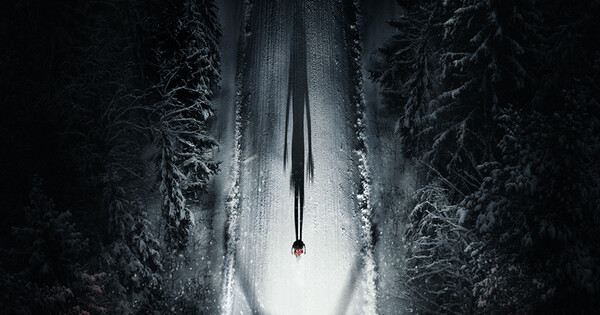
I’m fairly certain that RESIDENT EVIL doesn’t even make it to the ten-minute mark before its well-meaning hero, Bryan (Austin Abrams), is covered in blood and screaming for his life. The first and most significant thing that anyone is likely to notice about Zack Cregger’s crazed and confident stab at adapting CAPCOM‘s beloved franchise of survival-horror video games is that this sucker moves with the unrelenting ferocity of its ravenous undead hordes. In the frantic opening minutes of the film, we are introduced to our reluctant protagonist as he is navigating the personal crisis of a pregnancy scare with his girlfriend Michelle while trying to get his final medical delivery for the night. Once he accepts that fateful assignment that sends him down the snowy mountain roads towards Raccoon City, neither Bryan nor the audience are given more than a few moments to breathe and take stock before a bloody car crash and an even bloodier encounter with a doomed state patroller force Bryan to take up arms and start running and shooting his way through the monsters that are bearing down from every dark corner.
Throughout his promotional tour for the film, Cregger has been quick to emphasize how much his interest in helming the latest attempt to bring CAPCOM‘s legendary property to the silver screen lies in capturing the feeling of playing a meticulously crafted survival-horror experience, and not so much in carrying over the decades of accumulated bioterror backstory and soap opera melodrama. This, I think, was absolutely the right call. While there are plenty of visual nods to iconic elements from the games — a stray can of health spray, a safe room with a dusty old typewriter at its center, progress-barring padlocks that demand keys engraved with conspicuous symbols — RESIDENT EVIL is not concerned at all with the typical drudgery of dragging the same old story beats and characters out from whatever decrepit shaft of the IP Mines they’ve been trapped in for the last 30 years. I’m sure there are many diehard fans of the games who will be disappointed or even angry to learn that this movie will not be yet another remixing of storylines and boss monsters from specific RESIDENT EVIL games, but I would argue that Blumhouse Studio’s misguided Five Nights at Freddy’s series has demonstrated just how much we all stand to lose when a studio cares too much about activating the nostalgia-fueled dopamine receptors of its most lore-addled gatekeepers and not enough about making a proper, functional horror film.
Instead of worrying about finding the least awkward places to cram in cameos of everyone’s favorite Kennedys or Redfields, Cregger’s brutally efficient script locks in on the structure and pacing of the finest survival horror set pieces, and it is anchored by Austin Abram’s eminently likable and charming willingness to jump headfirst into whatever crazy cacophony of ultraviolence Cregger has devised. RESIDENT EVIL‘s greatest success is in how it intuitively understands the satisfaction that comes from navigating the constantly escalating set-pieces that define the best RE games’ design. The movie is defined less by the traditional three-act structure of a Hollywood script than by the “levels” Bryan must shoot and sprint his way across. We begin with a quiet, isolated trip into the snowy Colorado mountains, complete with a tension-filled excursion to a lone cabin in the woods. Then, after braving the unexpected horrors of undead flesh-eaters and tentacle-spewing demon dogs, Bryan has to carefully creep through a tunnel of the damned. The middle portion of the film sees Bryan rack up a body count and upgrade his weaponry as he makes his way through the streets (and sewers!) of Raccoon City proper.
The movie saves the best of its surprises, including some truly disgusting examples of its mix of practical and computer-generated special effects, for the climactic ascent of Raccoon City General Hospital. Each location that Bryan moves through is filled with awesome and horrifying creature designs that push the boundaries of good taste in the best way, and I can only hope that the artists working on the next games in the franchise are taking notes. The music by Cregger’s regular collaborators, Ryans and Hays Holladay, also worms its way into every scene, creating an appropriately moody atmosphere. I will leave the grumbling about missing cameos and clashes with canon to the disgruntled literalists. So far as I’m concerned, this movie has earned the right to carve the name of RESIDENT EVIL in jagged letters onto its very bones.
Zack Cregger famously got his start in the business with the sketch-comedy troupe The Whitest Kids U Know, and his knack for absurd comedic flourishes and timing mostly serves to elevate the entertainment factor of Bryan’s Terrible, Horrible, No Good, Very Bad Trip to Raccoon City. Bryan’s expletive-laden color commentary runs through his entire gauntlet through the woods and across the bloody streets of the city, striking the perfect balance of making the hero more sympathetic and relatable without diffusing the very real horror of his circumstances. He is, in many ways, the best possible version of the poor shmucks who always find themselves running for their lives when Umbrella Corp. starts getting feisty with the gene-splicing and quarterly finance reports. Bryan consistently demonstrates a knack for solving puzzles and adapting to each fresh new hell that Raccoon City spits up from its foul gullet, and he is genuinely heroic with how earnest he is to help out the scant few survivors he encounters along the way. That doesn’t mean that he won’t squeal in terror and scream hundreds of bitter curses into the frozen night about how awful and ridiculous his life has become, and who among us would be right there with him, grumbling about all of these “stupid monsters?”
It’s in the more obvious and self-conscious humor that RESIDENT EVIL overplays its hand, somewhat. As the night goes on, Bryan crosses paths with several representatives of the esteemed Umbrella Corporation, and they are without fail portrayed as feckless idiots who doomed the world mostly on account of their Three Stooges-esque talent for shenanigans. On the one hand, I can appreciate the satire of framing the heralds of the apocalypse as overpaid nincompoops whose lust for profits drowned the last of their functioning brain cells. That said, the silliness of these Umbrella mooks threatens to defang the story’s only real antagonist and make Bryan seem like a comparative Leon S. Kennedy in resolve and skill. One character in particular is played by Paul Walter Hauser as such a broad comic caricature that he almost seems transplanted from a completely different movie with a completely incongruous tone.
Then there is the matter of the movie’s rather abrupt ending. Personally, I respect how Cregger and his team refused to compromise the breakneck pace and horror tone in RESIDENT EVIL’s final moments. This is my way of saying that the movie does not so much as “end” as it does “slam into the credits with all of the warning and subtlety of a car colliding with a brick wall.” Some freaks, such as myself, will find themselves applauding with the Evil Dead-style swerves the final act takes. Many viewers, I am sure, will be more than a little pissed off.
Then again, the Resident Evil games are notorious for making hard swerves in their climactic levels that fans either adore or begrudgingly tolerate, so this is nothing if not more proof that Zack Cregger has earned his bona fides. This lean, mean, beautifully shot production has finally managed to translate the best aspects of these games into an entirely different medium. Not only is this easily the best RESIDENT EVIL movie we’ve seen, it stands as one of the best video game adaptations ever made, at least by my reckoning.
>

 The official website for the television anime adaptation of Kureha‘s Kekkaishi no Ichirinka (Bride of the Barrier Master) novel unveiled additional cast, a third teaser visual (pictured), and second teaser promotional video on Monday. The anime series will premiere on Netflix in January 2027.
Cast
Hazuki Ichinose: Kanon Takao (Haibara-kun no Tsuyokute Seishun New Game)
Nozomi Ichinomiya: Hiroto Shimizu (Dark Moon: Tsuki no Saidan)
Azuha: Yuzuki Tamukai
Aoi: Taihi Kimura (Kagurabachi)
Miyabi: Mao Ichimichi (Tensei shitara Slime Datta Ken)
Tooru Kitahata (Nihon e Youkoso Elf-san.) is directing the anime at TROYCA, with Yuuko Kakihara (Giji Harem) handling the series composition and script. Minami Murayama (Atri: My Dear Moments prop design) is designing the characters. Yukari Hashimoto (Komi-san wa, Comyushou desu.), Ruka Kawada (Toumei Otoko to Ningen Onna), and R・O・N (Tensei shitara Dainana Ouji Datta node, Kimama ni Majutsu wo Kiwamemasu) are composing music composers.
Kureha published the romantic supernatural novel under its Kadokawa Bunko imprint in December 2021, featuring illustrations by Bodax. The seventh volume was released on June 16.
Odayaka began drawing a manga adaptation in B’s-LOG Comic magazine in May 2020. Kadokawa published the eighth volume on July 30.
J-Novel Club licensed both the light novel and manga in English release in August 2022 and July 2023, respectively. The fourth light novel volume shipped on July 15, with the fifth volume scheduled for a December 8 release. The sixth manga volume went on sale on May 26.
Teaser PV 2
Source: Moca News
>

Kadokawa revealed on Monday a new teaser promotional video, third teaser visual, and additional cast members for the television anime of Kureha‘s Bride of the Barrier Master (Kekkaishi no Ichirinka) light novel series. Kadokawa also announced that the anime will stream on Netflix and on other streaming platforms.

クレハ・ボダックス・おだやか/KADOKAWA/「結界師の一輪華」製作委員会
Additional new cast members include:
Kanon Takao as Hazuki Ichise, Hana’s twin sister

©クレハ・ボダックス・おだやか/KADOKAWA/「結界師の一輪華」製作委員会
Hiroto Shimizu as Nozomi Ichinomiya, Saku’s younger brother

©クレハ・ボダックス・おだやか/KADOKAWA/「結界師の一輪華」製作委員会
Yuzuki Tamukai as Azuha, Hana’s shikigami that rests on her hair like an ornament

©クレハ・ボダックス・おだやか/KADOKAWA/「結界師の一輪華」製作委員会
Taihi Kimura as Aoi, a shikigami in human form created by Hana

©クレハ・ボダックス・おだやか/KADOKAWA/「結界師の一輪華」製作委員会
M.A.O as Miyabi, another shikigami in human form created by Hana

©クレハ・ボダックス・おだやか/KADOKAWA/「結界師の一輪華」製作委員会

©クレハ・ボダックス・おだやか/KADOKAWA/「結界師の一輪華」製作委員会
The anime will debut in January 2027.
The anime will star Akari Kitō as Hana Ichise and Kikunosuke Toya as Saku Ichinomiya.
Tōru Kitahata (Science Fell in Love, So I Tried to Prove It, Welcome to Japan, Ms. Elf!, Hinako Note) is directing the anime at TROYCA. Minami Murayama (ATRI: My Dear Moments six episodes, IDOLiSH7 Third Beat! three episodes animation director) is designing the characters, and Yūko Kakihara (Blue Box, Cells at Work!, 2022 & 2024 Urusei Yatsura) is in charge of series scripts. Yukari Hashimoto (Mr. Osomatsu, Penguindrum), Ruka Kawada (Is the order a rabbit?, Isekai Quartet), and R.O.N (Kusunoki’s Garden of Gods, FLCL Alternative) are composing the music.
Yen Press‘ Yen On imprint publishes the light novels in English and describes the story:
For thousands of years, Japan has been protected by five clans wielding barrier-weaving magic. Born to a branch family of one such clan, eighteen-year-old Hana has always been stuck in the shadow of her more capable, beautiful, and popular twin sister. When a strong power awakens within Hana, she chooses to hide it so she can continue living a quiet life out of the spotlight. But that ideal lifestyle begins to slip out of reach when Saku Ichinomiya takes over as the new head of the Ichinomiya clan and sets out to find a bride strong enough to stand by his side. Eager to keep her abilities secret, Hana steers clear of Saku… but will she be tempted to sign a marriage contract if it guarantees the peaceful, quiet future of her dreams?
Kadokawa published the novels’ first volume with Bodax‘s illustrations in December 2021, and it published the seventh volume on June 16. The novels have over 2.5 million copies in circulation.
Odayaka‘s manga adaptation launched on Kadokawa‘s B’s-LOG COMIC digital manga magazine in March 2022. Kadokawa published the manga’s eighth compiled book volume on July 31. Yen Press also publishes the manga adaptation in English.
Source: Press release
Disclosure: Kadokawa World Entertainment (KWE), a wholly owned subsidiary of Kadokawa Corporation, is the majority owner of Anime News Network, LLC. One or more of the companies mentioned in this article are part of the Kadokawa Group of Companies.
>

Stage play runs January 8-13 in Tokyo
Asari Endō‘s Magical Girl Raising Project light novel series is receiving a stage play adaptation on January 8-13 at the Owlspot Theatre in Tokyo.

© 遠藤浅蜊・マルイノ/宝島社 ©︎Odd
The cast includes:
Saki Nagata is writing and directing the stage play.

© 遠藤浅蜊・マルイノ/宝島社
Endō’s Mahō Shōjo Ikusei Keikaku light novel series is set in a world where a social game called The Magical G irl Raising Project allows one in tens of thousands of people to be a “magical girl” — possessing extraordinary physical capabilities and looks, as well as special magical powers that set them apart from the rest of the human race. But one day, in a district containing 16 magical girls, the administration announces that it must halve the number of magical girls to solve the problem of magical energy. At first, the 16 magical girls race to collect more “magical candy” than their competitors, but the rules quickly become twisted, and it quickly becomes a murderous battle for survival among them.
The first 12-episode Magical Girl Raising Project anime premiered in Japan on the AT-X channel in October 2016, and Crunchyroll streamed the series as it aired.
The Magical Girl Raising Project Restart television anime will premiere on October 5. The anime will air on TV Tokyo on October 5 late at night at 2:00 a.m. (effectively October 6), and then on AT-X and BS Fuji on October 7.
Hiroyuki Hashimoto returns from the first Magical Girl Raising Project anime as the director. Takao Yoshioka is returning to write the script. Masako Itou (Magical Girl Raising Project SD character designer) is designing the characters for the new anime based on original designs by Maruino. Satoki Iida is returning as sound director. Synergy SP is the new animation studio, replacing Lerche that animated the previous Magical Girl Raising Project anime. Minori Chihara performs the anime’s opening theme song “No tears here.” Daisy×Daisy performs the ending theme song “ReMind.”
Endō launched the original light novel series through Takarajimasha‘s Kono Light Novel ga Sugoi! Bunko imprint in June 2012, and Takarajimasha published the 18th volume in November 2023. The second and third light novel volumes, published in November and December 2012, cover the “Restart” arc. Yen Press began publishing the novel series in English in June 2017.
Nori-Senbei launched the manga adaptation of the “Restart” arc in Kadokawa‘s Monthly Comp Ace magazine in 2016, and Kadokawa published one volume in September 2016.
Sources: Odd Entertainment‘s X/Twitter account, Stage Natalie
>
Wrexham buy famous The Turf pub from Welcome to Wrexham documentary

Saudi Arabia’s Red Sea Film Festival Cancels 2026 Edition

Shaun Edwards: Red Roses bring in famed defence coach for WXV Global Series
-

 movies4 months ago
Search For Canadian TV Actor Stewart McLean Now Homicide Investigation
-

 Fashion9 years ago
These ’90s fashion trends are making a comeback in 2017
-
Fashion9 years ago
According to Dior Couture, this taboo fashion accessory is back
-
Fashion9 years ago
Model Jocelyn Chew’s Instagram is the best vacation you’ve ever had
-
Fashion9 years ago
Emily Ratajkowski channels back-to-school style
-
Fashion9 years ago
9 Celebrities who have spoken out about being photoshopped
-

 Anime3 months ago
Rurouni Kenshin: Hokkaido Arc Manga Takes 1-Issue Break – News
-

 Anime3 months ago
HIDIVE to Stream English Dubs for The World Is Dancing, The Forsaken Saintess and Her Foodie Roadtrip in Another World, The Dangers in My Heart: The Movie Anime – News