
Ba’s Book
toronto film festival


Concerts, and concert films, don’t come much starker than Cameron Winter at Carnegie Hall. Oscar-winning director Paul Thomas Anderson offers an unusual follow-up to his Oscar-winning One Battle After Another with this 72-minute effort chronicling a solo concert by the Geese frontman in December, 2025, at New York City’s legendary concert venue. Receiving its world premiere at the New York Film Festival, the movie will be receiving roadshow-type engagements around the country with 35mm projection.
Winter, only 23 years old at the time of filming, is very much in the Miles Davis mode of performers. Delivering his stripped-down set of songs, many of them taken from his acclaimed debut solo album Heavy Metal, while accompanying himself on a Steinway grand piano, he sits in near-darkness with his back mostly to the audience. Stage patter is virtually non-existent, and when he walks away from the piano briefly, seemingly in search of a stage exit, it produces one of the few laughs of the evening. You can feel the relief of the audience being given a break from the overall somberness.
Cameron Winter at Carnegie Hall
The Bottom Line
Beautifully done, though not for all tastes.
Venue: New York Film Festival (Spotlight)
Director: Paul Thomas Anderson
1 hour 12 minutes
Nonetheless, he’s an arresting performer, singing in a haunting baritone with occasional flourishes of falsetto and seemingly lost in a meditative trance. His songs — featuring such titles as “Cancer of the Skull,” “Take It With You” and “If You Turn Back Now” — aren’t exactly easy listening, and their lyrics, referencing such figures as the Devil, Jesus, God, and the Rolling Stones’ Brian Jones, are even darker.
That is, when you can discern their meaning, as they tend toward the elliptical — although there’s no mistaking the message in “Vines” when he sings, “I feel loneliest when I’m with you.” Indeed, he seems to relish the vitriol in his song “Take It With You” with the lyric, “I found a keepsake of you by the window in the kitchen, babe/Take it with you when you leave.” His style, reminiscent of Nick Cave, is incantatory, and the result is that the not-especially-melodic songs tend to bleed into each other with a sameness that ultimately proves monotonous.
Anderson matches his subject’s reticence with a similarly spartan approach. Other than a brief opening montage in which we see eager audience members having their tickets scanned upon entering, the film consists simply of the concert from beginning to end. The end credits are featured at the close of the show, followed by an encore song and a title graphic proclaiming Winter to be “Dead at 23,” as if jokingly hinting at his already seemingly mythical status at such a young age.
The movie certainly allows a better view of Winter than the one that was afforded the live audience, since Anderson provides plenty of close-ups of the singer in all his art cabaret-style intensity, even if the shadowy lighting often obscures his features. Performing instrumental passages, the singer often lowers his head so much that his forehead nearly touches the piano keys. Although the cinematography is largely straightforward, Anderson occasionally mixes it up with shots taken from various parts of the auditorium, including the rear of the stage and the ceiling. At one point, we watch from the POV of someone walking down the aisle toward the stage, the camera bouncing up and down in his hand. Later, there’s a jarring cut from Winter to the perspective of a camera entering the stage area through opened doors, as if desiring to make its presence known. During one number, we see an image of Winter’s shadow on one of the venue’s walls.
It’s all very arty and self-conscious, but undeniably effective. Like most good concert films, Cameron Winter at Carnegie Hall makes you feel as if you were actually at the show but provides an even better aesthetic experience.
>
Montreal documentary maker Ashley Duong saw her father, Anh Duong, end a lifetime of cold silence over his traumatic upbringing in war-torn Vietnam by publishing a memoir shaped as a series of letters to his daughter.
So it wasn’t long before Duong, in her chosen medium, film, adapted her father’s memoir into Ba’s Book, an inventive hybrid film that bends the edges of a documentary with drama and is screening on Sunday night at the Vancouver Film Festival. She pieces together the journey the director’s tight-lipped father, also known as Ba, took through Vietnam during that civil war and as a refugee in 1970s revolutionary Iran, before starting a new life in Canada in 1980.
During that lifetime, Ba kept painful memories hidden from his daughter and family until the 2024 publication of Dear Da-Le: A Father’s Memoir of the Vietnam War and the Iranian Revolution. “There’s all these moments throughout his life where he was really learning how to hide his emotions,” Duong tells The Hollywood Reporter, as her father had a need to navigate political landmines as a witness to wartime brutality in Vietnam and Iran.
Ba’s Book
toronto film festival
But what her father left out of his memoir and Duong captured in her film was the untold torment of Ba leaving his mother, Nguyen Thị Bay, or grandmother Ba Noi, and close relatives behind in their ancestral village in Vietnam. And it’s those siblings with whom Ba reunites — and is brought at times to bruising places as they reveal their own untold family secrets — in Duong’s film that provide the emotional backbone for Ba’s Book.
“I wasn’t sure what to expect from my relatives. But they really put all their heart and soul into the film. They helped with the design of the sets, the casting of the relatives. There was a lot of love shown and that meant so much to me,” Duong explains. But her relatives gave more than off-camera tips as Ba’s Book recreates the director’s father and his life in Vietnam alongside his relatives on camera.
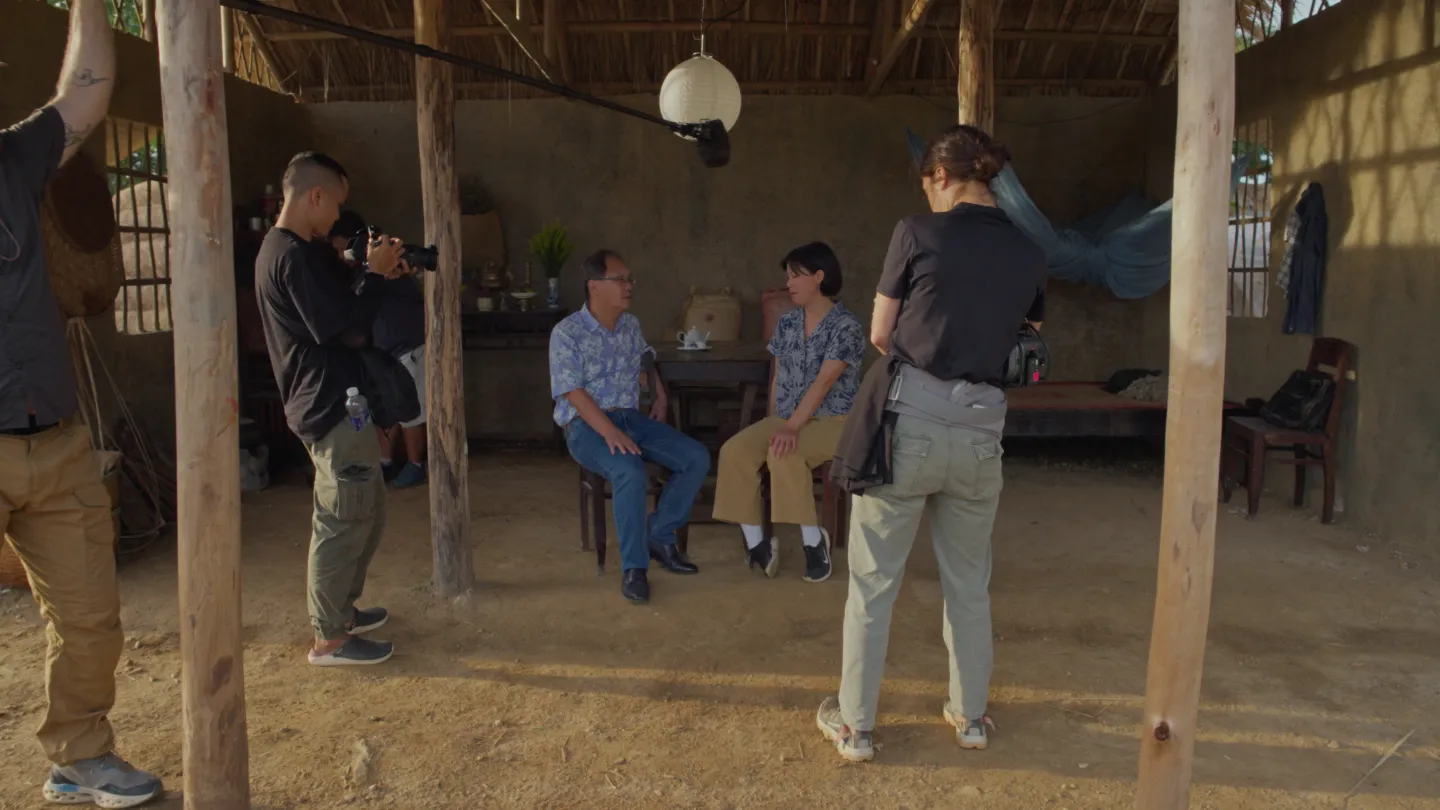
To get her father and his siblings to offer answers to questions no one had ever dared ask in the past until Duong’s cameras rolled, an inventive hybrid documentary-narrative model was hatched for the film. Some archival footage appears in Ba’s Book.
But mostly Duong’s relatives — and actors playing their younger selves as proxies to share wartime experiences — appear on camera and in re-enactments as cast and crew to help the director revisit and reveal secrets of the past as her father’s personal story and a family shaped by the legacy of violence and civil conflict unfolds.
Ba’s Book
Toronto Film Festival
“Not everybody is going to stage recreations with sets and actors and everything. But it’s just our family trying to figure out how to finally talk about things that they’d never spoken about,” the director explains. A hybrid film that moved fluidly between re-enactments and documentary, built on a set in Vietnam, the home Duong’s father and siblings grew up in, but with only three walls and not four to allow the relatives and actors, as if on a stage, to portray their younger selves.
Other inventive scenes include Duong’s father reading from his memoir in Vietnamese, as his relatives do not speak or read English, and so will not have heard his story as written down. And his relatives in turn gave notes to the actors playing their younger selves and were encouraged to interrogate Ba as his coming-of-age story was dramatized.
“I loved it when someone else asked the questions,” Duong recalls, as the veteran documentary maker has never come from behind the camera to appear in front of one. The actor who played the role of a youthful Ba, Duy Nguyen, who himself was born in Vietnam and is a Montreal-based actor today, was especially interested in knowing his character’s backstory.
“We really lucked out with Duy as he could relate to a lot of things my father went through — being the eldest son, the only one in his family who is in Canada and his guilt that comes from being abroad,” Duong explains. Ba’s Book also did not rely on one camera in the corner of a room to capture what goes by.
Duong instead had three cameras rolling at all times on set, with one focused on a documentary that captured mostly unfiltered footage, and another with a more narrative-focused lens zooming in and out and even using reverse angles as a three-person fiction crew followed a loose script she penned along with Steven Sych.
A particular focus in Ba’s Book is Dương Thị Hạnh, or the director’s Aunt Hanh, who reluctantly at first and then eventually reveals anger felt towards her older brother over the rigid patriarchy of wartime Vietnam that had her caring for Anh Duong so he could study and complete an education she was denied.
In the end, director Duong, recognizing Aunt Hanh’s residual indignation, lances that boil. “There’s a point in the film where I want to say thanks to (Aunt Hanh) because I’m thinking if she didn’t free my dad up from domestic labor, he wouldn’t have been able to study as he did. My life would have been totally different. I owe this woman so much. Somebody, and I never knew who, but she had sacrificed this way, having to stop school when she was nine,” Duong explains.
The result is Ba’s Book becoming equal parts observational and performance as Duong uses various camera angles and coverage to allow her father, his siblings and the director herself to share historical traumas, lay bare an emotionally wrenching story of family division and make peace with their past.
That’s far more inclusive healing than might have happened if Duong had only responded to her father’s memoir with her own letters. Instead, she brought a reluctant father to Vietnam to help via film to tell an emotionally wrenching story of family divisions and reconciliation.
“A lot of this film is us realizing the way we show up for each other is by being each other’s narrative devices,” the director explains. Duong recognized her father had really been writing to himself to confront an untold past.
Likewise, Duong used her cameras to create a safe space for her family to act out past memories to, at long last, talk about what each means to one another, good and bad. Duong argues, “It’s 50 years later. It’s not about division so much as how to move on. And a lot of people can relate to that kind of story, people who are in the diaspora, families who are divided by historical and political events and it’s a glimpse of their future.”
Ba’s Book movie poster.
John Godfrey/Chargefield
>

As Prime Video’s Reacher prepares a fifth and sixth season, the franchise’s creator is happy with the freedom provided by this adaptation.
Author Lee Child, who penned the Jack Reacher books on which the series is based, explained why he “exercised that veto” on a third entry in the Tom Cruise movies, opting instead for the “fabulous luxury” of a streaming series.
“I had a clause in that movie contract that after two movies I had a veto whether we would do any more. I exercised that veto,” he told Collider. “The deal was done in 2005, and it finished in a long, long time of development. Then the two movies finished in 2017. That first movie in particular was huge. It came out in December 2012. By January 2013, like one reporting cycle later, I had eight old paperbacks in the Top 10. You cannot buy that, and you cannot turn it down.”
Cruise starred as the former army police officer in writer/director Christopher McQuarrie’s Jack Reacher (2012) and co-writer/director Edward Zwick’s Jack Reacher: Never Go Back (2016).
Child added, “By 2017, of course, there was a whole new landscape. Binging television had been invented. Broadband was much more widespread. It was a thing now. It was not a thing in 2005. It hadn’t been invented, and nobody, I think, now would ever go for a feature film over streaming television for two reasons. First of all, the running time — it’s fabulous luxury. It really is. Eight hours, 10 hours, 12 hours, whatever you want. You can tell the whole story, all the light and shade, all the quiet parts, all the fun parts. It doesn’t have to be rammed together for 90 minutes of content.”

Alan Ritchson as Jack Reacher in ‘Reacher’
Prime
In 2022, Season 1 of Prime Video’s Reacher premiered with Alan Ritchson in the titular role. “The finances are totally different. With a feature film, the actor attracts the money. What actor is worth a $200 million investment?” explained Lee Child.
“Whereas with television, the platform pays it, and you can have anybody. You can have total unknowns,” he added. “The star on television doesn’t really attract either the audience or the money, and so we had a completely free hand for casting.”
Before Season 4 of Reacher premiered on Prime Video in August, the streamer gave it an early renewal for Season 5 back in May. The upcoming season adapts Make Me (2015), the 12th book in Child’s series, in which Reacher hitches a train to the Midwestern town of Mother’s Rest, where he helps private investigator Michelle Chang search for her missing colleague.
After Season 4 amassed 66 million viewers globally in its first 28 days on Prime Video, Amazon doubled down and gave the show an early Season 6 renewal.
>

Colleen Hoover can look forward to a nice brunch this morning as the feature take of her novel starring Anne Hathaway, Dakota Johnson, and Josh Hartnett, Verity, bowed to $62.5M worldwide, the second best start for the author at the global box office behind 2024’s It Ends With Us in like-for-likes, which was $95.6M WW.
Meanwhile, Alejandro Inarritu’s $160M net costing Tom Cruise political satire, Digger, was buried with a $20M global debut ($12M abroad, $8M stateside); in no way One Battle After Another which began at $48.5M WW reported in 74 territories a year ago, that ultimate multi Oscar winner becoming Paul Thomas Anderson’s highest grossing movie ever at $213.2M WW.
Verity also had more magic than the reported global opening of Warner Bros’ Practical Magic 2 which began with $46M WW in 77 offshore territories.
With a $40M net production cost, Verity continues to underscore Amazon MGM Studios’ mark in the female content space, their Prime side rallying with series such as Off Campus and Elle to name a few.
Verity was also more vivacious than the global starts of Hoover’s Regretting You ($23.6M in 43 markets) and Reminders of Him ($28.1M WW, 57 markets) in reported global launches. In several offshore markets, Verity was ahead of Reminders of Him and Regretting You. Housemaid, which is another global crowdpleaser by author Freida McFadden isn’t necessarily the comp here given its staggered rollout and year-end holiday boost, however, Verity slayed Housemaid in its openings in UK (No. 1 $4.5M 950 screens), Brazil ($3.8M at 715 screens, No. 1) and Australia ($3.1M 500 screens for a No. 1 rank). We told you heading into the weekend that Verity presales were already ahead of It Ends With Us in Brazil’s. Mexico’s $1.5M No. 2 rank at 1,522 screens is to be commended as the market is mostly known for the excelling of genre and family pics.
Word flowed into Amazon international from foreign offices that Verity wasn’t just a female skewing movie (in the U.S with a $32.6M start, it drew 78% female), rather pulled in non-literary lovers and dudes as well. Macho movie markets like Norway ($400K, 200 screens at No. 1), Turkey and Ukraine ($370K from 235 screens, No. 1 where it’s the biggest opening for a Hoover book adaptation) are to be commended.
Best starts for Hoover were also seen in Portugal ($575K at 60 screens, No. 1) and Hungary ($318K at 70 screens, No. 1).
Lots of No. 1s here with Germany ($3.8M at 715 screens), Netherlands ($590K at 115 screens), Austria ($380K from 68 screens), Sweden ($375K at 120 screens), Switzerland ($330K at 70 screens), Belgium ($320K at 65), Argentina ($300K from 190 screens), Greece ($245K from 106 screens), as well as Lithuania grossed ($205K from 18 screens), Finland ($190K at 110 screens) and Israel ($185K at 37 screens).
Pic was best MPA title in UAE ($670K at 91 screens) as well as India with $500K at 350 screens, just -12% behind It Ends With Us which is remarkable. U.S. genre has been working in the market with Obsession rallying there.
The Michael Showalter directed title kissed $1.7M in France at 384 screens for No. 2, Spain grossed $825K from 382 screens and ranked #4, Italy romanced $760K at 312 screens for No. 3, Saudi Arabia $535K from 105 screens and ranked #4, NZ was $370K from 110 screens No. 2, Poland was $240K from 152 screens No. 3, Colombia $238K at 140 screens No. 4, Colombia $238K from 140 screens and ranked #4 while Philippines grossed $233K from 168 screens and ranked #3.
Taiwan and the CIS region open next weekend, with Slovakia and Vietnam the weekend after. Korea opens on October 22 and Japan on November 6.
Brad Pitt and Odin in ‘Heart of the Beast’
Paramount Pictures
Paramount’s The Heart of the Beast continued to beat not just stateside with a great $11M second weekend hold, but also around the world with a $32.5M take. Of that foreign’s second frame was $21.5M in 66 territories with an overall running cume of $98.7M. China opened $2.1M at 7,300 theaters including previews while Turkey pulled in $225K at 194 sites with previews.
France’s second weekend was $3M, No. 1 in the market, -17% for a cume of $7.6M. Mexico had a second frame of $2M, also No. 1, -17% for a tally there of $5.1M. UK’s $1.6M second weekend at 554 sites ranked third, -22% for a cume of $5.5M. Spain did $1.1M second frame at 392 locations, No. 2, -25% for a local cume of $3.6M. Australia posted $1.1M No. 2 in second frame at 290, -17% for a total of $3.3M while Germany grossed $955K in second weekend at 428 theaters, No. 3, +2% for a cume of $2.3M. The Heart of the Beast storms into Korea on Oct. 29.
We’ll have more updates for you later.
>


Search For Canadian TV Actor Stewart McLean Now Homicide Investigation


These ’90s fashion trends are making a comeback in 2017
According to Dior Couture, this taboo fashion accessory is back
Model Jocelyn Chew’s Instagram is the best vacation you’ve ever had
Emily Ratajkowski channels back-to-school style
9 Celebrities who have spoken out about being photoshopped


Rurouni Kenshin: Hokkaido Arc Manga Takes 1-Issue Break – News


HIDIVE to Stream English Dubs for The World Is Dancing, The Forsaken Saintess and Her Foodie Roadtrip in Another World, The Dangers in My Heart: The Movie Anime – News