
Ba’s Book
toronto film festival


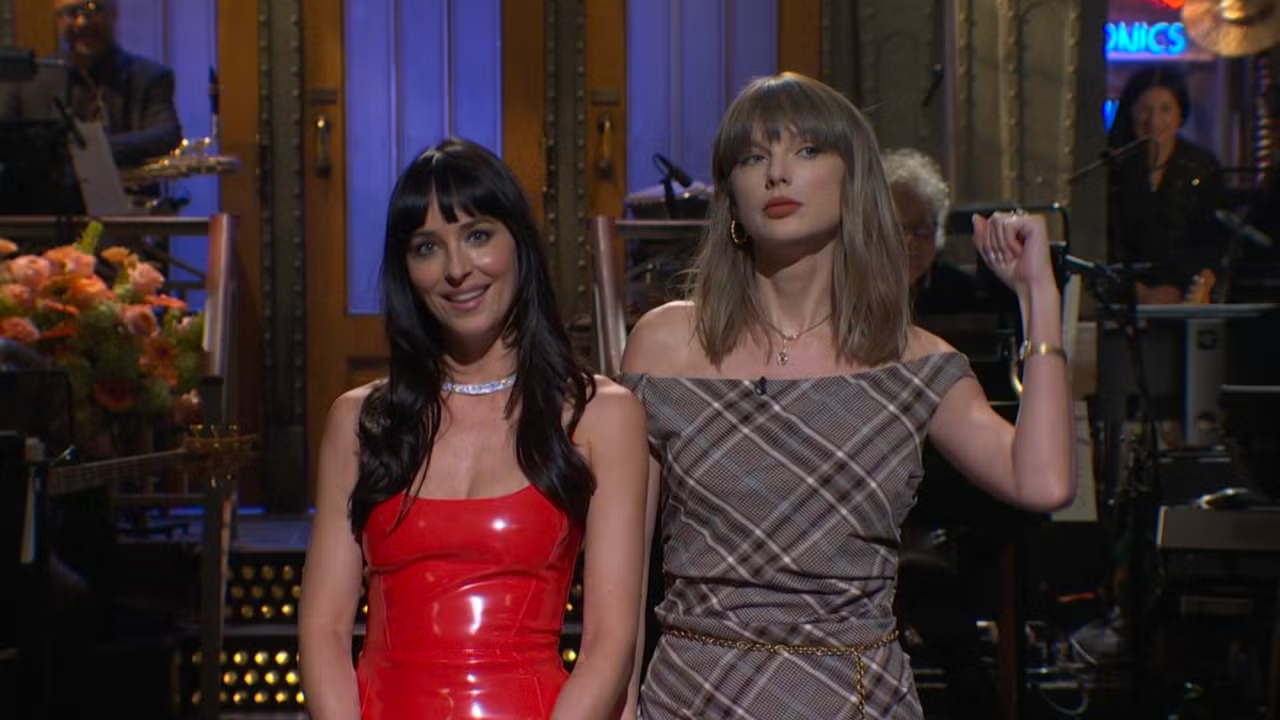
Dakota Johnson‘s “Saturday Night Live” monologue was interrupted this week by the actress’ “literal therapist,” Taylor Swift, who bonded with the host over their shared experiences dating musicians who “don’t wear shoes” and happen to be “terrible in bed.”
Johnson kicked off her “SNL” run this week with a joke about her failed 2024 superhero movie “Madame Web,” which she remarked she is still promoting because “it hasn’t made any money yet.” Afterward, the actress reflected on the other turns her life has taken since she last hosted “SNL.”
“I went through two very public, very lame breakups with two very awesome musicians. Looking for a third,” Johnson joked, referencing her splits from Coldplay frontman Chris Martin and Role Model singer-songwriter Tucker Pillsbury. While she vowed not to talk anymore about her personal life, Johnson’s monologue was derailed again after she noted that her new movie, “Verity,” is a psychosexual erotic thriller.
“So is dating musicians. Some of them don’t wear shoes. Some of them are terrible in bed. But all of them are in my DMs,” Johnson said. “Some people leave concerts with merch, and I leave concerts with a two-and-a-half year relationship.” Thankfully, Johnson said she has “good friends” who do not judge her for her dating choices.
Enter: Swift, whom Johnson called her “literal therapist,” much to the former’s discomfort. “I’m not your therapist, actually. You just show up once a week at my house with an empty bottle of wine and ask if I want some,” Swift said.
You can watch Johnson’s “SNL” monologue below.
Dakota Johnson’s monologue! https://t.co/ZxOi5zVZLF
— Saturday Night Live (@nbcsnl) October 4, 2026
Johnson argued that she shows up at Swift’s house because she has “manners,” but the “Patient Zero” singer-songwriter did not see it the same way.
“You plop on my couch and overshare, and every so often I just say, ‘Damn, that’s crazy,’” Swift explained. “And then I give you a pedialyte and my security drives you home.” Johnson, for her part, defended her taste in musicians as a “public service,” while Swift stood supportively next to her.
“I think actually I’m doing a public service by dating them because, ladies, I am saving you a lot of money on Zoloft,” Johnson said. “So you’re welcome, America… and also England and parts of Ireland and Cleveland, apparently.”
Swift’s appearance on “SNL” this week comes less than a week after she debuted the music video for “Patient Zero,” one of four “encore” deluxe tracks she released last week tied to her 2025 album, “The Life of a Showgirl.” Johnson starred in the “Patient Zero” music video as the current partner of a toxic man (Colin Farrell) who used to be with Swift’s ghostly character.
As part of the music video’s release, Johnson also presented Swift at the 2026 MTV Video Music Awards last Sunday night with the show’s inaugural Artist Directors Honors prize.

>
Montreal documentary maker Ashley Duong saw her father, Anh Duong, end a lifetime of cold silence over his traumatic upbringing in war-torn Vietnam by publishing a memoir shaped as a series of letters to his daughter.
So it wasn’t long before Duong, in her chosen medium, film, adapted her father’s memoir into Ba’s Book, an inventive hybrid film that bends the edges of a documentary with drama and is screening on Sunday night at the Vancouver Film Festival. She pieces together the journey the director’s tight-lipped father, also known as Ba, took through Vietnam during that civil war and as a refugee in 1970s revolutionary Iran, before starting a new life in Canada in 1980.
During that lifetime, Ba kept painful memories hidden from his daughter and family until the 2024 publication of Dear Da-Le: A Father’s Memoir of the Vietnam War and the Iranian Revolution. “There’s all these moments throughout his life where he was really learning how to hide his emotions,” Duong tells The Hollywood Reporter, as her father had a need to navigate political landmines as a witness to wartime brutality in Vietnam and Iran.
Ba’s Book
toronto film festival
But what her father left out of his memoir and Duong captured in her film was the untold torment of Ba leaving his mother, Nguyen Thị Bay, or grandmother Ba Noi, and close relatives behind in their ancestral village in Vietnam. And it’s those siblings with whom Ba reunites — and is brought at times to bruising places as they reveal their own untold family secrets — in Duong’s film that provide the emotional backbone for Ba’s Book.
“I wasn’t sure what to expect from my relatives. But they really put all their heart and soul into the film. They helped with the design of the sets, the casting of the relatives. There was a lot of love shown and that meant so much to me,” Duong explains. But her relatives gave more than off-camera tips as Ba’s Book recreates the director’s father and his life in Vietnam alongside his relatives on camera.
To get her father and his siblings to offer answers to questions no one had ever dared ask in the past until Duong’s cameras rolled, an inventive hybrid documentary-narrative model was hatched for the film. Some archival footage appears in Ba’s Book.
But mostly Duong’s relatives — and actors playing their younger selves as proxies to share wartime experiences — appear on camera and in re-enactments as cast and crew to help the director revisit and reveal secrets of the past as her father’s personal story and a family shaped by the legacy of violence and civil conflict unfolds.
Ba’s Book
Toronto Film Festival
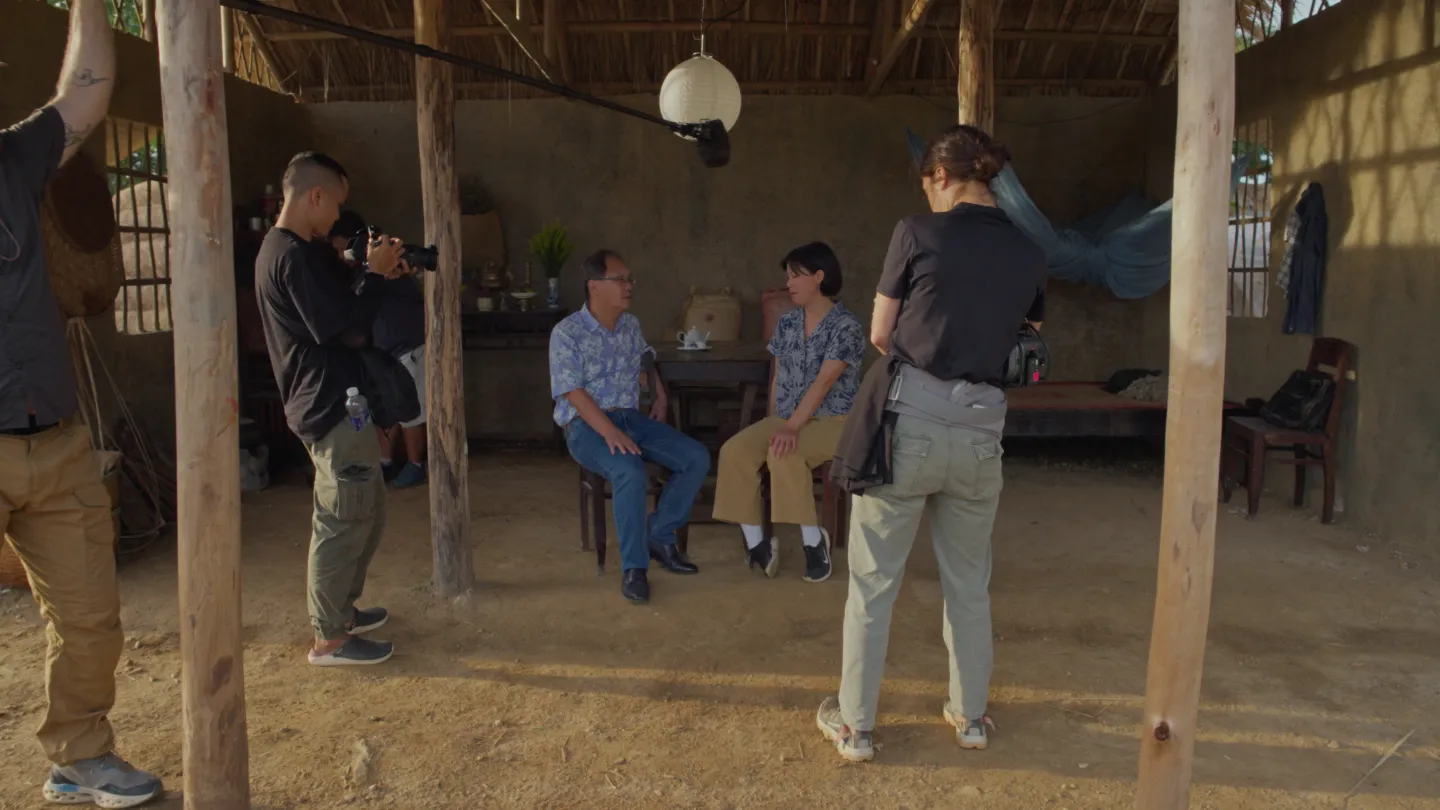
“Not everybody is going to stage recreations with sets and actors and everything. But it’s just our family trying to figure out how to finally talk about things that they’d never spoken about,” the director explains. A hybrid film that moved fluidly between re-enactments and documentary, built on a set in Vietnam, the home Duong’s father and siblings grew up in, but with only three walls and not four to allow the relatives and actors, as if on a stage, to portray their younger selves.
Other inventive scenes include Duong’s father reading from his memoir in Vietnamese, as his relatives do not speak or read English, and so will not have heard his story as written down. And his relatives in turn gave notes to the actors playing their younger selves and were encouraged to interrogate Ba as his coming-of-age story was dramatized.
“I loved it when someone else asked the questions,” Duong recalls, as the veteran documentary maker has never come from behind the camera to appear in front of one. The actor who played the role of a youthful Ba, Duy Nguyen, who himself was born in Vietnam and is a Montreal-based actor today, was especially interested in knowing his character’s backstory.
“We really lucked out with Duy as he could relate to a lot of things my father went through — being the eldest son, the only one in his family who is in Canada and his guilt that comes from being abroad,” Duong explains. Ba’s Book also did not rely on one camera in the corner of a room to capture what goes by.
Duong instead had three cameras rolling at all times on set, with one focused on a documentary that captured mostly unfiltered footage, and another with a more narrative-focused lens zooming in and out and even using reverse angles as a three-person fiction crew followed a loose script she penned along with Steven Sych.
A particular focus in Ba’s Book is Dương Thị Hạnh, or the director’s Aunt Hanh, who reluctantly at first and then eventually reveals anger felt towards her older brother over the rigid patriarchy of wartime Vietnam that had her caring for Anh Duong so he could study and complete an education she was denied.
In the end, director Duong, recognizing Aunt Hanh’s residual indignation, lances that boil. “There’s a point in the film where I want to say thanks to (Aunt Hanh) because I’m thinking if she didn’t free my dad up from domestic labor, he wouldn’t have been able to study as he did. My life would have been totally different. I owe this woman so much. Somebody, and I never knew who, but she had sacrificed this way, having to stop school when she was nine,” Duong explains.
The result is Ba’s Book becoming equal parts observational and performance as Duong uses various camera angles and coverage to allow her father, his siblings and the director herself to share historical traumas, lay bare an emotionally wrenching story of family division and make peace with their past.
That’s far more inclusive healing than might have happened if Duong had only responded to her father’s memoir with her own letters. Instead, she brought a reluctant father to Vietnam to help via film to tell an emotionally wrenching story of family divisions and reconciliation.
“A lot of this film is us realizing the way we show up for each other is by being each other’s narrative devices,” the director explains. Duong recognized her father had really been writing to himself to confront an untold past.
Likewise, Duong used her cameras to create a safe space for her family to act out past memories to, at long last, talk about what each means to one another, good and bad. Duong argues, “It’s 50 years later. It’s not about division so much as how to move on. And a lot of people can relate to that kind of story, people who are in the diaspora, families who are divided by historical and political events and it’s a glimpse of their future.”
Ba’s Book movie poster.
John Godfrey/Chargefield
>
>
>


Search For Canadian TV Actor Stewart McLean Now Homicide Investigation


These ’90s fashion trends are making a comeback in 2017
According to Dior Couture, this taboo fashion accessory is back
Model Jocelyn Chew’s Instagram is the best vacation you’ve ever had
Emily Ratajkowski channels back-to-school style
9 Celebrities who have spoken out about being photoshopped


Rurouni Kenshin: Hokkaido Arc Manga Takes 1-Issue Break – News


HIDIVE to Stream English Dubs for The World Is Dancing, The Forsaken Saintess and Her Foodie Roadtrip in Another World, The Dangers in My Heart: The Movie Anime – News