
Entertainment
‘Other Mommy’ Review: Jessica Chastain Doubles in Dreamy Horror Film


There’s something uniquely tragic about a monster who wants to be loved. Most supernatural villains are content to stalk, maim, and murder their victims, but the titular terror of “Other Mommy” has a much, much more intimate ambition. She wants a little girl to invite her inside her heart. And like any good manipulator, she has to convince the kid it was actually her idea first.
Whether or not you’ve had her arrival spoiled by the trailer, Other Mommy’s big kitchen entrance makes you want to laugh and scream at the same time — every time. Played by Oscar winner Jessica Chastain, this freakish apparition can twist her body into impossible shapes, stretch her neck around corners, and occupy just about any cramped, scary space. What she really wants, of course, is to be a person. But, uh, how do you smooth over a home invasion?


That’s the wonderfully warped foundation of director Rob Savage‘s adaptation of Josh Malerman’s 2024 novel “Incidents Around the House.” Starring Chastain as both a disconnected mother and the obsessive entity threatening to replace her, Universal Pictures’ “Other Mommy” is a hypnotic and frequently bewildering exercise in domestic horror that turns the actress’s gift for conveying tenderness and tenacity against itself. The resulting collision is frequently ridiculous, rarely frightening, and strangely sad.

At the center of this nightmare is Bela (Arabella Olivia Clark): an eight-year-old whose understanding of the world is still being assembled from whatever the adults around her are willing to explain. Her mother, Ursula (Chastain), and father, Russ (Jay Duplass), have problems of their own, although neither seems particularly aware of how much their daughter already understands. When a mysterious presence begins appearing around the house, the child initially treats the visitor with the cautious curiosity one might extend to an imaginary friend.
That would be a more reassuring arrangement if Other Mommy weren’t so obviously… wrong.
Chastain has already encountered Stephen King’s dancing clown in “It Chapter Two,” and her new supernatural alter ego feels less like Pennywise’s girlfriend than maybe one of his quieter pals from college. Other Mommy is manipulative and bendy, sure, but more than that, she’s so, so upset. Pennywise and the Other Mother from “Coraline” at least had somewhere to retreat when their victims rejected them. But Other Mommy, hiding in the very structure of the house, seems to crave existence itself, and Chastain channels that pitch-black despair with everything she’s got. Her most impressive special effect isn’t an elongated limb or grotesquely contorted face — but the sorrow, fear, and rage she can reflect in her eyes.
The actress has considerable experience playing mothers in distress, from “The Tree of Life” and “Take Shelter” to the otherworldly family nightmare of “Mama.” She’s especially convincing opposite young performers, and Clark gives her plenty to work with here. Before the house starts filling with deflated skin, confetti, broken glass, and blood, Chastain is even allowed to look freakin’ dynamite in a pair of dark-rimmed glasses.
Even so, Ursula is a more complicated proposition than that wholesome image suggests. At times, the real mother has a vaguely “Gone Girl”-esque air of domestic volatility, as though something might ignite at any moment. In fact, Other Mommy herself, routinely showing up a bit wet(?), practically smells like gasoline. There’s an unmistakable impression throughout that this woman… or whatever is pretending to be one… might burn down the house.
And yet, the creature becomes a surprisingly normalized part of the film‘s world. Even when her spine loops around Bela like an illustration from a particularly disturbed Dr. Seuss book, she eventually starts to resemble a fleshy extension of the family’s sleek modern furniture. Savage’s movie is so committed to its own absurdity that the extraordinary begins to feel mundane.
That strange acclimation extends to the human characters, whose emotional histories are gradually filled in. Duplass is particularly interesting in this environment. An icon of mumblecore, he looks as though he’s wandered onto the wrong set, but his unassuming presence eventually makes him feel like family. A quiet moment in which Russ performs a melancholy little dance for his daughter proves unexpectedly heartbreaking.
Still, by the time the family starts exploring ways to exorcise their unwanted houseguest, it’s difficult not to wish Russ were something more useful. Like a priest.

Their paranormal intervention involves Dichen Lachman as Lois Anthony, in a role best described as Chris Hansen for ghosts. Her solemn declaration that “we wish to be heard by the entity known as Other Mommy” is an exquisitely goofy piece of genre nonsense, delivered with precisely the Loomis-level conviction it deserves. By this point, the audience knows the monster a little too well to be properly terrified of her. Watching everyone attempt to conduct official business with the thing is practically irresistible.
Clark deserves considerable credit for keeping these escalating absurdities grounded. Magnetic enough to hold her own against two major acting talents and an exhausting parade of special effects, the young performer maintains a convincing sense of agency even as Bela’s surroundings become physically overwhelming.
When so-called Uncle Frank (Arian Moayed) treats her as though she’s younger than she really is, the sinister appeal of Other Mommy’s attention becomes painfully clear. The creature offers Bela something the adults frequently deny her: the feeling that she’s in control. Of course, nothing could be further from the truth and the chaos cranks up quickly.
Savage, whose pandemic-era breakthrough “Host” turned the limitations of a Zoom call into a remarkably effective horror mechanism, approaches this material with almost the opposite visual philosophy. Where the 2020 found-footage film fits terror into a rigid digital window, “Other Mommy” sends its camera sailing through walls, ceilings, and the metaphysical fringes of reality itself. The movie shifts between Bela’s more innocent perspective, and Other Mommy’s impossible viewpoint: a maddening lens of entitlement and pain that never stops.
Between a surreal balloon-popping nightmare on the ceiling and an abundance of brightly colored ball-pit balls through the film’s second half, “Other Mommy” sometimes resembles “Skinamarink” by way of “The Backrooms.” Its aggressively artificial imagery evokes the kind of AI-slop, dreamcore videos that tend to populate social media these days, thrusting the audience into increasingly unsettling spaces that seem generated from a stranger’s hazy childhood.

Other Mommy herself can rearrange her body like a tangram puzzle, and in doing so, she doesn’t just violate the laws of anatomy. She comes across as personally offended that anyone would expect her to obey them, and the visual extravagance of that slippery confidence is sincerely fun at first. Unfortunately, anything can happen — and does keep happening. And happening and happening and happening.
After an action-packed confrontation that comes midway but feels like the final 15 minutes of a different Blumhouse movie, “Other Mommy” kicks the suspense into high gear and largely lets it stay there. The family’s subsequent road trip to find safety gives the story an appealing sense of exploration. But just when the atmosphere starts to settle into a specific style, the movie repeatedly threatens to accordion away from itself. A gigantic Other Mommy intrudes on the frame, or some other bizarre impossibility blows the established scene apart like pixie dust.
The ending, which substantially departs from Malerman’s novel, offers a richer choice than the source material. Rather than treating parental love as an uncomplicated defense, Nathan Elston’s screenplay allows Ursula to acknowledge a more shameful truth. A Chastain delivers a beautiful climactic monologue that almost sees the accumulated melodrama pay off. Almost.
Whether she’s behaving like an action hero preparing to defend her family, or looking like a storyboard ripped straight from the production of “Courage the Cowardly Dog,” Chastain is perpetually impossible to ignore. There’s plenty of the actress in “Other Mommy,” and yet, it’s somehow tempting to ask for more. But by the climax, Bela and her parents’ problems have become so bizarre that just leaving the theater felt like trying to shake someone else’s therapist.
That said, “Other Mommy” is an exceptionally weird movie, and its monster is memorable enough that it deserves applause for that. More importantly, Savage’s evolution from the lo-fi “Host” to the studio-backed “Boogeyman” and now this technically extravagant explosion suggests an artist already figuring out how to stretch the boundaries of what he can accomplish.
Savage, with an appetite for spectacle that sometimes outpaces his patience for storytelling, stays genuine enough in his emotion that it makes the creative excess worth watching. As for Other Mommy, the filmmaker ultimately makes her easy to understand — even if their movie proves a bit harder to love.
Grade: C+
A Universal Pictures release, “Other Mommy” is now playing in theaters.
>
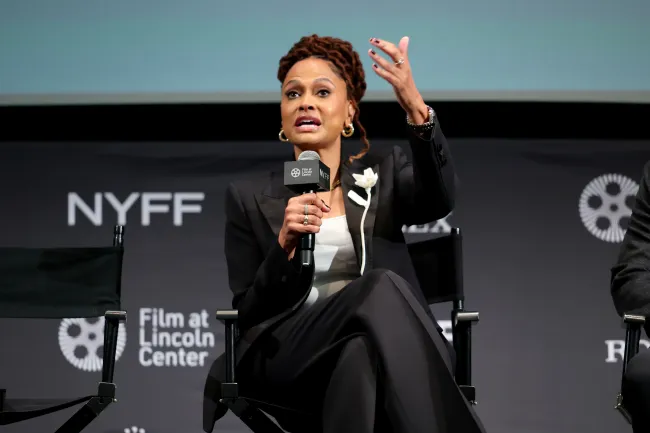
There are, of course, many connections between filmmaker Ava DuVernay’s Oscar-nominated documentary “13th” and her latest film “14th,” including both films world premiering at the New York Film Festival, a decade apart. “What a beautiful symmetry to be able to bookend it. Ten years ago, it’s opening night. Ten years later, it’s closing night,” the director told IndieWire over Zoom.
However, “I wouldn’t say it’s a sequel,” she said. “Even in its construction, all that it’s doing, it’s something different in a series of films and analyzing the Constitution against our current-day happenings, really.”
If “13th,” her documentary about the 13th Amendment of the Constitution of the United States, and how it pertains to America’s prison industrial complex and mass incarceration, was “very linear,” as DuVernay described it, then “14th” “was really a puzzle.”

Initially, the Academy Award-nominated filmmaker intended to make a documentary focused on birthright citizenship. This was before President Trump was re-elected in 2024, though he had already made his intentions to immediately eliminate that core part of the 14th Amendment to the Constitution his first day in office known to his base. “I literally did the worst thing you could do, pitched that very casually to Adam Del Deo who runs docs at Netflix. And he said, ‘Well, yeah, we should do that,’” she said.
What DuVernay didn’t realize was that “it [would] open this Pandora’s box.” Birthright citizenship is just one part in a document with five parts, with the first part being split into three sections. “Part of the journey of the film was learning the rest and seeing how it was ricocheting against current events in ways that were so startling and shocking. I couldn’t believe it was unfolding in front of my eyes as we were making it,” said the director. “I’ve likened it to building the plane while you’re flying.” As news would break, she’d often find herself saying “Oh, my God, this happened. Put that in there!”
She pitched and sold the film without having full grasp of what the 14th Amendment was, but she soon found out, even in interviewing top legal experts, “nobody knows.”
One part of the amendment, which was crafted during the Reconstruction period post-Civil War, was about public debt, and basically says that taxpayer money on both the federal and state level is not allowed to be used to pay off the debts of those who rebelled against the United States. “The secret, crazy thing about this is I couldn’t figure out how to do [it],” DuVernay said. “I can’t force some public debt thing. It’s so obscure. Even Eric Foner, our grandfather of everything, he’s reading it in his pocket [Constitution] because he doesn’t even know it off the top, public debt. And then he looked at the camera, and he said, ‘They must have thought it was important.’”

She said, “I was going to make a joke out of it. And then Trump puts together an insurrection fund.” The director saw the news, called legal expert Sherrilyn Ifill, a key participant in the film, and “I was like, ‘Is this public debt?’ And she was like, ‘Yes, it’s the public debt! We can’t believe it. It’s the public debt.’”
As a U.S. citizen, it was difficult to not be horrified at the precision with which the Trump administration was attempting to dismantle every part of the amendment, but as the director of “14th,” it contributed to making DuVernay’s vision for the film even clearer. She had an idea of using a star as a symbol for the amendment, with each point being ripped away by news of some new executive order the president signed, but “you can’t really rip when there’s one piece that’s unripped,” she said. The slush fund for January 6 rioters was the last bit she needed.
“It just shows how deliberate this is. How every single piece of every part of this is being undermined. Because if you can get one to crack, then the whole thing starts to crack. You could actually legally destroy the whole thing,” said the documentarian, in reference to the 14th Amendment. “And so, look, all hands on deck. Everything is attacking it. And it’s challenging because we don’t even know what to fight for because we don’t even know what it is.”
“14th” also became an opportunity for DuVernay to be more expansive as a director. “In ‘13th,’ my idea was that all the environments felt like labor, so [participants] were behind glass and brick and steel, forced labor of slavery and then of prison industrial complex,” she said. “And this, I wanted to get the pillars around folks, the railings, the iron, the things that hold us in place, because that’s what the 14th Amendment is.”
With that idea of the “architecture of democracy” in mind as both a thematic and visual motif, DuVernay added some verité to her repertoire, shooting librarian Carla Hayden inside the hallowed halls of the Library of Congress shortly before she had been fired by the Trump administration. Conversely, she followed contractor Devon Henry, who has made a career out of taking down Confederate monuments. “The question is, how does that fit in with everything else? At some point, you just put it in the stew and mix it up,” she said.

The director tapped designer William Roy Hodgson, who works at the Monuments Lab that tracked where and when all those Confederate statues first were erected, to be the film’s chief graphic artist and animator. He had never worked on a film before, but had the institutional knowledge she needed in addition to his artistic skill. “It’s one thing for me to assign, ‘Hey, make a graphic on this.’ It’s another thing to work with an artist who is also researching and bringing things too,” she said. “It’s really rare to have that in one person. So, all those graphics were done by one guy in his apartment in New York.”
DuVernay also collaborated with Asteria Film Co. to help restore some photos she and her team had come upon as they plowed through archives, from the Smithsonian Library of Congress to the Arkansas Historical Society, even people’s family albums. So while access was not a problem, “some of that stuff was really degraded,” she said. “We were down in boxes and crates and with slides that had never been digitized. They said, ‘Well, if you can digitize it, you can use it.’” The director added, “You can’t really get it to be high resolution enough to put in a film,” and that’s where Asteria’s AI-powered tools were of assistance.
That whole process of digging through photo archives and restoring them led to DuVernay developing a stereoscopic technique, building on the old idea of how two photos side by side could be framed in a way that made them look 3D. “When I saw those at the Library of Congress, I thought, ‘Oh, I want to do that for my audience to see a picture like that.’ And so, first you have to restore it, then you have to do rotoscope, and then just a little bit of animation for a little movement. And the artists there used those tools and brought it to life in the way that I wanted,” she said.
The way in which all of those elements are weaved together in “14th” is impressive, but DuVernay understands that it can be too much information to receive in one go, and so audiences need a break. In “13th,” she used music. “Lyrics come up on the screen. Different people through different times are talking about prison embedded in the artwork of their music,” she said. She got the notion from watching and studying Ken Burns documentaries. “I’m going to slow this down and just watch this flower bloom for a little bit so I can just process what’s been going because we’re moving really quickly,” she added.

The breaks in “14th” come through stand-up comedy segments. The first clip she found was one of Paul Mooney, which she uses in the film. “It makes me laugh so much. And I thought, ‘Oh, wow, let’s look at other political comedians, comedians who’ve really used comedy to pierce through. And I will say right now, the reason why I became so enamored with the idea of using the comedians is I believe they really are truth tellers in this moment,” said DuVernay. “News is skewed. Democrats have their news. Conservatives have their news. Ultraconservatives have their news. Super Progressives have their news. It’s just everyone is in their camp, and it really feels like it’s only the comedian who can get out and say what needs to be said, and pierce through it.”
The director also tried to cast participants in the film that were across party lines. “We wanted far right, far left, Anna Paulina Luna and AOC, completely different sides of the thing. It’s really important to get as much of that in there as I can. We tried,” she said. It was much more challenging than she thought, with former Arizona Senator Jeff Flake being the highest-ranking conservative politician among the handful she interviewed. “Three hundred and twenty-six requests to every sitting [Republican] congressperson, senator, governor, and mayor of a major city. Who said yes is who’s in the documentary.”
She said, “It was pretty challenging and a tough pill to swallow that none of them wanted to sit down with me. I feel offended,” but with “14th” now premiering at NYFF, DuVernay believes that audiences will be able to realize that the dismantling of the 14th Amendment is not a scenario in which everyone loses. She compares the film to the bell in a boxing match. “I want people to fight,” she said. “I want people to come out of it alert, aware, and wanting to stand up for this.”
That is one more difference between the America in which “13th” was released, and where the country is now. “[Then], we had the capacity to focus on the plight of one particular group,” she said. “Now, everyone is being attacked. Everything is happening. We see it with the immigrant community. Enough people are not leaning into what’s happening.”
DuVernay concluded, “You have to put on your own oxygen mask first,” but “what this [film] says is, ‘Look, we’re all in this together. And whether I like you or not, it’s going to take that kind of groupthink to dig ourselves out of it.’ That’s not possible if we’re not even talking to each other and we don’t know what we’re talking about. So, hopefully this gets people on the same page.”
“14th” will have its world premiere at the 2026 New York Film Festival on Friday, October 9. Netflix will release the film in select theaters on Friday, November 27. The film will arrive on Netflix on Friday, December 4.
>
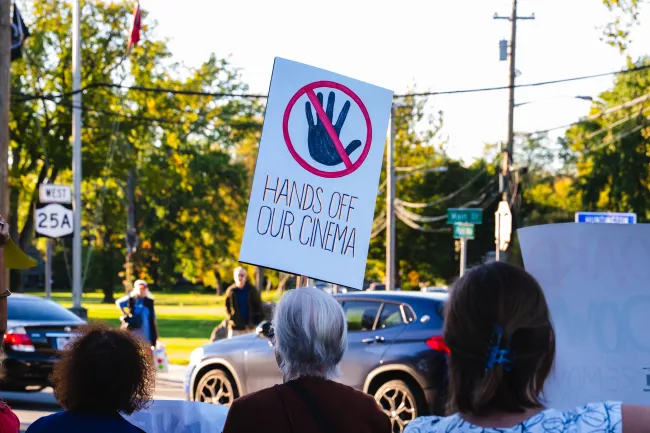
On the afternoon of October 3, a crowd of unhappy protesters gathered along a busy street in the heart of Huntington, New York, a sleepy suburb along the northern coast of Long Island. The demonstrators — local news estimated they numbered from 200 to 300 — brandished signs like “Honk if you hate fascism” and “Shame,” but they weren’t there in opposition to the latest political outrage. They were rallying to save the Cinema Arts Centre, Huntington’s beloved three-screen independent movie theater, and to support its former co-director, Dylan Skolnick, the man who, in their view, had been an indispensable part of the community institution since his parents founded it 53 years ago.

A month earlier, the CAC board of directors fired Skolnick, due to “what [the board] believed to be, and continues to believe was, serious misconduct,” it explained in social media post on September 2. No other details were provided, and since that announcement, the CAC and its membership have found themselves on opposite sides of an increasingly combative divide.
According to the CAC’s current leadership, Skolnick was a “dysfunctional” and “disloyal” manager whose freelance work as a film buyer for other indie cinemas was an egregious, and fireable, conflict of interest. According to Skolnick and his supporters, the CAC board has undergone a “hostile takeover” by members with no understanding of how the tight-knit world of independent film actually operates, and who are now recklessly damaging the CAC’s reputation as a first-class cultural destination for the area.
“I’m appalled by [Dylan’s] firing and its circumstances,” said director Wim Wenders in a statement provided to IndieWire. “‘Serious misconduct’ seems like total baloney, if you know Dylan.”
Filmmaker and critic Kent Jones — whose film “Late Fame” starring Willem Dafoe and Greta Lee was pulled from the CAC by Magnolia Pictures after Skolnick’s dismissal — called the board’s decision “a blow that strikes deep into the heart of New York movie culture.”
“Dylan knows the historical path of the Cinema Arts Centre, from an intimate point of view,” said actor Isabella Rossellini in a statement. “It is unimaginable for me that the board of directors doesn’t capitalize on Dylan’s knowledge and guarantee the continuity of relationships with clients and friends in the film community. I urge the board to reconsider this disgraceful, cruel, and offensive decision.”
“Some of my fondest memories of growing up on Long Island are trips taken with friends to see obscure movies at Cinema Arts Centre,” said actor Edie Falco in a statement. “That’s what makes Dylan’s removal so heartbreaking. To pull him out of a place that was built by his family, and that has meant so much to me and my friends and so many others is impossible to imagine. What is that place even, without Dylan?”
In response, Skolnick’s supporters have been aggressively campaigning to get him reinstated. Along with the protest, a MoveOn.org petition has garnered more than 3,100 signatures, and a GoFundMe campaign for Skolnick’s legal fees has raised more than $13,000. The fight has already appeared to affect the CAC’s ability to operate just as awards season kicks into high gear. Hosts have canceled at least two subscriber-based film series, and actor Dolph Lundgren withdrew from a scheduled appearance. Subscribers have reportedly demanded refunds, donors have pulled their support, and according to a knowledgeable source at the theater, box office receipts are down steeply, causing a cash crunch that could imperil the Cinema Arts Centre’s longterm future.
How did everything get so bad, so quickly? The first blow came on August 19, when Skolnick was placed on paid administrative leave for “ongoing concerns regarding leadership and management,” per an email from board chair Matthew Daidola that Skolnick shared with IndieWire. According to Skolnick and his attorney Jennifer Casey, the board provided no further details about these concerns until September 1, when Skolnick was informed he’d been terminated and he and Casey received a 15-page demand letter from the CAC board, which IndieWire has reviewed.
According to the letter, Skolnick was fired largely due to his decision to supplement his salary at the CAC — which this year reached $75,000 — by working as a freelance film booker for other indie cinemas. The letter alleged Skolnick violated its employee manual, which “prohibits every employee from holding any interest in an organization that competes with” the CAC. These activities were “without the company’s knowledge or authorization.”

By naming his side business Cinema Arts Booking, and doing this work using his CAC email address, Skolnick was “trading on goodwill associated with the Company.” Skolnick’s use of the CAC’s internet and company telephone for his freelance work “may constitute misuse, diversion, or waste of corporate assets.”
These actions, the letter said, “breached the duty of loyalty that Mr. Skolnick owed” the CAC. The board demanded Skolnick repay “all profits he earned … from disloyal work performed while he owed fiduciary or employment duties to CAC.”
Separately, the letter also said the CAC had “received reports” that Skolnick “pressured Company employees to file false and fictitious complaints against members” of the board, though the letter noted that the accuracy of those reports had yet to be confirmed. Skolnick denied that he coerced anyone, but he confirmed that a report against board members was filed. “And it wasn’t false,” he said. “It was totally accurate and correct to complain.”
As for his film booking work, to Skolnick, the board’s arguments not only don’t hold water, they betray a fundamental misunderstanding of how business is done in indie film. He said his freelance booking work has included theaters in Oklahoma, Maryland, Pennsylvania, and most recently, Queens, New York. “These are not in competition with the Cinema Arts Center in any way,” he said. More to the point, Skolnick doesn’t see any non-profit indie theaters as competition for the CAC’s audience. “Our competition is Netflix or Hulu, things that keep people in the house,” he said. “Anything that gets people going out to the movies will benefit all of us.”
He said he informed the CAC board about his work when he started doing it roughly 10 years ago, but he conceded that the current board “was not aware” of his activities. And he used his CAC email for the booking work because he used that address for everything. “Clearly, not a good idea,” he said. “But it didn’t cost the Cinema a penny.”
As for trading on the CAC’s reputation, Skolnick didn’t mince words: “I’ve been doing this almost 30 years,” he said. “I’m very active in the national community. I have a reputation. The Cinema’s reputation partly grows from those almost 30 years of work.”
Multiple individuals within the world of independent film backed up Skolnick’s assertions about his reputation and the wider industry to IndieWire. “He’s a beloved member of our independent film community,” said Isil Bagdadi-Sergio, who worked with Skolnick first as an indie distributor and then as the host of a film preview series for CAC subscribers (which she canceled following Skolnick’s dismissal). “Distributors, other exhibitors, art house cinema owners, everyone just has great respect for him. I can’t separate him from the Cinema. I think for most people, it’s this way.”
Michael Tuckman, head of indie distributor mTuckman Media, which brought the Oscar-winning documentary “No Other Land” to the CAC in 2025, said Skolnick is “beyond respected and highly regarded.” He argued that Skolnick’s freelance film buying work directly benefits the CAC. “It helps that exhibitor have even more clout knowing that they’re not just buying for one cinema but many,” he said. “Often film buyers will have a main gig at one theater and have accounts on the side.”
One such buyer, Adam Birnbaum of the Avon Theater in Stamford, Connecticut, told IndieWire that “it’s a very common practice for people on the exhibition side who are working as film programmers or film buyers to be doing different gigs simultaneously.” Birnbaum also operates the Nova Theater Circuit, which represents nearly 50 independent cinemas in the U.S. “It’s a strategic advantage for a film programmer to be taking on multiple clients or projects,” he said. “It gives them greater cachet, I suppose you could say, at the negotiating table.”
Birnbaum also noted that side gigs are an “economic necessity” for many in the indie film industry, which is populated with a relative handful of dedicated and passionate film lovers navigating paper-thin financial resources. “It’s not an extraordinarily lucrative career for somebody to be a film programmer for a lone cinema,” he said.
Given how widespread freelancing is within the indie film industry, firing the co-director of an independent theater for freelance work “seems like an utterly baseless rationale,” Birnbaum said. “It’s so highly questionable that it makes me wonder what is actually going on there.”
Indeed, the lack of further detail or communication from the CAC board about Skolnick’s dismissal has been a major point of contention for everyone affiliated with the theater who spoke to IndieWire for this story. Ellen Reynolds — who’s been a CAC member for 38 years, and a high-level donor for over 25 years — said she gave a few thousand dollars to the theater in August; when Skolnick was suspended days later, she demanded the money be returned. It was, she said, but no one from the theater contacted her directly, and no one has tried to connect with her since.
“It’s entirely possible that this board, for whatever demented reasons, thought they were doing the right thing, but they did a terrible job of implementing it,” she said. “It’s been over four weeks now since they fired him, and they have never reached out to me.”
Similarly, Kenneth Katz, former Cinema Arts Centre board co-chair from 2015 to 2018, said that no one on the current board “has reached out at all for anything” regarding Skolnick’s past performance as co-director. If they had, the board may not have asserted in its demand letter that Skolnick “never” informed the CAC about his work as a freelance booker. According to Katz, Skolnick did. In the weeks following Skolnick’s dismissal, Katz said he mailed a letter to every board member saying as much.
The CAC leadership’s silence about Skolnick’s departure was in keeping with a September 4 social media post that “in accordance with our legal and ethical obligations regarding personnel matters,” the CAC “cannot publicly discuss the specific details of any individual’s departure.” But in an email to IndieWire on October 6, CAC co-director Kelsie Greene — who was promoted into the job alongside Skolnick at the beginning of the summer — took issue with how Skolnick and his supporters were representing why he was fired.
“The overwhelming outcry to this dismissal is focusing on one publicly available sliver of information. It is far from the full scope of the situation at hand,” Greene said. “An intentionally false narrative is leading the charge in destroying a cultural institution that has the potential to do so much more for independent cinema, but the industry would rather fall for the halo effect of a prodigal son than try to understand the nuances of navigating a legal personnel issue.”
When asked to clarify what she meant by “the full scope of the situation at hand,” Greene replied that in August, Skolnick “was provided a detailed letter explaining the reasons he was put on paid administrative leave when the situation was being looked into” prior to the board’s decision to fire Skolnick. She added: “The demand letter regarding booking for outside theaters is an addendum to the provided reasons, not the sole reason.”
According to Skolnick, Casey, and his current attorney, Vess Mitev, however, the only details Skolnick has received from the CAC board or its leadership about why he was fired are in the board’s demand letter of September 1. When asked on what basis she’s contending that Skolnick received more details before the demand letter, Greene replied on October 6: “This is the information that was conveyed to me by the board when I was informed of their decision.”
Adding to the confusion, one hour after Greene’s October 5 email, Michael Kornfeld — who stepped down as co-chair of the board to take over Skolnick’s job as the theater’s interim co-director — sent IndieWire a lengthy statement that did provide additional reasons for firing Skolnick that were not mentioned in the board’s demand letter.
“Relieving Dylan of his responsibilities was not an easy decision and did not happen overnight,” Kornfeld said. “Indeed, it was a year in the making and through much of that time I had sought to talk with him and persuade him to change some of his ways.”
While Kornfeld applauded Skolnick’s “programming capabilities,” he said he found Skolnick “lacking in leadership and management skills,” and that “CAC operations were dysfunctional and not sustainable in my view.”
More pointedly, Kornfeld said that Skolnick was “generally unresponsive to employee complaints and even ignored or put off addressing those about abusive behavior and harassment by select patrons and program hosts.”
Skolnick confirmed that “there were some complaints” from staffers “that probably should have been investigated faster, but everything did get discussed and investigated.” “We talked to the people who there were complaints about,” he added. “I think they were pretty much all resolved.”
Kornfeld also went into more detail about the board’s issues with Skolnick’s freelance booking work. He said that, at Skolnick’s urging, the board contracted with Queens-based indie theater North Shore Towers Cinema “to book and program films,” but the CAC broke off the arrangement after 14 months.
“Or so we thought,” Kornfeld wrote. Although Skolnick acknowledged the board’s directive to end the CAC’s business relationship with North Shore Towers, Skolnick “continued undisclosed work” with the theater as a film booker. “This is clearly more than ample grounds for his dismissal.”
Skolnick acknowledged that when he ended the CAC’s relationship with North Shore Towers in June 2026, he offered them his services as a freelance film booker, and did not inform the CAC board about that work. “But there was no hidden agenda,” he said. “It was outside of my work at the Cinema, a separate relationship.” And he reiterated that he does not see North Shore Towers as competition: “We’re part of an ecosystem of cinemas. There’s no conflict of interest.”
For his part, Skolnick did agree with Kornfeld’s assessment that his dismissal was “a year in the making” — though he sees a far different reason for what led to his departure.
Skolnick believes that the current board is unhappy with what he characterized as the “socially pointed” and “really challenging artistic programs” he regularly brought to the CAC, including films about LGBTQ issues, reproductive rights, immigration, and the Israel-Palestine conflict. “I don’t see any more any of that on the schedule coming up, that’s for sure,” he said.
He added that he was always open to whatever suggestions board members had for programming. “Our default response is yes, and the result is lots of great, great programs,” he said. “I think they see me as an obstacle, a problem to be dealt with.”
The difficulty, Skolnick said, started when Daidola, a former NYPD officer who practices law in Huntington and earned a medical degree in 2024, became co-chair in 2025 after joining the board in 2024. Almost immediately, Skolnick said, the board began “micro-managing” decisions, including payroll and promotions, that Skolnick felt exceeded the purview of non-profit boards.
Jude Schanzer, the other co-chair, told IndieWire that her working relationship with Daidola deteriorated to such a degree that she resigned her chairmanship in February 2026 and from the board outright four months later. In a June 2 resignation letter Schanzer provided to IndieWire, she said that “under the current circumstances, I don’t think that I can achieve anything of consequence.”
Skolnick enjoyed the support of the CAC board since he took over as co-director in 2010 when his father, Vic Skolnick, passed away, according to Katz and Schanzer. But the board has turned over almost entirely to new members in the last two years, four of whom joined just this year.
“I used to be in banking,” Reynolds said. “This is like a classic hostile takeover. This is like the Kennedy Center or the Smithsonian, where someone just comes in and takes advantage because we allowed it.”
In an email to IndieWire, Greene wrote that “the insinuation that we are trying to do away with ‘socially pointed programming’ is genuinely offensive and a deliberate misrepresentation of the situation.”
“As a queer, Jewish, feminist raised in a progressive environment,” she added, “I aim to continue the established mission of exploring complex issues and expanding discourse on social causes.”
Kornfeld expressed a similar sentiment: “I am saddened and appalled by the false claims being shared by some of Dylan’s backers that I am part of a corporate cabal engaged in a hostile takeover of the CAC that is seeking to change the nature and programming of Long Island’s premiere, independent, nonprofit arthouse theater. That couldn’t be further from the truth.”
Daidola and the rest of the CAC board did not respond to multiple requests from IndieWire for comment. In an October 3 story in Newsday, Daidola said he has “tried to engage in good faith and find common ground” with Skolnick’s supporters “because I believe we share the same goal, which is protecting the Cinema Arts Centre,” adding that he is “open to constructive dialogue.”
With both sides seemingly dug in and litigation looking increasingly likely, it’s unclear when this dispute will be resolved, or if it even can be without lasting damage to the Cinema Arts Centre. Skolnick and his supporters believe the only way he could realistically return is if Greene, Kornfeld, and the current board all resign.
“It just seems impossible any other way,” Skolnick said. “All I really want to do is get back to work.”
>

Festival favorites Musk, Misty Green and Fjord debut in limited release in a crowded indie market with awards season rolling along.
Bleecker Street’s documentary by Oscar-winner Alex Gibney opens in four theaters in New York (Angelika and Lincoln Square, and LA (AMC Century City and Burbank). The buzzy portrait of Tesla, X and SpaceX chief Elon Musk premiered at Venice to critical acclaim, currently sitting at 100% on Rotten Tomatoes (off 28 reviews, see Deadline’s here). The world’s richest person, MAGA donor, chainsaw waver, baby daddy and would-be Mars colonizer takes a thrashing. He didn’t participate in the doc and has trashed it on X but wanders across the frames as CGI avatar speaking words that Musk has spoken.
Weekend Q&A screenings with Gibney were sold out in NYC and selling fast in Los Angeles, featuring producer and Pulitzer Prize-winner Ronan Farrow, journalist Zoe Schiffer, and former conservative influencer Ashley St. Clair, who shares a child with Musk and appears in the film. She refused to accept a financial settlement after her split with the multi-billionaire that would have required her to sign a non-disclosure agreement.
The doc, which also screened at fests from TIFF to Zurich, Hamptons, Mill Valley Film Festival, Beyondfest and more, is a hefty 225 minutes long – plus a ten-minute intermission – which limits showtimes. Expands to about 300 screens next week.
Musk has converged with Sony’s wide release this weekend of Aaron Sorkin’s The Social Reckoning, a sequel to The Social Network focused on the dangerous, sordid side of Facebook under founder and CEO Mark Zuckerberg. And Luca Guadagnino’s Artificial, a damning look at OpenAI co-founder Sam Altman isn’t coming out until December but has been making headlines since its world premiere at the New York Film Festival this week.
Filmmakers clearly have big tech on their minds, especially AI, which is everywhere in the national conversation heading into the mid-term elections.
Neon launches Cristian Mungiu’s Cannes Palme d’Or-winning drama Fjord starring Sebastian Stan and Renate Reinsve at four theaters in NY and LA. A devout Romanian Norwegian couple named Gheorghius resettle in a village in a distant fjord where they become close to their neighbors, the Halbergs. Their children bond. When adolescent Elia Gheorghiu shows up at school with bruises, the community questions the traditional education the Gheorghiu children are getting from their parents. Rotten Tomatoes Certified Fresh at 91%. Deadline’s review here.
The film reps the second Palme d’Or for Mungiu and the seventh consecutive win for Neon. The film also took the FIPRESCI Award at Cannes and is Romania’s Oscar entry for Best International Feature.
A24 debuts Chris Rock’s Misty Green at six theaters across New York (Lincoln Square, Alamo, Union Square) and LA (Grove, Burbank, Century City). The TIFF-premiering original indie drama has a first-time lead in Rosalind Eleazar and sees Rock as a filmmaker returning to the director’s chair after more than a decade. Eleazar stars as a talented actress whose career has stalled fighting for a second act years after her Hollywood breakthrough. See Deadline review.
Cohen Media Group is out with Winter Of The Crow starring Lesley Manville in 30+ markets and 63 screens, a mix of AMCs, Landmarks and arthouses. Manville’s U.K. professor Dr. Joan Andrews is invited to Warsaw to give a lecture in 1981 just as martial law is being imposed. As chaos engulfs the city, she witnesses a murder by the secret police and becomes a fugitive on the run fighting for her life and those of the students with whom she has allied. Directed and co-written by Kasia Adamik from a short story by Nobel and Booker Prize-winner Olga Tokarczuk. Premiered at TIFF 2025. Agnieszka Holland (Adamik’s mother) is an executive producer. At RT 94% off 16 reviews.
More to come
>
No longer the underdogs, Spain are proven winners going toe-to-toe with the USWNT
Apple’s Touchscreen MacBook Pro Could Debut Soon: Should You Wait?

Ava Duvernay Didn’t Make a Sequel, She Made ‘14th’
-

 movies5 months ago
Search For Canadian TV Actor Stewart McLean Now Homicide Investigation
-

 Fashion9 years ago
These ’90s fashion trends are making a comeback in 2017
-
Fashion9 years ago
According to Dior Couture, this taboo fashion accessory is back
-
Fashion9 years ago
Model Jocelyn Chew’s Instagram is the best vacation you’ve ever had
-
Fashion9 years ago
Emily Ratajkowski channels back-to-school style
-
Fashion9 years ago
9 Celebrities who have spoken out about being photoshopped
-

 Anime4 months ago
Rurouni Kenshin: Hokkaido Arc Manga Takes 1-Issue Break – News
-

 Anime3 months ago
HIDIVE to Stream English Dubs for The World Is Dancing, The Forsaken Saintess and Her Foodie Roadtrip in Another World, The Dangers in My Heart: The Movie Anime – News