
Entertainment
Trump Picks Conservative Media Commentator Katie Zacharia as White House Press Secretary


>
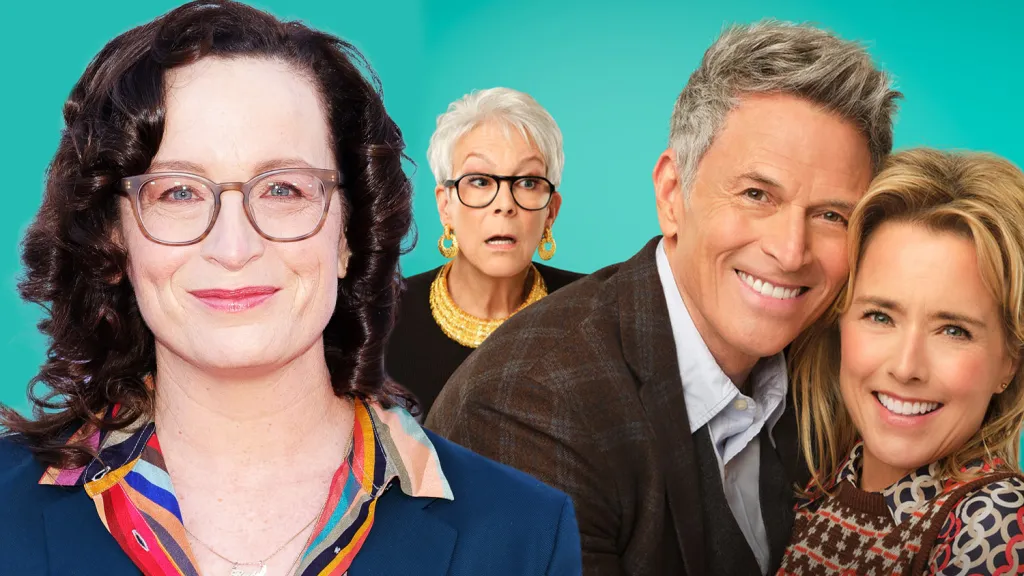
NBC‘s upcoming sitcom Newlyweds, starring Tèa Leoni and Tim Daly and featuring Jamie Lee Curtis, is undergoing a behind-the-scenes shakeup. Gail Lerner, who co-created the series with Curtis, is out as showrunner. The comedy veteran announced her firing on Instagram while plugging the show’s Oct. 23 premiere.
“The reason I’ve been given is ‘creative differences’,” Lerner wrote. “I’m so sad to be separated from the most joyous TV experience of my life. The cast, crew, and writers are unparalleled.”
Lerner added a “silver lining”: “The first six episodes were made under my leadership, and I wouldn’t change a thing.”
According to sources, Newlyweds is scheduled to film Episode 8 of its 13-episode order today. The show is going on a pre-planned hiatus next week. NBC and the series’ proucer Universal Television are expected to use the time to find a new showrunner.
Written by Lerner, Newlyweds is a later-in-life love story about a free-spirited woman, Jeanie (Leoni), and a buttoned-up professor who marry impetuously after a whirlwind courtship.
Lerner and Curtis executive produce alongside Eric Tannenbaum, Kim Tannenbaum, Scott Schwartz and Lionsgate Television. Leoni is a producer. Universal Television, a division of Universal Studio Group, is the studio.
“No one knows what’s going to happen in our meshuganah business, but I predict this show’s gonna be a barn burner,” Lerner wrote. “Please check out the first six (and beyond!). If you like them, please let me know! If you don’t, keep it to yourself. Sending all my love and hopes for a long and happy run to everyone who gave their talent and open hearts to make this happen. As my dear friend @courtneyaltonlilly told me, better to die on your feet than live on your knees. Love from your friend on her feet.”
>
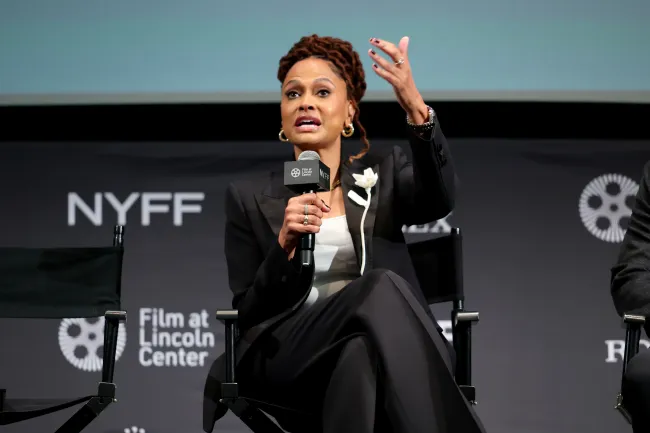
There are, of course, many connections between filmmaker Ava DuVernay’s Oscar-nominated documentary “13th” and her latest film “14th,” including both films world premiering at the New York Film Festival, a decade apart. “What a beautiful symmetry to be able to bookend it. Ten years ago, it’s opening night. Ten years later, it’s closing night,” the director told IndieWire over Zoom.
However, “I wouldn’t say it’s a sequel,” she said. “Even in its construction, all that it’s doing, it’s something different in a series of films and analyzing the Constitution against our current-day happenings, really.”
If “13th,” her documentary about the 13th Amendment of the Constitution of the United States, and how it pertains to America’s prison industrial complex and mass incarceration, was “very linear,” as DuVernay described it, then “14th” “was really a puzzle.”


Initially, the Academy Award-nominated filmmaker intended to make a documentary focused on birthright citizenship. This was before President Trump was re-elected in 2024, though he had already made his intentions to immediately eliminate that core part of the 14th Amendment to the Constitution his first day in office known to his base. “I literally did the worst thing you could do, pitched that very casually to Adam Del Deo who runs docs at Netflix. And he said, ‘Well, yeah, we should do that,’” she said.
What DuVernay didn’t realize was that “it [would] open this Pandora’s box.” Birthright citizenship is just one part in a document with five parts, with the first part being split into three sections. “Part of the journey of the film was learning the rest and seeing how it was ricocheting against current events in ways that were so startling and shocking. I couldn’t believe it was unfolding in front of my eyes as we were making it,” said the director. “I’ve likened it to building the plane while you’re flying.” As news would break, she’d often find herself saying “Oh, my God, this happened. Put that in there!”
She pitched and sold the film without having full grasp of what the 14th Amendment was, but she soon found out, even in interviewing top legal experts, “nobody knows.”
One part of the amendment, which was crafted during the Reconstruction period post-Civil War, was about public debt, and basically says that taxpayer money on both the federal and state level is not allowed to be used to pay off the debts of those who rebelled against the United States. “The secret, crazy thing about this is I couldn’t figure out how to do [it],” DuVernay said. “I can’t force some public debt thing. It’s so obscure. Even Eric Foner, our grandfather of everything, he’s reading it in his pocket [Constitution] because he doesn’t even know it off the top, public debt. And then he looked at the camera, and he said, ‘They must have thought it was important.’”

She said, “I was going to make a joke out of it. And then Trump puts together an insurrection fund.” The director saw the news, called legal expert Sherrilyn Ifill, a key participant in the film, and “I was like, ‘Is this public debt?’ And she was like, ‘Yes, it’s the public debt! We can’t believe it. It’s the public debt.’”
As a U.S. citizen, it was difficult to not be horrified at the precision with which the Trump administration was attempting to dismantle every part of the amendment, but as the director of “14th,” it contributed to making DuVernay’s vision for the film even clearer. She had an idea of using a star as a symbol for the amendment, with each point being ripped away by news of some new executive order the president signed, but “you can’t really rip when there’s one piece that’s unripped,” she said. The slush fund for January 6 rioters was the last bit she needed.
“It just shows how deliberate this is. How every single piece of every part of this is being undermined. Because if you can get one to crack, then the whole thing starts to crack. You could actually legally destroy the whole thing,” said the documentarian, in reference to the 14th Amendment. “And so, look, all hands on deck. Everything is attacking it. And it’s challenging because we don’t even know what to fight for because we don’t even know what it is.”
“14th” also became an opportunity for DuVernay to be more expansive as a director. “In ‘13th,’ my idea was that all the environments felt like labor, so [participants] were behind glass and brick and steel, forced labor of slavery and then of prison industrial complex,” she said. “And this, I wanted to get the pillars around folks, the railings, the iron, the things that hold us in place, because that’s what the 14th Amendment is.”
With that idea of the “architecture of democracy” in mind as both a thematic and visual motif, DuVernay added some verité to her repertoire, shooting librarian Carla Hayden inside the hallowed halls of the Library of Congress shortly before she had been fired by the Trump administration. Conversely, she followed contractor Devon Henry, who has made a career out of taking down Confederate monuments. “The question is, how does that fit in with everything else? At some point, you just put it in the stew and mix it up,” she said.

The director tapped designer William Roy Hodgson, who works at the Monuments Lab that tracked where and when all those Confederate statues first were erected, to be the film’s chief graphic artist and animator. He had never worked on a film before, but had the institutional knowledge she needed in addition to his artistic skill. “It’s one thing for me to assign, ‘Hey, make a graphic on this.’ It’s another thing to work with an artist who is also researching and bringing things too,” she said. “It’s really rare to have that in one person. So, all those graphics were done by one guy in his apartment in New York.”
DuVernay also collaborated with Asteria Film Co. to help restore some photos she and her team had come upon as they plowed through archives, from the Smithsonian Library of Congress to the Arkansas Historical Society, even people’s family albums. So while access was not a problem, “some of that stuff was really degraded,” she said. “We were down in boxes and crates and with slides that had never been digitized. They said, ‘Well, if you can digitize it, you can use it.’” The director added, “You can’t really get it to be high resolution enough to put in a film,” and that’s where Asteria’s AI-powered tools were of assistance.
That whole process of digging through photo archives and restoring them led to DuVernay developing a stereoscopic technique, building on the old idea of how two photos side by side could be framed in a way that made them look 3D. “When I saw those at the Library of Congress, I thought, ‘Oh, I want to do that for my audience to see a picture like that.’ And so, first you have to restore it, then you have to do rotoscope, and then just a little bit of animation for a little movement. And the artists there used those tools and brought it to life in the way that I wanted,” she said.
The way in which all of those elements are weaved together in “14th” is impressive, but DuVernay understands that it can be too much information to receive in one go, and so audiences need a break. In “13th,” she used music. “Lyrics come up on the screen. Different people through different times are talking about prison embedded in the artwork of their music,” she said. She got the notion from watching and studying Ken Burns documentaries. “I’m going to slow this down and just watch this flower bloom for a little bit so I can just process what’s been going because we’re moving really quickly,” she added.

The breaks in “14th” come through stand-up comedy segments. The first clip she found was one of Paul Mooney, which she uses in the film. “It makes me laugh so much. And I thought, ‘Oh, wow, let’s look at other political comedians, comedians who’ve really used comedy to pierce through. And I will say right now, the reason why I became so enamored with the idea of using the comedians is I believe they really are truth tellers in this moment,” said DuVernay. “News is skewed. Democrats have their news. Conservatives have their news. Ultraconservatives have their news. Super Progressives have their news. It’s just everyone is in their camp, and it really feels like it’s only the comedian who can get out and say what needs to be said, and pierce through it.”
The director also tried to cast participants in the film that were across party lines. “We wanted far right, far left, Anna Paulina Luna and AOC, completely different sides of the thing. It’s really important to get as much of that in there as I can. We tried,” she said. It was much more challenging than she thought, with former Arizona Senator Jeff Flake being the highest-ranking conservative politician among the handful she interviewed. “Three hundred and twenty-six requests to every sitting [Republican] congressperson, senator, governor, and mayor of a major city. Who said yes is who’s in the documentary.”
She said, “It was pretty challenging and a tough pill to swallow that none of them wanted to sit down with me. I feel offended,” but with “14th” now premiering at NYFF, DuVernay believes that audiences will be able to realize that the dismantling of the 14th Amendment is not a scenario in which everyone loses. She compares the film to the bell in a boxing match. “I want people to fight,” she said. “I want people to come out of it alert, aware, and wanting to stand up for this.”
That is one more difference between the America in which “13th” was released, and where the country is now. “[Then], we had the capacity to focus on the plight of one particular group,” she said. “Now, everyone is being attacked. Everything is happening. We see it with the immigrant community. Enough people are not leaning into what’s happening.”
DuVernay concluded, “You have to put on your own oxygen mask first,” but “what this [film] says is, ‘Look, we’re all in this together. And whether I like you or not, it’s going to take that kind of groupthink to dig ourselves out of it.’ That’s not possible if we’re not even talking to each other and we don’t know what we’re talking about. So, hopefully this gets people on the same page.”
“14th” will have its world premiere at the 2026 New York Film Festival on Friday, October 9. Netflix will release the film in select theaters on Friday, November 27. The film will arrive on Netflix on Friday, December 4.
>
There’s something uniquely tragic about a monster who wants to be loved. Most supernatural villains are content to stalk, maim, and murder their victims, but the titular terror of “Other Mommy” has a much, much more intimate ambition. She wants a little girl to invite her inside her heart. And like any good manipulator, she has to convince the kid it was actually her idea first.
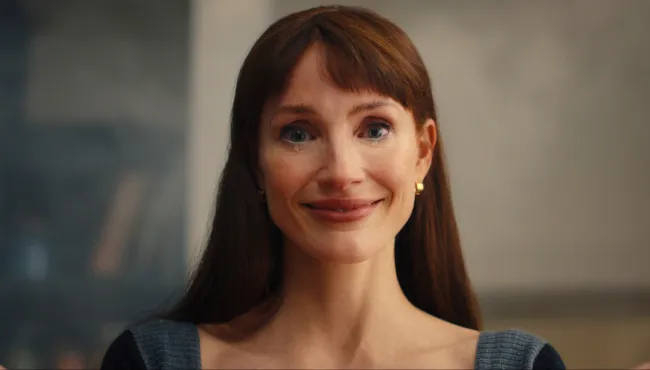
Whether or not you’ve had her arrival spoiled by the trailer, Other Mommy’s big kitchen entrance makes you want to laugh and scream at the same time — every time. Played by Oscar winner Jessica Chastain, this freakish apparition can twist her body into impossible shapes, stretch her neck around corners, and occupy just about any cramped, scary space. What she really wants, of course, is to be a person. But, uh, how do you smooth over a home invasion?

That’s the wonderfully warped foundation of director Rob Savage‘s adaptation of Josh Malerman’s 2024 novel “Incidents Around the House.” Starring Chastain as both a disconnected mother and the obsessive entity threatening to replace her, Universal Pictures’ “Other Mommy” is a hypnotic and frequently bewildering exercise in domestic horror that turns the actress’s gift for conveying tenderness and tenacity against itself. The resulting collision is frequently ridiculous, rarely frightening, and strangely sad.

At the center of this nightmare is Bela (Arabella Olivia Clark): an eight-year-old whose understanding of the world is still being assembled from whatever the adults around her are willing to explain. Her mother, Ursula (Chastain), and father, Russ (Jay Duplass), have problems of their own, although neither seems particularly aware of how much their daughter already understands. When a mysterious presence begins appearing around the house, the child initially treats the visitor with the cautious curiosity one might extend to an imaginary friend.
That would be a more reassuring arrangement if Other Mommy weren’t so obviously… wrong.
Chastain has already encountered Stephen King’s dancing clown in “It Chapter Two,” and her new supernatural alter ego feels less like Pennywise’s girlfriend than maybe one of his quieter pals from college. Other Mommy is manipulative and bendy, sure, but more than that, she’s so, so upset. Pennywise and the Other Mother from “Coraline” at least had somewhere to retreat when their victims rejected them. But Other Mommy, hiding in the very structure of the house, seems to crave existence itself, and Chastain channels that pitch-black despair with everything she’s got. Her most impressive special effect isn’t an elongated limb or grotesquely contorted face — but the sorrow, fear, and rage she can reflect in her eyes.
The actress has considerable experience playing mothers in distress, from “The Tree of Life” and “Take Shelter” to the otherworldly family nightmare of “Mama.” She’s especially convincing opposite young performers, and Clark gives her plenty to work with here. Before the house starts filling with deflated skin, confetti, broken glass, and blood, Chastain is even allowed to look freakin’ dynamite in a pair of dark-rimmed glasses.
Even so, Ursula is a more complicated proposition than that wholesome image suggests. At times, the real mother has a vaguely “Gone Girl”-esque air of domestic volatility, as though something might ignite at any moment. In fact, Other Mommy herself, routinely showing up a bit wet(?), practically smells like gasoline. There’s an unmistakable impression throughout that this woman… or whatever is pretending to be one… might burn down the house.
And yet, the creature becomes a surprisingly normalized part of the film‘s world. Even when her spine loops around Bela like an illustration from a particularly disturbed Dr. Seuss book, she eventually starts to resemble a fleshy extension of the family’s sleek modern furniture. Savage’s movie is so committed to its own absurdity that the extraordinary begins to feel mundane.
That strange acclimation extends to the human characters, whose emotional histories are gradually filled in. Duplass is particularly interesting in this environment. An icon of mumblecore, he looks as though he’s wandered onto the wrong set, but his unassuming presence eventually makes him feel like family. A quiet moment in which Russ performs a melancholy little dance for his daughter proves unexpectedly heartbreaking.
Still, by the time the family starts exploring ways to exorcise their unwanted houseguest, it’s difficult not to wish Russ were something more useful. Like a priest.

Their paranormal intervention involves Dichen Lachman as Lois Anthony, in a role best described as Chris Hansen for ghosts. Her solemn declaration that “we wish to be heard by the entity known as Other Mommy” is an exquisitely goofy piece of genre nonsense, delivered with precisely the Loomis-level conviction it deserves. By this point, the audience knows the monster a little too well to be properly terrified of her. Watching everyone attempt to conduct official business with the thing is practically irresistible.
Clark deserves considerable credit for keeping these escalating absurdities grounded. Magnetic enough to hold her own against two major acting talents and an exhausting parade of special effects, the young performer maintains a convincing sense of agency even as Bela’s surroundings become physically overwhelming.
When so-called Uncle Frank (Arian Moayed) treats her as though she’s younger than she really is, the sinister appeal of Other Mommy’s attention becomes painfully clear. The creature offers Bela something the adults frequently deny her: the feeling that she’s in control. Of course, nothing could be further from the truth and the chaos cranks up quickly.
Savage, whose pandemic-era breakthrough “Host” turned the limitations of a Zoom call into a remarkably effective horror mechanism, approaches this material with almost the opposite visual philosophy. Where the 2020 found-footage film fits terror into a rigid digital window, “Other Mommy” sends its camera sailing through walls, ceilings, and the metaphysical fringes of reality itself. The movie shifts between Bela’s more innocent perspective, and Other Mommy’s impossible viewpoint: a maddening lens of entitlement and pain that never stops.
Between a surreal balloon-popping nightmare on the ceiling and an abundance of brightly colored ball-pit balls through the film’s second half, “Other Mommy” sometimes resembles “Skinamarink” by way of “The Backrooms.” Its aggressively artificial imagery evokes the kind of AI-slop, dreamcore videos that tend to populate social media these days, thrusting the audience into increasingly unsettling spaces that seem generated from a stranger’s hazy childhood.

Other Mommy herself can rearrange her body like a tangram puzzle, and in doing so, she doesn’t just violate the laws of anatomy. She comes across as personally offended that anyone would expect her to obey them, and the visual extravagance of that slippery confidence is sincerely fun at first. Unfortunately, anything can happen — and does keep happening. And happening and happening and happening.
After an action-packed confrontation that comes midway but feels like the final 15 minutes of a different Blumhouse movie, “Other Mommy” kicks the suspense into high gear and largely lets it stay there. The family’s subsequent road trip to find safety gives the story an appealing sense of exploration. But just when the atmosphere starts to settle into a specific style, the movie repeatedly threatens to accordion away from itself. A gigantic Other Mommy intrudes on the frame, or some other bizarre impossibility blows the established scene apart like pixie dust.
The ending, which substantially departs from Malerman’s novel, offers a richer choice than the source material. Rather than treating parental love as an uncomplicated defense, Nathan Elston’s screenplay allows Ursula to acknowledge a more shameful truth. A Chastain delivers a beautiful climactic monologue that almost sees the accumulated melodrama pay off. Almost.
Whether she’s behaving like an action hero preparing to defend her family, or looking like a storyboard ripped straight from the production of “Courage the Cowardly Dog,” Chastain is perpetually impossible to ignore. There’s plenty of the actress in “Other Mommy,” and yet, it’s somehow tempting to ask for more. But by the climax, Bela and her parents’ problems have become so bizarre that just leaving the theater felt like trying to shake someone else’s therapist.
That said, “Other Mommy” is an exceptionally weird movie, and its monster is memorable enough that it deserves applause for that. More importantly, Savage’s evolution from the lo-fi “Host” to the studio-backed “Boogeyman” and now this technically extravagant explosion suggests an artist already figuring out how to stretch the boundaries of what he can accomplish.
Savage, with an appetite for spectacle that sometimes outpaces his patience for storytelling, stays genuine enough in his emotion that it makes the creative excess worth watching. As for Other Mommy, the filmmaker ultimately makes her easy to understand — even if their movie proves a bit harder to love.
Grade: C+
A Universal Pictures release, “Other Mommy” is now playing in theaters.
>
Bears mailbag: What's with their goal-line issues? Week 5 predictions vs. Packers
Natura’s $99 AI Ring Wants to Put Multiple AI Agents One Press Away
Minnesota Timberwolves 2026-27 TV info: Streaming updates for Anthony Edwards, LaMelo Ball
-

 movies5 months ago
Search For Canadian TV Actor Stewart McLean Now Homicide Investigation
-

 Fashion9 years ago
These ’90s fashion trends are making a comeback in 2017
-
Fashion9 years ago
According to Dior Couture, this taboo fashion accessory is back
-
Fashion9 years ago
Model Jocelyn Chew’s Instagram is the best vacation you’ve ever had
-
Fashion9 years ago
Emily Ratajkowski channels back-to-school style
-
Fashion9 years ago
9 Celebrities who have spoken out about being photoshopped
-

 Anime4 months ago
Rurouni Kenshin: Hokkaido Arc Manga Takes 1-Issue Break – News
-

 Anime3 months ago
HIDIVE to Stream English Dubs for The World Is Dancing, The Forsaken Saintess and Her Foodie Roadtrip in Another World, The Dangers in My Heart: The Movie Anime – News