
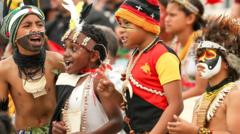
When the Rugby League World Cup lands in Port Moresby this month, expect noise levels that defy physics. Papua New Guinea — co-host of the tournament alongside Australia and New Zealand — is the one nation on Earth where rugby league isn’t just a sport. It’s a national obsession, a badge of unity, and, for many, the center of life itself.
Papua New Guinea’s Kumuls in action (Credits: BBC Sport)
The capital will host four World Cup matches, and the locals’ devotion to their national teams — the men’s Kumuls and the women’s Orchids — has to be witnessed to be believed. Children so mad about the game fashion balls out of whatever they can find. When the team bus rolls to the national stadium, kids sprint alongside it. Players are mobbed everywhere they go.
A Crowd of 15,000 That Sounds Like 30,000
PNG star Edwin Ipape, who plays in the NRL, gets emotional just talking about playing at home: travelling with his team-mates to the national stadium, hearing the crowd behind them singing the national anthem, makes him cry every time.
At their best and noisiest, a 15,000-strong crowd in Port Moresby can sound like twice that number — so loud the players on the field can’t hear each other. That intensity can be daunting for visiting sides; in the past, passion has boiled over to the point where police fired tear gas into crowds, including when Great Britain toured in 1992.
How an Island Fell for the Game
The seeds were sown by Australian miners in the 1930s, who brought the game — with its deep roots in New South Wales and Queensland — to the local population. It took hold fast. The ferocious physicality of rugby league sat naturally with a culture that had long fought battles on its own soil.
Today, PNG’s people are among the most knowledgeable and passionate fans anywhere. “People in Papua New Guinea probably don’t know who the prime minister is, but they know all the NRL players,” joked Orchids prop Elsie Albert, who plays for Parramatta Eels in Australia’s NRL Women’s Premiership.
A Symbol of Unity
In a land that can be torn apart by tribal fighting, where more than 800 languages and dialects are spoken, the national game is a powerful symbol of unity. Villages gather around television sets to watch the NRL and Super League. Participation is enormous — thousands of would-be Edwin Ipapes run about on bits of grass, gravel, and the scrawniest patches of clear land, anywhere they can play.
Ipape himself grew up in Mount Hagen in the Highlands, recalling how he’d save up lunch money to buy an American football and use it as a rugby ball. If you’re lucky, you play with a real ball — otherwise, “you play with containers, you put stuff in it, fill it up and then make it like a ball.”
The Highland games are rough, bordering on brutal — the perfect breeding ground for talent. And this month, when the World Cup comes to town, the whole island will be watching. A 15,000-strong choir of the most obsessed fans on the planet will be at full voice.
Also Read: Watkins Called Into England Rugby League World Cup Squad After Smithies Injury
Source: BBC Sport — read the full story there.