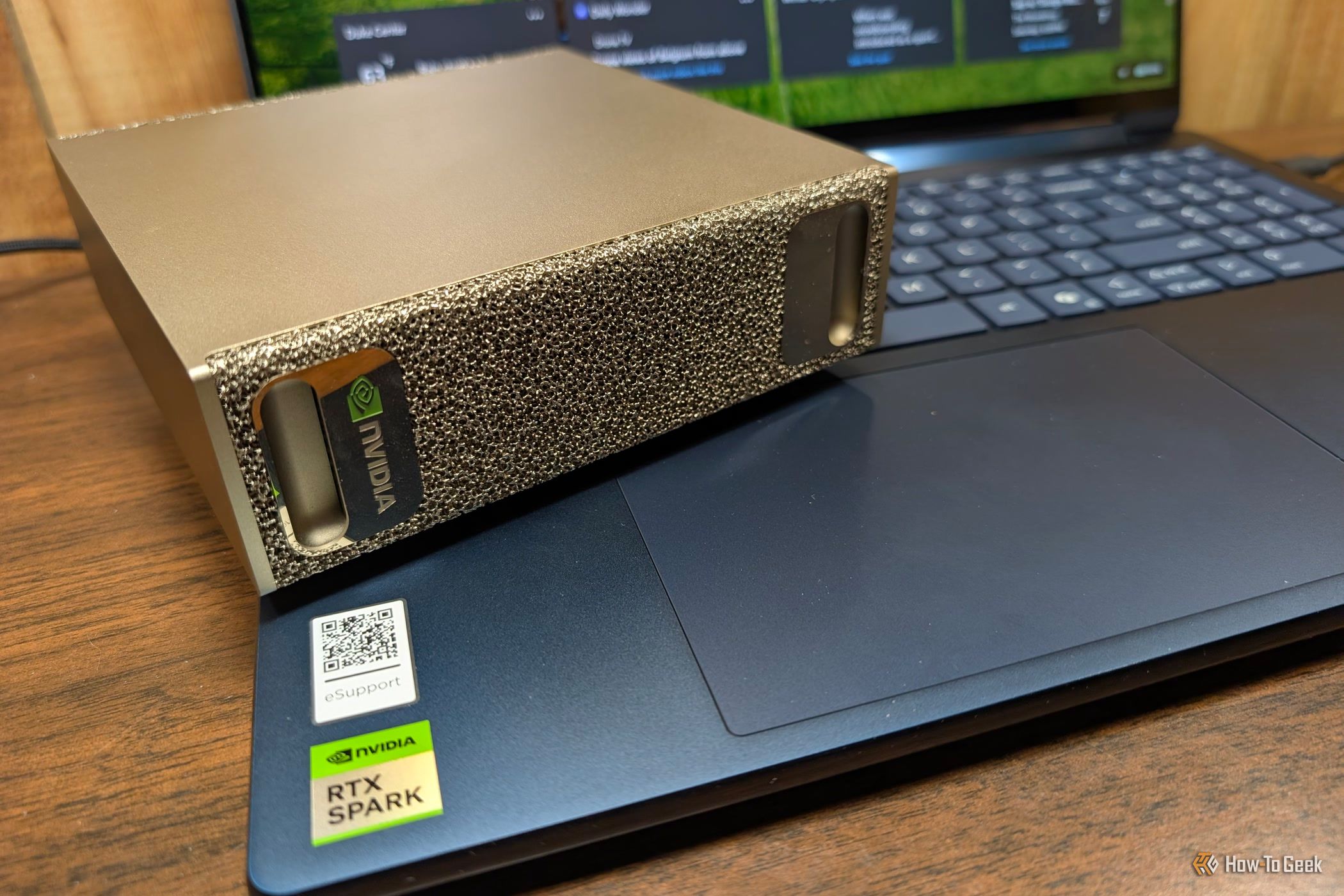
Trying to decide between NVIDIA’s RTX Spark and DGX Spark for your AI work? On paper they look like siblings — they share essentially the same superchip under the hood — but in practice they are built for completely different people, and only one feels like a complete product.
NVIDIA RTX Spark vs DGX Spark (Credits: How-To Geek)
Same Silicon, Different Machines
Both devices run on NVIDIA’s GB10 superchip (or the N1X variant in the RTX Spark), a compact AI-focused chip packing 6,144 CUDA cores, 192 Tensor Cores and 48 RT cores — roughly in the ballpark of a mobile RTX 5070. Both support up to 128GB of unified memory and deliver around a petaflop of FP4 AI performance.
The differences start with power: the DGX Spark feeds its chip a full 140W TDP, while RTX Spark laptops are capped between 45W and 80W. The DGX Spark also ships ConnectX-7 networking at 200 Gbps, letting you link two units with a single QSFP cable — and as of October 2026 you can manually cluster up to eight units into a 1TB memory pool. The RTX Spark has no such clustering ability.
Who Each One Is Actually For
The DGX Spark is a Linux mini PC built to be a ‘personal AI supercomputer’: no headphone jack, no USB-A ports, no card reader — it’s designed to sit headless and be accessed remotely for tasks like creating LoRAs, fine-tuning dense models, or pruning mixture-of-experts models. That focus makes it feel finished.
The RTX Spark is a Windows laptop or small desktop for AI and everyday use. The hardware is genuinely impressive, but after a week of use it feels incomplete — Windows doesn’t yet give you a real chance to put that AI horsepower to work the way the Linux-based DGX Spark does.
Bottom line: if you want a portable AI workstation for daily computing with AI on tap, the RTX Spark is your lane. If you want a dedicated personal supercomputer for serious model work, the DGX Spark — with its clustering and Linux-first design — is the finished article.
Also Read: NVIDIA Releases Nemotron 3.5 Bolt E4B 4GB: Open Small Language Model for Local Voice Agents and Nace AI Open-Sources Drex Max v1: A 27B Decision Model You Can Run Locally on Apple Silicon
Source: How-To Geek — read the full story there.