
Jeremy Strong as Mark Zuckerberg in ‘The Social Reckoning’
Leah Gallo/Columbia Pictures/Everett Collection


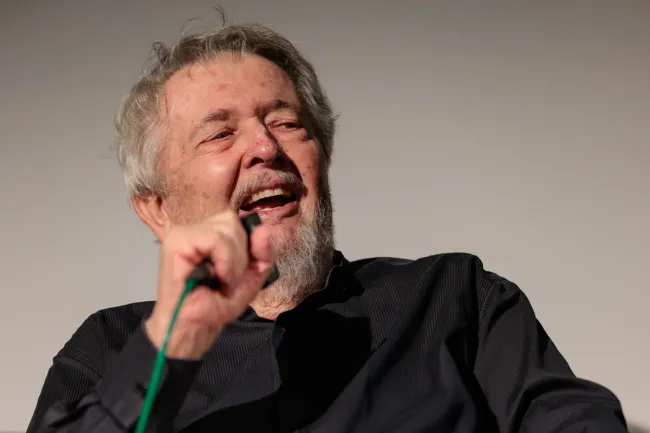
One wouldn’t necessarily think of Clint Eastwood and Eddie Murphy as vying for the same roles, but according to writer-director Walter Hill, the action-comedy classic that made Murphy a movie star began as a vehicle for the man who became famous playing Dirty Harry Callahan. “They wanted me to write it for Clint Eastwood,” Hill said of the screenplay that would ultimately become “48Hrs.” “We met with Mr. Eastwood, and he said he liked the idea, but he had to be the convict, because if he was the cop it was just Dirty Harry, and he was quite right about that.”
Hill screened “48Hrs.,” his raucous 1982 buddy movie about a racist cop (Nick Nolte) and a Black convict (Eddie Murphy) who team up to catch a killer (James Remar), at the American Cinematheque for a live edition of IndieWire’s Filmmaker Toolkit podcast. After presenting a gorgeous 35mm print to a packed crowd at the Cinematheque’s “Friend of the Fest” podcast festival, Hill took the stage for a lively discussion of the film‘s convoluted but serendipitous creation.


Although losing Clint Eastwood — then one of the biggest movie stars in the world — might not have seemed like good luck at the time, it led Hill to reconfigure “48Hrs.” and turn it into the potent blend of violent action and racially tense comedy it would become. “While I was [writing], [Eastwood] decided to take the Don Siegel movie, ‘Escape From Alcatraz,’” Hill said. “We knew he wasn’t going to play two prisoners in a row, so I wrote it for a Black man to be the prisoner.”
Hill wanted Richard Pryor, but the studio wasn’t interested in that idea, and the project lay dormant while Hill went off to make “The Long Riders” and “Southern Comfort.” Ironically, by the time Paramount was ready to resurrect “48Hrs.” Richard Pryor had become a huge star and was no longer available to play a part that was essentially the second lead. With Nick Nolte cast as the white cop, Hill went on a talent hunt for the Black convict after approaching Gregory Hines and finding that the actor couldn’t get out of a Broadway contract in time to make Hill’s start date.
At the time, Eddie Murphy was a rising star on “Saturday Night Live” but had never made a movie before. Hill didn’t watch “Saturday Night Live” — “I was usually drunk and asleep by the time it was on,” the director said — but his girlfriend Hildy Gottlieb was Murphy’s agent, and she made sure Hill saw some of the actor’s work. “She gave me a bunch of tapes, and I wasn’t such an idiot that I couldn’t see that the guy had enormous talent. I should say that I was so indebted to the agent that brought Eddie to my attention that we got married, and we’re still married.”

Because Murphy was an untrained actor, Hill knew he’d rely on his raw talent, and that capturing his best moments on camera would be like catching lightning in a bottle. “I said to Nick, ‘You better be good every take, because the one take where he’s good, we’re going to print it,’” Hill said. Letting Nolte and Murphy improvise a little fit Hill’s ambition for the movie, which was to be a little looser than his more tightly scripted prior films. “I wanted this one to be rough around the edges. I wanted it to move fast.”
Hill’s ambition was to combine a kind of gritty reality in the behavior — which he felt was necessary given the tricky depiction of race relations — with a slightly dreamier quality in the visuals, which he achieved with long lenses, split diopters, and, in one case, a spectacularly elaborate long take in which all of the movie’s exposition is laid out in one complicated unbroken shot. “All movies operate in their own special world, and you choose how you want to deliver that special world,” Hill said. “Even the movies that seem to be brutally realistic, they aren’t.”
One scene Hill allowed to be slightly heightened — to great comic effect — was the one in which Murphy enters a redneck bar posing as a policeman. Critic Roger Ebert said Murphy became a movie star in that one scene, and Hill recognized he had something special when he was shooting the material. “I looked over to [co-screenwriter] Larry [Gross] and said, ‘We’re rich,’” Hill said of the day he watched Murphy take command in the bar scene. “What I should have said was, ‘The studio’s rich,’ or ‘Eddie’s rich.’”
Ironically, the studio Murphy would indeed eventually make very rich — not just on “48Hrs.” but subsequent films like “Trading Places,” “Beverly Hills Cop,” and “Coming to America” — didn’t know what they had when Hill’s rushes started coming in. “One of the executives came out of dailies and said, ‘Walter Hill will never work at Paramount again,’” Hill said. “They didn’t think Eddie was very funny, and they thought that was my fault. We had a couple of knockdown, drag-out fights before they backed off.”
Hill says the studio feared racial tension, but he believes that’s one reason the movie has stayed alive 44 years after its release. “Both characters are in their way racist, certainly by the modern definition,” Hill said. “They grow to a mutual respect, but I didn’t want a silly, happy ending. [Murphy] goes back to jail, and Nick is in less-than-perfect condition at the end of the film. I think the reason the movie has consistent interest has to do with the racial tension creating an energy that was unusual in an action movie, and our country is not free of this racial tension to this day. That’s why I think this movie kind of hangs in there.”
To hear the entire conversation with Walter Hill and make sure you don’t miss a single episode of Filmmaker Toolkit, subscribe to the podcast on Apple, Spotify, or your favorite podcast platform.
>
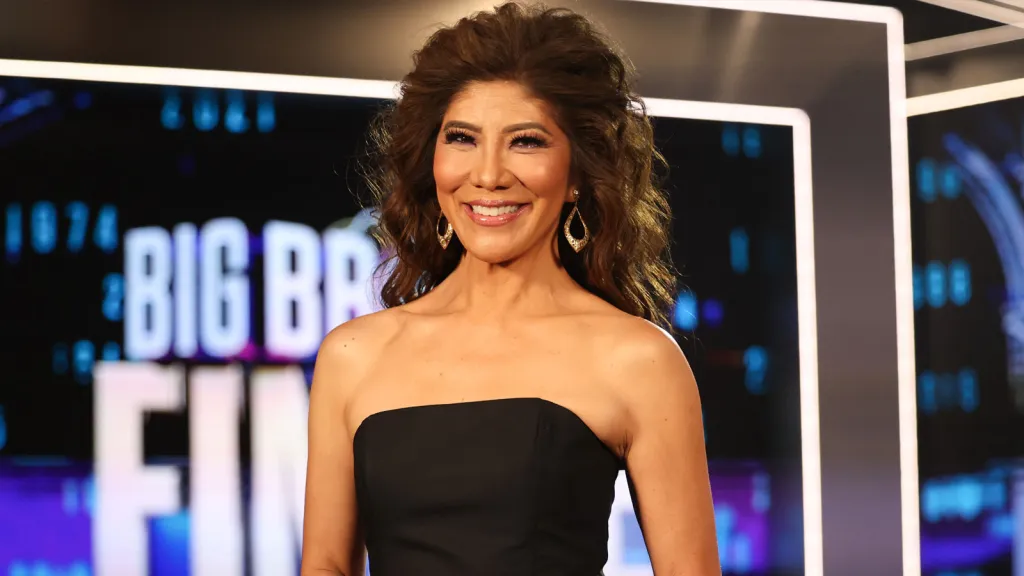
Big Brother USA wrapped another season on CBS, and host Julie Chen Moonves announced the network had renewed the competition series for two more seasons.
After announcing the winner of Season 28, Moonves confirmed the reality TV competition had been picked up for Seasons 29 and 30.
The most current season hit a milestone, becoming the first primetime series to reach 1,000 original episodes.
Big Brother follows a group of strangers who live in a house under 24/7 surveillance as they scheme and form alliances to make it to the end for a chance to win a $750,000 cash prize. The runner up of the season also wins $75,0000, while America votes for their favorite houseguest and awards them $50,000.
Big Brother Season 28’s cast included Ashley Trail (24), Barrett Pfeiffer (27), Chuck Anyanwu (27), Drew Campbell (22), Haley Thogmartin (29), Jason de Puy (35), Kamuela “Kamu” Kirk (32), LaTrice Verrett (57), Lyric Medeiros (25), Mallory Aurichio (24), Melody Morris (24), Rome Seymour (28) and Taylor Brown (27). The competition also added a trio of icons to the cast: BB26 alum Angela Murray (52), Survivor star Rick Devens (42), and Dee Valladares.
CBS recently revealed that Big Brother viewers have watched 14.8 billion minutes of twists, blindsides, and unforgettable moments throughout Season 28, up +9% from last summer. The summer staple also saw year-over-year audience growth, averaging 5.1 million viewers in seven-day multiplatform viewing, up +8% from last summer, while ranking as the summer’s most social program across all television programs (excluding sports).
Big Brother also earned two Guinness World Record titles – Most Episodes of a Primetime TV Series and Most Episodes of a Competitive Reality TV Series.
>
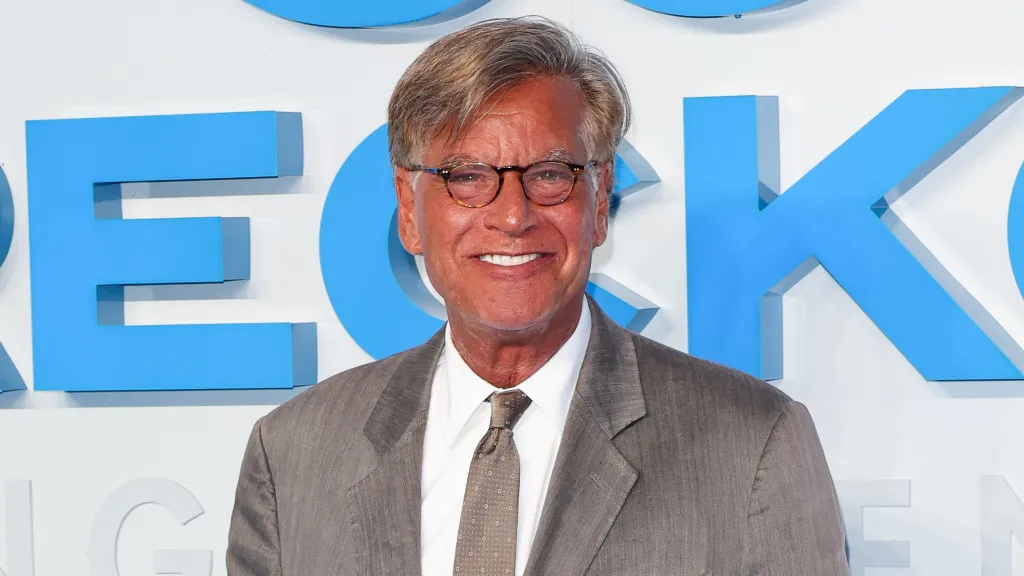
Although Facebook has played a big role in recent U.S. politics, Aaron Sorkin didn’t want to make The Social Reckoning a political statement.
The Oscar winner noted that although he “was never asked” to omit Trump from his upcoming movie about a young Facebook whistleblower, which premieres Oct. 9, he didn’t want the film to become “a red-blue thing.”
“I want to be clear: I was never asked to do that, to not mention Trump by name. I turned in the script and a day or two later met with Tom Rothman, who was full speed ahead on it,” he told Vanity Fair. “And I promised him, unprovoked, that we would not see any Trump signage, no ‘Make America Great Again.’”
Sorkin continued, “The movie is about Facebook’s role and the rise of divisiveness, extremism, and hyper-partisanship in the country. It is not a red-blue thing, even though, obviously, it will be felt that way.”
After The Social Network (2010) recounted Mark Zuckerberg’s creation of Facebook and the controversy that ensued, screenwriter Sorkin returned to write and direct the upcoming sequel, which focuses on a 2021 document leak that exposed harm Facebook caused on society.
Jeremy Strong as Mark Zuckerberg in ‘The Social Reckoning’
Leah Gallo/Columbia Pictures/Everett Collection
In The Social Reckoning, Facebook engineer Frances Haugen (Mikey Madison) goes to Wall Street Journal reporter Jeff Horwitz (Jeremy Allen White) with the social media platform’s most guarded secrets. Jeremy Strong, Bill Burr, Wunmi Mosaku, Billy Magnussen and Betty Gilpin also star.
>
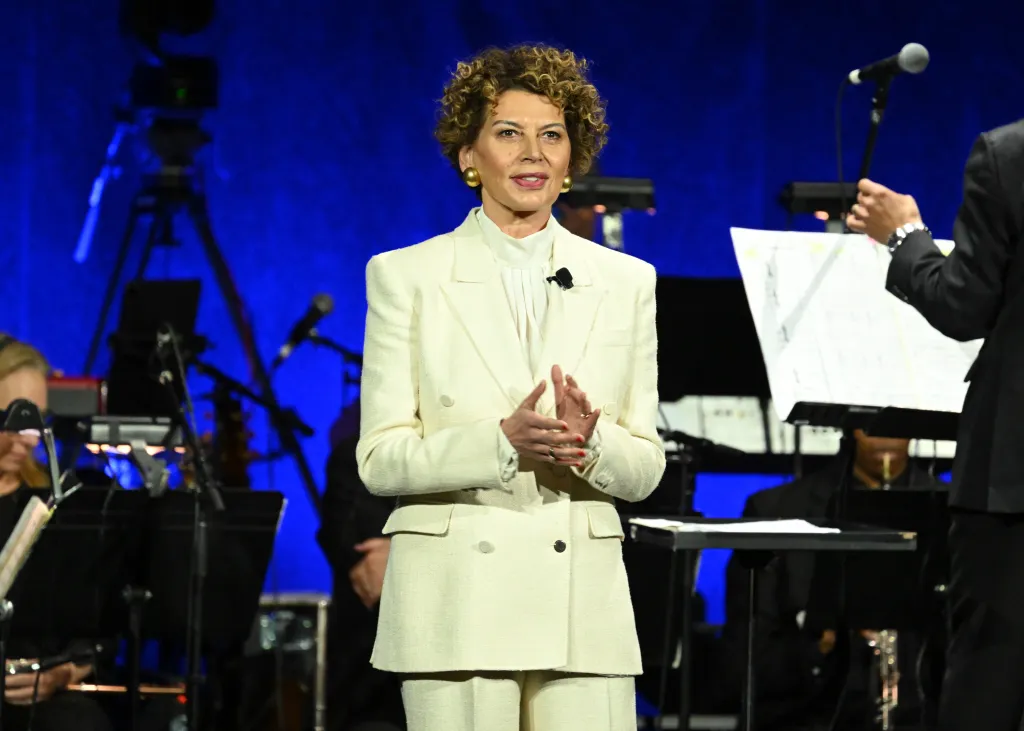
Donna Langley, chairman of NBCUniversal Entertainment & Studios, is not a fan of Paramount and Warner Bros. Discovery combining. “I think it is bad. I think it’s bad for everything,” she said bluntly, addressing the feature film market in particular.
“What this year has proven is, if you build it, they will come. Right? If you have the right mix of films in a steady diet for the audience, they’re going to show up. And we’re also cultivating this great habit with young people, who are coming to the cinema and we need to keep them there. So volume matters, and if we if we essentially lose a studio — which is I know not the stated plan and goal — but if we lose a studio, it’s bad … Look back at Fox-Disney. It wasn’t great, she said during a Q&A at the Bloomberg Screentime conference.
Paramount has committed to a legal settlement calling for the combined studios to release 30 theatrical films a year for the first two years post-merger, and 32 films for the following three years. The deal is expected to close next Tuesday.
Last fall, Universal detached the prolific Tyler Sheridan from his longtime studio home at Par for a new five-year film and television deal starting in early 2029. Asked how, Langley said, “Look, I think I saw an opportunity, with disruption and instability at moments where companies are going through something. And you know they are just moments to kind of look around the marketplace and see if there’s a competitive advantage. But really, where I started talking to Taylor was about film, because I knew that he had a film deal at Paramount but it was a first look deal, didn’t have as many teeth to it as his television deal. That’s how it started, and then we just got to talking, and one thing led to another.”
Split Looming
NBCU itself is in the midst of big corporate wrangling as parent Comcast plans to spin it off with Sky into a standalone, publicly traded company. “I’m mostly excited and optimistic about it. I’m not fearful of it at all, actually. I think it’s going to be good … Not to be tethered to a legacy business, Comcast, where the stock has struggled for a while, is a good thing.
“Now we are going to be the masters of our own destiny. It is more pressure. But in our neck of the woods, when you have to open movies, you know, however many times a year, there’s no more pressure than that.” She acknowledged “the scale question, of course,” but said it will be interesting for the slimmed down company to explore “at a moment of this real historical transformational change, what else can we be doing, and where else should we be playing in terms of growth.”
The split should be completed by mid-2027.
Box Office Run
The head of the number one movie studio in the world this year in the best overall box office since the pandemic, is more cautions about next year. “I think 2027 has a different complexion to it. I don’t think it has as much potential for the kind of big billion-dollar hits like this year, if you think about the breakouts, the ones that were surprises … But I think ‘28 will be kind of back again.”
“But you know, you really never know. I mean, I think if this year taught us anything, it was so exciting because it sort of reminds you that one of the fun things about this business is that surprises can always happen, good or bad. Luckily, it was good.”
Universal’s Christopher Nolan’s epicThe Odyssey is a juggernaut led and Obsession from Focus Features one of the year’s unexpected hits.
“They were both surprises for different reasons. I felt very confident that The Odyssey was going to cross a billion and then some. But the play-out pattern was so extraordinary. I mean, the fact that in week three we actually outgrossed the second week. It was just filled with surprises all the way along.”
Obsession “was just a good old-fashioned over-performing surprise. We knew we had something that could hit the cultural zeitgeist when we apparently, according to reports, overpaid for it in Toronto … We caught lightning in a bottle.”
The studio acquired the film for $15 million and it went on to gross over $500 million worldwide.
>


Search For Canadian TV Actor Stewart McLean Now Homicide Investigation


These ’90s fashion trends are making a comeback in 2017
According to Dior Couture, this taboo fashion accessory is back
Model Jocelyn Chew’s Instagram is the best vacation you’ve ever had
Emily Ratajkowski channels back-to-school style
9 Celebrities who have spoken out about being photoshopped


Rurouni Kenshin: Hokkaido Arc Manga Takes 1-Issue Break – News


HIDIVE to Stream English Dubs for The World Is Dancing, The Forsaken Saintess and Her Foodie Roadtrip in Another World, The Dangers in My Heart: The Movie Anime – News