
Entertainment
Behemoth! Review: Pedro Pascal Stars in Tony Gilroy’s Atonal Drama


Purposefully unfolding like a piece of classical music that’s lost its melody among a maze of overlapping leitmotifs, Tony Gilroy’s “Behemoth!” is a much slippier and more elegant thing than the scale implied by its title — the deception of which is purposeful as well. Sure, there are car crashes, crane shots, and nine different composers to the film’s credit (with giants of the form like Alan Silvestri, Michael Giacchino, and James Newton Howard each contributing their own diegetic accompaniments), but all of those outsized flourishes have the strange effect of making the elusive film around them feel easier to slip through your fingers.


At its most basic level, “Behemoth!” is a floaty little character study about a hot but avoidant cellist named Alex Sarian (Pedro Pascal) who returns to Los Angeles after 20 years of running away from it and immediately gets seduced back into his memories when he starts working as a session player on a variety of different film scores. Such is the singular effect of movie music — compositions that are inextricably bound to certain images from the moment they’re brought into the world, like a person to the family they never asked to have. Confronted with that strange alchemy for the first time since he abandoned the pictures for the philharmonic, and largely disinterested in the Hollywood slop he’s been hired to play over, Alex can’t help but map the arrangements onto the unresolved moments from his own life.
Maybe, we think, the music will help make sense of the stray thoughts that kick around his head, or at least turn them into the stuff of a “Stardust Memories”-like funhouse to explore. It’s all too easy to imagine what a conventional filmmaker could do with that same concept. But Gilroy, so eager to zag against expectations that he leveraged a mega-budget “Star Wars” show into an uncompromising political thriller about the brick-by-brick sacrifice required to build a rebellion, soon reveals subtler and more ambivalently cinematic intentions than the premise of his latest feature might suggest. By the time “Behemoth!” arrives at its dolcissimo stunner of an ending, it’s all the more rewarding for that.
Recording the percussive accompaniment for a chase scene in an action-comedy called “Spies Don’t Run,” Alex is spirited back to the wintry night in Chicago where he tried to sneak out of a symphony gala without getting caught by the indomitable blonde he’d been sleeping with (Olivia Wilde) — the very married wife of a rich donor. The lovelorn waltz Alex is asked to play during his gig in the orchestra for a romantic drama called “Seasons of Glass” inspires him to travel a bit further back in time and to the south, where a 2016 stint in Dallas was defined by the casually torrid affair he enjoyed with a brilliant violinist (Eva Victor, marvelously atonal) who was half-committed to an L.A. billionaire (Matthew Lillard). Later, a scene where Alex is scoring a top-secret blockbuster code-named “Behemoth!” is intercut with his more recent memory of sneaking into a mansion in order to steal a used toothbrush as a DNA sample for a paternity test, a scheme the music transforms into a comic infiltration setpiece worthy of the “Mission: Impossible” series.
While Alex has never been able to hear the rhythm of his own life, his slipstream of memories soon betrays a pattern that’s perfectly clear to us: The cellist is drawn to strong but unavailable women, and all too happy to string them along until the moment they threaten to strike a more permanent harmony with his life. Alex’s talent is as obvious as his dashing good looks (we later discover that he was something of a child prodigy, a third-generation musician so groomed for Hollywood glory that he played on “The Tonight Show Starring Johnny Carson” when he was only six years old), but he’s never been comfortable in the spotlight, and refuses to stay anywhere long enough for it to find him. Alas, Gilroy is about to torture this commitment-phobic virtuoso with a truth that no music-lover should ever have to be told: Something doesn’t have to last in order to stay with you forever.
Perhaps that explains why Gilroy doesn’t feel the need to tell Alex that. Or us. More restless than “Michael Clayton” and even slipperier than “Duplicity,” the “Andor” godhead’s first movie in 14 years might think of itself as a love letter to movie scores and the people who make them, but “Behemoth!” mostly prefers to play the notes between the notes. “Cinema Paradiso” this is not.
While Gilroy isn’t immune to the sentimental power of music, “Behemoth!” is more interested in using it as a portal — as a way of making sense of how people move through time. It might start by transposing Alex’s life into the stuff of a movie (all swooping camera movements and fantastical dream logic), but it gradually begins to grapple with all the ways that Alex’s life doesn’t lend itself to a Hollywood script, at least so far as the way that Gilroy chooses to show it to us is concerned. The flameout podcaster brother who looks nothing like him (Will Arnett), the senile mom (JoBeth Williams) whose dementia brings him back home, the hotel tryst he has with a long-time friend (Margarita Levieva)… it seems like the makings of a familiar drama even before we learn about Alex’s fascination with a Billie Eilish-coded L.A. music prodigy (a compellingly self-possessed Alexa Swinton), but “Behemoth!” rarely bothers to connect the dots between them.
Light on psychological details and wishy-washy about how one thing leads to another, the movie splits the difference between a Proustian reverie and a “Jay Kelly”-like this is your life story; the music carves wormholes into the flow of space-time as Gilroy lightly pushes Alex to seize control of where the sounds are taking him. He’s spent most of his life staring at a conductor and “waiting for the stick,” but at a certain point he’s going to have to find his own tempo. By virtue of suffusing that search into its structure and movement, “Behemoth!” effectively submits itself to the same challenge.
Real and recessive, Pascal’s unshowy performance resists explaining how Alex feels about the tension between art and money, which he inherited like a family heirloom. His father hated scoring cartoons, but loved the residuals. For his part, Alex seems vaguely unsatisfied by the role he’s forced to accept as a Tinseltown session musician — he loves the movies about as much as they love him back (which is to say, in job-starved 2026 Hollywood, not very much), and rues the fact that every rehearsal doubles as an audition for the next gig. Does he look down on his brother for so eagerly selling out? It’s hard to say. Does he resent their dad for fucking them both up so badly? Probably, but I sense that he also sympathizes with the fact that his dad never really knew what he was playing for. The obvious effort that Pascal spent practicing the cello pays off in the scenes where Alex intensely plays the instrument for his own private reasons, as if asking the same thing of himself.
A great film score can make the marriage between image and sound feel like destiny, and “Behemoth!” — the story of a life that has never been properly synced up with its soundtrack — commits itself to the uncertain process of reconciling how Alex sees himself with the music that he hears in head. That process of reconciliation takes precedence over the music, all of which is believable in its context (the verisimilitude of the The Behemoth! Collective is beyond reproach, as the fake scores invariably echo with the essence of real ones), but little of which is memorable in its own right. At least, not until it has to be. Not until the deeply affecting scene where a certain piece is performed with a presentness that suggests Alex’s sense of self has, at long last, been made diegetic.
The journey to that understated stunner of a finale is a strange and halting one, as “Behemoth!” is ultimately a movie less about the power of film music or the people who play it than it is a movie about one man’s need to make his own associations with the soundtrack of his life. But Gilroy endows that process with an unforced sense of discovery, so that it feels like Alex is re-learning how to conduct himself in real-time — to hear a different meter than the one that runs through his memories, and to prevent the musicians around him from being limited by the people who taught them how to play. “You need to pick a lane and commit,” he barks at his cello mentee about playing Mozart. “It comes alive when you make a decision.” This misshapen jewel of a film might seem slow to heed its own advice, but it eventually makes good on that promise with a gentle power that leaves you feeling like “Behemoth!” is every bit as big as it sounds.
Grade: B+
“Behemoth!” premiered at the 2026 New York Film Festival. Searchlight Pictures will release it in theaters on Friday, December 4.
>

On Friday Warner Bros film chiefs Mike De Luca and Pam Abdy waited for a phone call informing them of their future employment.
It came in the morning from Skydance CEO David Ellison confirming what they had read online the previous night in an anonymous report: that they would not be joining the new merged Warner-Paramount studio. That their upcoming slate of a half-dozen releases, including “Batman 2” and “Gremlins 3,” would be handled by someone else. And that their services were no longer needed.
It was certainly an inelegant way to handle the exit of two studio chiefs who had ushered Warner Bros to glory at the Academy Awards earlier this year, with the triumph of “One Battle After Another” winning Best Picture and Michael B. Jordan taking Best Actor for critical darling “Sinners,” capped off by a standout 2025 at the box office.
All day the internet was feeding on the unconfirmed (until now) report of their exit by Puck, with Paramount (now renamed Skydance) declining to comment. The executives were left dangling in the news cycle, increasingly angry at the slight.
Ellison called each of the executives, separately, to inform them in a tense exchange. According to knowledgeable individuals, he told them that the merged companies have a ton of debt and needed to restructure in order to meet those obligations. That, of course, is no secret to anyone. The combined entity is expected to carry around $80 billion in total debt.
They were not offered a production deal. Their film slates will be handled for the moment by their deputies, Jesse Ehrman and Mike Ireland, who are currently the Presidents of Production. Josh Greenstein and Dana Goldberg are co-chairs of Paramount Pictures and expected to lead the merged film studios.

Both De Luca and Abdy were livid at the way their exit was handled, according to individuals with knowledge of their reaction. Abdy was particularly offended and told the mogul with some bitterness: “Good luck to you. I left you 39 movies.”
Warner’s go-forward film slate is packed with likely blockbusters, including “The Lord of the Rings: The Hunt for Gollum,” “The Batman Part II,” “Gremlins 3” and “A Minecraft Movie Squared.”
Under De Luca and Abdy, Warner Bros. had a spectacular year in 2025, with two films nominated for Best Picture at the Academy Awards and Paul Thomas Anderson’s “One Battle After Another” ultimately winning the top prize, and multiple box office hits, including “A Minecraft Movie.”
But 2026 has been much tougher with movies like “Supergirl” and “The Bride!” failing to motivate audiences. The reported decision comes ahead of an expected underwhelming domestic opening weekend for the Tom Cruise-led film, “Digger,” which is predicted to bring in $12 million to $15 million.
Abdy and De Luca had no comment for this story. Paramount/ Skydance declined to comment.
The executives’ last day is expected to be when the two companies complete their merger on Tuesday.
>

The Justice Department argued that Donald Trump can legally ban CNN, MS NOW and Politico from the White House because he determined that they didn’t meet the “minimum requirements of professionalism.”
Last month, a federal judge granted the three outlets a temporary restraining order that forced the White House to reinstate dozens of their reporters’ hard passes. The outlets are now asking the judge to extend that 14-day order for a longer term via a preliminary injunction, claiming that Trump’s ban is a violation of their First and Fifth amendment rights.
U.S. District Judge Timothy Kelly, a Trump appointee, has said that he is bound by the precedent set in In a 1977 D.C. Circuit opinion, Sherrill vs. Knight, in which the judges ruled that “the protection afforded newsgathering under the First Amendment guarantee of freedom of the press requires that this access not be denied arbitrarily or for less than compelling reasons.”
In a court filing on Friday, the DOJ claimed that the Sherrill case still would allow for the president to restrict the three outlets from accessing the White House grounds because the White House has a “compelling interest.”
The DOJ lawyers claimed that the Sherrill decision does not “prevent the President from concluding that bona fide journalists would identify sources instead of relying on anonymous sources, commit to factual accuracy, and provide the White House an opportunity to comment, rather than ‘perform their duties in a way that … interfere[s] with the White House’s daily operations.’ …At a bare minimum, it is a significant violation of decorum to publish classified and sensitive national security information.”
The news outlets’ legal team has rejected that assertion, writing in a filing earlier this week that Trump’s “statements also make clear he implemented the ban to coerce more favorable coverage from CNN, MS NOW, and Politico, and to deter other journalists and news organizations from newsgathering and reporting that the President might view as negative. And his administration has continued to retaliate against Plaintiffs even after the temporary restraining order, only underscoring that Defendants’ motive is to punish and chill journalism they dislike.”
Even as access to the White House grounds has been reinstated, the White House has continued to restrict CNN from coverage of TV pool assignments, including travel with Trump on Air Force One.
The outlets’ lawyers, led by Theodore Boutrous Jr., also noted that Trump and other White House officials “overlooked that the First Amendment protects reporting on matters affecting national security.”
Kelly has set a hearing for Thursday on the news outlets’ motion for a preliminary injunction.
In granting a TRO, Kelly concluded that the White House failed to provide due process to the news outlets.
The DOJ has pointed to letters sent to the outlets as evidence that they were given due process. But those letters were sent on Sept. 22, four days after Trump’s ban was started.
The judge also has noted that some of the objectionable stories cited by the DOJ do not have to do with national security. Kelly wrote in his order that “even the justifications provided to Plaintiffs after this case was filed are ambiguous about the true purpose of the revocations: while Defendants’ letters to Plaintiffs mention national security concerns, they purport to identify reporting that ‘threatened national security and/or spread falsehoods’ leaving open the possibility that all the stories fall into the later bucket, rather than the former.”
>
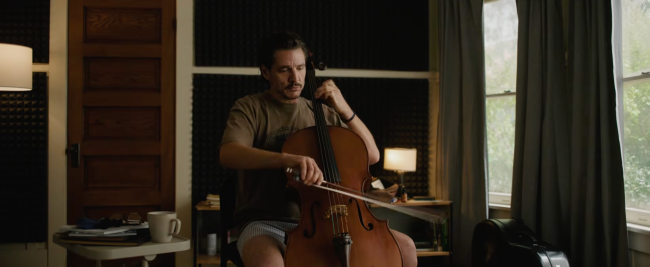
In New York Film Festival Centerpiece “Behemoth!,” writer/director Tony Gilroy has created a delicately calibrated film about a cellist (Pedro Pascal) in a midlife crisis. The movie played well at a packed Alice Tully Hall, and afterparty revelers were mildly upbeat.
Critics approve (see Metascore) of Pascal’s quiet, almost silent, reactive performance — he carries the movie, appearing in every scene — but the Best Actor category is so crowded that it will be tough for Pascal, who has never been nominated, to squeak past louder thespians like Matt Damon (“The Odyssey”), John Malkovich (“Wild Horse Nine”), Andrew Scott (“Elsinore”), Ryan Gosling (“Project Hail Mary”), and John Turturro (“The Only Living Pickpocket in New York”). So far, Pascal has been recognized for his television work in HBO’s “The Last of Us.” “Behemoth!” marks his most ambitious lead film role to date.


The movie’s strength is its innovative music structure, as Pascal’s cellist plays different movie scores in a series of Hollywood sessions that throw his memories back in time. Gilroy deployed nine composers, including James Newton Howard, Michael Giacchino, and Alan Silvestri, whom he calls The Behemoth! Collective. Academy rules call for no more than three composers to be entered for consideration for a movie’s Original Score. But Searchlight hopes the music committee will consider accepting the one Collective in this case.
The music branch was flexible about the “K-Pop Demon Hunters” multiple songwriters, who shared their one Oscar. But the “Birdman” drumming score was disqualified as not being music. The two composers on “Arrival,” Max Richter and Jóhann Jóhannsson, were disqualified. But later on, Richter was allowed to include both new material and old on “Hamnet.”
Searchlight will have no issues submitting the Lukas Frank song “Your God Is Sleeping.”
And “Andor” showrunner and “Michael Clayton” Original Screenplay and Directing nominee Gilroy, respected by the industry for his writing prowess, could be in the running for Original Screenplay. It defines the term.
Searchlight Pictures opens “Behemoth!” starting December 4.
>
How to watch White Sox vs. Guardians: Game 1 TV channel and streaming options for October 3
Gabby Williams needed a team to have faith in her. Now, she's given Valkyries reason to believe

Wales v Denmark: How Craig Bellamy can boost Euro 2028 hopes
-

 movies4 months ago
Search For Canadian TV Actor Stewart McLean Now Homicide Investigation
-

 Fashion9 years ago
These ’90s fashion trends are making a comeback in 2017
-
Fashion9 years ago
According to Dior Couture, this taboo fashion accessory is back
-
Fashion9 years ago
Model Jocelyn Chew’s Instagram is the best vacation you’ve ever had
-
Fashion9 years ago
Emily Ratajkowski channels back-to-school style
-
Fashion9 years ago
9 Celebrities who have spoken out about being photoshopped
-

 Anime4 months ago
Rurouni Kenshin: Hokkaido Arc Manga Takes 1-Issue Break – News
-

 Anime3 months ago
HIDIVE to Stream English Dubs for The World Is Dancing, The Forsaken Saintess and Her Foodie Roadtrip in Another World, The Dangers in My Heart: The Movie Anime – News