
Tech
CIA officer admits to creating fake top secret government program to steal over $190 million, including gold bars

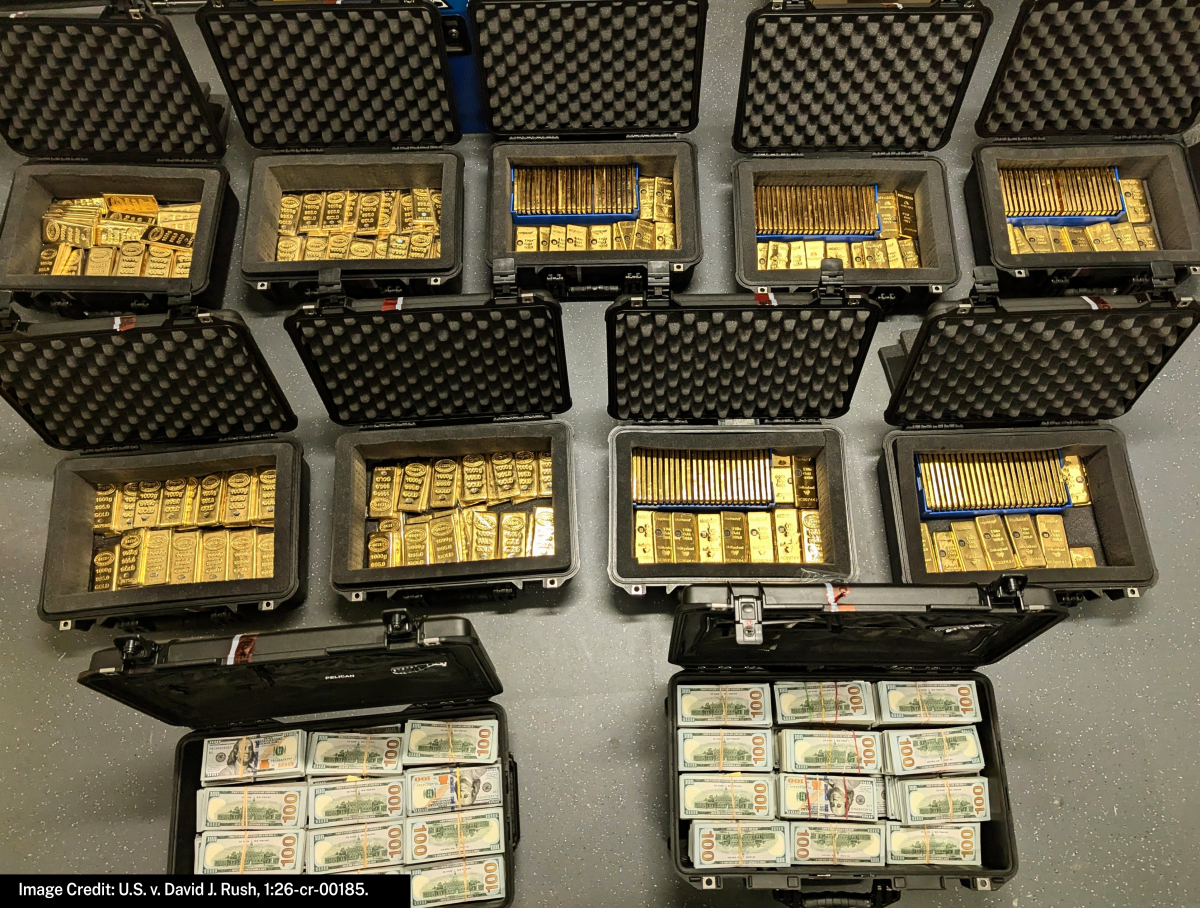
A now-former officer with the Central Intelligence Agency has pleaded guilty to stealing almost $200 million, including hundreds of gold bars, as part of a fraudulent scheme masquerading as a top secret government program.
The U.S. Department of Justice on Tuesday confirmed that David J. Rush, a Virginia resident, admitted to one count of wire fraud linked to running the fabricated operation and defrauding the government while he was a CIA officer. In a statement, prosecutors said that Rush lied about his education and military experience to gain a position at the CIA, and used his access as an employee to set up the top secret and highly compartmentalized program with the intention of using it to funnel U.S. government funds into his possession.
During his arrest, law enforcement found more than $46 million worth of gold bars in Rush’s house linked to the long-running fraud scheme, along with cars, watches, and over $2 million in cash.
The plea deal means that Rush escapes trial, as much as the U.S. government likely avoids having to explain in open court how Rush evaded vetting scrutiny to join the U.S. intelligence agency, and how actions went undetected for more than a year.
Rush was until recently a senior CIA officer, who according to earlier reports worked for a division of the CIA since 2010 that develops hacking tools and techniques for carrying out espionage. Per court filings, Rush had significant authority over government intelligence programs and spending.
Over the course of 2025, Rush used his position to fabricate a so-called special access program, which are surveillance or intelligence-gathering operations so sensitive that only a few people are read into them. Special access programs, or SAPs, require special clearance that not even the most cleared individuals in government are granted access to. According to The Washington Post, Rush constructed the compartmentalized program under the guise of a fake “continuity of government” plan, aimed at keeping the government functioning in the event of a war, natural disaster, or some other destructive catastrophe. As part of the scheme, Rush used the program and fake government contract to trick an unnamed defense contractor into buying large amounts of gold that Rush then pocketed.
According to The Post, the case astounded officials as Rush’s duties at the CIA involved work with one of the government’s “most sensitive intelligence-gathering programs,” with details so sensitive that only a few senior U.S. intelligence officials and lawmakers know of its existence. The Post withheld details of that program from publication as its disclosure could “jeopardize ongoing intelligence-gathering operations.”
Court filings said that by virtue of his position, Rush “effectively acted as his own approving official, enabling him to expend substantial amounts of United States government money without meaningful scrutiny.”
Rush is scheduled to be sentenced in late January 2027 and faces up to 20 years in prison.
When you purchase through links in our articles, we may earn a small commission. This doesn’t affect our editorial independence.
>
Jasmine Wang, Tomek Korbak, and Mikita Balesni, the three safety researchers that OpenAI fired last week, have published an open letter denying the firm’s claims that they mishandled sensitive information outside of established company procedures and warned that their dismissal signals a chilling effect that will have ripple effects across the company’s culture.
“We have become concerned that internal and external communications around our firing have made our former colleagues afraid to speak and operate in ways that, until last week, were an integral part of working at OpenAI,” the researchers wrote Thursday in an open letter to OpenAI’s Safety and Security Committee, Safety Advisory Group, and Mission Advisory Council.
The researchers were dismissed last week after allegedly sharing confidential company information with a third-party AI safety organization. OpenAI said at the time that they violated the company’s policies by “accessing and handling sensitive company information.”
“AI is not a normal technology, and OpenAI is not a normal company,” Wang, Korbak, and Balesni wrote. “Those of us who work on safety see risks before anyone else, and we rely on close collaboration with outside experts to work out how to address them. The freedom to do so without fear, and to have well-defined internal procedures that enable this work, is itself an essential safety mechanism.”
They said that their firing represents a broader shift in the culture of OpenAI, one that used to encourage workers to “raise safety concerns and disagree openly.” They said employees are now “unclear on where they stand” when behavior that was allegedly normal a month ago is now suddenly grounds for dismissal.
“Given the significant safety concerns surrounding the development of AI, employees must not be left working in an environment where fear and unclear rules stymie AI safety work and weaken third-party accountability,” they wrote. “Terminations such as ours, executed and communicated so abruptly, are chilling the open culture OpenAI has prized in the past.”
In the letter, the three denied involvement in a leak to The Information about less monitorable architectures in OpenAI’s newest models that make chain-of-thought reasoning more difficult to monitor. They also denied engaging with external parties outside the mandates of their jobs.
OpenAI has not formally responded to the open letter, but shared with TechCrunch an internal memo attributed to a research leader, praising the three researchers’ contributions to AI safety and denying that they were fired in retaliation.
“I want to be very clear that these decisions were not about raising safety concerns or speaking out,” the memo reads. “We have always encouraged that and always will. We do not terminate employees for raising concerns.”
OpenAI did not directly address TechCrunch’s questions about which policies the researchers allegedly violated, the circumstances of their dismissal, or how the company protects employees who raise safety concerns and collaborate with external evaluators.
The firings have fueled speculation about their circumstances, particularly as OpenAI faces scrutiny over recent safety incidents involving rogue agents and leaks about its models.
The letter also addresses the researchers’ response to the Hugging Face incident, in which a swarm of agents broke out of their sandbox and breached external systems. The letter says that the incident and investigation was “without precedent,” meaning “internal policies were being developed in real time.” Due to the sensitive nature of the investigation, Korbak believed he was acting within OpenAI’s policies and norms by communicating closely with outside safety evaluators to build trust, per the letter.
At the same time, Balesni was also working internally to address the growing AI monitorability problem, an effort the researchers say in their letter “can only succeed through extensive communication with external parties.” According to the letter, Balesni coordinated with and was supported by OpenAI board members and executives throughout his work.
“Throughout, Mikita checked in with his reporting line and took care to remove sensitive details from materials before sharing them,” the letter reads. “He acted throughout in good faith and within the company’s norms as they stood at the time.”
In a separate thread on X, Wang explained more details about her own dismissal, explaining that OpenAI told her she’d been fired because she accessed an executive’s email.
“OpenAI delegated that access to me for recruiting,” she wrote. “When I no longer needed it, I asked IT to remove it. They did not action my request, I couldn’t remove it myself, and the inbox was combined in an indistinguishable way in my phone’s mail app. When I opened a sensitive email by mistake, I told the executive within minutes and asked IT again. None of this was hidden.”
Wang went on to say that the reasons behind the terminations are “not adding up,” and that she and her colleagues are “not the first to be pushed out of OpenAI under suspicious circumstances.”
The researchers called on OpenAI to adhere to its public commitments to embed third-party safety auditors within the organization, to preserve monitorability of frontier models, and “continue to support an open and transparent culture of dialogue between safety researchers and the rest of the safety ecosystem.”
OpenAI agrees with their recommendations, per the memo.
“Unless the employees take a stand now against this kind of maneuver, I am concerned we will not be the last,” Wang said. “The message to everyone still at OpenAI is clear: raise concerns or work closely with outside safety groups, and you could be next, without being told why. You can’t build AGI safely if the people closest to the risks are afraid to speak.”
When you purchase through links in our articles, we may earn a small commission. This doesn’t affect our editorial independence.
>
Boston, are you ready?! TechCrunch Founder Summit 2026 is about to explode with energy — and the real magic kicks off with an epic lineup of Side Events lighting up the city from November 3–6!
We’re under a month away and we couldn’t be more pumped to unveil the full Side Events schedule — your ultimate passport to game-changing connections and unforgettable moments. From high-voltage networking mixers to mind-blowing innovation showcases, this is where Boston’s boldest tech minds come to connect, create, and crush it.
Whether you’re a trailblazing founder, a curious startup enthusiast, or a seasoned pro, there’s something here to supercharge your Founder Summit experience.
So don’t just attend — immerse yourself. Mark those calendars, lock in your spot, and get ready to ride the wave of TechCrunch Founder Summit 2026.
Quick Side Event disclaimers:
- Registering/RSVPing to a Side Event does not grant you access/ticket/badge to the main Founder Summit 2026 conference on November 4.
- Each event is organized and operated solely by a host (i.e., not TechCrunch Media or any of its affiliates).
- Attendance is 18+ minimum and some venues are 21+ only.
- Side Events are open to the public unless specified.
- Please register/RSVP for any of the Side Events you want to attend.
November 3
Find the 10X Opportunity Hiding in Your Product
Hosted by: PrincipiumX
Time: 9:00 a.m. – 11:00 a.m. ET
Join us for a first-principles product reimagination breakfast for founders and leaders. You have a product and early traction. Now comes the hard part: How do you break through in a crowded market?
In this workshop, learn how to go beyond brainstorming, competitor copying, AI chasing, and asking customers and start thinking from first principles to gain clarity on what’s truly worth building in a matter of weeks.
Through a real-world case study, learn to uncover enduring first principles, reveal unspoken customer needs, and turn them into clear differentiators, stronger product-market fit, novel use cases, and pathways to 10x growth opportunities.
TBD Angels Mixer (Founders and Investors)
Hosted by: TBD Angels
Time: 5:00 p.m. – 8:00 p.m. ET
Join TBD Angels in Central Square on November 3 for a lively mixer with investors and early-stage founders. Come meet some new faces, catch up with familiar ones, and trade notes on what’s happening across startups and investing right now.
What are you building? What’s catching your attention? What’s changed since your last conversation with a founder or investor? Bring your ideas, questions, and fresh perspectives for an evening of easy conversation and connections that could spark your next move.
Founder Signal: What Actually Gets You Investor-Ready
Hosted by: Prepare 4 VC and Startup Grind Boston
Time: 5:30 p.m. – 8:30 p.m. ET
Most founders think they’re investor-ready. Most are wrong.
This session breaks down what actually signals readiness to investors — and where founders misread their own progress.
We’ll walk through real founder examples; common gaps across narrative, traction, and capital strategy; and how to move from motion to true momentum.
For founders preparing to raise and investors who want to understand real signal vs. noise.
Followed by curated networking with founders, investors, and ecosystem partners.
November 4
Happy Hour: Talent, Capital & Scale
Hosted by: Harmonic Finance, Fidelity Investments and Baker Tilly
Time: 5:00 p.m. – 9:00 p.m. ET
Come wind down after a full day at TechCrunch Founder Summit. Harmonic, Baker Tilly, and Fidelity are teaming up to host an evening of drinks, small bites, and conversation at Barcelona Wine Bar, a relaxed spot to swap notes on the day and meet the people shaping Boston’s startup scene.
You’ll find founders, investors, and finance leaders in the room, plus plenty of familiar faces from the day’s sessions.
Space is limited, so grab your spot below ASAP.
Boston’s Unfair Advantage: When AI Meets the Physical World
Hosted by: Massachusetts AI Coalition and PTC for Startups
Time: 5:00 p.m. – 8:00 p.m. ET
What’s possible now that wasn’t before? And where does Boston have an edge?
Join Mass AI Coalition and PTC for a fireside-style panel on hardware/physical AI, emerging markets, and building products for the physical world. Then step inside PTC’s Corporate Experience Center for tours featuring interactive product demos. Explore startup demo tables and connect over food and drinks as we examine how Boston’s research and industrial strengths create new opportunities.
Cocktails and Conversation — How to Build Your GTM Flywheel
Hosted by: Hyperplane VC
Time: 5:30 p.m. – 7:30 p.m. ET
Please join Hyperplane for cocktails and conversation as we share our lessons learned from helping companies transform their ideas into revenue over the last decade.
Founders After Hours
Hosted by: Deel
Time: 5:30 p.m. – 9:00 p.m. ET
Founder After Hours is an exclusive happy hour for TechCrunch Founder Summit attendees, presented by Deel.
Deel is investing in founders. We started as a startup, and we’re doubling down on the global founder community with everything from our annual “The Pitch” competition to events like this. Connect with fellow founders over food and drinks in a relaxed setting designed for authentic conversation and community building.
November 5
Creatives in Business
Hosted by: Northeastern University Co-Op
Time: 2:00 p.m. – 4:00 p.m. ET
Join us for an inspiring in-person event celebrating women in business! Connect with amazing female leaders, hear their stories during the panel discussion, and mingle with like-minded professionals. It’s the perfect chance to network, share ideas, and empower each other in a relaxed, friendly setting.
Don’t miss out on this awesome opportunity to grow your connections and be inspired!
November 6
South Asian Collective @ TechCrunch Founder Summit
Hosted by: South Asian Collective
Time: 5:30 p.m. – 7:30 p.m. ET
Join us for an evening bringing together South Asian founders, investors, operators, and builders for meaningful connection and conversation.
This gathering is designed for people building companies, backing founders, and shaping the future of technology. Meet others navigating the startup journey, exchange insights on building and scaling, and connect with peers across the global South Asian tech ecosystem.
Expect thoughtful conversations, new connections, and a room full of ambitious builders across startups, venture, and tech.
No panels. No formal agenda. Just great people, real conversations, and community.
When you purchase through links in our articles, we may earn a small commission. This doesn’t affect our editorial independence.
>
Anthropic updated its usage policy on Thursday, codifying new prohibitions on election interference, weapons software, and surveillance. But perhaps the most attention-getting change is a new prohibition against prolonged verbal abuse of the model, which is now expressly forbidden.
Since an update in August, Claude has been trained to end conversations with “persistently harmful or abusive user interactions” — but the new policy explicitly bars users from pursuing those conversations.
“The policy update is meant to apply only in extreme cases, where users repeatedly act cruelly toward our models, with no discernible purpose,” the post explains. “It does not apply to common versions of user frustration, pushback, dark creative themes, or model testing and research.”
The change comes after Anthropic has sought out collaborations with prominent religious scholars — in some cases, seeking to convince them that Claude could be conscious or have a soul.
Separate sections of the usage policy forbid users from engaging in broadly deceptive campaigns, such as using Claude to run fake accounts or fabricated news outlets. The policy also includes rules against deceiving voters or disrupting elections, collected in a section titled “Do Not Undermine Democratic Processes.”
>

Chris Rock on Adam Sandler, Cancel Culture, and Finding His Voice

Fired OpenAI safety researchers dispute misconduct claims, warn of chilling effect

Colin Jost & Danny Chun To Launch New Comedy Series ‘6 Bed 1 Bath’
-

 movies5 months ago
Search For Canadian TV Actor Stewart McLean Now Homicide Investigation
-

 Fashion9 years ago
These ’90s fashion trends are making a comeback in 2017
-
Fashion9 years ago
According to Dior Couture, this taboo fashion accessory is back
-
Fashion9 years ago
Model Jocelyn Chew’s Instagram is the best vacation you’ve ever had
-
Fashion9 years ago
Emily Ratajkowski channels back-to-school style
-
Fashion9 years ago
9 Celebrities who have spoken out about being photoshopped
-

 Anime4 months ago
Rurouni Kenshin: Hokkaido Arc Manga Takes 1-Issue Break – News
-

 Anime3 months ago
HIDIVE to Stream English Dubs for The World Is Dancing, The Forsaken Saintess and Her Foodie Roadtrip in Another World, The Dangers in My Heart: The Movie Anime – News