
Entertainment
‘Wicker’ to Host 4DX Screenings for One Night Only


You will be redirected back to your article in seconds
A Demotion That’s Really a Promotion
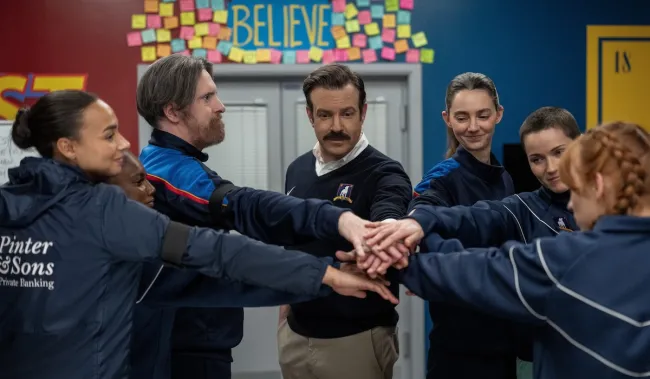
After a disastrous third season, the return of Jason Sudeikis’ warmhearted Apple comedy didn’t take the same big swings that helped make it a mega-hit. Instead, Season 4 acclimated to its comfy sitcom environs, becoming a little less ambitious — and a lot easier to enjoy.
ad
>

Brett McGurk‘s new book Brink: Inside the Race to Free the October 7th Hostages offers an insider account of the diplomatic rollercoaster to secure a ceasefire and hostage release in the war in Gaza.
The book, published this week, also offers a glimpse at White House messaging about the conflict, including two figures the president turned to in delivering a key speech: Jeffrey Katzenberg and Steven Spielberg.
McGurk, who served as deputy assistant for national security affairs to Biden, wrote of the scene as they prepared the president for his address on May 31, 2024. While Katzenberg and Spielberg’s role have been reported before, McGurk gave a first-hand account in the room, for a speech focused on a proposal to end the fighting and to secure a release of the hostages.
By that point, the Gaza conflict had created divisions within the Democratic coalition, protests at college campuses and presidential appearances and concerns over its impact on the November elections. There was pressure from the campaign for the president to make an address on the crisis, per McGurk.
McGurk wrote of the rehearsal, “In the Map Room, Biden peered at two screens behind me. ‘Jeffrey, Steven, welcome,’ he said. I turned around to see Jeffery Katzenberg and Steven Spielberg on Zoom. They greeted Biden warmly, Spielberg saying this was the speech they wanted to hear.
“It was a reminder that while I saw this speech as a policy address with a functional aim, it had a political purpose, too,” McGurk wrote.
He added, “The speech was timed for Friday night in Israel, when much of the country shuts down, allowing time for us to shape its reception there and around the world. Notably, we did not inform Netanyahu that we were making the speech until shortly before Biden delivered it, as we knew the address would lock Netanyahu into the terms of the deal now on the table.
“Biden said he was ready.
“Katzenberg advised, ‘Remember, slow Joe, let the audience hear every word.’
“Biden smiled, ‘Slow Joe? Don’t let Jill hear that.’
“He read through the draft, pausing at times to ask questions about the text, which we addressed with rewrites.”
McGurk wrote that he found Biden “fully engaged, leaning forward on the podium.”
He wrote, “The moguls told him he looked strong, and he did. There was no sign of the Biden we’d all see on a debate stage with Trump only four weeks later.”
The latter was a reference to Biden’s disastrous debate performance against Trump. What followed were weeks of calls on Biden to drop out, coming from some elected Democrats and prominent donors, until he exited the race on July 19. Katzenberg had played a prominent role as a top adviser to Biden’s re-election campaign.
While the Biden speech focused on a peace proposal, as it turned out, it would take until the next year, a week before Trump returned to office, for a ceasefire agreement to be reached.
>

Skydance shares closed down about 7% in day two of trading after a dip Tuesday, a second down session in a rocky NYSE debut for the merged company as investors started to weigh in.
The combination of Paramount and Warner Bros. Discovery finally closed, a big step forward. A legal settlement with Attorneys General who tried to block it went very much in the company’s favor. Beyond that, “It’s a show me story,” says Matthew Condon, an analyst at Citizens.
Wall Streeters are wary of SKYD’s $80 billion in debt, high leverage, and ability to both generate a promised $6 billion in cost synergies ($3 billion each in 2027 and 2028) and ramp up content spending. There’s quite some excitement around streaming as HBO Max and Paramount+ catapults top-tier status, but little clarity still on structure, strategy or pricing.
Chairman and CEO David Ellison and co-chief executive Ynon Kreiz at a press conference Tuesday reiterated a commitment to reduce leverage dramatically by 2028 and insisted they can spend and save at the same time.
Condon is more sanguine than some with a “market overperform” rating and a $14 price target on the shares, which closed Wednesday down 6.8% at $8.98.
“If you’re building a best-in-class content platform, and this is going to hopefully create a must-have streaming platform, between all the IP that Warner Bros. has and Paramount has and with 30 films coming per year that gives you a steady stream of content coming to streaming. You’ve got all these sports rights. You’ve got a $30 billion content budget. How do you optimize that to really go after the best opportunities? There are a lot of things that can go right here.”
With the stock so low, he thinks “the risk/reward” looks favorable.
But much of the deleveraging framework, Condon acknowledged, assumes the underlying businesses continue to perform largely in line with their pre-transaction trajectories, making execution incredibly important.
“The question is, can they actually achieve” what they’ve promised, asked analyst Rich Greenfield on CNBC. “Because what Warner Bros. Discovery ran into, the tidal wave they ran into, was their legacy business. The core [cable programming] businesses eroded faster than the synergies could be piled on. And so that’s going to be the real challenge facing David Ellison and Ynon Kreiz.”
“We remain quite cautious on the ability of the company and its management to avoid integration and execution problems that have bedeviled other major media mergers,” said Doug Creutz of TD Cowen, who has a “hold” recommendation on the stock.
The co-CEOs have modeled a cash ramp-up in coming years but meanwhile there’s not a big cushion if churn rises, cable network declines accelerate, the box office softens again or there’s macroeconomic or geopolitical disruption. The company can’t issue more debt after Paramount’s just-concluded massive bond sale to finance the merger. Skydance does have the Ellison family’s backing. It could also potentially find new equity investors
One Wall Streeter believes there will be will a secondary offering at some point. “There are a lot of groups that helped in financing the deal, including the Ellisons themselves, who are going to want to sell stock … So why rush to get involved when a lot of stock is going to hit the market at some point?”
For now, “They need to launch streaming, show synergies, cohesiveness among management, and tell the story to investors.”
The Street will get an update on the new Skydance when it reports third quarter earnings.
“We remain guarded on the ability for management to reach its $3B net synergies goal by YE27 [year end] and $6B by YE28, but they still sound confident in their ability, and it will be quite impressive if they hit their goals – $6B is 11% of pro forma expenses, so it is not out of the realm of possibility, but we want to see how it unfolds,” said David Joyce of Seaport Research in a note.
>
Best PC Cases for 2026: Fractal, Lian Li, Corsair, NZXT and Montech

‘Ted Lasso’ Season 4 Finale Forges a New Path for Season 5 — Spoilers

Biden Aide Details Role Of Jeffrey Katzenberg & Steven Spielberg
-

 movies5 months ago
Search For Canadian TV Actor Stewart McLean Now Homicide Investigation
-

 Fashion9 years ago
These ’90s fashion trends are making a comeback in 2017
-
Fashion9 years ago
According to Dior Couture, this taboo fashion accessory is back
-
Fashion9 years ago
Model Jocelyn Chew’s Instagram is the best vacation you’ve ever had
-
Fashion9 years ago
Emily Ratajkowski channels back-to-school style
-
Fashion9 years ago
9 Celebrities who have spoken out about being photoshopped
-

 Anime4 months ago
Rurouni Kenshin: Hokkaido Arc Manga Takes 1-Issue Break – News
-

 Anime3 months ago
HIDIVE to Stream English Dubs for The World Is Dancing, The Forsaken Saintess and Her Foodie Roadtrip in Another World, The Dangers in My Heart: The Movie Anime – News