
Tech
We can’t help treating AI like it’s human. But should we?


In a tan polo shirt, brown leather belt, and round bolo tie, MIT PhD student Wil Norton kind of looks like a park ranger, leading our tour group through a tropical jungle. We’re not actually on safari, though — we’re at MIT’s Computer Science and Artificial Intelligence Lab (CSAIL). But what we’re about to see is even more exotic than a cheetah or a jaguar: a pair of humanoid Unitree robots, which each cost about $50,000.
(“They’ll tell you they cost $16,000,” Norton says. “That’s a lie.”)
We usually only see these robots on YouTube when they’re performing a synchronized martial arts routine, or dancing on “America’s Got Talent.” Here, they’re approachable. Even though I know it isn’t sentient, I want to be its friend.
With Norton’s permission, I approach the robot, whose nickname is Gabe. For a moment, I’m not sure how to interact with something that has a LiDAR sensor where its brain should be, but I default to treating it like a person.
“Hello, sir, it’s nice to meet you,” I say, grabbing its gloved, dextrous hand and shaking it.

I think about this interaction later — my instinctive impulse to be friendly to a robot — when I attend Dr. Sherry Turkle‘s “Artificial Intimacy” book launch at MIT Future Fest.
Turkle, who joined the faculty at MIT in 1976, has been researching the relationship between humans and computers perhaps longer than anyone, charting technology’s psychological impact on us from the first home computers to ChatGPT.
“When we are drawn into even the most primitive exchanges with a relational artifact, we believe it cares for us,” Turkle writes in the book. “And we are wired to care for it in return.”
I’m not alone in my tendency to anthropomorphize robots and large language models (LLMs) — as Turkle notes, it seems to be in our nature. One study found that about 70% of people are polite when interacting with AI, while another showed that users are more likely to say “please” or “thank you” to chatbots once a conversation has progressed past a first prompt-and-response.
“People tend to categorize whether this is the right use or wrong use, but I don’t think that is a clear boundary,” Dr. Pat Pataranutaporn, a colleague of Turkle who founded the Cyborg Psychology research group at the MIT Media Lab, told TechCrunch. “The question is, who are we becoming when we talk to [AI]?”
There’s no material consequence of my politeness toward Gabe the robot, but as LLMs infiltrate everything from Google searches to customer service interactions, it has become routine for people to interact with these seemingly sentient chatbots. We’re more vulnerable than ever to the flip side of this impulse, which is that some people can ascribe so much legitimacy to the feelings of chatbots — which are programmed to never spark conflict — that they end up favoring them over other humans.
“You can think of it like fantasy and fiction. We go to the cinema even though we know the story is completely fictional, but we want to experience a certain dimension of human experience that maybe our reality cannot give us,” Pataranutaporn said. “How do we benefit from that ability to experience other dimensions of human experience without losing it to the fantasy, where you can no longer come back to the reality?”
Pataranutaporn describes himself as a “critical optimist,” and he studies AI’s potential to contribute to human flourishing. But he’s well aware of how dangerous this technology can be in the extremes. He even served as an expert in a wrongful death lawsuit over the suicide of 14-year-old Sewell Setzer, III, whose mother sued the chatbot platform Character.AI, alleging that a chatbot modeled after a “Game of Thrones” character had encouraged her son to end his life.
“It can create a situation where people don’t feel agency in actually creating their own future — like when you say that AI will replace everyone, people ask, what are we gonna do? And these companies are not really responding ethically or responsibly,” Pataranutaporn said. “How do we have imagination while still being responsible for the impact of that imagination?”
While Turkle’s book explores the risk of turning to AI for emotional support, rather than other people, she doesn’t think that AI-human interactions are universally harmful.
She recalls a project she advised in which a student created an AI bot to help people practice for job interviews.
“My big metaphor is, stay in your lane, chatbot!” Turkle said at the event. “Coaching for a job interview? That’s a lane. I can do that… A chatbot that says to a three-year-old, ‘I’m your parent, you can talk to me, not your parents,’ is not in a lane.”
But when this technology deviates from its lane even slightly, we become vulnerable to the way it can slowly chip away at our skepticism and make us trust it. It can start with something as simple as a handshake.
When you purchase through links in our articles, we may earn a small commission. This doesn’t affect our editorial independence.
>

Apple revealed in a regulatory filing that it has reached an agreement to bring on team members and technology from personalized audio startup Huxe, in what’s commonly known as a reverse acqui-hire deal.
As first reported in MacRumors, Apple disclosed to the European Commission that it has agreed to make employment offers to “certain employees of Huxe AI,” and to “receive a non-exclusive license to Huxe’s intellectual property rights.”
Reverse acqui-hires emerged in recent years as a way for larger companies to hire key team members and license technology from startups without acquiring the startups outright — presumably allowing them to build up AI talent and tech without drawing as much antitrust scrutiny. (Confusingly, these deals have both been referred to as “reverse acqui-hires” and as plain old “acqui-hires.”)
In the case of Huxe, the startup was founded by developers who’d previously worked on the AI-generated podcast features in NotebookLM (recently renamed Gemini Notebook). But Huxe announced on May 21 that it was shutting down, with the team posting on the Huxe website that the company would be removing its app from the Apple and Google stores, halting service, and deleting user data.
“The team is moving on to new things, and we won’t be continuing development of the product,” the company said. It also thanked its users, saying, “The fact that you used it, told friends about it, sent us your suggestions and your ideas, made it feel like we built it together.”
On June 9, shortly after Huxe’s announcement, Apple notified the European Commission of its deal.
The filing does not say who received employment offers or if they accepted. Nor does it disclose anything about Apple’s plans.
Possibly related: Huxe’s shutdown announcement came just a day after Spotify unveiled AI-powered podcast generation features of its own, so Apple could be hoping to add similar functionality to its Podcasts app. Tech executives seem enamored with the idea that personalized audio can replace regular podcasts (and maybe even parent-child interaction?), though it’s not clear how many normal listeners agree.
When you purchase through links in our articles, we may earn a small commission. This doesn’t affect our editorial independence.
>
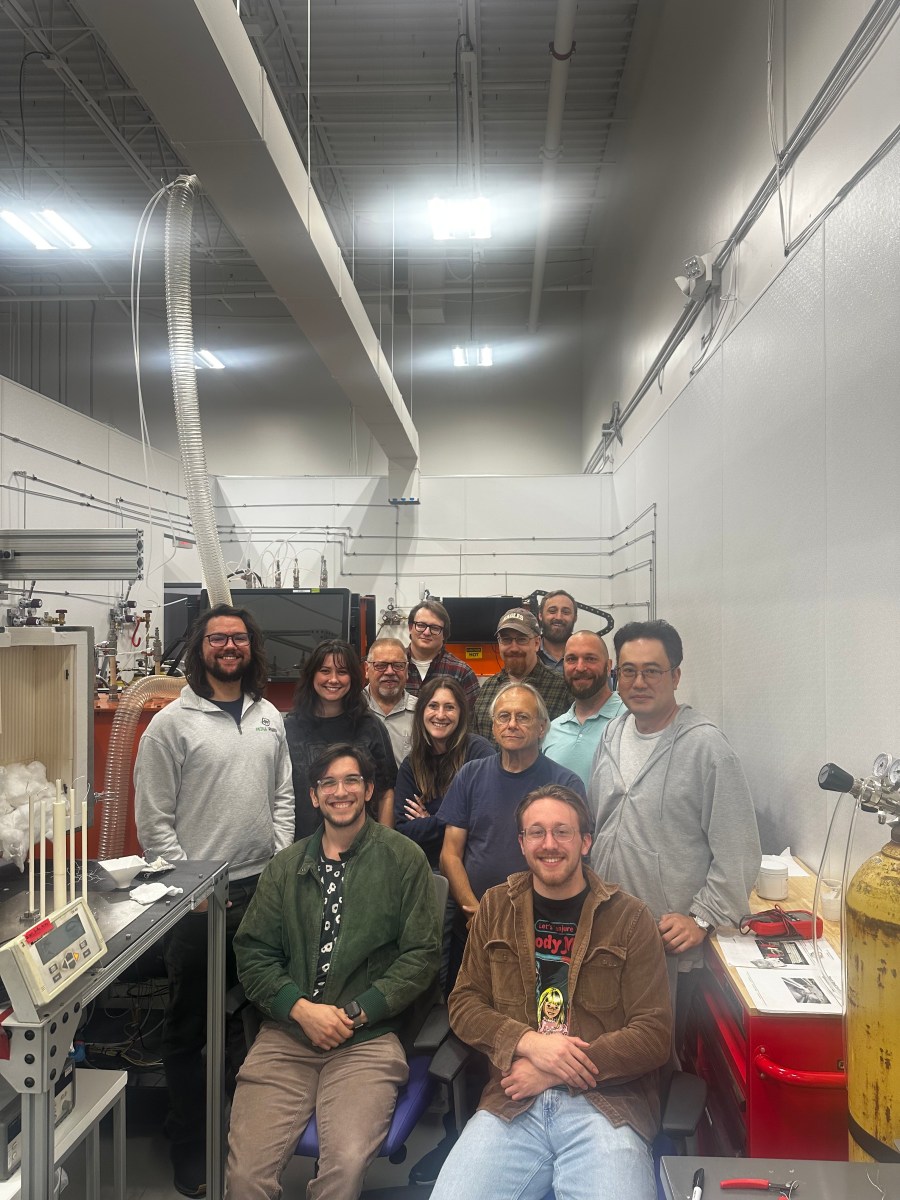
As AI gobbles up an ever larger amount of energy, the hunt is on for efficient and cost-effective power sources. One of the companies leading the charge is Petra Power.
Petra, which was founded in 2017, sells solid oxide fuel cells — ceramic devices that convert fuel, like natural gas, into electric power without burning it. The company markets them as a more efficient and environmentally friendly way to operate data centers and large vehicles.
Petra’s founder, Aaron Goodman, told TechCrunch that his company’s product has significantly lower fuel costs and emissions than traditional power sources, and that they have much less of a physical footprint, too, because they’re more compact and lightweight.
The efficiency, and the cost savings that come with it, is what makes the fuel cells attractive. “Combustion takes fuel and creates explosions,” Goodman said, describing how traditional power generation works. “Those explosions create heat. That heat creates motion. The motion powers an electromotive force, which eventually creates electricity. It’s a lot of steps, and they all have so much loss in them that you end up with a really inefficient system.”
Petra’s fuel cells skip most of these steps. “What fuel cells do is they take the electrons directly off of the fuel, so they strip the fuel of its electrons, which creates electricity,” he explained. “It’s one step, no loss, and subsequently, in theory, at least, they’re much, much more efficient.”
As a result, companies that run off fuel cells stand to save a significant amount on fuel costs, Goodman said.
Although it may offer an innovative product, the customer base is still emerging for Petra. Goodman said that his company is targeting two different types of customers: data centers and the Defense Department.
Goodman doesn’t want to reveal specific agreements just yet, but said Petra is currently working with neoclouds and other infrastructure providers that were a few steps down from the hyperscaler crowd. The target for first deployment with these customers is 2028, with full-scale production for the company hopefully set for 2029, Goodman said.
“Hyperscalers are an ICP [ideal customer profile] for us, and we talk a lot to them, but we don’t have anything firm with them yet,” said Goodman. “We’re still kind of working in that direction. Obviously, they’re the largest consumers of power. They’re the ones that we can make the biggest impact with, so that’s where we’d like to go.”
The other customer — the government — is also still taking shape. The idea is that Petra’s fuel cells will be able to provide auxiliary power for land vehicles, meaning electricity for onboard equipment when the main engine is off. But Petra’s product has not actually deployed on a live vehicle yet, Goodman clarified. Instead, the fuel cells are in the testing phase, during which the government is deciding whether to move forward, he said.
Petra is a small team — some 15 people — but the company is growing, Goodman said. Petra has so far received nearly $9 million in contracts from the Defense Department, and the hope is to scale that work significantly in the coming years, he said.
Petra Power was selected for this year’s TechCrunch Startup Battlefield 200, a group of 200 startups chosen for the program. You can catch all the action this coming week in downtown San Francisco at Moscone West.
When you purchase through links in our articles, we may earn a small commission. This doesn’t affect our editorial independence.
>

Cloudflare announced Friday that it’s acquiring Deno, the startup behind the programming runtime of the same name.
According to Cloudflare’s Kenton Varda, Cloudflare will use this acquisition to improve its Workers programming model and platform, which allows customers to build and run software on Cloudflare’s network. (Varda is principal engineer for Cloudflare Workers.)
Deno — which was co-founded by Bert Belder and Node.js creator Ryan Dahl — recently launched celld, an open source implementation of Workers, which Varda wrote “delighted” the Cloudflare team. Varda argued that contrary to “a popular theory” that the company “made Cloudflare Workers work differently from other cloud platforms in order to create ‘lock-in,’” the company believes “being open source and giving people an escape hatch is good business.”
Dahl, meanwhile, wrote that his team is “joining Cloudflare to make the Workers programming model a mainstream way to build servers.”
The financial terms of the acquisition were not disclosed. Deno had raised a total of $26 million, including a Series A led by Sequoia.
>

Premier League: Manchester United 1-1 Tottenham Hotspur – Tottenham Hotspur post match interview

Apple discloses deal to hire team and license tech from personalized podcast startup Huxe

Nicolas Cage Won’t Work With “AI-Friendly” Amazon; Teases ‘True Detective’
-

 movies5 months ago
Search For Canadian TV Actor Stewart McLean Now Homicide Investigation
-

 Fashion9 years ago
These ’90s fashion trends are making a comeback in 2017
-
Fashion9 years ago
According to Dior Couture, this taboo fashion accessory is back
-
Fashion9 years ago
Model Jocelyn Chew’s Instagram is the best vacation you’ve ever had
-
Fashion9 years ago
Emily Ratajkowski channels back-to-school style
-
Fashion9 years ago
9 Celebrities who have spoken out about being photoshopped
-

 Anime4 months ago
Rurouni Kenshin: Hokkaido Arc Manga Takes 1-Issue Break – News
-

 Anime3 months ago
HIDIVE to Stream English Dubs for The World Is Dancing, The Forsaken Saintess and Her Foodie Roadtrip in Another World, The Dangers in My Heart: The Movie Anime – News