
Tech
Apple HomeView Expected in November: What Buyers Should Know

Apple HomeView is reportedly due in November. Explore its expected designs, colors and Siri features, plus the compatibility questions buyers should ask.
The post Apple HomeView Expected in November: What Buyers Should Know appeared first on TechRepublic.
>

The U.S. Department of Justice is warning that hackers working for the North Korean regime are increasingly relying on Americans to facilitate the hacking of U.S. companies.
In an announcement on Tuesday, prosecutors said they have indicted and arrested at least two people, and conducted searches across dozens of suspected “laptop farms” in Texas. The computers were allegedly used by North Koreans to remotely hack into American companies and steal sensitive data.
According to the DOJ, federal authorities seized over 180 computers that they believe American companies had shipped out to their newly hired employees, not realizing that they were sanctioned North Korean spies who had used stolen identities of U.S. citizens to gain employment. The DOJ said that it raided over 40 laptop farms across Texas, the largest disclosed number of homes and residences used for facilitating North Korean hacks, which were owned by at least two American facilitators.
CrowdStrike, which helped the FBI investigate and disrupt the latest North Korean operations, said that laptop farms are “vital” to North Korea in helping its hackers overcome physical, financial, and legal challenges of not physically being in the United States.
The prosecutors said at least 70 U.S.-based companies had been infiltrated by the hackers, who are believed to have generated around $3 million in stolen funds. The DOJ did not name the affected companies, but described them as healthcare, cyber support, retail, communications, and manufacturing sectors across Ohio and 16 other states, including the District of Columbia.
“Increasingly, North Korean IT workers are turning to recruiting American facilitators to counter improved private sector detections and law enforcement actions. These workers are hiring facilitators to complete a wider variety of tasks, and in some cases subcontracting entire jobs to third-party foreign nationals,” the Justice Department said.
Oftentimes, North Korean hackers use real-looking email addresses, spoofed LinkedIn profiles, and extensive online and social media accounts as cover for their activities.
In a separate public service announcement, the FBI said that there are “thousands” of North Korean-state controlled IT workers working at Western companies, which “pose a significant national security and intellectual property theft insider threat.”
This is the latest wave of arrests, indictments, and enforcement action targeting North Korean activities in the United States in recent years. The breakaway regime has used this “remote IT workers” scheme to allow North Koreans to gain employment with U.S. and European companies, earn a wage, and then steal sensitive information and intellectual property while as employees. The victim companies are then extorted into paying the hackers further.
The remote IT workers’ scheme is one of several strands of illicit revenue that the North Korean regime aims to generate, including hacking crypto exchanges and open-source developer projects, with the aim of funding its internationally sanctioned nuclear weapons program. The regime is thought to have stolen at least $2 billion in crypto during 2025 alone.
Experts on North Korea have put the number of hacked companies and the amount of stolen crypto as likely much higher than reported.
Earlier this year, CrowdStrike said in a separate report that North Korean hackers were behind around half of all documented “hands-on-keyboard” intrusions over the past year, referring to hacks that are carried out by humans and not automated tools or AI.
When you purchase through links in our articles, we may earn a small commission. This doesn’t affect our editorial independence.
>
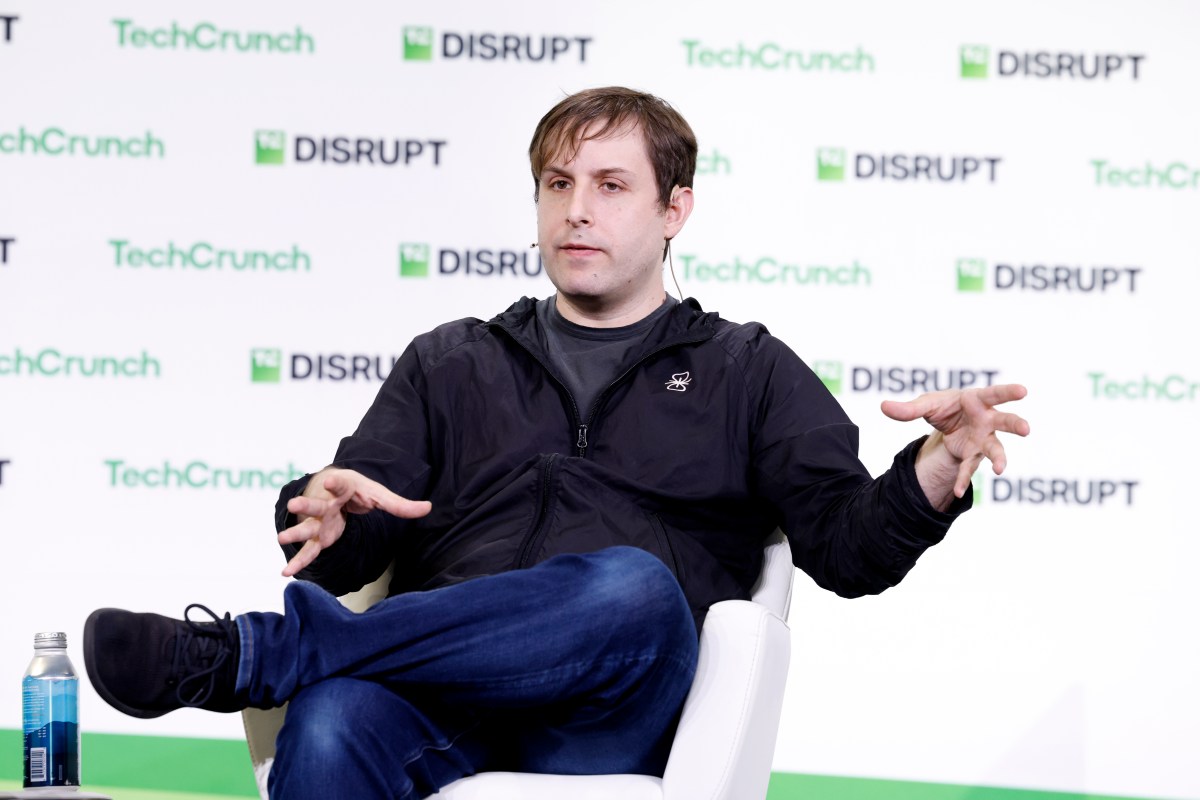
Science Corporation CEO Max Hodak announced that the company has implanted its vision-restoring chip, PRIMA, into its first patient with Stargardt disease, an inherited eye disease that gradually destroys central vision. Hodak, the former president and co-founder of Neuralink, the brain implant company, explained on stage at TechCrunch Disrupt how the company’s work with PRIMA fits into its broader pursuit of a novel brain-computer interface (BCI).
“The retina is part of the central nervous system,” Hodak said on stage. “We consider cochlear implants, retinal prostheses, motor prostheses, these are all different types of BCIs.”
Hodak outlined a vision in which BCIs expand into a wide range of medical technology applications, rather than simply being a way to control computers.
While PRIMA is commercially available in Europe for patients who’ve lost their sight to geographic atrophy, an advanced form of age-related macular degeneration, the company believes its approach can be applied to multiple diseases, including Stargardt disease, which is currently considered incurable.
Stargardt disease affects the outer retina, causing the gradual death of the eye’s light-sensing cells while potentially sparing the inner retina, the part that passes visual signals onto the brain. It causes a central blind spot that gradually enlarges over time. Approximately 150,000 people worldwide have lost vision due to the disease.
“One of the nice things about this device approach, when I was saying the brain’s a computer, vision is electrical potential, like electrical activity down the optic nerve,” Hodak said. “That’s all vision is to the brain, and so if you can get the optic nerve to signal the the rest of the brain correctly, then you can provide vision to it.”

The company says its first patient with Stargardt disease received the PRIMA implant in May as part of its ongoing trial at the Sydney Eye Hospital in Australia. During the patient’s first rehabilitation session, he saw a letter, and during the second, he was able to read a word.
To use the device, patients undergo an hour-long procedure that plants a small chip in the back of their eye, where the photoreceptors have degenerated. Then they wear camera-equipped glasses that transmit a view of the world to the chip. The implant essentially works like artificial photoreceptors.
“The device that this patient has is a two millimeter by two millimeter implant placed under the in the back of the eye, and so it’s like looking through a straw,” Hodak said. “It is not a big field of view color vision. It’s a patch in their central vision where . . .it’s black and white, but it is sharp. It’s high-contrast sharp, and so they can see a couple letters at a time. The next step is to make the field of view bigger. So to make a bigger implant, you have to deal with the curvature of the eye, and we need to make the electrodes smaller so that we get closer to native levels of detail.”
He continued, “I think we have a clear path. There’s a there’s a next ‘next generation’ that’s being worked on that’ll be in humans in the next year, and over the next five years, I think we’ll be able to get pretty close to native acuity.”
When Hodak founded Science Corporation in 2021 after leaving Neuralink, the company outlined plans to develop advanced neural engineering and brain-computer interface technology. But first, the company wants to prove its methods work and develop a sustainable business, which is why it’s working to restore vision with the visually impaired.

As for Science Corporation’s brain-computer interface technology, it has previously said that its sensor will be implanted inside the skull and rest on top of the brain, unlike a Neuralink device, which is inserted directly into brain tissue.
The company has said it believes the device could help address neurological conditions, such as possibly monitoring neurological activity in patients with brain tumors.
“In the near term, we’re going to be applying our first clinical indication, which hasn’t been announced publicly, is a neurodegenerative disease that everybody’s heard of,” Hodak said. “We’re also looking at stroke. For example, if you’ve lost part of your brain because it’s been dead due to stroke, if you can get connections into the deep brain in two different areas, you can imagine adding new cortical areas, just like adding new brain areas entirely — something simply not possible with conventional electrodes. But, I’d say longer term, the long-term mission of the company is to understand how the brain creates the mind and to learn to build engineered brains.”
Hodak went on to note that Science Corporation’s belief is that many people will eventually use some kind of BCI. While the company isn’t designing for “healthy 40-year-olds,” he said, it believes people will eventually need some kind of BCI by the age of 60 or 70.
“We want to figure out how do we extend not just lifespan but health span,” Hodak said.
When you purchase through links in our articles, we may earn a small commission. This doesn’t affect our editorial independence.
>

Cerebras Systems CEO and co-founder Andrew Feldman believes we’re nearing a future where everyone will have an AI appliance in their own home.
Speaking on stage at TechCrunch Disrupt 2026 on Tuesday, the chipmaker executive answered a question about what would need to happen for AI to become a home appliance, saying, “Actually, I don’t think that’s very far away.”
He pointed to the advances in consumer AI agents, like Meta’s Muse and Instinct, the startup now valued at $10 billion, as examples of how AI is finding its footing with everyday users.
As for home AI? He predicts that we’ll have personal AI assistants that run locally.
“Just like your cell phone, they’ll do some work on device and some work going back to the cloud,” Feldman explained. “But I think they will get to know you very well, and you will have a security perimeter around them. And they will certainly have access to credit cards and be able to buy things for you,” he continued. “I think they will make a meaningful impact in making our lives better.”
Of course, for an AI chipmaker, the vision of a home AI appliance, or at least widespread consumer adoption of agentic technology, is certainly appealing.
But Feldman isn’t just working on the hardware infrastructure; he’s a personal AI user himself, saying that he now uses “a collection of agents” to sweep his calendar, pull up information about the people he’s going to have a call with, and more. While AI is already doing many of the things we used to do manually, Feldman is most excited about the new possibilities — things that weren’t possible before.
He’s leaving it up to other founders to figure out what those might be, though.
“One of the reasons I love being in infrastructure is because I don’t need the consumer-facing idea … I like building the platforms that other people’s ideas take flight on,” he said.
When you purchase through links in our articles, we may earn a small commission. This doesn’t affect our editorial independence.
>

Live Commentary – Arsenal vs Lille

South Africa vs Australia: Josh Hazlewood claims career-best Test figures of 6-49 as Australia take 1-0 series lead | Cricket News

Ben Affleck Calls Filming Justice League a ‘Low Point’ in His Career
-

 movies5 months ago
Search For Canadian TV Actor Stewart McLean Now Homicide Investigation
-

 Fashion9 years ago
These ’90s fashion trends are making a comeback in 2017
-
Fashion9 years ago
According to Dior Couture, this taboo fashion accessory is back
-
Fashion9 years ago
Model Jocelyn Chew’s Instagram is the best vacation you’ve ever had
-
Fashion9 years ago
Emily Ratajkowski channels back-to-school style
-
Fashion9 years ago
9 Celebrities who have spoken out about being photoshopped
-

 Anime4 months ago
Rurouni Kenshin: Hokkaido Arc Manga Takes 1-Issue Break – News
-

 Anime3 months ago
HIDIVE to Stream English Dubs for The World Is Dancing, The Forsaken Saintess and Her Foodie Roadtrip in Another World, The Dangers in My Heart: The Movie Anime – News