
Politics
Politics Home Article | Why Rent Controls Remain Controversial


Interest in rent controls has increased as the cost of living and rents continue to rise. (Alamy)

6 min read
The political discussion around rent controls has become a hot-button topic in England and Wales as record-breaking rents continue to put pressure on households struggling with the rising cost of living.
In July, Rightmove reported that the average private rent for a home advertised outside London hit £1,397 per month, while London hit a record £2,791. And, according to the Office for National Statistics (ONS) in 2025, tenants in England pay over 30 per cent of their salary on rent on average, above what the ONS officially views as affordable.
The government rolled out its Renters’ Right Act in May in order to give tenants more rights over the properties they rent in light of the increasing financial challenges facing renters, including the banning of Section 21 no-fault evictions, and ending Assured Shorthold Tenancies – also known as fixed-term contracts. However, the political discussions around rent controls remain active as rents continue to rise and the cost of living continues to put pressure on living standards.
Prominent UK political figures that have called for rent controls include London Labour mayor Sadiq Khan, Green Party leader Zack Polanski and even Prime Minister Andy Burnham while serving as Manchester mayor – before backpedalling after entering Number 10. In 2023, Burnham signed a letter supportive of rent controls – and in 2022, expressed support for them when seeking re-election as Manchester mayor.
What are rent controls?
Put simply, rent controls refer to controls by the government put on the rent landlords can charge their tenants. How far-reaching and how complicated the controls are can vary, including how regularly landlords are able to increase rents, the percentage increase landlords are allowed to increase rents by, or simple rent freezes for set periods of time. Rent controls did exist in various forms in the UK during the 20th century until the 1988 Housing Act, which ended rent controls for new lets in England and Wales.
Rent controls have also been implemented across the world, such as in San Fransico and Berlin – and also closer to home in Scotland, where a temporary emergency rent freeze and 3 per cent rent increase cap was implemented from 2022 to 2025. The goal is to protect tenants from steep rent increases, provide some predictability to rent rises in the future for tenants, and introduce some stability to rental prices.
Why are rent controls controversial?
Rent controls have been controversial in large part because their critics say they have unintended consequences – such as resulting in a scarcity of housing stock, which can therefore lead to ultimately higher rents, because it makes renting out properties a less attractive enterprise for landlords. A key report on the topic conducted by economist Konstantin Kholodilin, published in 2024, looked at several examples of rent controls around the world – and found that when rent freezes were announced in 2020 in Berlin, the number of rental properties available fell – and the number of rental properties moving from rented to privately owned rose steeply.
In the conclusion of his report, Kholodilin said that “although rent control appears to be very effective in achieving lower rents for families in controlled units”, it also has a “number of undesired effects” – such as higher rents for properties without rent controls, lower mobility and reduced residential construction.
“These unintended effects counteract the desired effect, thus, diminishing the net benefit of rent control,” said Kholodilin. “Therefore, the overall impact of rent control policy on the welfare of society is not clear.”
Other critiques by hawks of rent controls include landlords simply increasing rents between tenancies instead, or landlords charging higher rates on properties exempted from rent controls like new builds. The example of Scotland, where an emergency 3 per cent cap on rental increases ended in 2025, and average rents spiked by more than 5 per cent immediately afterwards, is highlighted by critics of the policy.
What do those who support the policy argue?
Advocates of the policy say rent controls are successful in keeping down the price of rents when implemented as part of a system of rent controls – which Kholodilin concedes happened, albeit with unintended consequences.
Maya Singer Hobbs, senior researcher at the influential think tank Institute for Public Policy Research (IPPR), told PoliticsHome her organisation now supported rent controls but in a “comprehensive way” in order to avoid unintended consequences caused by rent controls. The think tank released a report in May titled ‘High housing costs in the private rental sector: The case for action’, outlining their proposals for what a rent control policy could look like.
“We recommend for rent controls to be applied to all tenancies, with a few caveats,” Singer Hobbs told PoliticsHome, explaining some of the IPPR’s proposals.
“And we recommend for them to be both within and between tenancies. The Renters’ Rights Act limits rent increases to once a year anyway – so that would mean that, once a year, the landlord can raise the rent in line with the lowest of wage growth or inflation, and that would also apply between tenancies. If you move out, the landlord can’t then jack up the rent by 20 per cent [for example] – and the reason that [measure] is important is because it means that there isn’t a disincentive for moving out.”
The IPPR proposes rent controls are rolled out nationally, as regional or area focus may act to create significant disparities in rent based on area. They also propose exempting new-build properties for ten years, and some exemptions for landlords carrying out improvement works on the property, in a bid to ensure the quality of rental housing does not decline as a result of controls.
What’s the government’s position on rent controls?
Housing secretary Angela Rayner in July told the BBC that she did not believe “rent freezes” or “rent controls” were the way forward “at the moment” when asked about Burnham’s previous support for introducing rent controls.
“Three years ago, Andy called for that because there was a significant crisis in the rental market,” said Rayner. “We implemented between then the Renters’ Rights Act, which is giving renters more power and control.”
But introducing rent controls remains a key priority of Labour’s most powerful local mayor, London mayor Sadiq Khan – who in March reiterated his calls for the government to devolve powers to local mayors to allow them to enforce caps on rents.
“If young people are priced out of our fantastic city, London loses out,” said Khan on X last year. “I back rent controls, and we need greater powers to make housing fairer, more secure and more affordable.”
And earlier this month, Green Party leader Zack Polanski called for a “three-year emergency brake” on private rents, which would limit rents to rising only by wage growth or 2 per cent – whichever is lower.
“That emergency brake would give renters vital breathing space,” said Polanski. “Let wages begin to catch up with the rents that have outstripped them for too long. And give government time to develop a national Fair Rents Guarantee – to keep rents fair and affordable for everyone, forever.”
In Scotland, the Housing (Scotland) Act 2025 leaves space for “long-term, evidence-based rent controls” that can be “introduced in areas where rents are rising steeply”. Local authorities in Scotland are set to send their first report to Scottish ministers on the topic by 31 May 2027, which “will inform decisions on whether to designate a rent control area”.
>


(ASTIK)
6 min read
Parliament was assured it would have an enhanced ability to review how newly introduced legislation is working in practice. But Hleb Buziuk says it is far from clear this vital part of scrutiny is taking place
Parliament does have a general system for looking back at legislation. Since 2008, departments have been expected to publish a memorandum three to five years after Royal Assent explaining how the legislation has worked. A Commons select committee can then decide whether a fuller inquiry is needed. But the department and committee may agree that no memorandum is required.
FairGo, the organisation that I help lead, tested how visible that system is in practice. We examined every substantive Public General Act passed at Westminster between 2008 and 2021 – 311 in all. We counted departmental memoranda, committee inquiries, statutory reports and other formal reviews covering all or part of an act. We began in 2008, when the modern system was established, and stopped in 2021 so that every piece of legislation had entered the three-to-five-year review window.
In 137 cases (44 per cent) we found no public document meeting those criteria. The rest had at least one review or report covering all or part of the legislation. Major pieces of legislation fared better on this measure, but not uniformly. Of the 130 items pre-classified as major legislation under our published criteria, 118 had at least one such document. The 2019 and 2020 Acts of Parliament discussed here were among the 12 that did not.
This is a measure of public trace, not quality: we counted whether a document existed, not how deep it went. Not finding a document does not prove that no internal work occurred. Nor was every piece of legislation necessarily due a memorandum. Our claim is narrower: through the routes in our published methodology, we found no such public document. The underlying register and citation ledger are published with the report.
The sharpest contrast was statutory follow-up. All 78 Acts of Parliament containing a duty to review or report had at least one such document. Among the legislation without such a duty, 59 per cent had none. Part of that relationship is mechanical: the duty creates the document.
That is also the point. A statutory duty can be found, cited and chased. A promise outside legislation may leave a record without creating a trigger.
What is missing is not a verdict on whether each law worked. It is a routine public moment when ministers must explain what happened.
This is not just some theoretical anomaly – it has real-world consequences.
In March 2020, at Committee Stage in the Lords, Baroness Deech proposed a statutory review of financial provision on divorce – the law governing who leaves a marriage with what. Her amendment was to the Divorce, Dissolution and Separation Bill, but concerned an older body of law. Lord Keen of Elie later wrote that the work would likely take two to three years from commencement to report. In light of that commitment, he said, she had “no need to table a future amendment”. She did not bring the clause back for a vote.
Three years later, Deech told the House that she and Baroness Shackleton had been “misled”.
The government later asked the Law Commission to scope possible reforms. Its December 2024 report said the law needed reform but did not choose among four possible models. In June 2026, the government opened a consultation on one of them, a “codification-plus” model. The law itself remains unreformed. The Law Commission concluded that uncertainty in the law fuels disputes rather than settlement. For tens of thousands of separating couples navigating the financial remedies system each year, that means more cost and conflict.
The promised exercise was not a review of the 2020 legislation itself. It concerned a different body of law. But the assurance shaped the bill’s passage: the review clause did not return for a vote, and no statutory deadline or reporting duty took its place. Separately, FairGo found no public review of the 2020 Act of Parliament meeting our criteria. The gaps are different. Both show what can happen when follow-up is not written into law.
By contrast, the story of the Mental Capacity Act of 2005 shows scrutiny working – and implementation stalling. In 2014, a Lords committee reviewed the legislation and declared its Deprivation of Liberty Safeguards (DoLS) not fit for purpose. Parliament responded with the Mental Capacity (Amendment) Act 2019, creating Liberty Protection Safeguards to replace them. The new safeguards have never come into force.
Parliament should be able to tell, for each piece of legislation, whether it was reviewed, whether a memorandum was waived, or whether it simply fell from view
In 2023, the then government said that implementation would not happen before the end of that Parliament. In October 2025, the new government announced a further consultation for the first half of 2026. That window has passed; at the time of writing, we could find no sign on GOV.UK that it had opened, and no implementation date has been set.
England’s official 2024-25 figures show the scale of the system left in place. Local authorities received 364,900 DoLS applications. At year end, 118,850 applications remained uncompleted. Of completed standard applications, only 21.1 per cent met the statutory 21-day deadline. Those figures pre-date the Supreme Court’s June 2026 change to the legal test for deprivation of liberty, so future caseloads may differ. A regime not yet in force cannot be reviewed for its effects. But a post-legislative memorandum is meant to identify provisions that have not been brought into force and explain why. It could also tell Parliament what to expect next.
The diagnosis that DoLS were not fit for purpose came from post-legislative scrutiny itself. The 2014 committee went back, looked at how the legislation worked in practice and said so in public. Scrutiny works when it happens. Our data shows how often Parliament lacks the public record on which further scrutiny can build.
Even Parliament cannot easily establish the overall picture. Lord Norton of Louth chaired the Constitution Committee inquiry that helped make the case for systematic post-legislative review. He later asked the government which pieces of legislation were undergoing such a review and which were scheduled for 2026. The answer to both was the same: “This information is not held centrally.”
The argument is not that every Act of Parliament requires a committee inquiry. Parliament should be able to tell, for each piece of legislation, whether it was reviewed, whether a memorandum was waived, or whether it simply fell from view. A central register should identify the responsible department, record the memorandum’s status and link to it where one exists. The government should maintain that register. Until it does, Members can protect each bill one clause at a time.
Parliament is diligent about making law. The missing half of the job is finding out, in public, what the law did – and explaining when it did not take effect at all.
The next time a review is offered in exchange for an amendment, ask for three things: a duty, a date and a report to Parliament. A promise can help a bill pass. A statutory trigger turns it into an obligation that outlasts the minister.
Hleb Buziuk is founder and director of FairGo CIC
>


Andy Burnham addressed the House of Commons on Monday (Alamy)
3 min read
The Prime Minister has said that Britain must be open to closer ties with the European Union and that “sticking with the status quo is not good enough”.
Andy Burnham told the Commons on Monday: “If we are serious about promoting growth, controlling immigration, upholding our values and security, it is a conversation we must have.”
He also told MPs that “it would be a major dereliction of duty to turn away” from a discussion about the UK’s longer-term relationship with the EU.
The PM announced that the EU-UK summit would take place in Brussels on 20 November. Burnham said that the “immediate priority is securing a successful outcome at the summit”, where the UK will hope to strike deals including on trade and get a better deal for UK farmers.
“We need to take a calm, clear-eyed, rational look at the world as it is today to consider what is best for our country. Our immediate priority is securing a successful outcome at the summit, and I believe we should then set up a serious dialogue about the different options for our relationship in the long term.”
“At every stage, the British public will be the boss, and I am clear that public opinion currently supports a pragmatic approach like the one I am suggesting, but if we go into this further phase, we will proceed with care and complete transparency.”
It comes after Burnham opened the door to rejoining the EU during his speech to Labour conference in Liverpool last month.
On Monday, Burnham said that this was the leadership needed “to draw a line on a decade of drift and division, and take the country forward beyond Europe.”
Earlier on Monday, Downing Street was forced to clarify that Burnham does not think Russian interference in the 2016 Brexit referendum affected the result, after he claimed that upon entering Downing Street he was told that Russia had interfered with the Brexit vote.
Turning to the alleged terror plot at RAF Fairford last month, Burnham told the Commons that the government had confirmed that “it is highly likely to have been coordinated in Iran, almost certainly directed by Iran’s Islamic Revolutionary Guard.”
“We will not tolerate these threats on our soil. We will crack down on Iran’s use of criminal networks, using our full range of powers to target them and their funding streams.
“And we will bring further sanctions to restrict the capacity of Iran and the IRGC [Islamic Revolutionary Guard Corps] to do us harm.”
On Ukraine, Burnham called for an energy ceasefire “with both sides stopping their attacks”, after President Trump’s announcement on Sunday.
Burnham said: “President Zelenskyy has assured me Ukraine would immediately implement it when a start date is confirmed, and I will be discussing this further with him in the coming days.”
>
Politics
Politics Home | Andy Burnham Says Brexit Result Was Legitimate Despite Russian Interference
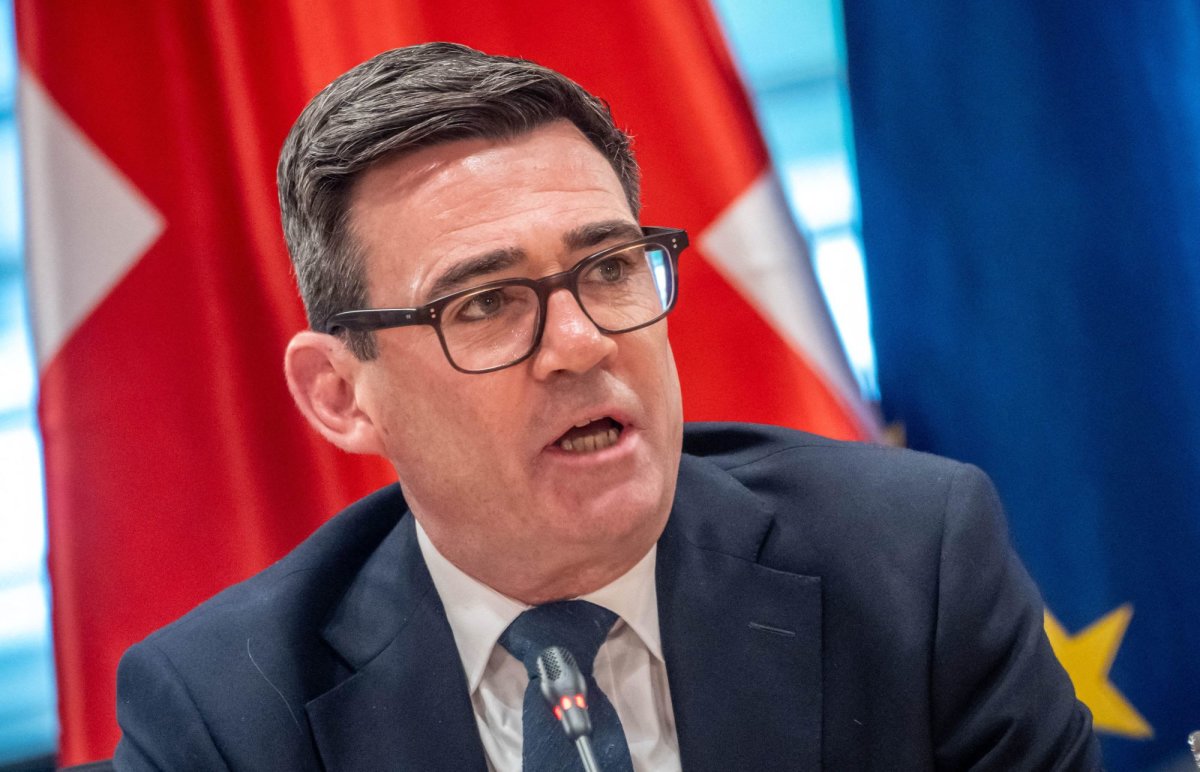

8 October | Andy Burnham attends business forum in Berlin (Alamy)

2 min read
Downing Street has said that Andy Burnham does not think Russian interference in the 2016 Brexit referendum affected the result.
The Prime Minister’s official spokesman said it was “inconceivable” that the Kremlin had not sought to use the referendum to their benefit, but said the Government did not believe it had succeeded.
“Given everything we know about Russia, it is inconceivable they did not seek to use the referendum to their benefit. But as the minister [Stephen Doughty] said this morning, we do not believe they have succeeded,” he said.
Downing Street said the Prime Minister “absolutely accepts the referendum result” and, after several attempts at asking, said: “Yes, we do believe the referendum results to be legitimate.”
Over the weekend, Burnham appeared on The Rest Is Politics podcast where he claimed that upon entering Downing Street he was told that Russia had interfered with the Brexit vote.
He told the podcast: “I asked the question coming to Downing Street, well was there interference in the 2016 referendum from Russia? I’ve had the clear answer that, yes, there was.”
“These things are important now to put clearly on the record and I believe help voters in Germany and France understand that some of this politics is instigated via our enemies, namely, Russia.”
The intervention has fuelled speculation that he will use Russian interference as a pretext for re-running the 2016 referendum.
The Prime Minister’s spokesman told reporters on Monday: “He’s said this isn’t about leaping to a referendum or leaping to any option, it’s about being honest that Britain needs to settle its long term relationship with Europe.”
“He’s clear that the Brexit deal he inherited has left Britain worse off and we can do much better.”
Downing Street also pointed to “a pattern of behavior from Russia” that shows they have been “conducting a campaign of evidence for years”.
“We know, for example, that in 2020 the last government set out that Russian actors sought to interfere in the 2019 election. We know they tried to interfere in the French election in 2017. It’s evident from that pattern of behavior that Russia has been conducting a campaign of interference for years”.
In January, Security Minister Dan Jarvis told Parliament that “successive governments have not seen any evidence of successful foreign interference” in the 2016 EU referendum. He also acknowledged that Russia posed an “enduring and significant threat” to UK democracy.
The government has announced the creation of the National Centre for Information Defence (NCID) to detect, attribute, and disrupt hostile state-backed disinformation and information warfare, including Russian interference.
>

IDFA Announces Competition Lineups, Adds ‘Musk’ & Elizabeth Holmes Doc
Paris Saint-Germain have started the season slowly. Are they still Europe's best side?

Amex introduces a framework to prevent AI agents from making unauthorized purchases
-

 movies5 months ago
Search For Canadian TV Actor Stewart McLean Now Homicide Investigation
-

 Fashion9 years ago
These ’90s fashion trends are making a comeback in 2017
-
Fashion9 years ago
According to Dior Couture, this taboo fashion accessory is back
-
Fashion9 years ago
Model Jocelyn Chew’s Instagram is the best vacation you’ve ever had
-
Fashion9 years ago
Emily Ratajkowski channels back-to-school style
-
Fashion9 years ago
9 Celebrities who have spoken out about being photoshopped
-

 Anime4 months ago
Rurouni Kenshin: Hokkaido Arc Manga Takes 1-Issue Break – News
-

 Anime3 months ago
HIDIVE to Stream English Dubs for The World Is Dancing, The Forsaken Saintess and Her Foodie Roadtrip in Another World, The Dangers in My Heart: The Movie Anime – News