
Entertainment
‘What Happened Was’ (1994) Reminds Cult Film Fans Why Dating Is Hell


On Friday nights, IndieWire After Dark honors fringe cinema in the streaming age with midnight movies from any moment in film history.
First, the BAIT: a weird genre pick, and why we’re exploring its specific niche right now. Then, the BITE: a spoiler-filled answer to the all-important question, “Is this old cult film actually worth recommending?”
The Bait: “Before Sunrise” Meets David Lynch in the Creepiest First Date Movie Ever Made
If you’re in New York City now through June 14, you can see Dill Harcourt in “Girls” (aka Corey Stoll) and an “SNL” MVP from 2012-2022 (aka Cecily Strong, in a brilliant, full-throated dramatic performance) onstage Off-Broadway at the Minetta Lane Theatre in “What Happened Was…”


It’s based on a 1994 play and Sundance Grand Jury Prize-winning movie directed by and starring the late, great Tom Noonan (RIP). If you can’t make it to attend this addictive and seriously warped stage adaptation, you can very easily find this underseen indie on YouTube for a skin-crawly night in. (It’s a favorite of Charlie Kaufman, who would later cast Noonan in “Synecdoche, New York,” and fans of Kaufman’s two-hander “I’m Thinking of Ending Things” will find much to love in “What Happened Was.”)
The play, and the film, revolve around paralegal Michael and executive legal assistant Jackie, co-workers at the same firm who meet for a first date at Jackie’s apartment, the same way nervous neighbors meet over a tall fence: How much damage and ruin await on the other side of the parapet if you look too closely? Over the course of an eventually boozy evening, both reveal acid-spiked truths to one another while swapping wounded badinage — one being that Jackie is the writer of truly twisted short stories that might be based on her own real trauma, and the other being that Michael is a phony and a play actor in his own life.

Shot luridly in neo-noir-streaked honest-to-god celluloid the way only indies in the ‘90s were — and perhaps with Martin Scorsese’s all-nighter “After Hours” as a touchstone — “What Happened Was” is one of those great one-night movies. Think of it as “Before Sunrise” directed by David Lynch, and a romance fueled by self-consciousness and insecurity. Vulnerability risks emotional exposure, but Michael and Jackie use a fear of intimacy as firewood to possibly spark something real, maybe the first real thing they’ve felt in their lives.
Noonan plays Michael in the film with a quiet watchfulness that contrasts Jackie’s nervy, open wound of a woman played with emotive genius by Karen Sillas. “What Happened Was” the movie plays up the creep factor by filling Jackie’s apartment with watchful porcelain dolls, positioned like voyeurs to a long-winded and eventually perverse conversation between broken people.

The centerpiece of this movie — and what blew me away in the play, as read by Strong — is the absolutely unhinged monologue Jackie delivers, reading from her short stories. (It turns out she’s a published author!) In a terrifying oner punctuated only by visualizations of it that Michael projects onto the TV, Jackie tells the story of a woman sexually abused by everyone around her, including her own parents, in a Southern Gothic-tinged Florida where she eventually “topless-danced her way West” to ward off trauma. “End of part one,” the story concludes, and our jaws are on the floor.
“What Happened Was” made a minor indie splash at the time, and reportedly, Noonan planned a schedule that he pitched to various streamers in the last years of his life. I would’ve loved to see where these two ended up — which, after that speech, is unlikely to be in each other’s arms. For now, Ian Rickson’s stage version gives an approximation of what another version of this story might look like — one where drunkenly singing along to Joni Mitchell’s “A Case of You” is fodder for a painful first date.
There’s no worse nightmare than dating in 2026, making 1994’s “What Happened Was” feel oh so — that dreaded word — prescient. —RL

The Bite: Speak for Yourself, I Love Trauma Dumping
Look. Any woman in a movie who gets introduced listening to ’Til Tuesday’s “Voices Carry,” running around her silk-draped apartment half-naked, is going to have my allegiance, full stop. And sorry, but there’s just no denying that Karen Sillas looks absolutely stunning in that little burgundy dress. Hell, even watching Tom Noonan visibly shake as Michael struggled to process the passive-aggressive complexities of the batshit woman’s home he was in, nothing — nothing!! — could make me hate Jackie.
Blending the unease of something like 1979’s “When a Stranger Calls” with the everyday misery of a more grounded relationship drama, “What Happened Was” frames its main characters like potential players in a would-be horror movie from the jump. But those archetypes are hard to pin down at first. Michael isn’t an obvious predator so much as he is socially off, faintly alien, and hard to read. That ambiguity clashes with Jackie’s cool, home-field advantage in a way that feels fun… until that very chemistry sours into a poison that’s one part “Sliver,” two parts “Who’s Afraid of Virginia Woolf?”

Drenched in purple hues and shifting candlelight, Jackie’s apartment does a lot of the unsettling. The set feels less like a ’90s living room than a cozy villain’s lair, warm but volatile (and easily set ablaze). Every detail on screen feels both meaningful and intentionally unstable, from the light-up goose we see glaring at us from Jackie’s feet, to the strange mix of posters featuring Andrew Lloyd Webber’s “Cats” and a black-and-white photograph of Martin Luther King Jr.
The room suggests a personality that has been carefully curated and is still intensely personal, but coming from an occupant who’s obviously unwell. That shift in Michael’s understanding is subtle but arrives early on, when his casual, “I guess this is a lull,” quip turns an awkward beat into an excruciating disconnect. With more than half the film to go, that’s the second you feel truly “stuck” with them.

From there, “What Happened Was” settles into a rhythm that feels painfully recognizable and yet rarely predictable. Anchored in the universal psychological tensions that underlie not just bad dates but most bad dynamics, Jackie and Michael’s thorny sense of instant codependence eventually prompts each person to deliver their own unhinged monologue. But Ryan was right to warn me about Jackie’s feverish description of an abusive Southern Gothic childhood — if only, because both Michael and my reaction to that reveal fundamentally changed how I saw the rest of the night.
Critically, Michael doesn’t recoil when Jackie shares her horrific story. He lights up, and for most women I know, that’s scarier. Once offered, vulnerability isn’t always met with care by the people we date, and instead, it can be absorbed or even fetishized with reckless cruelty. When Michael pivots from his sweaty-lipped, almost horny fascination with Jackie’s trauma to clumsily suggesting she publish her book professionally, the tone suggests her weakness has made him somehow ravenous.

I’ve dated several writers, and broadly speaking, it’s a fast track to mutual emotional cannibalism. If someone’s job is to mine reality for meaning, intimacy can feel like raw material. And when two artists date each other, one of them almost always has to shrink. Watching Jackie read her profoundly scary tale, my reaction moved from curiosity to revulsion to fear… not of her, but of Michael. Too many women know the feeling of watching a man lean in too close when the subject turns to her pain, and “What Happened Was” dares to ask a question that still stings years later: What do you disclose, and why?
By the end, Noonan’s film stops feeling like a first date and starts to resemble the makings of a crime scene as his mood lurches toward something dangerous. Every frame tightens with dread, to the point that even a corked champagne bottle feels like a weapon, and Jackie’s birthday cake becomes a test Michael was never going to pass. And yet, even as the world’s worst renter spiraled out of control, I stayed on her side. If only because these two colleagues’ brush with real connection crystallizes what it’s truly like when one person insists something was “important” — while the other retreats.
When Michael asks if this was “a date,” it’s not clarifying so much as strategic, and what’s striking about Noonan’s meditation on misery is how much dating hasn’t changed since 1994. Decades on, “What happened was…” is still how many of us soften our most difficult romantic stories, subtly blurring sharp memories into an arc that’s more survivable. But like Jackie washing dishes, and turning off that (very cool?!) lamp, you have to wonder if we rewrite our experiences primarily because, then, we don’t have to admit to ourselves that we already knew how those relationships would end. When Jackie says, “We all are where we are because we want to be there, right?” it lands like a threat with no weight behind it. And when Michael asks, “What do I do now?” the suggestion to go home isn’t a comfort so much as a guilty verdict. —AF
Read more installments of After Dark, IndieWire’s midnight movie club:
>
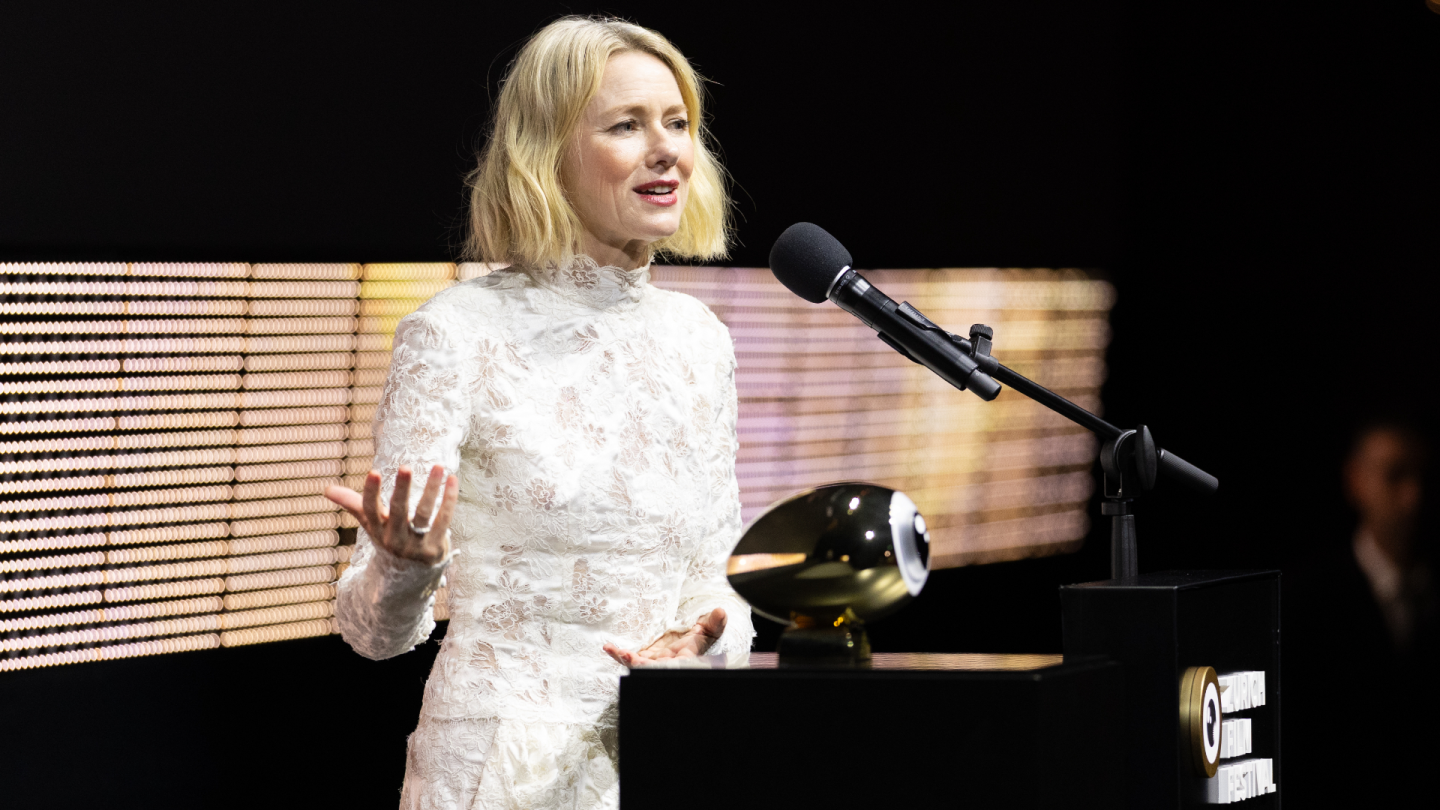
It felt like Naomi Watts covered it all in a Zurich Film Festival masterclass on Sunday afternoon: dreams, drama and, of course, the menopause.
The British star opened up with host Max Loong about struggling for around a decade auditioning in Los Angeles before she would go on to meet David Lynch and star in his career-transforming Mulholland Drive. Watts was speaking the day after a glitzy Zurich ceremony in which she accepted the fest’s prestigious Golden Eye award for her latest feature, The Housewife.
The conversation began with Watts’ childhood and acting aspirations. Her ambitions were made a little more complicated when Watts’ mother moved the family from the U.K. to Australia when she was only a young teenager.
In a bizarre way, meeting the late, great Lynch — whom Watts did an impeccable impression of, pretend cigarette and all — was almost like therapy for the actress, who landed that breakout role at the age of 31. She was worn down by Hollywood’s faux interest in her talent and the fickle nature with which casting directors operated. “[You’d] line up and see 10 or 15 girls, running their lines, looking much better for the part than you do, and it was really a grind,” Watts told the room.
“That 10 years before I met David Lynch, I just became so locked up and I felt worthless,” she continued. “My agent actually pulled me aside because she put together a reel with some of the work I’d done in Australia — little bits of things — and she said, ‘We need to have a heart-to-heart. Come in and talk to me because I don’t understand why you’re not getting these jobs.’”
Watts was told by that agent: “‘Honey, you’re too intense. You’re freaking people out.’ And I was like, ‘Yeah, no shit. I’m desperate. I’m three months behind on my rent. I’m getting evicted! They told me I wasn’t funny last week. I’m trying to be funny now. They told me I wasn’t sexy. I’m trying to be sexy!’” she said, likely validating a lot of women in the room vying for a foot in the door. “You reshape yourself to try and read the tone of what is needed, and it becomes freaky. And I just couldn’t be myself. I was either an extreme version of myself or a diluted version. I was further and further away from myself, and it took a genius like David Lynch to be able to see beyond all of that weirdness that I had built up and undo it and get to the real me.”
At the Cannes Film Festival premiere of the beloved Mulholland Drive, in which Watts plays an aspiring actress who arrives in L.A. and befriends a car crash victim, she remembers sitting in the car with co-star Justin Theroux, about to hit the iconic red carpet, when a sentimental song came on the radio. “The crowds are there waiting, and the song changed to Cat Stevens’ ‘Morning Has Broken,’ and this was the song that had played at my dad’s funeral.”
Watts became teary at this point in the conversation, earning a raucous round of applause from the crowd. Her father, Peter Watts, a road manager and audio engineer who went on the road with Pink Floyd, died of an apparent heroin overdose when she was just seven years old. “It was always a very meaningful song, and I just remember turning to Justin and went, ‘Oh my God, that song!’ […] Thank God I wasn’t alone in that car [and had] Justin because all I could think about was my mascara running down my [face]. He just grabbed my hand and he was like, ‘Come on. Let’s go. Let’s do it.’ I put my head up and off we went onto the red carpet, and it was wonderful. David was obviously very beloved and we just held on tight to each other.”
Mulholland Drive is widely considered one of the greatest films of all time, and made an international superstar out of the bright-eyed and bushy-tailed Watts. It was a modest commercial success, making around $20 million on a $15 million budget.
Towards the end of the masterclass, Watts took a moment to talk about her menopause activism, revealing how her four-year-old menopause and wellness company, Stripes Beauty, came to be. “Menopause has become a huge topic of conversations [and a] passion because I went into it early on in my life and had no clues about what was going on with my body and there was no open conversation,” she said. “Once I talked about it with my partner, who’s now my husband, and he was encouraging of it, I just thought: ‘How about I just own this story? How about I get ahead of it? I’m in on the joke that is not actually a joke, but why should we suffer?’” Watts’ goal was to inject normalcy into menopause, whether it’s through “humor, storytelling, just connectivity, or product solution.”
She lauded her husband of three years, fellow actor Billy Crudup, for being curious about menopause — and implored other men to replicate his openness. “I was hiding in the bathroom trying to scratch off my estrogen patch, and he was like, ‘Is everything okay?’ And I told him what was going on, and I really was so nervous and thinking, ‘Oh God, I bet he’s not going to want to be with me now. He knows I’m in menopause.’”
Crudup’s reaction was quite the opposite. “He was like, ‘Hold on a second. We’re the same age, and that’s great that you’re taking care of yourself. Love science, love medicine. And why are you ashamed? That’s fantastic. Thanks for telling me.’ And so instantly, I felt, ‘Oh my God, this is so sweet and generous and sexy!’ Like, that just felt really intimate. And I felt safer than I’d ever felt,” continued Watts. “And I told him that I wanted to create a company for women who are not clued in, and the company would be about hydration from scalp to vag.”
Watts comes to Zurich promoting The Housewife, directed by Ben Shirinian and co-starring Tye Sheridan, Michael Imperioli and Luke Evans. It is based on a true story and set in 1964 New York. When a young journalist tracks down a potential Nazi officer living secretly in Queens, he befriends the lead suspect’s charming wife. But the investigation soon takes a disturbing turn.
Her fellow Golden Eye recipients include John Turturro and Tom Hiddleston this year. The 22nd Zurich Film Festival runs Sept. 24-Oct. 4.
>
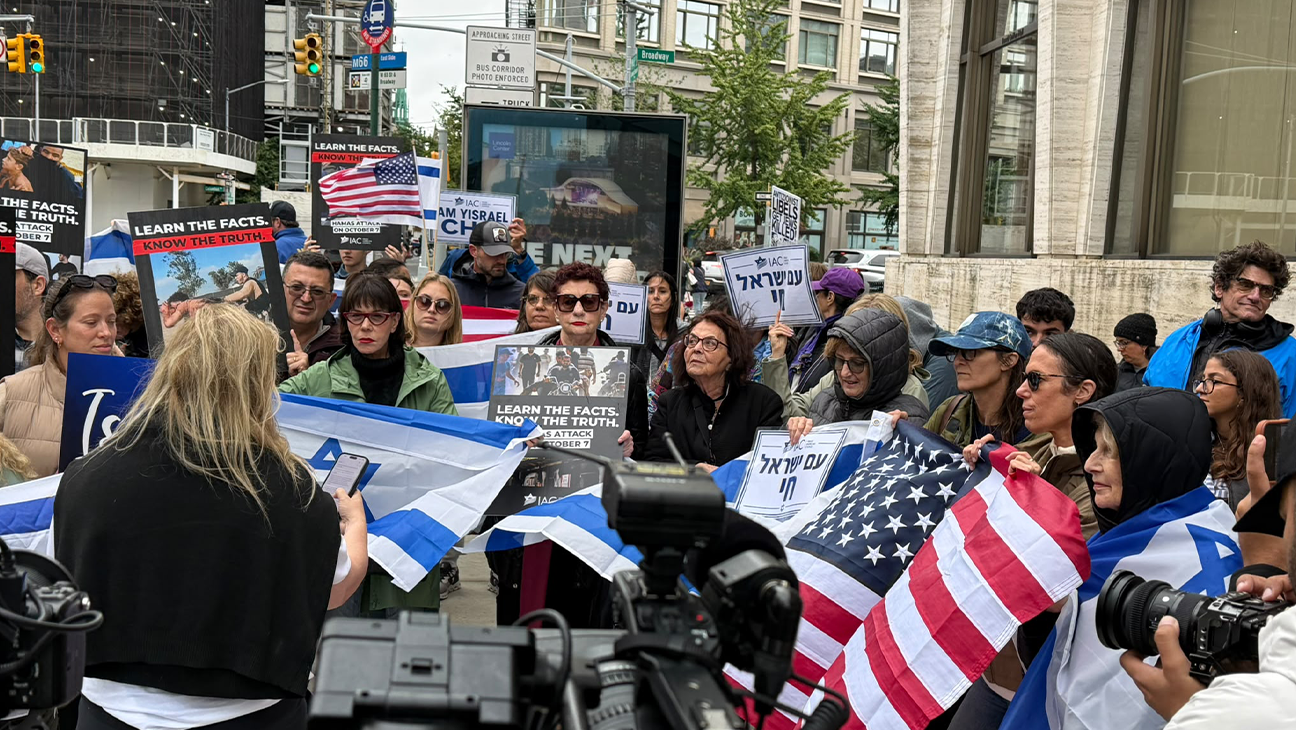
Dozens of Israeli Americans and members of Jewish communities gathered outside the Lincoln Center on Saturday to protest the premiere of NAZA at the New York Film Festival.
The documentary, directed by Yuval Abraham and Rachel Szor, was filmed at night from Tel Aviv rooftops and examines “the systems behind the mass killing of Palestinian civilians” by Israel‘s military operations in Gaza, the filmmakers previously said.
During the protest, demonstrators screened footage from the Oct. 7 attacks on Israel from LED screens mounted on trucks outside the premiere. Nova festival survivors Rom El-Hai and Shalev Biton also spoke to the crowd, sharing their accounts of Oct. 7.
“We’re here not because we’re saying, don’t show the film,” Israeli-American Council (IAC) co-chair Tal Shuster said of NAZA during the rally. “Everyone has the freedom of speech, that’s the United States. We are saying: it’s not all the facts. Show everything else, not just the documentary.”
“We have the trucks here,” Shuster continued. “Let’s each one of us be an ambassador and show people what actually happened. If you screen the film, invite a survivor, let them speak, at a panel. Let them be heard. Don’t just show one side without the facts from the other side. Before you go into the film, or after it, come hear about what happened in Israel on Oct. 7. 1,200 people were murdered. 251 people were kidnapped. Yes, show all the facts.”
The IAC also launched a petition, “calling on cultural institutions, film festivals and movie theaters across the United States to accompany screenings of NAZA with panels, survivor testimony, and background and context materials,” according to a press release.
“We are not here to silence a movie, but we believe people should watch, ask difficult questions, challenge what they see and decide for themselves, but they also deserve to hear the perspectives and facts that this film does not present,” Noa Peri-Jensch, the IAC’s chief communities officer, added during Saturday’s protest.
NAZA, which took home the Special Jury Prize at the Venice Film Festival earlier this month, will start its theatrical release in the U.S. on Oct. 9, followed by a global rollout.
“We made this film out of a sense of obligation to use our position as Israelis to examine the systems behind the mass killing of Palestinian civilians for which our country is responsible,” filmmaker Abraham and Szor previously said of their Israel–Gaza war documentary. “The threats from the Israeli government to revoke our citizenship and the death threats do not change that and will not stop the film. We thank our colleagues for the solidarity and look forward to sharing NAZA all over the world very soon.”
>
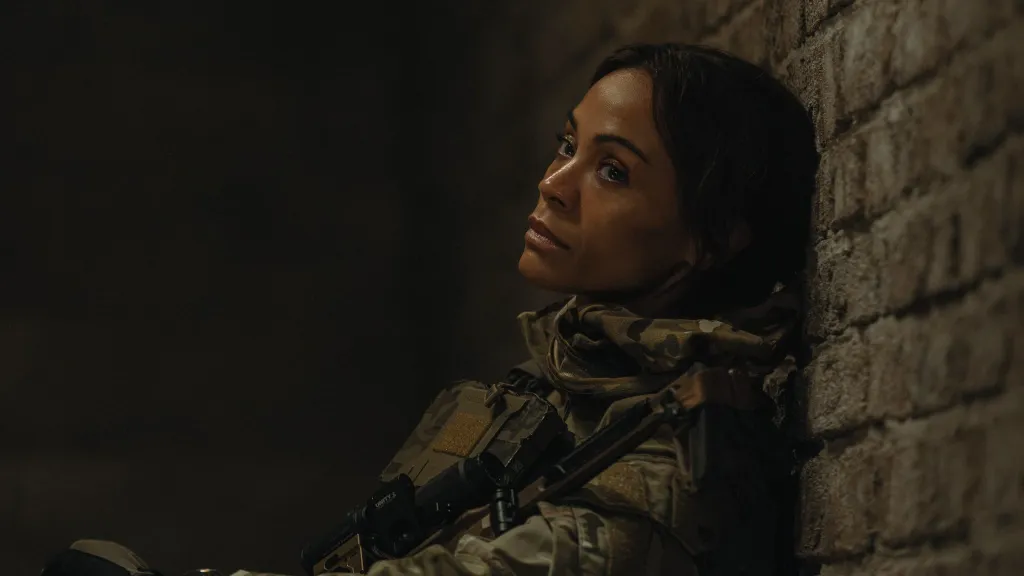
Although Zoe Saldaña speaks highly of collaborating with Taylor Sheridan, don’t expect her to make a trip to Dutton Ranch anytime soon.
The Lioness star recently explained why starring as Joe McNamara “is all that I can handle at this time,” noting she doesn’t have any plans to pop up elsewhere in the Sheridan TV universe after three seasons on the Paramount+ series.
“I’m number one on the call sheet. I am first one in, last one out. I am prepping months before anybody ever is able to prep,” she told People. “So it’s already a lot of work for me.”
Saldaña said she “can’t imagine me taking on more of a Taylor Sheridan world,” adding, “The good takeaway that I’m grateful for is that he knows that I’m reliable, just like Joe is.”
“I have my views, and I come with all heart, all brains, all muscle at all times,” said Saldaña. “So, no, I think I’m good here at Lioness.”
Starring and executive produced by Saldaña and Nicole Kidman, Season 3 of Lioness sees hidden networks, foreign operatives and personal betrayals collide. Joe (Saldaña) walks the line between duty and home as unseen forces circle her world. Patterns appear where they shouldn’t, names vanish and paths rearrange. Guided by Kaitlyn (Kidman) and Westfield (Michael Kelly), Joe confronts enemies operating in the shadows, leaving her to reckon with a war that now reaches into every part of her life.
>

Naomi Watts Praises Husband Billy Crudup for Menopause Support
Predicting the College Football Playoff bracket: SEC grabs 6 spots in latest projections

Anthropic’s Dario Amodei gets the SNL treatment
-

 movies4 months ago
Search For Canadian TV Actor Stewart McLean Now Homicide Investigation
-

 Fashion9 years ago
These ’90s fashion trends are making a comeback in 2017
-
Fashion9 years ago
According to Dior Couture, this taboo fashion accessory is back
-
Fashion9 years ago
Model Jocelyn Chew’s Instagram is the best vacation you’ve ever had
-
Fashion9 years ago
Emily Ratajkowski channels back-to-school style
-
Fashion9 years ago
9 Celebrities who have spoken out about being photoshopped
-

 Anime4 months ago
Rurouni Kenshin: Hokkaido Arc Manga Takes 1-Issue Break – News
-

 Anime3 months ago
HIDIVE to Stream English Dubs for The World Is Dancing, The Forsaken Saintess and Her Foodie Roadtrip in Another World, The Dangers in My Heart: The Movie Anime – News