
Anime
Bleach Volume 56-74 Manga Review – Review

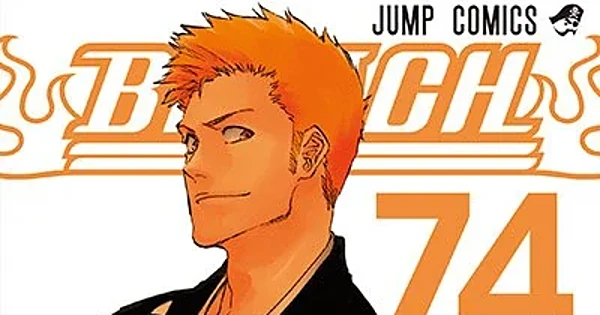
Stop me if you’ve heard this one before, but when a mysterious figure from an otherworldly race/organization appears before Ichigo and pals, their peaceful lives are thrown into chaos! Together, they’ll have to venture into unforeseen realms adjacent to the Soul Society, become allies with cool new characters who have even cooler powers, train to unlock new abilities, and fight people with impressive/weird-sounding names! Along the way, Ichigo will realize that he has an intrinsic and inherited connection with this organization, turning these battles to save the world into a crisis of conscience and identity. With his friends and loved ones anchoring him, he will overcome insurmountable odds and defeat a nearly all-powerful foe to protect those precious to him.
If you’ve read the preceding 55 volumes of Bleach, you should have stopped me no less than eight times in that opening paragraph. Tite Kubo penned an incredibly affecting story about the strangeness and fear built into transitioning from an adolescent into an adult in Bleach‘s Soul Society arc, and then he just kept going back to that well! Moreover, by the time the series got through the Arrancar saga, this well was starting to run dry. It was then completely drained by the time the Fullbring arc wrapped, leaving only the narrative equivalent of mud for the Thousand-Year Blood War that roughly covers volumes 56 to 74 of the manga.
I really cannot understate how every longstanding deficiency in Bleach‘s writing bubbles to the surface in these nearly 200 chapters of manga, and practically becomes a greater focal point than the actual characters or events present in this part of the series. For instance, Ichigo is repeatedly framed as a saviour of Soul Society or described as an overt member of their ranks in this arc, when his relationship to the Gotei 13 has always been, at best, tenuous and driven by mutual benefit. While he’s definitely aligned with the Soul Society and is interested in protecting it, as some of his friends live there and the universe will blow up if it’s destroyed, he hasn’t really been on their team, and much of these volumes clunkily force Ichigo to participate in the combat. Until Ishida joins the Wandenreich, Ichigo learns that his mom was a Quincy and that the final boss, Yhwach, is tangentially responsible for her death; the stakes never feel personal for our main character, and his participation in the events of this narrative up until this point feels less than motivated. Though I suppose giving the Wandenreich an overt nazi motif does at least create a visual shorthand for why Ichigo and company should be against them.
Speaking of shorthand, pretty much every element of these volumes comes up short compared to the standard set by earlier parts of this celebrated franchise. While the character designs are as cool and legible as ever, many of the events of the Thousand-Year Blood War happen in a void that robs the action of any sense of space or scope. The pacing of these volumes also feels like a series of fits and starts, largely because the Wandenreich seemingly has a limitless supply of unmentioned-until-their-introduction combatants with growingly overpowered abilities that give fan favorite characters a chance to show off. Don’t get me wrong, as someone who’s followed Bleach in one way or another since I was twelve, it’s cool that we finally get to see Urahara and Yamamoto’s bankai and have Yoruichi actively participate in a consequential fight, but a series of fancams for Bleach‘s bloated character roster doesn’t make for a great story.
As for the character-centric twists and turns that crop up in these volumes, they range from cool if hamfisted to betrayals of longstanding established lore. Stereotypical material healer Unohana turning out to be a bloodthirsty baddie is an amazing twist that subverts genre tropes that earlier chapters of Bleach helped establish, even if this character reveal is ultimately just used as a means to give Kenpachi a power up. Speaking of Kenpachi, I cannot believe Kubo thought it’d be an interesting twist to turn the unique way Kenpachi’s ability works and his relationship with the childish Yachiru, two of the main things that define the character, into every other character’s relationship with their Zanpakutō. Furthermore, Kenpachi’s bankai makes him even stronger while also robbing him of the ability to communicate or seemingly even reason, really dumbs down the character, as it’s way more fun if he’s a little freak choosing to be an avatar of violence rather than transformed into an embodiment of violence.
Maybe the greatest disappointment of these volumes of Bleach, more so than the cavalcade of characters that do not matter, the fast and loose treatment of previously established plot points, and the left field transphobia with Giselle Gewelle, is the ending of the series. Ichigo and friends being able to defeat the functionally omnipotent Yhwach thanks to Ishida’s last-minute macguffin is such a less impressive finale than Ichigo bodying Aizen after spending like a decade in this universe’s version of the Hyperbolic Time Chamber. This ending reads as though Kubo realized he made Yhwach too powerful after becoming a god and had to introduce a last-second kryptonite to pull out a win for the good guys. This is a bullshit ending, while Ichigo basically doing nothing but working out until he’s strong enough to defeat a transcendent Aizen is also pretty bullshit, at least we got a cool fight out of that ending to an arc, and it feeds the series themes of people being able to overcome adversity through hard work and dedication.
I have a vivid memory of, as a teenager, reading an IGN article that describes Bleach as “the thinking man’s anime.” The volumes that comprise Bleach‘s final arc prove that this was always a misinformed, if not insulting, opinion. With its growingly stylish characters, impressive sounding proper nouns, and explanations rooted in real-world science and terminology, Bleach is really good at posturing and making itself seem cool. These volumes lay bare that this franchise has been running on faulty logic, difficult to write around powers, and characters with inconsistent values for a long time. If, like me, you’re a longtime Bleach reader, you owe it to yourself to see this manga to its completion. You’re going to have a bad time, though, and the goodwill the series was already running low on will not carry you to its conclusion.
>
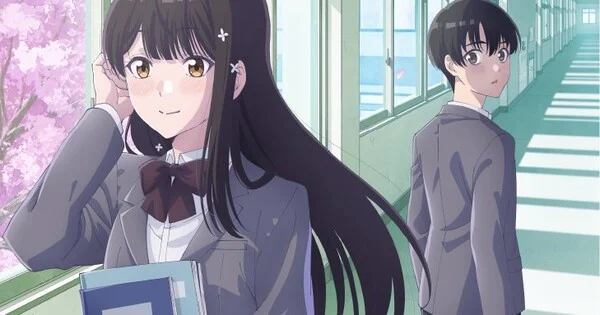
An X (formerly Twitter) account opened on Monday to announce that a television anime of Kashiko Amane‘s Everyone’s Darling Has a Secret (Hōkago no Idol ni wa Himitsu ga Aru) manga will premiere next April.

© あまねかしこ・白泉社/藍色インパルス・StarryCube
The main cast members are:
Hikaru Sato (The 100 Girlfriends Who Really, Really, Really, Really, Really Love You, Dropkick on My Devil!) is directing the anime at Gekkō, and Fumihiko Shimo is overseeing and writing the series scripts. Kibidango 14-gō (Azuma Tozawa) is designing the characters. Satoru Kōsaki and monaca are composing the music. Ryō Aizawa (Starry Cube) is producing.
Yen Press publishes the manga in English, and it describes the story:
Hizashi Hiruno, a freshman at a super-elite high school, has just finished his first academic proficiency test of the year. He anxiously awaits the results, which will set the tone for his next three years at school. But due to a mistake on his answer sheet, he receives an abysmal score and gets sent to remedial lessons! If there’s one silver lining, he’s not the only one—and his comrade could be the girl of his dreams?!
Amane has been serializing the manga on Hakusensha‘s Young Anime Web site. Yen Press published the fourth manga volume in June.
Source: Everyone’s Darling Has a Secret anime’s X/Twitter account, Comic Natalie
>
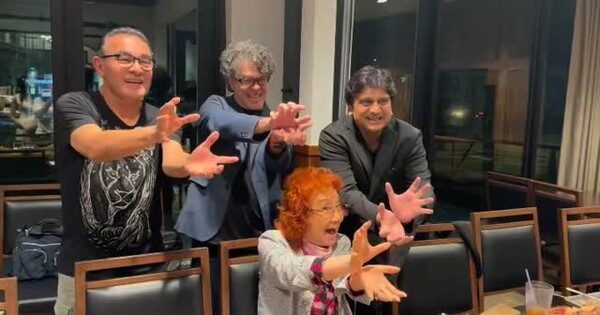
If you thought a Kamehameha from one Son Goku from Dragon Ball Z was powerful, what about four? That very moment was captured by Mexican voice actor Georgina Sanchez last week. As four of the voices behind Son Goku, Masako Nozawa (Japanese, front and center), Mario Castañeda (Spanish, left), Sean Schemmel (English, center back), and Ankur Javeri (Hindi, right) performed the move before the Tokyo X convention in Houston.
Nozawa, Castaneda, Schemmel, and Javeri appeared at the Tokyo X convention at the Reliant Center in Houston, Texas between September 26 and 27.
Dragon Ball Z was the second anime series to adapt Akira Toriyama‘s Dragon Ball manga. The anime series premiered in April 1989 and continued until January 1996. It spawned several feature-length films and the truncated Dragon Ball Kai anime series in 2009.
Nozawa holds the Guinness World Record for “voice actor who voiced the same character in a video game for the longest period” and “longest video game voice acting career,” for her work as Son Goku. She won one of the 71st Kan Kikuchi Prizes “as a traiblazing representative of Japanese voice actors” in 2023. In her acceptance speech, she confidently stated she will continue voice acting until she is 182 years old. The Japanese government honored her as a Person of Cultural Merit in 2025. She released a new line of merchandise in late August 2026 in celebration of her 90th birthday.
Sources: Georgina Sánchez’s Instagram account, Tokyo X’s website (link 2, link 3)
>
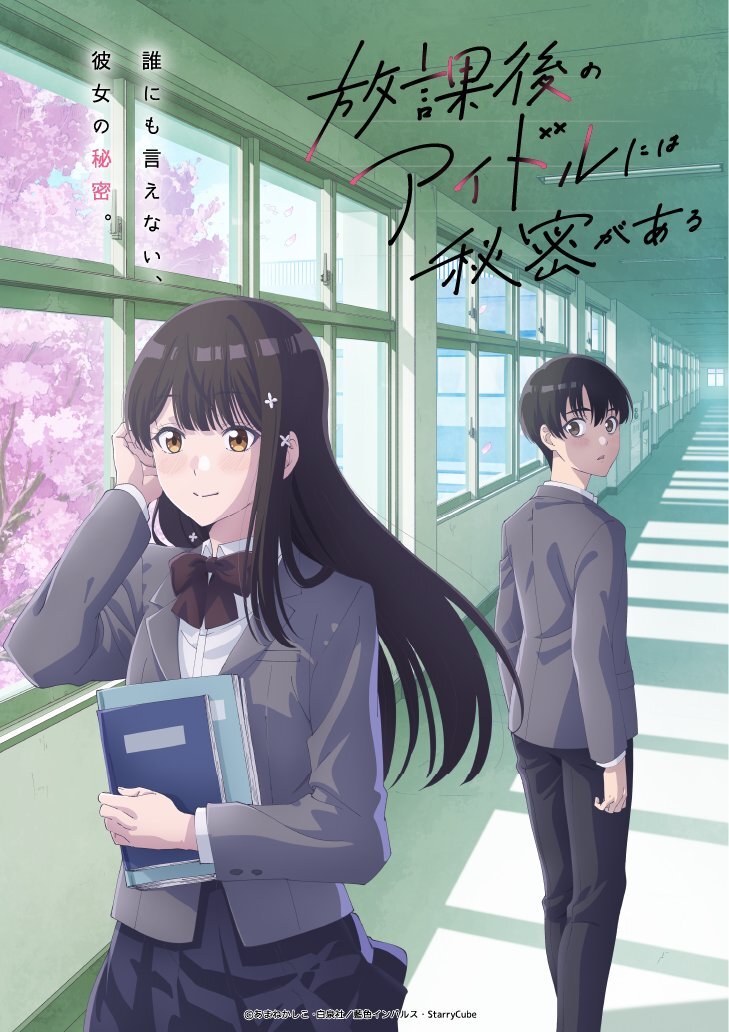
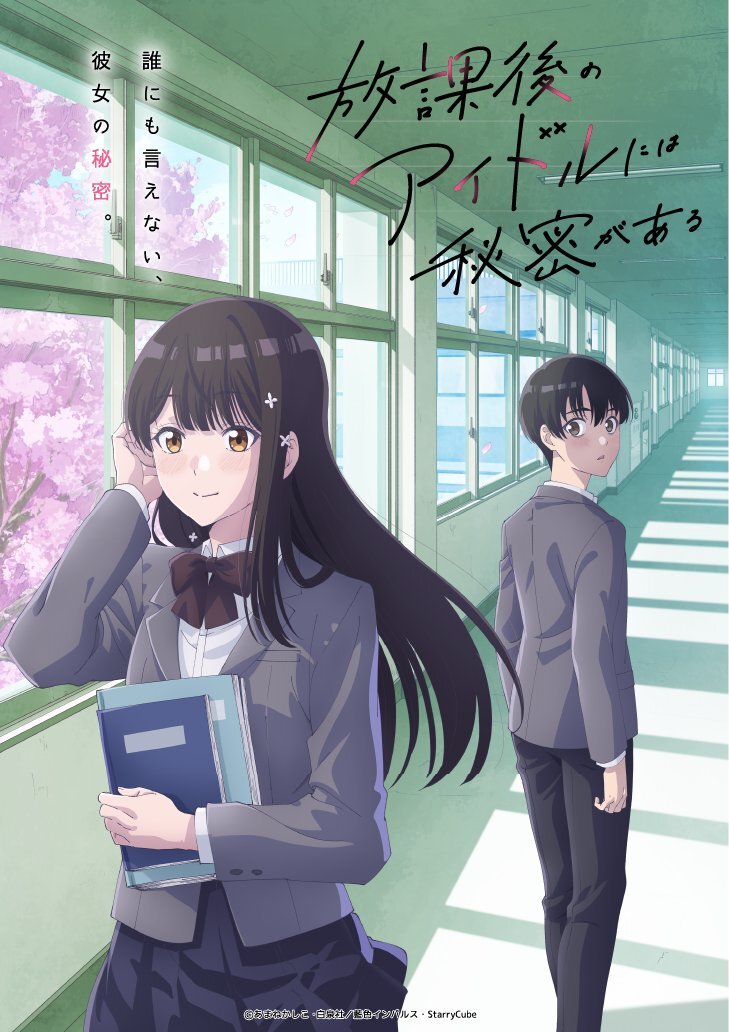 Production company Starry Cube opened an official website for a television anime adaptation of Kashiko Amane‘s Houkago no Idol ni wa Himitsu ga Aru (Everyone’s Darling Has a Secret) web manga on Monday, revealing the main cast, staff, and a teaser visual (pictured). The anime series will premiere in April 2027.
Cast
Hiruno Hizashi: Reiji Kawashima (Fumetsu no Anata e)
Rei Kuromiya: Hikaru Tono (Make Heroine ga Oosugiru)
Sakura Akai: Iori Noguchi (=LOVE) (Hashiri Tsuzukete Yokatta tte.)
Sora Konno: Ami Maeshima (BanG Dream! 2nd Season)
Staff
Director: Hikaru Satou (Lycoris Recoil animation director)
Series Composition, Script: Fumihiko Shimo (Clannad)
Character Design: Azuma Tozawa (Kirei ni Shitemoraemasu ka.)
Music: Satoru Kousaki (Kusuriya no Hitorigoto), MONACA (Summertime Render)
Studio: Gekkou
Producer: Ryou Aizawa (Starry Cube) (Yuusha Party ni Kawaii Ko ga Ita node, Kokuhaku shitemita.)
Amane originally launched a preview serialization of the comedy romance manga in Young Animal magazine from July to August 2022. The series later began regular serialization on the Manga Park and Young Animal web service in September 2022. Hakusensha published the ninth volume on July 29.
Yen Press licensed the manga in English in August 2024. The fourth volume went on sale on June 9.
Synopsis
Hiruno Hizashi, a freshman at a super-elite high school, has just finished his first academic proficiency test of the year. He anxiously awaits the results, which will set the tone for his next three years at school. But due to a mistake on his answer sheet, he receives an abysmal score and gets sent to remedial lessons! If there’s one silver lining, he’s not the only one—and his comrade could be the girl of his dreams?! (Source: Yen Press)
Official site: https://idol-afterschool.com/
Official X: @idolafterschool
Source: animate Times
>

NFL: Denver Broncos beat Los Angeles Rams and Seattle Seahawks lose
Department of Homeland Security posts video featuring highlights of ex-NFL star Brian Dawkins

Flex your football brain with our daily quizzes
-

 movies4 months ago
Search For Canadian TV Actor Stewart McLean Now Homicide Investigation
-

 Fashion9 years ago
These ’90s fashion trends are making a comeback in 2017
-
Fashion9 years ago
According to Dior Couture, this taboo fashion accessory is back
-
Fashion9 years ago
Model Jocelyn Chew’s Instagram is the best vacation you’ve ever had
-
Fashion9 years ago
Emily Ratajkowski channels back-to-school style
-
Fashion9 years ago
9 Celebrities who have spoken out about being photoshopped
-

 Anime4 months ago
Rurouni Kenshin: Hokkaido Arc Manga Takes 1-Issue Break – News
-

 Anime3 months ago
HIDIVE to Stream English Dubs for The World Is Dancing, The Forsaken Saintess and Her Foodie Roadtrip in Another World, The Dangers in My Heart: The Movie Anime – News