
Entertainment
Cinematographer Michael Bauman on ‘Monster: The Ed Gein Story’

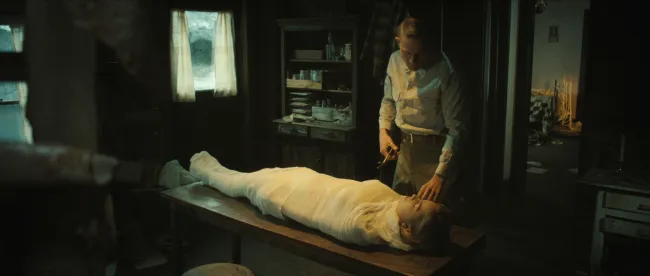
When cinematographer Michael Bauman was growing up in Wisconsin, his neighbors and relatives told stories of local legend Ed Gein, the serial killer whose horrific acts in the 1950s inspired “Psycho,” “The Texas Chainsaw Massacre,” and “The Silence of the Lambs.” Bauman was more than ready, therefore, when his frequent collaborator Max Winkler told him he’d be directing an Ed Gein streaming series and asked if Bauman would be interested in shooting it.
“I was pretty familiar with the mystique of the Ed Gein story,” Bauman told IndieWire. “One of the things that was fascinating to me was the fact that this one incident affected so many things in American culture, even up to ‘Silence of the Lambs.’” Bauman came on board Winkler’s project, “Monster: The Ed Gein Story,” and immediately got down to work creating one of the most ambitiously photographed films or series of 2026 — a beautiful, horrifying, and meticulous portrait that lives up to and even exceeds the expectations Bauman set when he photographed the VistaVision epic “One Battle After Another” last year.


“Monster: The Ed Gein Story” is the third incarnation of Ryan Murphy and Ian Brennan’s Netflix series, and like “Dahmer” and “The Lyle and Erik Menendez Story” it’s as precise in its period detail as it is audacious in its narrative provocations — the scripts don’t just acknowledge Ed Gein’s influence on pop culture auteurs like Alfred Hitchcock and “Texas Chainsaw Massacre” director Tobe Hooper, the incorporate Hitchcock and Hooper as characters. For Bauman, the work began with a deep dive into the historical record.
“There’s a lot of documentation of Ed’s home and the case,” Bauman said, noting that Gein’s notoriety foretold the tabloid culture that would become prevalent in later decades. “It was the start of post-World War II sensationalism.” Bauman’s research, and that of production designer Matthew Flood Ferguson, ended up determining how Bauman would approach lighting sets like Gein’s home. “Where Ed grew up, they were a little late to the game in terms of electricity. He didn’t live in the city. So we knew a lot of our light sources were going to be kerosene lamps and things like that.”
The old-fashioned interior light sources provided a nice contrast with the sunlight from outside, and one of the show’s greatest strengths is its ability to flawlessly replicate the Midwestern sense of a sunny day that’s simultaneously ice cold. Bauman drew on his own memories of growing up during brutal Wisconsin winters to visually represent the feeling, a task made more challenging by the fact that all of the interiors were shot on a stage in California and the exteriors were on location in Illinois.
“In a perfect world, you would shoot the locations first and then match them on the stage,” Bauman said. “We were doing it in reverse for a variety of reasons.” That meant Bauman, Ferguson, and the rest of the crew had to create a Midwestern winter on stage in California without knowing exactly what they’d be getting into when they began shooting months later in Illinois. Luckily for the project — though not for the cast and crew’s comfort — when the production moved to Illinois, they found a harsh winter waiting for them.

“We had gambled that it was going to be snowing with all the backdrops and things like that,” Bauman said. “When we arrived in Illinois, it was insanely cold, and there had just been a snowstorm. So we got all that right out of the gate, which was great because later in the shoot it got warmer and we had to create the snow. The special effects department had to bring in 80 tons of ice that they could shred to create snow that would only last for an hour.”
While the wintry exteriors give a real sense of Midwestern scale to “Monster,” the haunting interiors of Gein’s house are where the show finds most of its terror. Bauman and Ferguson worked closely to find ways of remaining faithful to the actual house’s architecture while using it as a storytelling tool to evoke a sense of dread and claustrophobia. “Max and I talked a lot about frames within frames,” Bauman said, noting that although the series is shot in a widescreen aspect ratio, the frame is often narrowed by windows and doorways to create negative space that both focuses the viewer’s attention and generates a real sense of mystery about what’s hidden in the darkness.
Production design, lighting, and performance come together to unsettle the audience with particular effectiveness in the “Buxom Bird” episode, for which Bauman is deservedly nominated for an Emmy. The central set piece of the episode, in which a pair of cops enter Gein’s home and discover the carnage within, is expertly choreographed so that each camera move subtly reveals one horror while teasing what’s to come, with Bauman’s lighting perfectly calibrated to keep the audience leaning forward to discern the meaning behind every detail.
The use of mirrors and other reflective surfaces, along with the frames within frames, was key, and Bauman attributes the impact of the sequence to a close collaboration between departments. “We’re really trying to build the tension as the two police officers come in,” Bauman said. “One of them is savvy, the other more uninitiated, and he’s the one who wanders through the space the most. So it became about isolating and separating them and teasing out those moments.”

Though “Monster” is filled with impressive set pieces ranging from the “Buxom Bird” reveal to an all-out musical number later in the series, but some of its most memorable moments are simple close-ups of Ed in all his tormenting and tormented complexity. Bauman knew early on what he had in Charlie Hunnam’s performance, and was intent on capturing all of its nuances. “The work he had done became really obvious in our first tests. And Max and I talked a lot about portraiture as we looked at hundreds and hundreds of visual references.”
To convey the range and subtlety of Hunnam’s performance in a way that focused the eye on its details, Bauman worked with Panavision to use vintage lenses that would isolate Hunnam in the frame and let the depth of field grow shallower and shallower around him. “We also worked with a 58mm Petzval lens, which has a swirly bokeh pattern that happens as you shoot at certain stops,” Bauman said. With both Ed and the supporting characters, there was a desire to emphasize their individual reactions in distinctive ways.
“Max and I talked a lot about how to isolate people from the environments and create separation as everyone goes on their own journey of discovering the horrors of what’s happening,” Bauman said, adding that as he worked on the show he realized how the impact of Gein’s crimes was still being felt among his family and their neighbors. “We had a researcher who interviewed many of my folks’ friends, two of whom were teenagers in the 1950s and could describe specific things about Ed, like the way he walked and the kinds of environments he was in. It was an interesting reminder that this was not that long ago. This all happened very recently — it’s not ancient history.”
“Monster: The Ed Gein Story” is currently streaming on Netflix.
>

Filmmaker John Carpenter and actors Colman Domingo and Charlize Theron have been named as this year’s honorees of the Academy Museum of Motion Pictures‘ annual fundraising gala in October.
The gala, co-chaired by Robert Rodriguez, Steven Spielberg and Kate Capshaw, is set for October 17.
Theron will receive the Icon Award, celebrating an artist whose career has had a significant global impact. Carpenter, a director and composer, will receive the Luminary Award, given to an artist whose singular contributions have expanded the creative possibilities of filmmaking. Domingo will receive the Vantage Award honoring an artist who is helping to challenge dominant narratives around cinema.
“The Academy Museum Gala is a celebration of the artists and storytellers whose work continues to shape the cultural impact of cinema around the world,” said Academy Museum Director and President Amy Homma. “For our sixth annual Gala, we are honored to recognize John Carpenter, Colman Domingo, and Charlize Theron, whose extraordinary careers exemplify the creativity, innovation, and excellence that continues to move the industry forward.”
The Academy previously announced upcoming programs that include Theron in conversation with the museum’s Teen Council on August 22, featuring a screening of Mad Max: Fury Road (2015); Carpenter will host three nights of screenings of his films, including Halloween (1978), on September 26, in celebration of The Horror Show, the Academy Museum’s new large-scale exhibition.
The 2026 Academy Museum Gala Host Committee, also announced today, includes Jessica Alba, Judd Apatow and Leslie Mann, Autumn Durald Arkapaw, Adrien Brody and Georgina Chapman, Jon M. Chu, Kirsten Dunst, Nicholas Galitzine, Ludwig and Serena Göransson, Regina Hall, Kate Hudson, Jessica Lange, Greta Lee, John Legend and Chrissy Teigen, Rami Malek, Demi Moore, Olivia Munn, Gina Prince-Bythewood, Questlove, Da’Vine Joy Randolph, Seth Rogen and Lauren Miller Rogen, Bird Runningwater, and Teyana Taylor.
>
“The Devils” are on their way.
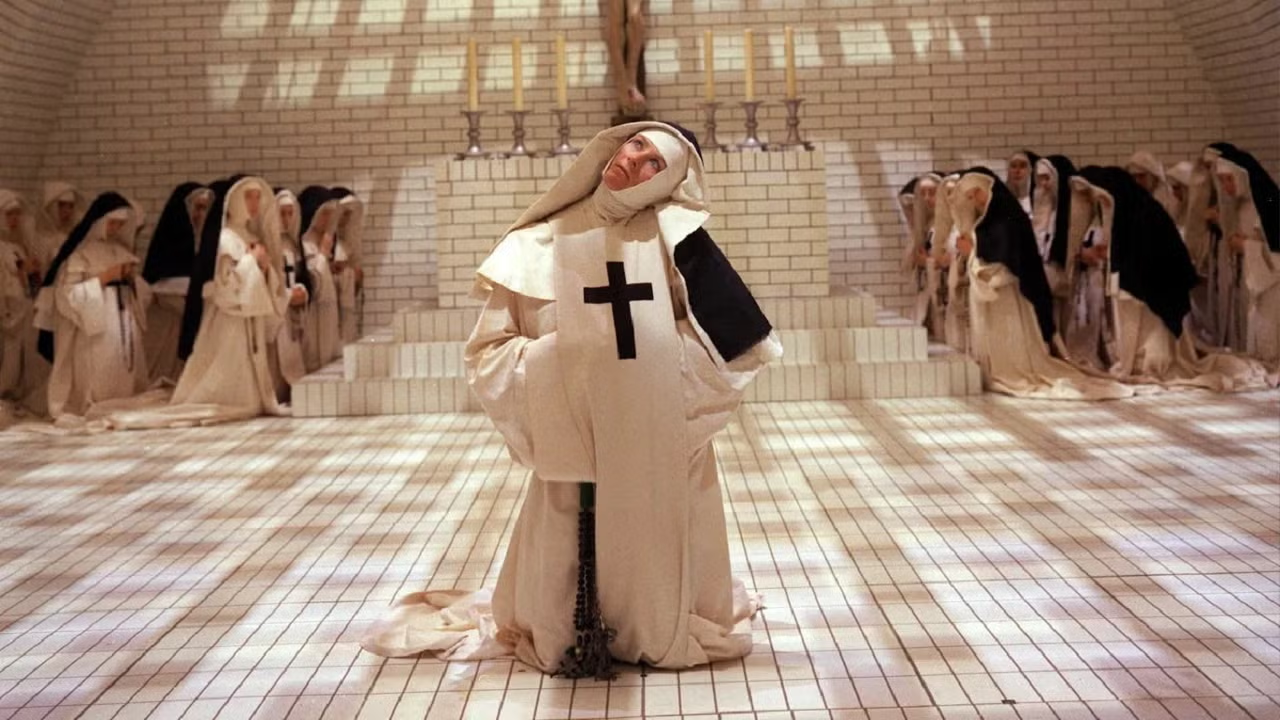
A restored 4K re-release of Ken Russell’s controversial classic, which has been largely unavailable in the United States, is arriving this fall in a limited, one-week engagement beginning Oct. 16, complete with select 35mm screenings. (It will be followed by a U.K. release on Oct. 30 — just in time for Halloween.) And ahead of the re-release, Clockwork, the new artsy Warner Bros. imprint, has unveiled a new trailer, which you can watch below. Those with epilepsy or photosensitivity might want to skip it; there are a whole lot of flashing lights in this one.
The 1971 horror movie, starring Vanessa Redgrave and Oliver Reed, is based in part on Aldous Huxley’s 1952 nonfiction book “The Devils of Loudun,” along with John Whiting’s 1960 play “The Devils.” Reed plays a 17th-century priest accused of witchcraft; Redgrave is the nun who instigates the accusations against Reed’s priest.
Controversial since its release for its frank depictions of sex and violence and what was considered sacrilegious imagery, the film was awarded an X rating in America and the United Kingdom. Elsewhere, it was heavily edited or outright banned. Since its initial release, “The Devils” has been largely unavailable on home video or in revival screenings.
But now, “The Devils” has returned.
This uncensored, NC-17-rated version — the first time Warner Bros. has ever released a film with this rating in its 103-year history — first debuted at this summer’s Cannes Film Festival. “The Devils” also serves as the inaugural release for Clockwork, Warner Bros.’ new specialty label. Talk about making a splash. The film will also screen as part of the Toronto International Film Festival.
See what all the fuss was about when “The Devils” opens for its one-week-only, can’t-miss-it engagement Oct. 16. Hell yes.

>
movies
Matthew McConaughey Says ‘How To Lose A Guy In 10 Days’ Is “The Gift That Keeps On Giving”: “It Still Pays The Best Mailbox Money”

Matthew McConaughey has starred in multiple rom-coms, but there’s one in particular that he says still makes him money even after 20 years.
In a new interview, the actor said that How to Lose a Guy in 10 Days still brings him money in residuals after all these years.
“How to Lose a Guy in 10 Days is the gift that keeps on giving,” McConaughey said on the Happy Sad Confused podcast. “I think it’s probably my favorite romcom I’ve done.”
He added, “And it still pays the best mailbox money of any film I’ve ever done. By far. By lengths.”
Other romantic comedies McConaughey starred in include The Wedding Planner (2001), Failure to Launch (2006), Fool’s Gold (2008), and Ghosts of Girlfriends Past (2009), among others.
McConaughey said he used to be able to pinpoint the spike in residuals, saying, “When it used to be just DVDs or cable, every March I’d get a big check because Valentine’s Day.”
“But, I mean, look: the movie for me, for that genre, let me just own that genre. How to Lose a Guy in 10 Days … that’s a real anchor in the rom-com genre through time,” he added.
Donald Petrie directed How to Lose a Guy in 10 Days, which is based on the picture book by Michele Alexander and Jennie Long. The screenplay by Kristen Buckley, Brian Regan, and Burr Steers revolves around advertising executive Benjamin Barry (McConaughey), who makes a bet he can make any woman fall in love with him. At the same time, writer Andie Anderson (Kate Hudson) plans to write an article about how to make a man dump you.
In an interview from 2024, McConaughey’s co-star, Kate Hudson, revealed she was open to a sequel, saying on Bravo’s Watch What Happens Live, “All that matters would be the script and if Matthew and I would be into the script. I think we’re both totally open but it’s just never happened.”
Watch Matthew McConaughey’s interview in the video below.
>

John Carpenter, Colman Domingo & Charlize Theron Named Academy Gala Honorees

How to watch the men’s National Bank Open Presented by Rogers: Streaming options for the Final

Ken Russell’s The Devils Returns This Fall, Watch the New Trailer
-

 movies3 months ago
Search For Canadian TV Actor Stewart McLean Now Homicide Investigation
-

 Fashion9 years ago
These ’90s fashion trends are making a comeback in 2017
-
Fashion9 years ago
According to Dior Couture, this taboo fashion accessory is back
-
Fashion9 years ago
Model Jocelyn Chew’s Instagram is the best vacation you’ve ever had
-
Fashion9 years ago
Your comprehensive guide to this fall’s biggest trends
-
Fashion9 years ago
Emily Ratajkowski channels back-to-school style
-
Fashion9 years ago
9 Celebrities who have spoken out about being photoshopped
-
Fashion9 years ago
A photo diary of the nightlife scene from LA To Ibiza