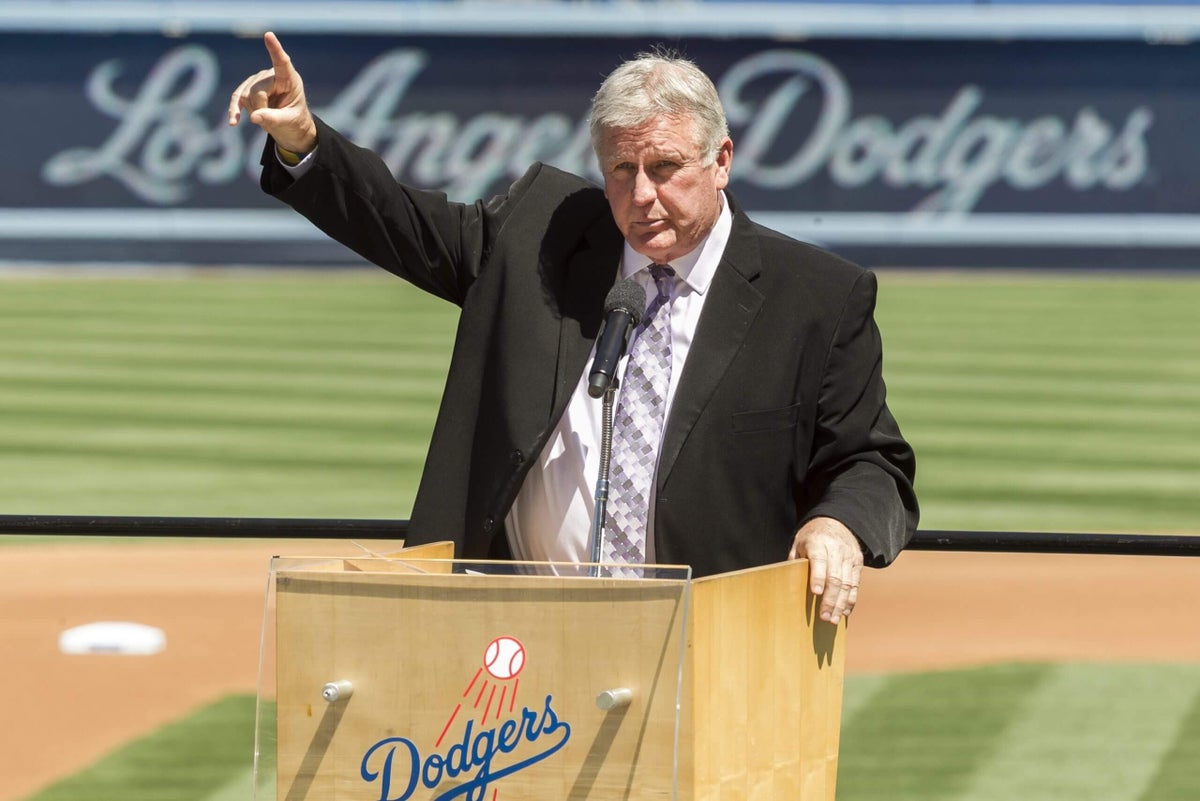
Tommy John, an enduring left-hander whose eponymous elbow surgery has saved countless pitchers’ careers since it resurrected his own in the mid-1970s, died on Sunday. He was 83 years old.
According to a statement his agent, Mike Maguire, gave to TMZ, he died at his home in Lakewood Ranch, Fla. The Yankees released a goodbye letter penned by John on Aug. 8, with the club citing “health issues.”
John went 288-231 with a 3.34 ERA across 26 major league seasons with six teams. His 700 career starts (second to Steve Carlton among left-handers) included 382 after the groundbreaking procedure by Dr. Frank Jobe, the orthopedic surgeon who saved his career.
The surgery, on Sept. 25, 1974, replaced John’s torn ulnar collateral ligament with a tendon from his wrist. John, an All-Star with the Chicago White Sox who had gone 40-15 in two and a half seasons with the Los Angeles Dodgers, returned in 1976 and pitched until 1989, when he finally retired at age 46.
John had three 20-win seasons, one for the Dodgers and two for the New York Yankees, and helped the California Angels to the playoffs in 1982. But his name is best known for the surgery, which has revived hundreds of careers, especially as pitchers throw harder and harder, increasing the stress on their elbow ligaments.
“The metrics people want speed, speed, speed,” John said in 2017, “and the harder these kids throw when they’re younger, it means they’ve got a better chance of having to have Tommy John surgery.”
Throwing hard was not John’s style. He was a sinkerballer who specialized in weak contact; his career high in strikeouts was 138, and he averaged just 4.3 per nine innings. Only nine pitchers ever allowed more hits.
But John was effective and durable enough to rank 26th in career victories; only two pitchers with more are not enshrined in the Hall of Fame: Roger Clemens, because of his ties to steroids, and Bobby Mathews, who pitched before the creation of the mound.
John’s support peaked at 31.7 percent in 15 years on the writers’ ballot, and five subsequent committees have not elected him, either. But his legacy is carved into the elbows of pitchers everywhere.
“We did a little surgery, but the man did all the hard work,” Jobe said at a Hall of Fame ceremony honoring his medical career in 2013, the year before he died at age 88. “His tenacity and unique intelligence enabled us to develop the rehab program that has lasted the test of time.
Thomas Edward John was born May 22, 1943, in Terre Haute, Indiana. He took to pitching as a boy, working with a strike zone made of strings that his father assembled, following the example of a master.
“I saved up Coke bottles and I sold the empty Coke bottles at the store and saved up enough money to buy this book: ‘How to Pitch,’ by Bob Feller,” John said in a 2015 interview. “It cost like $4.95. I sent the money off and it came back and he talked about the strings in that book. So we constructed them in the backyard.”
The strings taught John precision, and a family friend named Arley Andrews, a former minor-league pitcher, taught him a curveball. John used both so well that the Cleveland Indians — Feller’s old team — signed John out of Gerstmeyer High School in Terre Haute in 1961.
John debuted at age 20 and pitched parts of two seasons for the Indians, who traded him to Chicago before the 1965 season. In seven seasons with the White Sox, he had a middling record (82-80) but a 2.95 ERA, and led the majors in shutouts in 1966 and 1967. He threw only two pitches, a curve and a sinking fastball, without altering his grip.
“That way, you didn’t have to put the ball in your glove and fiddle around with it,’ John said in a 2015 interview. ‘I wanted to pitch fast. I wanted to get the ball and throw it, get the ball and throw it.”
In 1971, John’s final season with the White Sox, a new pitching coach, Johnny Sain, encouraged him to develop a slider. He worked on it so much that he lost the command of his other pitches, prompting an offseason trade to the Dodgers for slugger Dick Allen.
The deal worked out for both sides: Allen won an MVP award for the White Sox in 1972, and John embarked on his prime by leaning into his sinker with the encouragement of Dodgers pitching coach Red Adams.
After a strong debut season in Los Angeles, John went 16-7 in 1973 and started 13-3 the next year. But on July 17, 1974, while facing the Montreal Expos at Dodger Stadium, John threw a blooper of a sinker to Hal Breeden that would change the craft of pitching forever.
“It felt like my arm pulled apart at the elbow and just went ‘floop!’ — like a rubber band, and then snapped back,” John told the Long Beach Press-Telegram that August. “Then I threw the next one and it was the same way, and that was it.”
John left the game, telling the team trainer that he felt a pop and a painful sensation above and below the elbow. Jobe examined John that night and initially told reporters that the injury “looks like a pulled muscle” — but of course it was much worse. John traveled with the team for a while before conceding that he was finished for 1974.
Had he suffered a serious arm injury earlier in his career, John might have been done for good. Some of his Dodgers predecessors were not so lucky.
In the mid-1950s, Karl Spooner — who had debuted for Brooklyn with 15 strikeouts — flamed out at age 24 with a shoulder injury so baffling that team doctors tried to heal it by pulling his teeth. In the mid-1960s, Sandy Koufax retired at the height of his greatness with severe elbow pain that was possibly caused by a torn UCL. Koufax was just 30.
In 1974, though, the 31-year-old John had a lifeline: the ingenuity of Jobe.
“The arm in baseball has two eras: Before Tommy John and After Tommy John,” Jeff Passan wrote in “The Arm,” an engrossing 2016 book about the UCL. John, he added, “was a walking billboard for the power of medical innovation, the genius of Frank Jobe.”
Jobe had been a medic for the 101st Airborne in World War II, serving at the Battle of the Bulge. He earned a medical degree after returning and went on to work with Dr. Robert Kerlan, the Dodgers’ team physician. The two would open a renowned orthopedic clinic together and become pioneers in the emerging field of sports medicine.
Jobe joined the Dodgers’ medical staff in 1968 and was team physician when John hurt his elbow. An X-ray revealed damage to the UCL, which was still so obscure that John did not even know what it was. A month later, when he struggled to even throw batting practice, John could tell that rest was not helping this mysterious injury.
The tear, Jobe told him, would not heal; he could live a normal life but could never pitch again. John, whose wife was pregnant with the first of their four children, was unwilling to accept that he had thrown his last pitch. He pleaded with Jobe for options.
Perhaps, Jobe thought, a wrist tendon called the palmaris longus could be useful. Doctors had used it to strengthen the ankles of polio patients and to rebuild finger joints. It might work on elbows, too, but Jobe told John that he could not know for sure. His candor convinced John to be Patient Zero.
“When a doctor admits he’s not a god, a deity, and he can (mess) up, that sold me,” John told Passan.
The surgery, performed at Centinela Hospital Medical Center, took four hours. The palmaris longus — a functionless tendon that some people do not even have — proved to be the perfect size, allowing Jobe to drill into the humerus and ulna bones in John’s arm and wrap the tendon through in a figure-eight pattern.
A follow-up procedure that December moved John’s ulnar nerve, which had been damaged during the initial operation and was causing pain in his fingers. He rested for the remainder of that offseason, worked patiently to rebuild arm strength in spring training, and by July 1975 felt sound enough to start throwing in the bullpen.
On Sept. 26, 1975, one year and one day after surgery, John returned to competition with a three-inning appearance in the instructional league. After four weeks there and another offseason of rest, he was back with the Dodgers as a healthy member of the rotation. On April 16, 1976, he worked five innings in Atlanta and was on his way.
“I’m not one to volunteer quotes, but I’d like to see this in print,” said Mike Marshall, a curmudgeonly Dodgers reliever with a doctorate in kinesiology, to Ross Newhan of the Los Angeles Times. “What Tommy John did tonight qualifies him for the Comeback of the Year award. He wins it, flat out. What he has done in coming back from that injury is the greatest accomplishment I’ve ever seen.”
John, largely through trial and error, had become devoted to using his rebuilt arm as much as possible. Belatedly, he took to heart a lesson from Sain, his last pitching coach with the White Sox, and would always believe it contributed to his extraordinary durability.
“The thing Johnny got me to do — and he never got me to do it when he was my pitching coach, because I never believed it then — was to throw off the mound every day,” John said. “When I had surgery and I came back, (I realized) the only way you’re gonna get your arm stronger is to throw a baseball every day. So when I’m rehabbing in 1975, until I quit in 1989, I threw a ball off the mound to a catcher every single day of the season.”
John made 31 starts in his first year back, with a sinker so effective that he surrendered just seven home runs in 207 innings, the best ratio in the league. In the four seasons that followed, 1977 to 1980, John would win 80 games, one behind Carlton for the most in the majors during that stretch.
He also beat Carlton, the Phillies’ towering ace, with perhaps his finest performance: A complete game in the 1977 NLCS clincher to win the pennant in the rain in Philadelphia. John used the elements to his advantage and said he never had a better sinker.
“I told our pitching coach, Red Adams, ‘God, I hate to pitch on Astroturf in the rain. It’s the worst for ground-ball pitchers,’” John said. “He said, ‘Don’t try to throw the ball as hard. Instead of striding out, maybe take a six-inch shorter stride and stay within yourself and throw the ball.’
“Whether I did or not, I don’t know, but that was on my mind: Don’t stride out, don’t drive out and try to overpower the ball. Boom — it worked.”
The Dodgers would lose the World Series in six games, and the next fall was a virtual repeat. John mastered the Phillies again in the NLCS with a shutout in Game 2, but the Dodgers dropped another six-game World Series to the Yankees, despite John’s victory in the opener.
“We are saddened to hear the news of Tommy John’s passing today,” said Stan Kasten, President & CEO, Los Angeles Dodgers. “Tommy was an exceptional pitcher throughout his career in Major League Baseball, and his courageous role in becoming the first to have surgery that would go on to bear his name can’t be overstated. His impact both on and off the field has been felt by ballplayers of all ages and will be for generations to come.”
John never pitched for a World Series champion but generally sparkled in October, with a 6-3 record and 2.65 ERA in 14 postseason appearances for the Dodgers, Yankees and Angels, who released him in 1985. John finished that season with Oakland, then found work again with the Yankees for a final four-year stint.
His craftiness led to allegations of doctoring the ball, which was something of a phenomenon in the late 1980s. Once, John said, after the Yankees had suspected an Oakland pitcher of scuffing, John was convinced that the A’s manager, Tony La Russa, would order him to be checked the next night. John went to a baseball card shop, bought a La Russa card, and stuffed it in his back pocket with a Sharpie.
“I wanted the umpires to come out and check me,” John said. “I was gonna back away, go into my pocket, draw my hand up and flip the card on the ground. When they picked it up, I was gonna go over to Tony with the pen and say, ‘Tony, would you sign this for me please?’ But he never checked me!”
By then, John was baseball’s Methuselah — an ageless marvel, like Nolan Ryan without the strikeouts or Phil Niekro without the knuckleball. In May 1988, as John subdued the Angels for eight innings on the NBC “Game of the Week,” the network played “He’s So Fine” by the Chiffons; it was a No. 1 song in 1963, the year of John’s MLB debut.
“John has been given up for dead, in a baseball sense, more than once,” broadcaster Bob Costas said that day. “Nobody thought that at age 42, Tommy had anything left at all. George Steinbrenner took yet another chance on him, and John has pitched effectively here.”
John led the Yankees’ staff with 33 starts and 13 victories in 1987, when he was 44 years old. Only two pitchers before him (Jack Quinn and Niekro) and one since (Jamie Moyer) have won so many games at that age or older.
The Yankees released John after 10 starts in 1989, when he was 2-7 with a 5.80 ERA. Fittingly, the pitcher who had refused to accept physical demise in his prime would not concede defeat at the end.
“If my sinker wasn’t working and I wasn’t getting groundballs, then I’d be worried,” John said at the time. “But I am getting groundballs and my fastball is even better than it was in spring training.”
John, alas, did not get the chance for the 12 more victories he needed to reach 300. He worked as a broadcaster in the 1990s, mainly for the Minnesota Twins, and then went into coaching, working in the minor leagues for the Montreal Expos and the Yankees, and managing the independent Bridgeport (Conn.) Bluefish from 2007 to 2009.
His surgery, meanwhile, soared in popularity as baseball evolved to emphasize power pitching. By 2023, according to the American Medical Association, 35.3 percent of active major-league pitchers had undergone Tommy John surgery, an increase of 29 percent since 2016.
The operation is so common that “Tommy John” and “TJ” are widely understood in baseball vernacular; to call it anything else would sound strange. Yet if it were up to the man himself, he could have lived just fine without it.
“It’s something that you probably wish didn’t happen to you; nobody wants to be hurt and be operated on and all that,” John said. “But I thank God I was with the Dodgers and I had Dr. Jobe as my doctor and he had Tommy John as his patient — and between the two of us, we made each other a little more famous.”