
Sports
Want to be a great leader? We asked 11 pro athletes to share the trait that matters most


Peak newsletter 🧠 | This is an excerpt from The Athletic’s weekly newsletter covering the mental side of sports. Sign up here to receive the Peak newsletter directly in your inbox.
I’ve come to the conclusion that leadership is both subjective in how it is experienced and applied and objective in the goals it seeks to achieve.
The approaches may differ, the personalities may differ and the environments definitely differ. But if the goals are ultimately the same – developing people, improving skills, success – then it made me wonder: What is the single most important trait a leader should have?
I asked current and former professional athletes across different sports that question. Here are my 11 favorite answers:
Work ethic
Jayden Daniels, Washington Commanders quarterback: As a leader, you can’t have guys follow you if you’re not going out there and putting the work in yourself.
I feel like I can’t ask anybody personally to do stuff that I’m not doing myself. I can’t expect people to come up here and do a walk-through at 6 in the morning if I’m not doing it myself.
Adaptability
Chelsea Gray, Las Vegas Aces guard: Adapting to circumstances. Injuries happen. How can you adapt and make others better?
Adapting within a game when our energy is down, our belief, how do you change people’s perspective and adapt in that way?
(Aces coach) Becky (Hammon) has been great in that regard. Just adapting to the situation. Whether it’s to know to yell, whether to know to give us love, to wrap her arms around us, to give us a break and not see each other, or whether to change the circumstances in certain moments.
Positive character
Charlie Davies, former MLS and USMNT player: The coaches who can remain positive and find positives even when things are going bad, those are the coaches everyone wants to fight for and play for.
Plays to their strengths
Jack Drury, Nashville Predators center: A good leader bases the way they lead on their personality and who they are and what the team needs.
The good leaders I’ve been around have been unique. I’d say the two captains I’ve played under in the NHL, Jordan Staal and Gabriel Landeskog, were both incredible captains and I think are — around the league — looked at as two of the best.
There are certainly some similarities in that they lead by example, they practice what they preach, things of that nature, but I also think they’re two very different people. And that manifested itself in the way each of them led.
Landy is a very outgoing guy, very friendly, very positive, and he could be more of a vocal leader at times when it was necessary for the team.
Staal could be a little bit more reserved, but when he did say something, it carried a ton of weight, because you knew how much he meant it and how much he felt the team needed to hear it.
Three pro athletes have the same favorite mental advice
Elise Devlin
Consistency of who they are
Jeff Francoeur, former MLB player: When I played for Bobby Cox with the Atlanta Braves, you could walk in his office and you could not tell if we won five games in a row or lost five games in a row. He was the same dude every day.
When you have that, man, you have players who want to play for you and want to learn. But when you have a leader who is one day happy and one day sad and it’s nothing but results-based, are you going to want to follow that person? Probably not.
When I played for the Kansas City Royals and Dayton Moore was the general manager, the reason he was my favorite dude is he’d come down in the locker room and ask about my family: Hey Jeff, how’s Catie? How are the kids?
He didn’t ask about baseball, even when I was going good. He wouldn’t come down and go: Man, you’re having a great week. It was always something else.
That consistency is so important.
Lo’eau LaBonta, Kansas City Current midfielder: A leader and a captain cannot always just choose the players’ side or the staff’s side. There has to be some give and take.
But if you’re fair all the way through, when you’re being very honest — which sometimes looks like an uncomfortable truth and you’re not always agreeing with someone — but if you’re consistently doing that, your voice is going to carry more weight.
Accountability
Roquan Smith, Baltimore Ravens linebacker: Taking ownership of anything and never pointing the blame, never pointing a finger and always figuring out what you can do better.
Even if it was another teammate’s job, I would never throw them under the bus. I still would take accountability for it, take ownership, and say, “Yeah, it’s me. Put it on my back.”
I have had a lot of tremendous coaches like that, as well as my mom. Maybe there was something that me and my brother did early on that wasn’t really a great representation of the core and moral beliefs that she taught us. Then I would hear her saying to the neighbors, “OK, yeah, granted they did do that, but put this on me. I should have taught them better.”
I think it creates a positive environment, and it allows individuals to think, Hey, we’re all human. We are all going to make mistakes.
You’re not in this together without accountability.
Jason Kelce’s favorite piece of mental advice
Elise Devlin
Delegating
Mikaela Shiffrin, gold medal skier: Mostly to know when your plate is full and to know your team around you, so you can play to their strengths and pass off responsibilities that will be the most effective use of their time. And then you can optimize the production of the team as a whole.
Authenticity
Zaza Pachulia, former NBA player: Authenticity lays the foundation for any leader or role model because it makes it easier to build trust.
Trust is such an important thing. It moves the train, moves the team, moves the business. Without trust, it’s hard to get from point A to point B. And authenticity creates that trust.
Steph Curry, for example. Imagine having this kind of leader, where for 16 years in the league, he’s going 100 miles per hour, every single drill, every pass. It inspires you, motivates you, pushes you.
It doesn’t let you cut corners, because your leader goes 100 miles per hour, and he’s been doing it for every single practice, every single day, every season, all these years.
And nothing, nothing is better than that.
Conviction
Claire Liu, pro tennis player: It’s really important for me to believe my coach and fully buy into what they’re thinking.
Sometimes I wouldn’t agree with what my coaches were saying, but because they believed it so much and they were so bought into it, I was so bought into it. It almost didn’t matter what they were saying; I was still doing well because I was fully on the train.
There are so many different playing styles and techniques. I feel like people think, If I have this perfect technique for this stroke, then everything will be fine. But it’s not even that. It’s so mental that if you just fully buy in, it doesn’t matter if technically it’s right or wrong. It could still totally work for you.
That’s the biggest thing that you need as an athlete to make it: that belief. If you have someone who doubles that belief in you, that really helps.
Be a chameleon
Austin Hedges, Cleveland Guardians catcher: I have a bunch of different masks to wear.
Sometimes it might be a little bit more soft-toned. It might be a little bit more loving. There might be another person where it’s a little more fiery. You talk to people about what their goals are. (There are) people who want to make a lot of money for their family, or they want to have a lot of personal success. I want to be talking to them more from their perspective.
I’ve had some conversations with young players in this game, and in those conversations, I don’t really know them very well. Something might happen on the field where they need a little bit of guidance. I go into that conversation, and what I do is kind of throw out a few ideas.
I’m just reading their body language to see which one of these things really registers with them. What actually motivates them to want to be great? I look for a nod of the head, eyes get wide, maybe a lean forward. That’ll tell me, “Oh, that! That version of motivation or inspiration hits home for this individual person.”
I’ll just dive deeper into that to help make whatever point I’m trying to make.
— Jayson Jenks contributed reporting
>
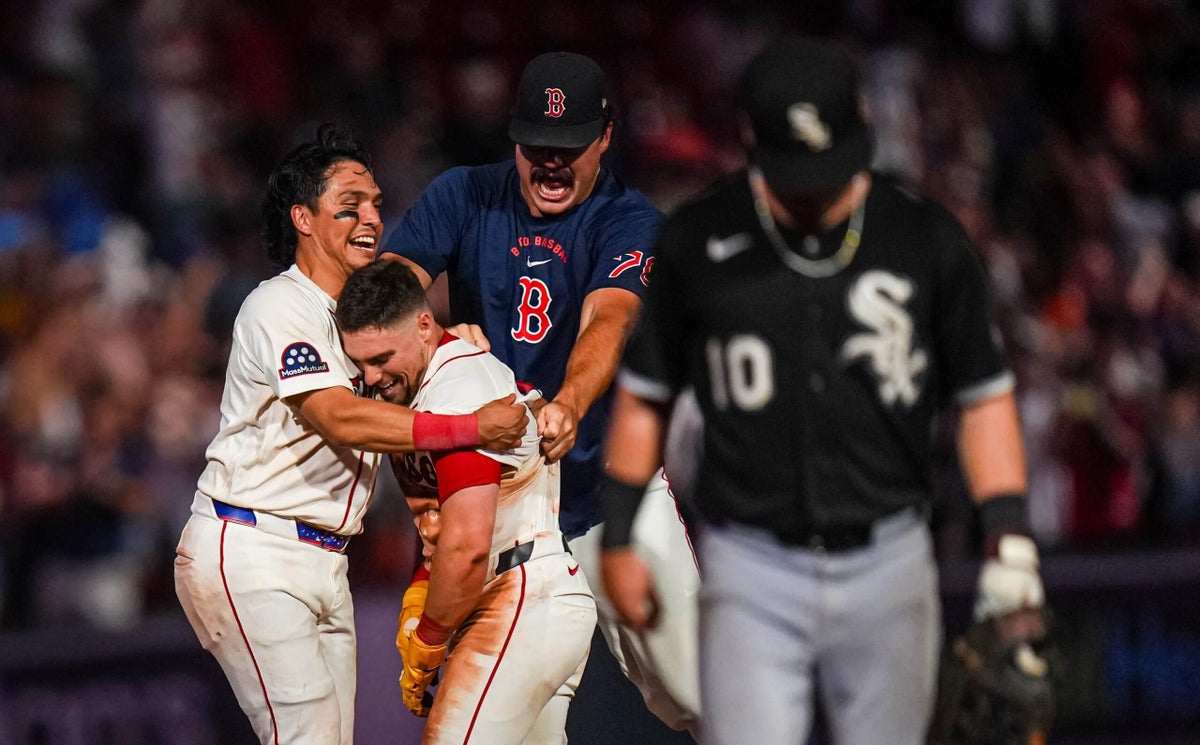
If we were in charge of writing the script for the Strangest But Truest baseball game of the year, we’d probably dream up something like this:
A team that trailed in the ninth inning …
And the 10th inning …
And the 11th inning …
And the 12th inning …
And still won.
Even in a universe teeming with Zombie Runners, that still seems impossible. Right?
Ho-ho-ho. Have you been to Fenway Park lately?
Last week, on a Thursday night unlike any in Fenway history, the Red Sox played — and won — a game in which that script somehow came to life.
Red Sox 12, White Sox 11, in 13 surreal innings. Epic baseball theater. But here’s the reason it deserved a special edition of the Weird and Wild column:
A team wins after trailing in four different extra innings? Crazy. But believe it or not, that wasn’t even the Strange But True part.
If you’re ready for that part, here we go.
Why the Red Sox resurgence is historic
Ken Rosenthal and Johnny Sweet
Take five
In the Greatest World Series Game Ever Played (don’t @ me) — Game 6, 2011* — the Cardinals won a game in which they trailed five different times. You don’t see that much!
But on this night of Fenway Magic, you know how many times the Red Sox fell behind the White Sox? Yep. That would be five.
They trailed, 5-2, in the fourth — and tied it.
They trailed, 7-6, in the ninth — and tied it again.
They trailed, 9-7, in the 10th … and 10-9 in the 11th … and 11-10 in the 12th … and tied it yet again in all of those innings … before winning in the 13th.
Thanks to the work of the great Katie Sharp from Baseball Reference, we can tell you just how rarified that was — even for a Red Sox team that was such a baseball fireball, it had gone 25-3 in its previous 28 games.
Since the David Freese Game … this was only the third time any team had won a game after trailing at least five times. This sport made it through a whole decade without another team doing it. But since then — because, well … baseball — this was the third game like that in the last five seasons.
The others to pull off that feat: the White Sox on July 6, 2022 (White Sox 9, Twins 8) and the Guardians on June 9, 2023 (Guardians 10, Astros 9 in 14 madcap innings). Meanwhile …
The Red Sox have played nearly 20,000 games in franchise history … but Ted Williams never played in a game like this … and Carl Yastrzemski never played in a game like this … and good old Denton (Cy) Young never played in a game like this.
That’s because there had been only two other instances — in the 117 years of data in the Baseball Reference archives — that the Red Sox had ever won a game after trailing five times. The others: June 13, 1996 (Red Sox 8, Rangers 7) and April 17, 2006 (Red Sox 7, Mariners 6).
The Magic Number was 443

Ranger Suárez was one of nine pitchers used by the Red Sox. The White Sox used eight. The teams combined for 443 pitches. (David Butler II / Imagn Images)
To make it through this 4-hour, 23-minute marathon, these teams had to launch a ridiculous 443 pitches toward home plate. That’s the most in any game at Fenway in the Zombie Runner era (since 2020).
But how’s this for a wild Strange But True plot twist:
The team that won didn’t hold a lead for any of the first 442 pitches.
According to Baseball Reference/Stathead, no team in the Zombie Runner era had won a game in which it had to slog through that many pitches to take its first lead, on the final pitch of the game … because of course there hadn’t been.
443 plus 5 does not equal 448

Caleb Durbin sent the Fenway faithful home happy, with a walk-off on the 443rd pitch of the game. (David Butler II / Imagn Images)
Let’s recap the nutty knowledge we’ve already laid on you: The Red Sox trailed five different times … and they won. … and 443 pitches were thrown in this game … and the winning team didn’t lead until Caleb Durbin walked it off on the 443rd pitch.
So how impossible is it to win a game like that? Let’s break that down.
• Katie Sharp found only one other Red Sox game since 1910 that was kind of like this one: trailed five different times and never led until the final pitch of the game. That was that 2006 game against Seattle. But “only” 313 pitches were thrown in that game. So let’s give that one a Sorry, Not Quite Award.
• And there are only five other teams in the Baseball Reference database that won a game in which they trailed at least five times and never led for a single pitch until they won. However …
• We can’t vouch for anything that happened in, say, 1927, because the pitch-counting era only goes back to 1988. But that’s still 39 seasons and more than 140,000 regular-season games. Want to guess how many other teams in all those games had ever won a game in which they trailed at least five different times, saw at least 443 pitches thrown and never held a lead until the last pitch of the game?
Right you are. That would be zero. Until the 2026 Red Sox.
More extra points than Adam Vinatieri

Chase Meidroth homered in the third inning as the White Sox took an early lead. But the Red Sox just kept coming back. (David Butler II / Imagn Images)
Extra innings. It was all those extra-inning miracles that allowed the Red Sox to turn a Thursday night at the ballpark into an all-time night for the history books.
Does this seem hard? Having to score in the ninth … 10th … 11th … 12th … and 13th innings of a game to finally win it? Let’s go with yes on that, possibly because …
According to our friends from STATS Perform, only one team in the modern era has ever won a game by scoring in at least five innings from the ninth on. And that team was …
Yessir, Ceddanne Rafaela’s 2026 Red Sox.
But wait …
Because as Katie Sharp reminded me, there has been one other game in which a team trailed in the ninth, 10th, 11th and 12th innings of a game and still won. I’ll never forget it, possibly because …
I was at that very game.
On July 24, 1998, the Phillies trailed the Marlins, 3-1, in the ninth … and 4-3 in the 10th … and 5-4 in the 11th … and 6-5 in the 12th … yet still won it in the bottom of the 12th, 7-6.
Ruben Amaro Jr. tied it with a home run in the bottom of the 12th. Then my Starkville co-host, Doug Glanville, singled and scored the winning run on a Rico Brogna walk-off. I’ll never forget Len Kasper, then the voice of the Marlins, seeking me out later to say: “We need to know if this has ever happened. And you’re just the man to find out.”
Yeah, even back then, this was my thing. But did I find out that answer was “never”? You know I did. Then, all these years later, Glanville and I found ourselves breaking down the only other game like that the other day while recording this weekend’s episode of Starkville.
So I asked Doug if he thought, when that game happened: I’ll never see that again?
“You always think that, if it’s never happened before,” he said. “But because baseball’s so crazy, you’re like: Well, I guess it’s crazy enough to make it happen again. It just might be 100 years from now.”
Or … possibly 28 years later, on a wondrous night at Fenway that will live on forever, any time people like us go looking for the Strangest But Truest Games Ever Played.
>
Available for over a year
The new EFL season is back with nine months of drama to come across the Championship, League One and League Two. Aaron Paul is joined by Andy Woodman, Luke Chambers and Lyle Taylor to preview all three divisions on our new 72+ feed, looking at promotion contenders, relegated giants and, dark horses. West Ham and Wolves return to the second tier, Southampton and Middlesbrough all have their eyes on promotion.
Bromley manager Andy Woodman discusses the club’s historic first season in the third tier, while Leicester City and Sheffield Wednesday look to bounce back after relegation.
Salford City manager Peter Cklamovski joins us to discuss his journey from Australia and Asia to English football, working with Ange Postecoglou and the pressure of taking charge of one of the division’s promotion favourites.
And don’t forget to join the official 72+ EFL Fantasy League using the code 72EFLPOD.
TIME CODES
00:00 Intro
02:10 Championship preview
03:05 West Ham
09:40 Wolves
13:50 Burnley
17:30 Southampton
22:40 Middlesbrough
25:40 Championship dark horses
31:30 League One and Bromley
36:10 PFA open legal proceedings over the EFL
37:10 Leicester City, Sheffield Wednesday and Oxford United
39:40 Salford City boss Peter Cklamovski
46:30 York City
5Live commentaries this week:
Wednesday 12th August: PSG v Aston Villa
Sunday 16th August: Manchester City v Arsenal
>
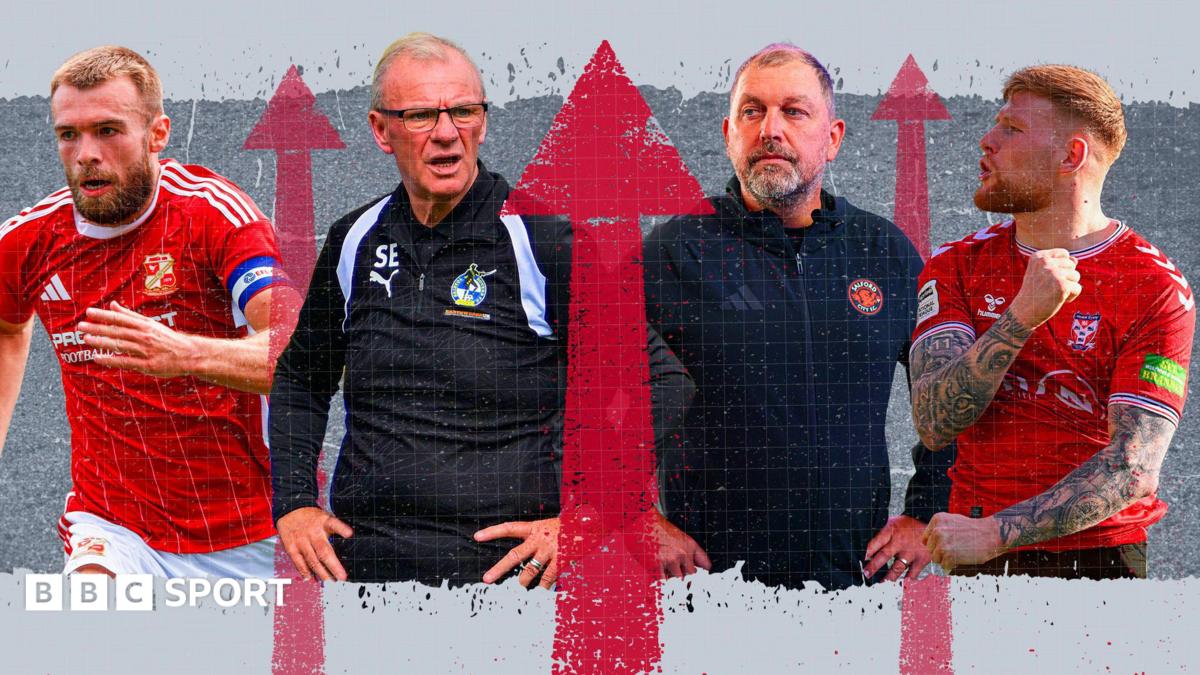
Michael Clarke, BBC Radio Manchester
Manager: Ian Watson
Last season: 2nd in the National League (won play-off final)
Key ins: Laurence Maguire (MK Dons, free), Sam Sherring (MK Dons, free), Zain Silcott-Duberry (Sheffield Wednesday, free), Dajaune Brown (Derby County, loan), Jonny Smith (Wigan Athletic, free), Kaiden Wilson (Chelsea, loan), Nils Ramming (Brighton, loan), Cian Hayes (Peterborough United, undisclosed), Sam Waller (Harrogate Town, free), Jake Spaven (Wigan Athletic, free)
Key outs: Kyron Gordon (Stockport, free), Liam Humbles (Altrincham, undisclosed), Aidan Barlow (Altrincham, free), David Tutonda (Accrington Stanley, free), Tarryn Allarakhia (Boreham Wood, free), Tyler Smith (Derry City, free)
What are the expectations heading into the season? Survival scrap. With a new manager, a new system and some new signings, a season where Dale can consolidate their place in League Two is the primary objective, however they’ll quietly hope for more.
After an impressive 106 league points amassed in the National League last season, and only narrowly missing out on the title on the final day, they showed spirit to gather themselves, reach Wembley and even overcome a 2-0 deficit in the play-off final to tie the game and eventually beat Boreham Wood on penalties.
What are the major strengths of the team to help them achieve that? A young, hungry squad who will hope to utilise pace and width to provide plenty of service to Mani Dieseruvwe, who scored 28 goals across all competitions for Rochdale last season.
And what are the underlying weaknesses that could hold them back? It’s early days, but so far Dale have struggled defensively with individual errors seeing them gift goals during pre-season and in their first two competitive matches of the campaign in the EFL Cup.
However, I think it’s only fair to point out that we haven’t seen what Ian Watson believes is his best XI yet, owing to injuries and players arriving who aren’t fully match fit.
Who’s a player to look out for this season who could be a difference-maker? While many will understandably point to Dieseruvwe, I’m looking forward to seeing more of Zain Silcott-Duberry.
He scored off the bench on his debut against Tranmere in the preliminary round of the EFL Cup and he has the potential to really excite the fans. If he can find consistency, the former Bournemouth man could be a real menace to defenders in League Two.
>

The Red Sox-White Sox 4-hour, 23-minute marathon at Fenway was an instant classic

Get an HP EliteBook G8 for Just $390 While Stock Lasts

72+: The EFL Podcast – 2026/2027 EFL season preview
-

 movies3 months ago
Search For Canadian TV Actor Stewart McLean Now Homicide Investigation
-

 Fashion9 years ago
These ’90s fashion trends are making a comeback in 2017
-
Fashion9 years ago
According to Dior Couture, this taboo fashion accessory is back
-
Fashion9 years ago
Model Jocelyn Chew’s Instagram is the best vacation you’ve ever had
-
Fashion9 years ago
Your comprehensive guide to this fall’s biggest trends
-
Fashion9 years ago
9 Celebrities who have spoken out about being photoshopped
-
Fashion9 years ago
Emily Ratajkowski channels back-to-school style
-
Fashion9 years ago
A photo diary of the nightlife scene from LA To Ibiza