
Tech
Efficient and Accurate Prediction of Cosite Isolation on Large Platforms



More Information
Aircraft, ships and vehicles now carry many radio systems in a small space, so designers must know how much energy leaks from one antenna into another before any hardware is built. This leakage is described by the mutual s-parameters between the antenna ports, and it decides whether two systems can operate at the same time on the same platform. Measuring it by trial and error at every candidate position is slow and costly. Predicting it by simulation is difficult for two reasons. First, the platform is electrically large, which means that its dimensions span several hundreds of wavelengths, so the model needs a large number of unknowns. Second, the coupling levels of interest are very low, in some cases down to -100 dB, which leaves little margin for numerical error. This White Paper addresses both problems with a full-wave solution based on the Method of Moments applied to the Surface Integral Equation, using higher-order basis functions to keep the number of unknowns low. Two examples are studied in detail: a metallic cube carrying two quarter-wavelength monopoles, and a realistic airliner carrying five monopoles at 1.06 GHz, where the fuselage is about 140 λ long. Three modelling techniques for obtaining accurate low-level results are compared in terms of accuracy and the number of unknowns each one requires, and the complete geometry of each model is documented so that every result can be checked independently.
>

In Thrive Capital’s first-ever investor letter, founder Joshua Kushner has some unexpected things to say about his venture capital rivals on the West Coast.
“It is difficult to overstate the magnitude of the opportunity,” Kushner wrote about AI in the letter, leaked to Bloomberg. “It would also be a grave error in our minds to let excitement weaken our investment discipline. … Within Silicon Valley in particular, the industry can become fixated on hyperincremental technological turns rather than where the technology ultimately leads.”
While his secretive New York-based firm, just like those in Silicon Valley, is betting heavily on AI, Thrive is doing so differently, he argues. There’s no so-called spray-and-pray investing. Thrive tends to goes big on the companies it backs. Bloomberg estimates about 90% of its capital is poured into the top 15 investments in each fund.
That makes Thrive, he contends, a company of independent thinkers. “We are independent because markets move between fear and enthusiasm, and neither is a substitute for judgment.”
His comments are in direct contrast to one of the basic premises of Silicon Valley venture capital: that it is a business of “outliers” as espoused by Marc Andreessen.
In the “outlier” view, a VC firm makes a lot of bets prepared to lose money on many — even most — of them. The few big hits will be so lucrative that they will cover the losers and much, much more. That philosophy leaves VCs forever looking for the next OpenAI or another mega hit. It can also lead to, as we saw during the post-pandemic lean years, cutting ongoing support for startups not deemed to be on track to be the biggest winners.
In contrast, Kushner writes, “We believed an investment firm could be opportunistic across stage, sector, and geography, while remaining deeply concentrated in a small number of people and ideas.” The idea is to “build Thrive to concentrate our time, capital, and energy on the people and ideas we believe in most.”
He also dismisses Silicon Valley’s idea that VCs are in the business of disrupting incumbents.
“Unlike many of our peers, our conviction was not only that these industries would be disrupted from the outside in but also that many would be transformed from the inside out,” he wrote about AI’s impact.
Thrive has largely stuck to this thesis. Its deepening relationship with OpenAI is its biggest example. The VC firm is a major investor in the AI lab. But in December 2025, the roles switched when OpenAI took an ownership stake in Thrive Holdings, the VC firm’s spinout. Thrive Holdings buys companies and then works with OpenAI to give them an AI makeover. Part of the deal involved OpenAI dedicating employees to work with Thrive’s companies.
Thrive Holdings has bought more than 70 businesses and has a team of 35 engineers. Kushner says its accounting platform uses agents to produce tax returns 30% faster with 98% accuracy, and its IT services firm has agents independently solving half of its help desk tickets.
Still, Thrive’s strategy is working in part because it nabbed stakes in some of the industry’s best-performing startups ever. Its $516 million 2022 early-stage fund, for instance, made early bets on OpenAI, Anduril, and SpaceX, and is now worth more than $3.7 billion as of the end of June, Bloomberg reports. Thrive has, over its 15 years, increased its stakes in all of them (and also had a sizeable stake in Cursor, which just closed its sale to SpaceX).
It has also backed Wiz, Ramp, and Stripe, to name a few other big names. Plus, it has led seed investments in new labs like Essential AI, founded by former Google Brain researcher Ashish Vaswani, the lead writer of the famed “Transformers” paper that spawned today’s AI industry.
All told, Thrive has $60 billion of assets under management, Kushner revealed in the letter. He reports impressive profits: a gross internal rate of return (IRR) across all funds of 41% and a net IRR of 33%. Thrive has returned more than $1 billion of liquidity to its investors in the last 12 months alone, he said.
“There may be an opportunity for billions of dollars in additional liquidity in the coming quarters,” he promises.
He doesn’t specify which companies are headed for their exits but obviously, the SpaceX IPO was a start, and OpenAI is working toward its own public debut.
It should be pointed out that both Kushner’s and Andreessen’s approaches obviously work in terms of making money. Andreessen Horowitz returned $25 billion to its investors between 2009 and 2025, according to the last leaked returns, reported by Eric Newcomer.
Thrive’s philosophy of concentrating capital may not even be possible for most smaller, scrappy emerging seed funds, whose founders weren’t born into the kind of access that the son of a billionaire New York real-estate family has.
That said, Kushner’s general premise of how overheated Silicon Valley’s AI investing has become isn’t wrong either. As he puts it: “Not every fast-growing business is exceptional. And not every exceptional company is a great investment at every price. Our responsibility is to maintain those distinctions.”
When you purchase through links in our articles, we may earn a small commission. This doesn’t affect our editorial independence.
>

Since the end of last month, several water utilities in the United States have been hit by cyberattacks, causing alarm in the country.
For years, water utilities and other critical infrastructure facilities in the power sector, for example, have been targeted by hackers, whether government-backed or individuals. What makes this recent series of attacks—allegedly carried out by Iran—particularly concerning was how widespread they have been, hitting targets in around a dozen states.
The U.S. has more than 150,000 water systems, some of them run by local companies. In theory, that should make it harder for hackers to target several facilities at the same time. But on the flip side, the companies running these systems may not have the resources or cybersecurity expertise needed to protect themselves.
Cybersecurity experts have long believed that Iranian hackers target low-hanging fruit in opportunistic isolated attacks, so this hacking campaign could be a significant escalation.
A lot has happened since news of the initial attacks broke two weeks ago. So we decided it was a good time to recap what we know so far, and what we don’t.
Where have there been attacks?
On July 28, Minnesota authorities announced that water treatment plants in more than 30 communities were hit by coordinated cyberattacks.
Two days later, the FBI said water and wastewater utility companies in “at least seven states” reported incidents, and in some cases the attacks “degraded water operations.” Since then, apart from Minnesota, there have been reported hacks against water facilities in Arkansas, Georgia, New Jersey, and Michigan.
Who is behind the attacks?
The short answer is: we don’t know yet, but the number one suspect is the Iranian government.
As of today, officially, the U.S. government has yet to name the culprit behind the coordinated wave of hacks.
However, the first incidents in Minnesota came days after the U.S. Cybersecurity and Infrastructure Security Agency (CISA) warned that Iranian hackers were targeting internet-connected devices in water systems and the energy sector, without saying where those attacks were occurring. (CISA had originally published this warning in April, and updated it before the Minnesota attacks.)
After the initial wave was uncovered in Minnesota, President Donald Trump said he did not think “there was an Iranian cyberattack.” Instead, he blamed the state, perhaps because it is run by democratic governor Tim Walz, who was chosen as Kamala Harris’s vice president in the 2024 elections.
Trump’s claim came a day after Wired reported that the Water Information Sharing and Analysis Center, or WaterISAC, a nonprofit group that distributes cybersecurity information among the water sector, told its members that the recent attacks “aligned” with the hacking campaign CISA warned of—effectively accusing the Iranian government.
Earlier this week, The Washington Post reported that U.S. intelligence agencies “are confident” that Iran, and in particular the Islamic Revolutionary Guard Corps (IRGC), is responsible. The attribution isn’t public yet, according to the paper’s sources, because the agencies are not sure which specific unit within the IRGC was responsible, and also because officials may be reluctant to contradict Trump’s claim.
Iranian government hackers have a history of targeting critical infrastructure in the U.S., and it’s possible that these attacks are part of its strategy to retaliate against the country because of the six-month-long war.
Until now, Iranian hackers had had only limited success in their cyberattacks against U.S. targets. In March, a hacktivist group called Handala disrupted the operations of medical tech giant Stryker. The U.S. government later accused Handala of being operated by Iran’s Ministry of Intelligence and Security (MOIS). Then, the group claimed responsibility for hacking the personal Gmail account of FBI director Kash Patel.
What effects have the attacks had?
The reality is that some systems inside critical infrastructure facilities are exposed to the internet and relatively easy to find. Earlier this month, cybersecurity firm Forescout reported finding more than 2,800 controllers in U.S. water systems exposed online. If a system is exposed, it doesn’t automatically mean hackers can take over control and cause real-world effects. But that has happened in some isolated cases in recent attacks.
The FBI said some of the cyberattacks around the country caused loss of pressure, which “could potentially allow untreated groundwater to seep into pipes,” and flooding.
The town of Braham in Minnesota, one of the first ones to report an incident, had to take its water plant offline for a few hours, urging its around 1,700 residents to conserve water. The city of Maple Plain, also in Minnesota, briefly declared a state of emergency. In a county outside Atlanta, Georgia, local officials briefly told residents to boil water before using it as a precautionary measure.
The worst effect, however, may be psychological. These attacks have been widely covered in national and local press, causing people to worry about the safety of a fundamental and basic need like water. That may very well be part of the hackers’ goals: to spread panic and fear.
When you purchase through links in our articles, we may earn a small commission. This doesn’t affect our editorial independence.
>
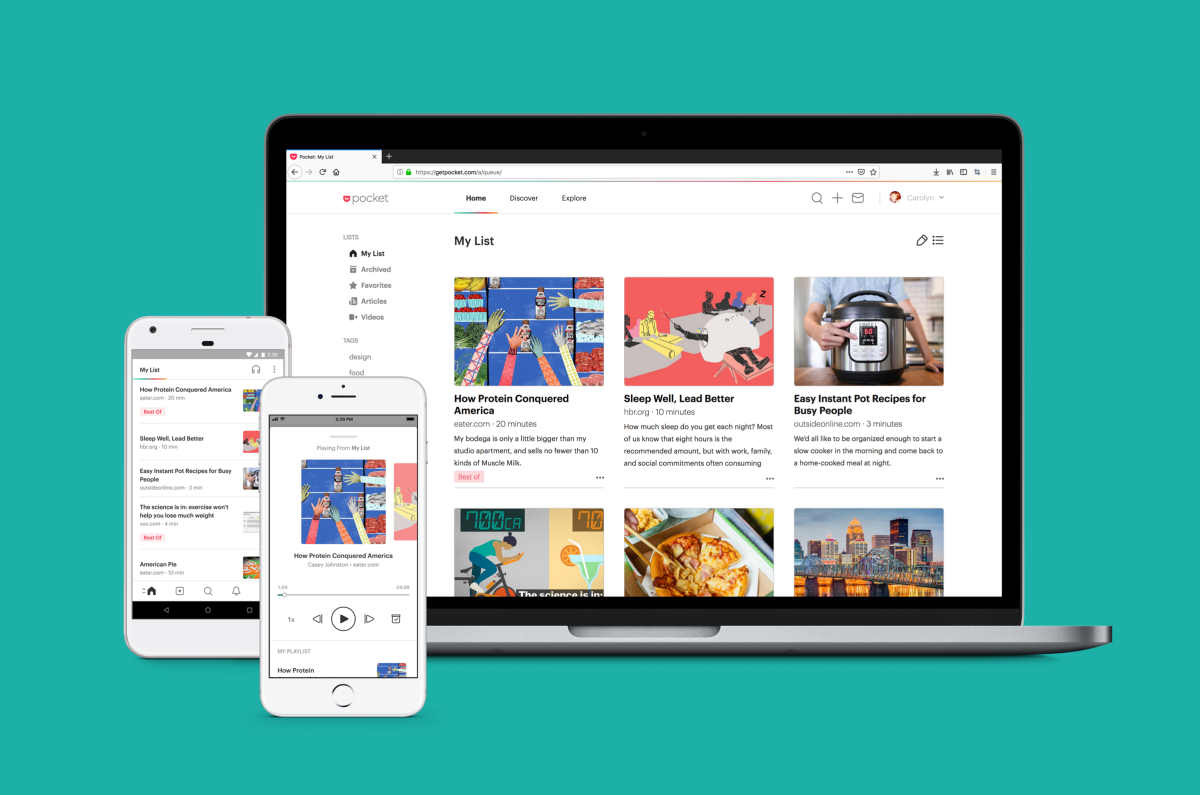
In May 2025, Mozilla announced that it was shutting down the popular read-it-later app Pocket, which it had acquired back in 2017 for an undisclosed amount. That led to a growing demand for alternative apps that could help people save online content, particularly longer articles, that they want to read later when they have more time.
While Mozilla exited the business, saying the way people are browsing the web is changing, the shutdown boosted adoption of a number of other apps, like Matter, Instapaper, and Raindrop.io, among others. It’s supporting the creation of new, indie alternatives, as well.
Many of the apps will support imports. However, Pocket users only had until October 8, 2025, to export their saved articles and other items, including lists, archives, favorites, notes, and highlights.
Below are the read-it-later alternatives that are picking up where Pocket left off.
Matter
Matter is a GV-backed company that makes an eponymous iOS app along with browser extensions for Chrome, Safari, and Firefox. The app lets you listen to articles and transcribes your favorite podcasts.
Though the app itself is free to use, you can pay $79.99 per year to unlock features like improved transcriptions for podcasts and YouTube videos, tools to adjust reading speed, and additional integrations with other apps like notes apps, Gmail, and Kindle.

In March 2025, the company also added an AI-powered co-reader to answer questions about different topics users might have while reading an article.
Instapaper
Instapaper, which was founded by developer Marco Arment in 2008, is one of the oldest read-it-later apps. It’s available on both iOS and Android, and lets you save unlimited articles and videos without paying any fees. It was acquired by Pinterest in 2016.

However, for $59.99 per year, you can add notes to saved articles, have a permanent archive of articles in your accounts, create a text-to-speech playlist to listen to stories, enable full text search for all saved items, and get the ability to send articles to your Kindle.
The company allowed Pocket users to import their account into Instapaper. Users who imported this way also received an email offering a three-month free trial to Instapaper Premium.
Raindrop.io
Raindrop works primarily as an alternative bookmark manager for web browsers. However, its accompanying mobile apps for iOS and Android allow you to read your saved articles and PDFs. The free version gives you unlimited bookmark saving along with integrations like Zapier and IFTTT.
If you decide to pay $33 per year, you’ll also get AI-powered suggestions for organizing your content better, full text search, reminders for your bookmarks, a duplicate and broken links finder, and a file upload limit of 10GB per month.

Plinky
Former Twitter engineer Joe Fabisevich created Plinky to allow users to save and categorize any kind of link, including articles, videos, recipes, and memes.
The app is available across all Apple platforms, along with browser extensions to save links. Once you’re signed up, Plinky lets you use folders and tags to categorize your links, and even set reminders to read them at a specific time.
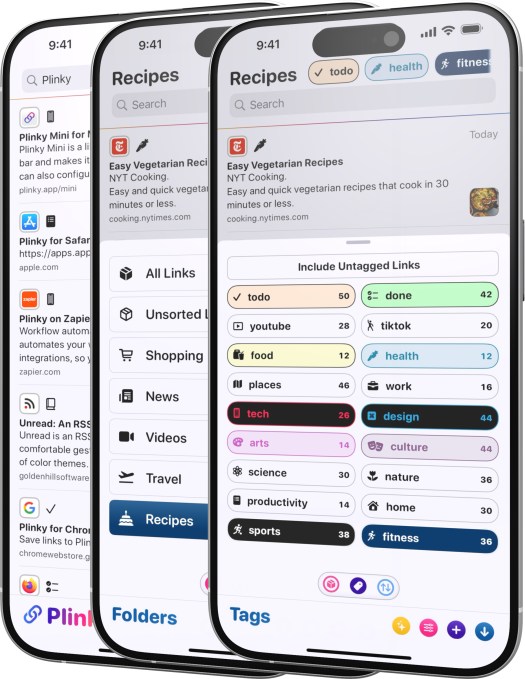
You can save 50 links, create three folders, and use five tags with the free version. To remove these restrictions, you can pay $3.99 per month, $39.99 a year, or a one-time fee of $159.99. Pro users are able to save unlimited links, create an unlimited number of folders, use an unlimited number of tags, and set an unlimited number of reminders.
Paperspan
Paperspan is a very simple app that offers a reading list across devices, allows you to add notes, and has text-to-speech functionality.
The app is free, but it offers an $8.99 per month subscription to unlock advanced search, as well as the ability to create playlists, show reading stats, and send your articles to Kindle.
(Though the app works, PaperSpan hasn’t been updated for some time, which may not be a good signal about its long-term future. The app is available on both iOS and Android.)
Readwise Reader
Readwise, a tool to add notes and highlights to articles, launched its Reader app in 2021. The app allows you to import RSS feeds, YouTube videos, Twitter threads, and more to read at your convenience. Because of its integration with Readwise, the Reader app offers great annotation features. It also features offline text search and an AI assistant.

Plus, you can integrate Reader with knowledge management apps such as Obsidian, Notion, Roam Research, Evernote, and Logseq. The app is free to try for 30 days, and then you have to pay a $9.99 per month Readwise subscription to access it.
Readwise had allowed Pocket users to import their entire Pocket archive into Reader, adding that its app supports a number of features — like PDFs, ePubs, X posts, AI, and filtering — that Pocket never did.
DoubleMemory
DoubleMemory is a newer indie app focused on the Apple ecosystem, offering native apps for both Mac and iOS.
On Mac, you can easily save any link or content by pressing Cmd + C twice. The saved content will then appear in a Pinterest-style tile format.
The app also allows you to read offline and search through text, notes, and tags. You don’t need an account to start using DoubleMemory. And if you have multiple apps, it uses your iCloud account to sync content across them.

DoubleMemory is free with in-app purchases. It offers a $3.99 monthly subscription or an annual subscription of $17.99.
Recall
Recall works as a browser extension and offers a mobile app that allows users to save content from the web, including articles, PDFs, blog posts, podcasts, Wikipedia pages, YouTube videos, and recipes.
However, unlike traditional read-it-later apps, Recall uses AI to automatically summarize content, categorize it, and then resurface it when it’s related to something new you’re looking to learn about.

Designed to enhance your ability to remember information, you can review your summaries from your personal knowledge base on a saved spaced repetition schedule.
Recall is free to try with support for up to 10 free, AI-generated summaries. After that, you can continue to use Recall as a read-it-later tool, or you can upgrade to a $7 per month plan for unlimited AI summaries and other features.
Wallabag
Wallabag is an open-source read-it-later app that is available on major platforms like iOS, Android, and the Web, with support for e-readers like Kindle and Kobo. The app lets you save articles for offline consumption and also export all of your data in PDF, ePUB, .mobi, JSON, CSV, TXT, or HTML formats.

The app has a simple interface and lets you highlight sections and add tags to articles. It also has a reader mode and supports importing data from other services like Pocket, Instapaper, and others.
The app is also available as an €11 per year hosted subscription, if you prefer. The company will use the money to fund its open-source efforts.
Readeck
Open source web app Readeck is designed to help you organize any web content you want to revisit later, whether that’s articles, videos, photos, or anything else. You can also use the service to highlight text, export articles to e-book format, save video transcripts, and more.

Readeck works as a browser extension so you can save your bookmarks as you surf the web. Users can host Readeck themselves, but the company says it will offer a hosted version in 2025. It’s also developing a mobile app.
Obsidian Web Clipper
Obsidian‘s web clipping service lets you highlight and capture web pages you want to save with just a click on its browser extension. You can also use templates that customize how certain types of web pages are saved.
For instance, articles are saved with their citations and footnotes, while recipes will include ingredients, steps, and nutrition. You can even set up custom templates to save from your favorite websites.

As an open source app, Web Clipper is free to use, allowing you to highlight text, images, and blocks of content for saving into the Obsidian note-taking app.
Karakeep
Karakeep‘s bookmarking app lets you save links, notes, and images, and then uses AI to automatically tag items and make retrieving them faster. The app includes other features like support for lists, bulk actions, dark mode, full-text search, and more.

The open source app is available on iOS and Android as a browser extension for Chrome and Firefox. You can support its developer here.
Dewey
Dewey is another “save everything”-style app that lets you save and organize web links, videos, and images, including posts from social media sites like X, TikTok, Bluesky, Threads, Reddit, Instagram, LinkedIn, and others.

The service offers built-in organizational tools like folders and tags, AI bulk tagging, keyboard shortcuts, automatic syncing to Notion, export, a personalized RSS feed, and more. Dewey offers multiple plans, starting at $7.50 per month, which you can choose to pay annually for $30 off.
Folio
Cross-platform app Folio’s design might remind you of Pocket, in part. That may not be an accident, either, as the app’s creator, Nick Chapman, worked at Pocket as head of product.
Folio’s interface is simple and lets you filter articles using the tagged, favorites, short reads, and long reads tabs. You can easily add articles through the Chrome extension, the share sheet, or by manually adding URLs. Plus, it’s easy to import data from other apps like Instapaper.

Currently, the app offers premium features like text-to-speech, highlights, custom fonts, and full-text search for free. It also has a discovery section where you can explore articles to read.
Folio is currently on the web, iOS, and Android.
Burn 451
While a lot of apps allow you to save articles, we all know it is easy to hoard articles and not read them. Burn 451 is trying to change that habit. It will let you save an article, but you have to read or tag it. If you don’t do that within 24 hours of saving the article, it gets deleted.

The app is currently available on the web and iOS. If you use AI tools, the app also offers a model context protocol (MCP) server to reason over reading habits.
Omphalis
Omphalis is an AI-powered consume-it-later app, as you can save articles, documents, podcasts, and videos. The app turns these media into a more comprehensible version by adding a summary, top points, and a chapter-like structure.
The free version gives you limited AI-powered comprehensions, subscribed sources, and transcription minutes. Pro plans starting from $9 per month will get users higher limits and features like key moments recaps and read-alongs.
This is not an exhaustive list, and we will keep adding more tools as we discover them.
When you purchase through links in our articles, we may earn a small commission. This doesn’t affect our editorial independence.
>

How to watch Fire vs. Storm: TV channel and streaming options for August 14

‘Deli Boys’ Canceled After 2 Seasons at Hulu and Onyx Collective

Bring your questions for a special contracts edition of our MLB mailbag
-

 movies3 months ago
Search For Canadian TV Actor Stewart McLean Now Homicide Investigation
-

 Fashion9 years ago
These ’90s fashion trends are making a comeback in 2017
-
Fashion9 years ago
According to Dior Couture, this taboo fashion accessory is back
-
Fashion9 years ago
Model Jocelyn Chew’s Instagram is the best vacation you’ve ever had
-
Fashion9 years ago
Your comprehensive guide to this fall’s biggest trends
-
Fashion9 years ago
Emily Ratajkowski channels back-to-school style
-
Fashion9 years ago
9 Celebrities who have spoken out about being photoshopped
-
Fashion9 years ago
A photo diary of the nightlife scene from LA To Ibiza