Connect with us

Sports

Breaking down Erling Haaland’s unique running style: 35.5 km/h top speed, curves and acceleration mode

Published

on

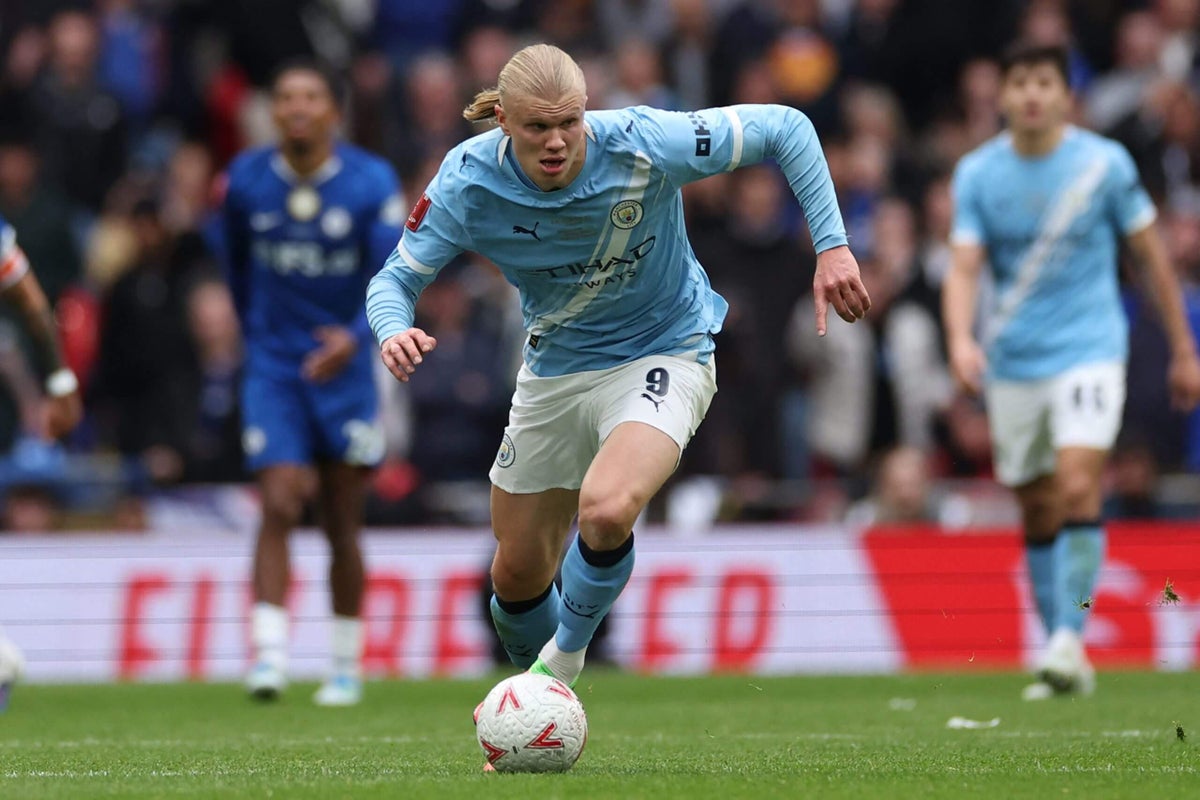
Thierry Henry curved away from defenders, Cristiano Ronaldo attacked their blind side and Kylian Mbappe outran them. But Erling Haaland has a claim to football’s perfect run that borrows from all three.

Haaland is 195cm (6ft 5in), but the Manchester City and Norway striker’s best movement begins before the sprint, with a glance, a drift away from danger and one step that changes his direction. He then opens his stride and turns a few yards of space into a route to goal.

The Athletic spoke to Archit Navandar, assistant professor of biomechanics at the Technical University of Madrid, who compared Haaland with eight-time Olympic champion and 100m and 200m world-record holder Usain Bolt, who is the same height.

“Unlike Bolt, who relied a lot on stride length over stride frequency to accelerate to max velocity, Haaland uses a combination of both to generate speed and control the ball at the same time,” Navandar says.

The 26-year-old scored 38 goals and provided nine assists in 52 appearances for City last season, including 27 Premier League goals to claim his third Golden Boot in four years. He then scored seven times at his debut World Cup as Norway reached the quarter-finals for the first time, surpassing their previous best finish of the round of 16 in 1998.

Opta tracking data shows the scale of the work Haaland does between touches. The distance covered by regular Premier League starters can vary by almost four kilometres per 90 minutes according to position and role, with midfielders generally covering more ground than centre-backs or centre-forwards.

Across City’s opening seven league matches last season, Haaland covered 66.3km, around 9.5km per game, while averaging only 24.2 touches per 90 minutes. He ranked 10th among Premier League forwards and wingers for distance covered despite having the third-fewest touches of any player to complete at least 300 minutes. That equates to roughly 390 metres covered for every touch recorded.

When Haaland accelerates, those metres disappear quickly. His average across his three highest speeds last season was 35.5km/h, joint-sixth in the Premier League data and the highest figure among recognised centre-forwards. Benjamin Sesko was the next-fastest striker at 34.7km/h.

“Tall and big athletes always draw attention when running at high speeds, like Usain Bolt,” Navandar says.

But the comparison only goes so far. Bolt could devote every stride to reaching maximum speed in a straight lane. Haaland has to stay onside, read a pass, evade defenders and retain enough control to change direction or shoot.

His most common high-speed off-ball runs show the difference. Defined as movements averaging at least 25km/h for 0.7 seconds, several begin around halfway before travelling diagonally or bending towards the penalty area rather than taking the shortest route.

Those curves allow Haaland to change the angle from which he attacks the defence while continuing to build speed, rather than committing immediately to a straight-line race.

Navandar analysed one example from City’s 2-1 win over Newcastle United at the Etihad Stadium in February.

Haaland had already crossed for Nico O’Reilly to head what proved to be the winner and, despite not scoring himself, had 43 touches, his most in a Premier League game, and contested a career-high 12 duels.

Pep Guardiola later called it a performance he would “never forget”, praising his striker for having to “run, run, run and fight”.

The sequence came in the 72nd minute, with City protecting their lead. Haaland is almost stationary on the right, waits for the ball and turns infield. Little more than four seconds later, he is approaching Newcastle’s penalty area at speed.

Navandar broke the movement down step by step. The first is deliberately short and lands beneath Haaland’s centre of mass, essentially the point around which his weight is balanced.

He says that positioning helps rotate the shoulders and trunk before his entire 6ft 5in frame commits to the new direction. His second step is much wider and remains on the ground for longer. It produces the sideways force required to turn while still driving him forwards.

Navandar adds that the step generates the turning force needed for Haaland to lean into the turn, comparing the movement to a motorbike taking a corner. Rather than slowing, changing direction and then rebuilding speed, his body can lean through the curve while continuing to accelerate.

The third step comes further inside the bend, allowing a greater lean and a sharper turn without significantly compromising his speed.

“He uses his arms to stabilise the movement, like a speed skater on a curve,” Navandar says.

Once Haaland completes the bend, his mechanics change. The sideways lean becomes a forward one, the gap between his legs increases, and his feet begin landing beneath or slightly behind his centre of mass as his stride lengthens.

Navandar says he shows “all the characteristics of a good acceleration technique, similar to a sprinter”, including a forward trunk lean that gradually reduces as his speed rises, a large arm swing and significant movement through the hips.

But Haaland never quite becomes a conventional sprinter. A 100m runner gradually becomes more upright approaching maximum velocity. Haaland remains inclined forwards because he is still accelerating, allowing a quicker change of direction if the defender or the ball moves.

“It is more like sustained acceleration mechanics, rather than max velocity sprinting mechanics,” Navandar says.

In other words, Haaland is still in the process of speeding up rather than settling into the body position required to run at top speed.

The ball forces another adjustment. Haaland’s stride continues to lengthen, but when a touch is required, he changes where his foot lands before returning to his running pattern. Navandar found his step frequency — how rapidly his feet hit the ground — beginning to settle after around his 12th stride.

Before shooting, he adjusts once more. A wider step gives him greater hip extension and more room for his striking leg to swing, while his upper body contributes to the power of the shot.

A Newcastle defender catches him as he strikes and Haaland ends up on the turf, but Navandar believes it was through no fault of his own.

“He falls down because of the tackle, not loss of balance,” he says.

The move does not produce a goal, but in little more than four seconds, Haaland has changed direction, accelerated, controlled the ball and reorganised his body to shoot. Bolt’s perfect run had a fixed finish line 100 metres away — Haaland’s keeps moving.

>

Continue Reading

Sports

How Malaga returned to La Liga after dropping into Spain’s third tier

Published

on

After finishing fourth, the 2025-26 season boiled down to a play-off final against Almeria.

Malaga had one of the smallest budgets in the division and had spent just £325,000 on permanent transfers since 2020. Almeria spent more than £10m that season alone.

After a goalless home draw in the first leg, hundreds of fans lined motorway bridges heading out of the city to wave the team on their way to Almeria.

It was a sight symptomatic of the strong bond forged between the team and its fanbase in recent years. It became a common occurrence for fans to welcome the team bus to the stadium with flags and pyrotechnics.

A song adopted by the club’s Fondo Sur ultras, borrowed from the ultras scene in Morocco, became the soundtrack of the season. ‘Es la Vida Loca’ – the crazy life.

Malaga’s average attendance last season was the 11th-highest in the country, but only a few hundred tickets were available for the game in Almeria.

Yet when Chupe steered Malaga in front before Larrubia curled in a stunning second, the whole fanbase did too – kit supplier Hummel incorporated the names of all 26,550 season-ticket holders into a special one-off strip.

The 2-1 victory sparked mass celebrations in Malaga. After partying all weekend, an estimated 185,000 fans lined the streets to give the team a triumphant welcome.

“It was a once-in-a-generation moment. Many young fans had never seen Malaga play in La Liga,” says Fernandez.

“An entire generation had grown up after the club’s Champions League years knowing little more than financial turmoil, sporting disappointment and uncertainty surrounding the club they loved.”

After a second night of partying, several players took to social media to challenge fans to meet them at 07:00 on Monday at a roundabout in a western suburb. Hundreds answered the call.

“That connection between the squad and the fans was one of the defining features of the campaign,” adds Fernandez.

“It helped create a sense that everyone, from the dressing room to the streets of the city, was pulling in the same direction.”

Given their financial constraints, Malaga’s preparations for the top flight have been low-key.

Several important players have renewed their contracts, while sporting director Loren Juarros has made some astute loan signings.

Promotion winner Carlos Dotor returned on loan from Celta Vigo, while £256,000 was spent on loaning winger Juan Cruz from Leganes.

Malaga fans know their club are favourites for relegation.

They open the season with daunting trips to Atletico Madrid (Wednesday, 20:00 BST kick-off) and Real Madrid, but after what they have been through that should not faze them.

“Malaga’s story is beautifully convoluted, with plenty of plot twists and the most enchanting ending,” says Sabatel.

“From now on, we can only enjoy.”

>

Continue Reading

Sports

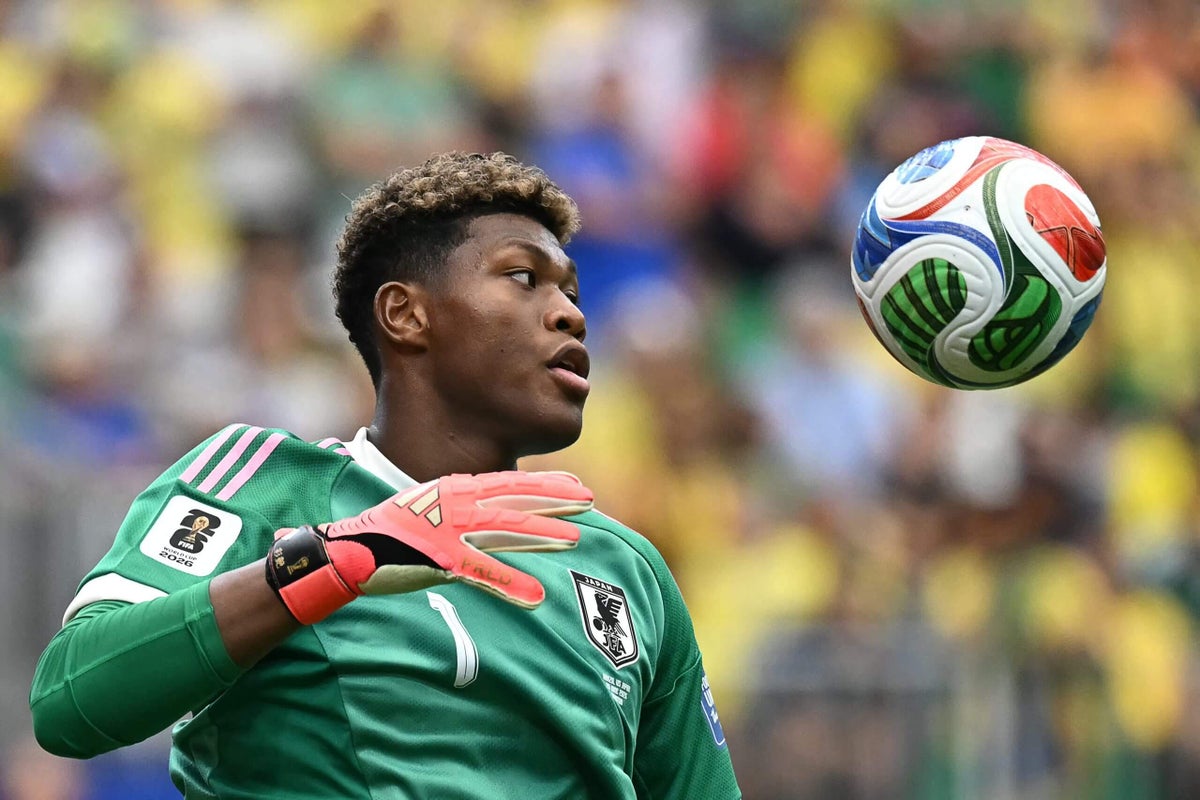
Aston Villa’s Zion Suzuki: The U.S.-born Japan goalkeeper who turned down Man United

Published

on

Zion Suzuki was just 20 and had never played in Europe, but when he strode into the training ground of Sint-Truiden in 2023, his new team-mates were impressed.

The 6ft 3in (191cm) goalkeeper, who turns 24 this month, had turned down interest from Manchester United to join the Belgian Pro League side, but his age was always going to give more experienced players pause for thought.

Any fears the new arrival on loan from Japanese team Urawa Red Diamonds may have lacked maturity, though, were quickly dispelled.

When asked why he had turned down a move to compete with then United No 1 Andre Onana at Old Trafford, he told Goal three years ago: “I decided to transfer this time as a step up in aiming to be the best in the world. There was an offer from Manchester United. I decided on this transfer to steadily take the next step in my career.”

The level of maturity, willing to take a less illustrious step to further his career, was an insight into Suzuki’s mindset. Even at that formative stage, it was not the first big decision he had faced.

Suzuki was born in Newark, New Jersey, in August 2002 to a Ghanaian-American father and Japanese mother, but his family moved to Urawa shortly after, when he was still a baby.

It meant he was eligible to represent the USMNT, Ghana and Japan, but chose the nation where he had spent most of his life before moving to Belgium. He played for Japan’s age-group sides as a teenager before making his senior debut aged 19 in 2022, keeping a clean sheet in a 6-0 win over Hong Kong.

Now the player, reportedly named by his mother after the biblical Mount Zion in Jerusalem, is ready to cap his ascent by becoming Aston Villa’s new goalkeeper, having played all four games for Japan at the World Cup before they lost to Brazil in the round of 32.

Japan were knocked out of the World Cup by Brazil in the round of 32 (Alex Slitz/Getty Images)

Succeeding the Premier League club’s current No 1 Emi Martinez represents a challenge, but Suzuki is resilient and has faced far more difficult issues.

Back in 2024, he had to deal with racist abuse after errors in his sixth performance for Japan, during an Asia Cup defeat by Iraq. At the time, he said he accepted criticism of his performances but “would like people to stop making racist comments”.

“I’m not about to let it beat me,” he said. “I want to come back at them by producing good results.”


“It was crazy to think he was as young as he was when he arrived,” Sint-Truiden centre-back Wolke Janssens tells The Athletic.

“I would call him a top professional. He would work really hard in training and always try to better himself.”

Janssens would be one of those defenders playing in front of Suzuki in a new environment.

The young ‘keeper had spent all his club career at Urawa, in a city around 30km (18 miles) north of Tokyo, where his parents moved when he was young.

But the chance to move to Belgium was his opportunity to play regularly, with his new club’s former goalkeeper (fellow Japan international Daniel Schmidt) on the brink of moving on.

Suzuki moved to Sint-Truiden in Belgium in the summer of 2023 (VIRGINIE LEFOUR/BELGA MAG/AFP via Getty Images)

“He was still young when he arrived in Belgium, but it felt like he was already a professional player who had been going for 15 years,” says Janssens. “His eagerness was what stood out most to me.

“You could see he adapted quickly to life here. With his big frame and excellent mindset, it was clear he was destined for a future in Europe.

“I remember him as a reliable ‘keeper. You could see STVV (Sint-Truiden) wasn’t going to be his final team. Whilst he wasn’t faultless, he was very self-assured.”

It was that confidence which led Suzuki to turn down one of the world’s biggest teams, even if his dream was to play in the Premier League.

“With so many players succeeding overseas, being a goalkeeper is truly a difficult position to fill,” Suzuki told Goal as he moved to Belgium in 2023.

“There aren’t any Japanese goalkeepers currently playing in the Premier League, so I want to be the first one to achieve that.”

Fast-forward three years and Suzuki is on the verge of fulfilling that ambition at Villa, after starring for his country at this summer’s World Cup.

Such has been the depth of Villa’s planning, they have taken in Suzuki’s season in Belgium, which was followed by his move to Parma in Italy.

He made 32 appearances for the upwardly mobile Sint-Truiden, with six clean sheets, as other clubs around Europe intensified their interest in him.

He has long been on Villa’s radar. Unai Emery has been planning for the exit of No 1 Emi Martinez for the last two summers, and much detailed work has duly gone into sourcing his replacement.

Emery and Villa have been planning for Martinez’s exit (Francisco Seco / POOL / AFP via Getty Images)

The Midlanders have been in contact with Parma all summer about Suzuki’s situation, keeping abreast of his proposed move to Paris Saint-Germain and then, last week, learning that it was on the brink of collapse. They wasted no time in acting.

Although James Trafford, who has since joined Leeds, and Lens shot-stopper Robin Risser were strong options, Suzuki was always the preferred choice.

Villa believed the player’s preference, as he had stated with his Premier League ambition, was always to move to Villa Park.

When it became clear he was going to leave Italy, the Villa hierarchy decided to address the position of their new No 1 now instead of waiting for another season.

Martinez had a strong campaign as Villa finished fourth, and he reached a World Cup final again with Argentina in July, but there has been concern around the 33-year-old’s late withdrawals last season (on four occasions, he pulled out in warm-ups).

Marco Bizot, recruited last year from Brest in France, stepped in and covered well. He is considered a capable and experienced deputy to Suzuki, who travelled to Birmingham on Sunday, had a medical on Monday, and is in line to be the club’s first-choice ‘keeper this term.

A source with knowledge of many of the Villa players, speaking on condition of anonymity to protect their relationships, says the squad is impressed and enthused by his impending arrival.

Away from the pitch, Suzuki told CBS in 2024 that he likes to play golf, although not watch it, and listens to the music of Japanese rapper AK-69 for motivation.

His high-profile performances for Japan at the World Cup caught even further attention, beginning with some excellent stops in the 2-2 draw with the Netherlands.

“I watched that game,” adds Janssens. “A lot of the players on the pitch (in that game), I’ve played with at STVV. It’s great to see so many of them at the biggest stage.

Suzuki impressed against the Netherlands at the World Cup (Aric Becker / AFP via Getty Images)

“I knew Zion had a lot of qualities, but was somewhat surprised he got to this level as soon as he did. Normally, it takes players numerous years to improve as much as he did.

“He was great at communicating. You could see that he wanted to make sure his defenders are completely aware of what’s going on.

“I’ve played with a lot of great goalkeepers, but with Zion you could feel like there was someone you could rely upon.”

Single-minded, calm and ready to flourish. Villa will hope Suzuki’s ability to thrive at every step continues into the first season of his dream move.

>

Continue Reading

Sports

How to watch the men’s Western & Southern Open: Streaming options for the Round of 16

Published

on

There are eight men’s matches at the Western & Southern Open today, highlighted by No. 11-ranked Rafael Jodar versus No. 10 Flavio Cobolli.

Western & Southern Open key details

  • Tournament: The Western & Southern Open
  • Round: Round of 16
  • Date: August 19
  • Streaming: Fubo (Stream now)
  • Venue: Lindner Family Tennis Center
  • Location: Cincinnati, Ohio
  • Court Surface: Hard
  • Watching in person? Get tickets on StubHub.

Western & Southern Open schedule today

  • Rafael Jodar vs. Flavio Cobolli, 11 a.m. ET (Round of 16)
  • Thiago Agustin Tirante vs. Jakub Mensik, 12:10 p.m. ET (Round of 16)
  • Alexander Zverev vs. Tommy Paul, 1 p.m. ET (Round of 16)
  • Arthur Fils vs. Alex de Minaur, 1:20 p.m. ET (Round of 16)
  • Nuno Borges vs. Brandon Nakashima, 3:10 p.m. ET (Round of 16)
  • Jaime Faria vs. Lorenzo Musetti, 4:20 p.m. ET (Round of 16)
  • Taylor Fritz vs. Christopher O’Connell, 7 p.m. ET (Round of 16)
  • Frances Tiafoe vs. Felix Auger-Aliassime, 8:10 p.m. ET (Round of 16)

Western & Southern Open odds

  • Grigor Dimitrov: +100
  • Learner Tien: +100
  • Ben Shelton: +100
  • Michael Zheng: +100
  • Mark Lajal: +100
  • Juncheng Shang: +100
  • Ignacio Buse: +100
  • Chak Lam Coleman Wong: +100
  • Valentin Royer: +100
  • Sebastian Baez: +100
  • Juan Manuel Cerundolo: +100
  • Adam Walton: +100
  • Jenson Brooksby: +100
  • Ugo Humbert: +100
  • Nicolas Mejia: +100
  • Daniel Altmaier: +100
  • Stefanos Tsitsipas: +100
  • Lorenzo Sonego: +100
  • Arthur Rinderknech: +100
  • Fabian Marozsan: +100
  • Felix Auger-Aliassime: +140
  • Lorenzo Musetti: +150
  • Frances Tiafoe: +400
  • Jaime Faria: +750

This watch guide was created using technology provided by Data Skrive.

Betting/odds, ticketing and streaming links in this article are provided by partners of The Athletic. Restrictions may apply. The Athletic maintains full editorial independence. Partners have no control over or input into the reporting or editing process and do not review stories before publication.

Photo: Clive Brunskill, Carl De Souza, Filipe Amorim, Valery Hache / Getty Images

Connections: Sports Edition Logo

Connections: Sports Edition Logo

Connections: Sports Edition

Spot the pattern. Connect the terms

Find the hidden link between sports terms

>

Continue Reading

Trending

Copyright © 2017 Zox News Theme. Theme by MVP Themes, powered by WordPress.