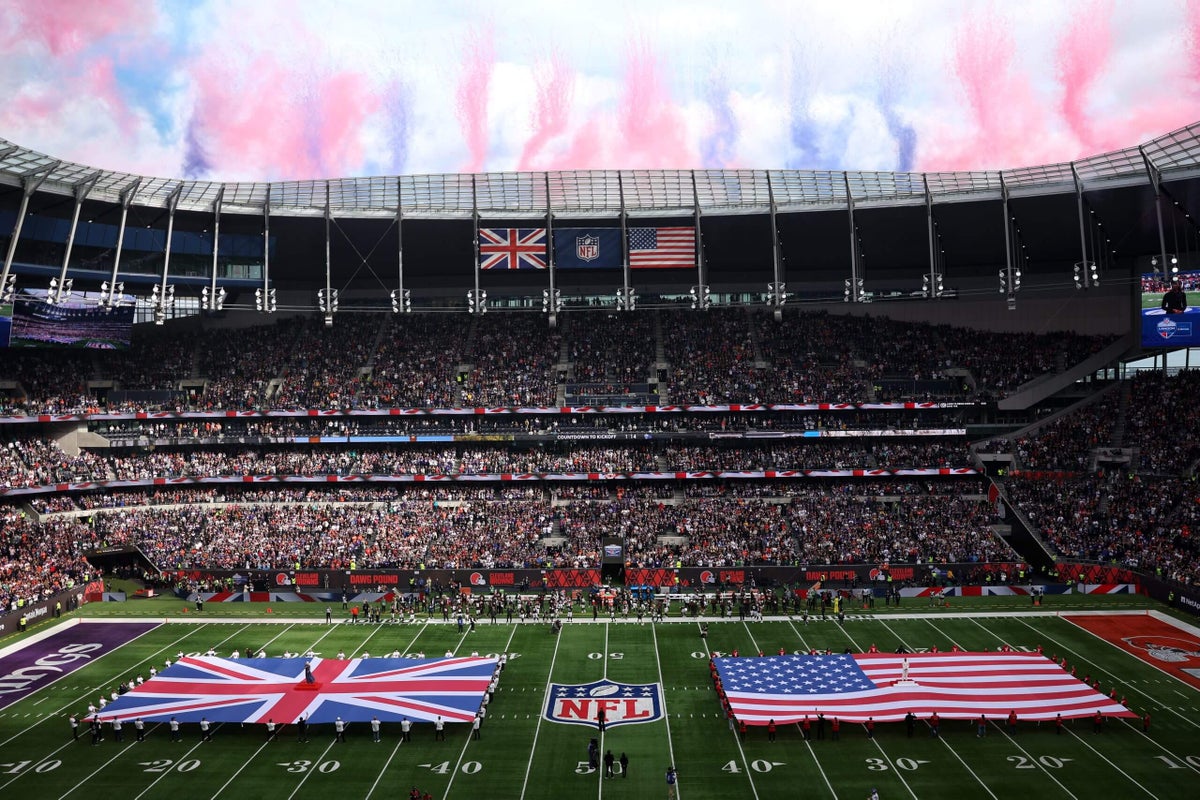
NFL commissioner Roger Goodell told a German media outlet Tuesday that he has “no doubt” the NFL will eventually have teams outside of the United States. But what logistical challenges could come with an international franchise?
For years, the NFL has been expanding its global footprint with games overseas in new countries and markets. This season will feature a record nine international contests, including first-time trips to Melbourne, Rio de Janeiro and Paris.
But with added travel miles — the San Francisco 49ers will venture a record 38,105 miles in 2026, per Bookies — comes added logistics. NFL teams start preparing for international travel as soon as their games are announced, beginning with obtaining passports and visas for every member of the traveling party all the way down to shipping gear and meals.
Once teams arrive at their destination, there are new facilities to navigate and jet lag to overcome. Take this year’s Week 1 game in Melbourne for example. The San Francisco 49ers are planning to arrive a full week before the game to acclimate to the 17-hour time difference, while the Los Angeles Rams are planning to take a more in-and-out approach. There’s no one way of doing things, and players and coaches have previously bemoaned travel’s impact on performance.
Scheduling is also a consideration. The league avoids scheduling teams coming off international travel for Thursday night games, opting to give either a bye or the full week to recover. In a world with an international franchise, what would the travel look like? Would the NFL schedule blocks of extended home stands followed by weeks on the road? If the latter, would that require a U.S.-based training facility?
There’s also the competitive issue. Would players willingly sign in free agency with a team based in another country? In The Athletic’s 2023 anonymous NFL player poll, a majority of players (55.4 percent) said they would not want to play on an NFL team based overseas (34.9 percent responded “yes” and 9.6 percent said “maybe”).
Perhaps a U.S.-based training facility could serve as the team’s offseason home for OTAs and minicamps, limiting a player’s time required in the other country to just in-season.
However far off it may be before a team is based outside the U.S., robust international travel doesn’t seem to be going anywhere, with the NFL previously saying it could go as high as 16 games — nearly one per week.
Robert Kraft outlines what an 18-game schedule could look like
Chad Graff
Here’s a breakdown of the considerations, complications and reference points the NFL could use when debating the feasibility of an international franchise.
Which locations could be considered for an international NFL franchise?
London has been the most common international host for the NFL, with 42 games played since 2007. The Jacksonville Jaguars have marketed themselves as London’s team, and have hosted a home game in the English capital at Wembley Stadium each season since 2013 (except for the pandemic-altered 2020 campaign).
London was toyed with as a temporary home for the Jags in 2027, when their stadium will be under construction, but the franchise ultimately landed on playing their home games that season at Camping World Stadium in Orlando, Fla. It’s also worth wondering how often the Jags will visit London upon the completion of their $1.4 billion stadium renovation.
Speaking at a UK fan event in 2022, Goodell said there was “no question that London could support not just one franchise, I think two franchises,” according to the British media outlet Sky Sports. Goodell said the question would come down to whether a London-based team — and the teams visiting — would be able to maintain competitive balance.
Logistically, a team in North America would ease travel headaches as opposed to jetting across the pond. Mexico City, which is in the Central time zone, is the NFL’s second-most-visited city with four hosted games (in 2018, poor field conditions led the league to move a scheduled Kansas City Chiefs versus Los Angeles Rams game to Los Angeles Memorial Coliseum). The last game in Mexico City was in 2022, but the league is entering the first year of a three-year agreement to return in 2026 following completion of renovations at Estadio Banorte (formerly Estadio Azteca). The San Francisco 49ers will host the Minnesota Vikings there on Nov. 22, marking their third trip to the Mexican capital.
The NFL hasn’t explored as many opportunities in Canada. The Buffalo Bills hosted a Toronto series from 2008 to 2013, during which the team played six regular-season games and two preseason games at Rogers Centre (home of MLB’s Toronto Blue Jays). The series was postponed and later terminated early due to dwindling attendance and concerns from Buffalo fans about losing a true home game each season. The Green Bay Packers and Oakland Raiders played a preseason game in Winnipeg in 2019 that had to be contested on an 80-yard field with no kickoffs due to an issue with the artificial surface in one end zone.
As for other places the NFL seems to be investing, the league will play its third game in Brazil (first in Rio) this year after opening the international slate in São Paulo the last two years. There has also been a game hosted in Germany in each season since 2022, with a game scheduled in either Munich or Berlin in each of the next four years.
What logistics do teams already deal with during international contests?
My colleague Peter Carline is based in London and has followed the NFL’s presence overseas closely. Here’s how he described the logistics of an international trip:
When the Jaguars first played back-to-back games in England in 2023, around 180 people — players, coaches, staff and families — traveled on their nine-night excursion. The Rams took it to the other extreme last year, staying for one night ahead of their game against Jacksonville at Wembley Stadium.
Teams charter flights to London Stansted Airport and book blocks of rooms at The Grove or Hanbury Manor, two five-star hotels outside London. They are transformed into temporary headquarters ahead of arrival, with multiple meeting rooms and offices.
Both have a custom-built NFL practice field and gym on site, but, recently, the Baltimore Ravens (2023) and Denver Broncos (2025) opted to use the facilities of Premier League club Tottenham Hotspur for practice and media.
Most teams have sleep experts explain several concepts about transatlantic travel and jet lag to players ahead of time, including the effect on circadian rhythms and the importance of taking magnesium to aid sleep. Staples such as condiments and drinks are also imported, while team chefs work with hotels to provide extensive, familiar menus.
The nominal home team has a couple of advantages: They have first choice on hotels and are the first to leave the stadium. — Carline

The Jaguars have played in London every season since 2013, except the pandemic-altered 2020 campaign. (Alex Pantling / Getty Images)
How have other leagues navigated having teams based outside the U.S.?
For additional perspective, I asked around The Athletic’s newsroom about the challenges non-U.S. teams face in other American leagues. I found it interesting how different currencies impact both player salaries and team revenues. Plus, the NHL has seen examples of visa complications at the trade deadline and competitive disadvantages for Canadian teams.
NHL
The NHL has always been a multinational enterprise operating in both Canada and the United States. The impact of this has been far-reaching and, occasionally, unpredictable.
For example, drawing league revenues in multiple currencies inevitably creates some level of vulnerability for the NHL, as a result of real-world events and value fluctuations. In 2015, for example, the value of the Canadian dollar abruptly plummeted by 16 percent. Given how much of the NHL’s revenues at the time were tied up in CAD, the NHL salary cap — which is tied to hockey-related revenues — was suddenly and unpredictably flat year-over-year, significantly altering the amount of liquidity in the system for free agents and fundamentally altering the exchange value of player contracts that had been previously agreed to.
The COVID-19 pandemic was another illustration of these factors. Because of logistical issues posed by various quarantine protocols on either side of the border, the NHL was effectively forced to hold a form of competition that prevented Canadian and American teams from playing against one another until the conference finals of the 2020-21 season.
On a day-to-day basis, there are immigration challenges to work through. For example, the Washington Capitals last season acquired a player, David Kampf, in a trade at the deadline whose debut with the team was held up over work visa issues. There’s also the taxation dynamic, which has a broader impact on player recruitment outcomes.
This factor has been more pressing in recent years, with star players like Alex DeBrincat, Matthew Tkachuk, Mitch Marner and Quinn Hughes utilizing their leverage before free agency to play for teams based in the United States. It’s a factor that’s noted with increasing frustration among Canadian hockey fans, given that a Canadian team hasn’t won the Stanley Cup since 1993. — Thomas Drance, Canucks writer
MLB
The Toronto Blue Jays are the only Major League Baseball franchise outside of the United States. While there are certainly some players trepidatious about playing in another country, the Jays don’t believe their location is a significant obstacle.
“Every market has its challenges,” general manager Ross Atkins said in winter 2025. “There are players that don’t want to play in certain markets for various reasons. We’ve found Toronto to be exceptionally attractive to a large part of the baseball population.”
There are some logistical challenges, though. All players require passports to cross the border regularly, though that’s not a huge issue in MLB as so many players come from outside of the United States anyway. Both the Jays and road teams need to clear customs upon entry and exit from Canada, as well, but that’s described as more of a minor inconvenience than a major obstacle.
Perhaps the largest issue is that a significant portion of the Blue Jays’ revenue is in Canadian dollars, while every other team earns in American dollars. As of Aug. 18, the CAD is worth about $0.72 USD. The revenue generated from ticket sales, stadium concessions and local merchandise is all in CAD. That earning imbalance hasn’t held the Jays back from spending in recent years, though, as they currently own the fifth-highest payroll in the sport, per FanGraphs. — Mitch Bannon, Blue Jays writer
NBA
You would be surprised at how many players chafe at having to go through customs. Even as this process has become easier over the years, Toronto Raptors players and their opponents still get annoyed at the extra time a cross-border trip takes. Also, draft prospects often don’t have their visas or passports, meaning the Raptors have had to do individual workouts across the border in Buffalo — although that doesn’t figure to be a big issue in the NFL.
There is also the issue of taxes. Again, the Raptors have gotten better at finding their players the right resources over time, but the local/provincial taxes in Ontario are higher than they are almost anywhere in the United States, and significantly higher than in no-state-tax locations such as Florida and Texas. — Eric Koreen, Raptors writer