
Anime
A Bona Fide Killer Webtoon Views Rise 10-Fold Following Live-Action Series Premiere – News



© Kakao Entertianment
Kakao Entertainment announced on August 18 that views for the original A Bona Fide Killer webtoon have increased tenfold following the premiere of its MBC television series adaptation.
According to Kakao Entertainment, views on Kakao Page and Kakao Webtoon rose 10 times when comparing the week before the show’s premiere (July 20–26) with the period of August 3–9. The series debuted on July 31.
The live-action series has been gaining popularity with its action sequences and fast-paced story. Kakao Entertainment also launched promotional campaigns for the original webtoon alongside the premiere, further driving interest in the series.
The story of the webtoon reads:
Yu Bona is no ordinary mom returning to the office after maternity leave. For her first assignment back she heads to a rooftop, points a sniper rifle at her target in a nearby hotel room, and “bang!” the legendary assassin “Kingfisher” is back. But as Bona takes on a series of new targets, her news reporter husband Taesung is ordered to investigate Kingfisher’s return, and as the bodies pile up, the line between personal and professional slowly starts to blur.
The webtoon, created by GUM and YOON, has been serialized since 2022 on Kakao Webtoon. The official English version of the webtoon is available on Tapas. Season 3 of the webtoon ended last September, and Season 4 returned on July 27.
Fans can watch the live-action series on Viki.
Source: Kakao Entertainment‘s press release
>

If there’s one thing that people who follow the magazine closely can agree on, it’s that the pages of Weekly Shonen Jump are a battleground every bit as fierce as their most iconic action manga. For every Naruto or Demon Slayer that manages to survive and reach untold heights of global popularity, there are series like The Hunters Guild: Red Hood or Mama Yūyū that meet an untimely end and get lost to the winds of history. The pages of JUMP run red with the blood of hundreds of canceled manga, and while most of these cancellations tend to be brief, some managed to gain an extended stay of execution, never quite finding enough popularity to earn an anime adaptation. When it comes to such JUMP titles with a noted reputation in Western circles, though, there are no examples more infamous than the tale of Psyren by Toshiaki Iwashiro.
Despite lasting a whopping three years in the magazine, it never performed well enough to get an anime adaptation green-lit during its run, and this helped to be its undoing, as without that extra blanket of security, it too was inevitably met with the sting of Shonen Jump‘s axe. Unfortunately, that blow could also be felt right into the pages of the manga itself, as its cancellation resulted in an extremely rushed finale, and while Iwashiro managed to wrap the story, this ultimately left a pretty notable mark on the manga’s overall reputation.
While the series has maintained some vocal fans clamoring for an anime adaptation (I myself being having also been one of them), and it’s even managed to appear on Anime Japan’s yearly poll of Most Wanted Anime Adaptations more than once, it’s pretty rare for a cancelled JUMP manga to be given that kind of second chance at life, so that seemed to be the end of Psyren‘s story. Yet against all odds, an anime adaptation has finally gotten greenlit courtesy of REMOW and Studio Satelight, giving the series another chance to grow its audience; with Psyren experiencing a sudden revival, it’s as good a time as any to look back and see just how well this manga holds up.
The series functions as something of a cross between GANTZ and a more straightforward battle shonen setup, as it follows a troubled teen named Ageha whose quest to find his missing classmate and childhood friend, Sakurako, leads him to investigate rumors surrounding a secret society called Psyren. However, when he finally tracks Sakurako down, he discovers that rather than simply being a cult, Psyren is a post-apocalyptic future brimming with modified lifeforms called Taboo that possess psychic powers, and that Sakurako has been traveling back and forth between this future as part of a mysterious game. Having now been locked into that game himself, Ageha decides to make it his mission to protect Sakurako from becoming another one of its casualties while the two try to learn how to prevent this dark future from coming to pass.
All of this is just the opening hook from the first volume, so it’s pretty easy to see where the series gets a lot of its appeal as it balances itself between the characters attempting to uncover the mysteries of how the future of Psyren came to be, and squaring off against all the dangers that world has to offer in flashy psychic shonen battles. Whereas a lot of the bigger Shonen Jump battle manga of its day like Naruto or Bleach were known for their largely slow-moving plots, Psyren‘s secondary status as a mystery thriller allows its story to move at a much brisker pace, and it never feels as though the series is wasting your time. While most of its overarching mysteries aren’t overly complex, they do help to add a lot of extra tension to the story. New information also tends to be drip-fed at a steady enough rate that it’s rare to go more than a few chapters without some brand-new revelation connecting Psyren to the present, which generally rewards readers for staying attentive.
That brisk pacing also extends into most of the manga’s fights, which center on the use of psychic powers called “PSI,” functionally split between physical enhancements, manipulating other people’s senses, and generating some form of psychokinesis like making fire or healing wounds. Much like the mystery side of the series, the battle system here isn’t anything terribly complicated (and does perhaps have a bit too much overlap with Ninjutsu in Naruto), but the series does manage to get some creative uses out of it, like giant scythes that can make illusions or making solid blocks out of air that are cool enough to keep the fights engaging. While some of the action paneling can be a little clunky in places, it flows enough that it’s fairly easy to digest, and the same extends to the art, which generally doesn’t stand out too much for what’s expected from a battle manga, but looks good enough to add some extra spectacle to all of the fights. The ability to comfortably shift between mystery and action works as the manga’s biggest strength, and those elements work together in tandem to give it a solid sense of momentum that makes it extremely easy to read.
As much as that constant sense of momentum works for it, though, it’s also the manga’s biggest weakness, as that pace doesn’t leave much time for its characters. Out of the central cast, Ageha and Sakurako get the most focus, and their respective arcs end up heavily intertwined. Ageha starts off the story as an aimless delinquent who plays at helping people in trouble as an excuse to satisfy the emptiness he feels through violence. Although he finds a sense of purpose in helping Sakurako to survive in Psyren, his brash attitude ends up being a double-edged sword as his battles there slowly lead him to realize that he’s a lot more comfortable with the thought of killing his opponents than he knows he should be.
Sakurako, on the other hand, deals with a lot of trauma brought about by all the lives she was unable to save during her previous trips to Psyren, and it’s mostly through Ageha coming back into her life that she starts to let go of those burdens in order to allow herself to be happy. While these are both pretty solid foundations for their characters, and allow them to have a good dynamic with each other, that relationship largely plays second fiddle to the central mystery, so despite its prominence, it’s never given enough room to breathe to feel as compelling as the story wants it to be.
The same also extends to the rest of the main cast, who have pretty simple character arcs such as a sleazy playboy named Kabuto who has to learn not to run at every opportunity, and a celebrity named Oboro who acts childish but has a dangerous side to him that causes him to view all of Psyren’s dangers as nothing but a game to amuse himself with. While they’re both given just enough focus to help keep them involved with the plot, there otherwise isn’t quite enough depth to them to make them one of the series’ better draws. The same also extends to the members of the organization W.I.S.E that serve as the manga’s main antagonists, as while they’re all entertaining enough, they otherwise don’t display much personality outside their general archetypes, and the mystery of how they managed to bring about Psyren’s future takes priority over their characterization.
This unfortunately bleeds into the quality of the fights, as the overall simplicity of the characters keeps the battles low on emotional stakes and makes it harder to get fully invested in them. This wouldn’t be too much of an issue if the battles opted to focus on being strategic instead, like with Hunter x Hunter or Jujutsu Kaisen, but the battles are extremely straightforward; that lack of a push towards either direction leads to many of the fights coming off as merely functional rather than being essential to the story or the characters. The biggest exception to this would be the battle that takes place in volume 3 between one of the main characters, Hiryu, and his childhood friend Tatsuo, who had previously gone missing in Psyren only for Tatsuo to have been turned into a Taboo. It’s given a fair amount of dramatic weight as Hiryu owes much of his current image as a tough guy to becoming someone Tatsuo could look up to since the latter spent his entire childhood unable to walk, but while those extra stakes make this fight more memorable, it’s sadly the exception rather than the rule, and it ends up being the most Hiryu has to do in these volumes as he largely fades into the ensemble afterwards.
Still, while it’s a little easy to see how these issues might have prevented Psyren from becoming a big commercial success, they aren’t anywhere near severe enough to keep it from being an extremely fun comic. Even if it doesn’t quite do enough with its characters to reach its full potential, the series does enough with its overarching mystery and explosive battles to make for an overall easy read that does just enough well to be consistently enjoyable. In that respect, it’s not hard to see why the series has maintained a loyal following even over a decade past its conclusion, and even though it doesn’t quite reach the heights of Shonen Jump‘s heaviest hitters, it’s still more than good enough to be worth a read.
>


©BROCCOLI ©ARIA entertainment
The official website for Uta no Princess-sama, the female idol counterpart project to the male idol franchise Uta no Prince-sama, announced last Saturday that the project’s third anniversary concert has been canceled due to “various circumstances.”
The project announced the third anniversary concert in December, but did not announce a date or venue for the concert prior to the cancellation.
The project launched in March 2023, and currently has two trio groups: “Flower Candy” and “Silent Queen.” The project’s concept is time traveling idols, with the characters attending an all-girls school named St. Saotome Girls’ Academy, starting an idol group, and finding themselves suddenly transported through time.
Uta no Prince-sama – Maji Love 1000%, the first anime season adapting Broccoli‘s Uta no Prince-sama dating simulation video game for female players, premiered in Japan in July 2011. In the first season of the slapstick romantic comedy, the female protagonist goes to a school for the performing arts with young men who are budding idols. The subsequent seasons followed seven of the young men after they form the idol group ST☆RISH. The 13-episode second season, Uta no Prince-sama – Maji Love 2000%, premiered in Japan in April 2013. The 13-episode third season, Utano☆Princesama Revolutions, premiered in April 2015. The 13-episode fourth season, Utano☆Princesama Legend Star, premiered in October 2016.
The Uta no Prince Sama Maji Love Kingdom film then opened in Japan in June 2019. The Utano☆Princesama Maji LOVE ST☆RISH Tours film opened in Japan in September 2022. The film ranked at #7 in its opening weekend.
The franchise also has a one-hour television anime special titled Utano☆Princesama♪ Maji Love ST☆RISH Tours: Tabi no Hajimari (The Start of a Journey) that celebrates the 10th anniversary of the 2011 Uta no Prince-sama – Maji Love 1000% television anime, as well as the release of the film. The special aired in Japan in July 2022.
The Gekijōban Utano☆Princesama♪ TABOO NIGHT XXXX anime film opened in Japan in May 2025.
>
Grab your dice and join Chris and Lucas for a journey through old-school anime fantasy!
Disclaimer:
The views and opinions expressed by the participants in this chatlog are not the views of Anime News Network.
Crunchyroll streams Record of Lodoss War.
HIDIVE streams Yandere Dark Elf.
OceanVeil streams Ren the Fairy Princess.
Netflix streams Bastard!!. (2022)
Chris, somehow, in the year of our lord 2026, there is yet another new piece of Record of Lodoss War media! A webcomic by Studio White (itself a joint venture between KADOKAWA, LINE Digital Frontier, and REDICE STUDIO), Record of Lodoss War: Queen of Death is a prequel to the original, beloved story. After reading through the first four translated chapters, I regret to inform you and our readers that Queen of Death does not have the juice…

© STUDIO WHITE/REDICE STUDIO/Kadokawa/LDF
However, this release did motivate me to finally watch the Record of Lodoss War anime, which absolutely whips, and I now desperately need to talk about it, and a bunch of other classic fantasy anime with you and whoever else will listen!

© 1990 Group SNE / Kadokawa Shoten Publishing Co., Ltd/Marubeni Corporation/Tokyo Broadcasting System
Please Chris! Heed my call to action and come on this journey DnD and Tolkien-tinged “let’s remember some anime” TWIA column with me! My fiancée and friends have done their best to indulge me, but I need another anime professional to join me on this noble quest!
I’ve been in a tabletop campaign or two myself; I know all about heeding the call to adventure!

© 1990 Group SNE / Kadokawa Shoten Publishing Co., Ltd/Marubeni Corporation/Tokyo Broadcasting System

© 1990 Group SNE / Kadokawa Shoten Publishing Co., Ltd/Marubeni Corporation/Tokyo Broadcasting System
And I’m happy to, since Lodoss has been a blind spot for me over my anime-watching years as well. I mean, it’s definitely faded a bit since its heyday, given the aforementioned webtoon snuck out last month with nary a peep at launch. But at least the legend lives on somehow. If Ryo Mizuno‘s classic fantasy setting can get a follow-up after all this time, maybe there’ll be hope for that Dungeons & Dragons: Honor Among Thieves sequel yet!

© 1990 Group SNE / Kadokawa Shoten Publishing Co., Ltd/Marubeni Corporation/Tokyo Broadcasting System
And with that side quest out of the way, we can get back to the main event! Maybe I just watch too much isekai slop for this column, and ANN’s Preview Guide, but I was immediately enchanted by Lodoss War, and its desolate world that’s barely clinging to its post-calamity existence! Seeing a Western fantasy world in an anime that’s not at all inspired by Dragon Quest is super enticing to me, and also touches on why I love FromSoftware‘s authored dark fantasy games so much!

© Ryo Mizuno, Group SNE 1988, 2013
The beginning of Lodoss the anime absolutely gets this. So many solid RPG sessions start out with the party together and on their quest, so after a relatively quick deep lore recap, Lodoss just drops viewers right in with Parn and crew in medias res and off to the races!

© 1990 Group SNE / Kadokawa Shoten Publishing Co., Ltd/Marubeni Corporation/Tokyo Broadcasting System

© 1990 Group SNE / Kadokawa Shoten Publishing Co., Ltd/Marubeni Corporation/Tokyo Broadcasting System
Look at that, just in the first episode they go into a dungeon and fight a dragon! This show understands the assignment!

© 1990 Group SNE / Kadokawa Shoten Publishing Co., Ltd/Marubeni Corporation/Tokyo Broadcasting System
I’m sure you and our audience have heard the expression “every frame a painting.” Well, every frame in Lodoss War looks like it should be airbrushed onto the side of your cool uncle who’s way into Led Zeppelin’s van! I truly cannot undersell how sick this anime looks!

© 1990 Group SNE / Kadokawa Shoten Publishing Co., Ltd/Marubeni Corporation/Tokyo Broadcasting System
Look at this supporting villain whose name I can’t even remember! We’ve had 35-some years of anime release since this OVA premiered, and no dude has looked more evil than this guy!!!
 © 1990 Group SNE / Kadokawa Shoten Publishing Co., Ltd/Marubeni Corporation/Tokyo Broadcasting System |
 © 1990 Group SNE / Kadokawa Shoten Publishing Co., Ltd/Marubeni Corporation/Tokyo Broadcasting System |
 © 1990 Group SNE / Kadokawa Shoten Publishing Co., Ltd/Marubeni Corporation/Tokyo Broadcasting System |
 © 1990 Group SNE / Kadokawa Shoten Publishing Co., Ltd/Marubeni Corporation/Tokyo Broadcasting System |
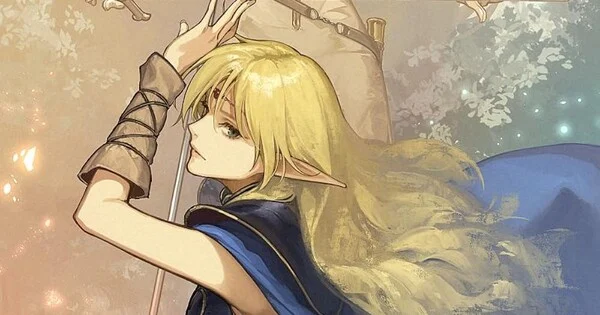
It’s not just that Lodoss is quintessentially fantasy, it’s quintessentially fantasy anime. Not the first to do it, but one of the best and still most influential in ways you can still pick out. Even I, who hadn’t checked this show out before now, knew that when fans wax about the bygone days of amazing anime elf women with pauldrons you could serve drinks off, they’re talking about Deedlit.

© 1990 Group SNE / Kadokawa Shoten Publishing Co., Ltd/Marubeni Corporation/Tokyo Broadcasting System

© 1987 Andrew Greenberg Inc, Robert Woodhead Inc, Sir-Tech Inc ©1991 SHOCHIKU FUJI Co
While technically Tolkein’s The Hobbit and Lord of the Rings as well as the Wizardry franchise are ultimately the germination point for much of Japanese takes on western fantasy that’s not an overt Dragon Quest clone, the way Lodoss War crystalizes this aesthetic and tone is nothing short of invigorating.
 © 1990 Group SNE / Kadokawa Shoten Publishing Co., Ltd/Marubeni Corporation/Tokyo Broadcasting System |
 © 1990 Group SNE / Kadokawa Shoten Publishing Co., Ltd/Marubeni Corporation/Tokyo Broadcasting System |
This naturally lets me point to the likes of Delicious in Dungeon as a modern series derived from Lodoss War‘s lineage. Lodoss even has its own dwarf who advocates for monster meals!
 © 1990 Group SNE / Kadokawa Shoten Publishing Co., Ltd/Marubeni Corporation/Tokyo Broadcasting System |
 © 1990 Group SNE / Kadokawa Shoten Publishing Co., Ltd/Marubeni Corporation/Tokyo Broadcasting System |

© 1990 Group SNE / Kadokawa Shoten Publishing Co., Ltd/Marubeni Corporation/Tokyo Broadcasting System
There’s a reason that Deed is the waifu template that other anime creators would draw from for the next decade and change! There is so much sexual energy tied to this character without her ever being reduced to eye candy, and I respect whichever person on this team decided that their dream girl absolutely needed to be a badass!
 © 水野良・グループSNE/KADOKAWA/Team Ladybug・WSS playground |
 © 水野良・グループSNE/KADOKAWA/Team Ladybug・WSS playground |
But I could espouse such appreciation for the whole party. Slayn seemed unassuming at first, but I quickly grew to dig his efficient demeanor. And how could I not love Norio Wakamoto voicing a scuzzy thief named…”Woodchuck”?
 © 1990 Group SNE / Kadokawa Shoten Publishing Co., Ltd/Marubeni Corporation/Tokyo Broadcasting System |
 © 1990 Group SNE / Kadokawa Shoten Publishing Co., Ltd/Marubeni Corporation/Tokyo Broadcasting System |

© 1997 Yun Kouga/Enix, TV Tokyo, Sony Music Entertainment
Though Lodoss War isn’t the only classic fantasy anime we watched for this column! While none of them quite live up to Lodoss War, Gestalt does at least give all dark elf appreciators a very fun character in Suzu!

© 1997 Yun Kouga/Enix, TV Tokyo, Sony Music Entertainment

© 中乃空・竹書房/ウェイブ
Getting back to our main convo, I was surprised by how much more Gestalt felt like a parody of fantasy anime media despite only releasing seven years after Lodoss War. Common anime tropes are far more overt in this anime, and there are even some fourth-wall-breaking references to other media in this space like Final Fantasy.

© 1997 Yun Kouga/Enix, TV Tokyo, Sony Music Entertainment
I know this is likely because of how rapidly this kind of media became popular in Japan in the early and mid 90s, but it really is astonishing how much closer Gestalt feels to a present-day take on western fantasy anime than its predecessors.

© 1993 Ryusuke Mita/Kadokawa Shoten Publishing Co.,LTD/Victor Entertainment, Inc

© 1993 Ryusuke Mita/Kadokawa Shoten Publishing Co.,LTD/Victor Entertainment, Inc
Similarly, you’ve got shows like Magical Circle Guruguru, though that’s a TV series, not an OVA. Though within that purview, it’s not like you need to look for something that swings more for comedy and isn’t entirely rooted in the classic fantasy tropes with the dragons and the dungeons and whatnot.

© 1995 KSS.
Honestly? Thank god the 90s were turning out weird experiments like Elf Princess Rane. Or Ren the Fairy Princess, as OceanVeil calls it.
I’m also surprised by how timeless much of the humor in Ren the Fairy Princess is! While the OVA features incredible, gag-a-minute writing, the extended bit of Gou interrupting some of his sisters trying to take a sick album cover pic feels like a joke I could see on TV today!

© 1995 KSS.

© 1995 KSS.
It’s also worth noting that of the shows we were suggested to sample from, Rane/Ren is the only one besides Lodoss to be streaming anywhere… for the time being, anyway. Catch it on OceanVeil while you can!

© 1995 KSS.
Not sure if the incidental nudity is a reason OceanVeil picked it up in the first place. Of course, we could probably write a whole lot of words’ worth of material on hentai series that took on these established fantasy tropes if we wanted to…

© Kazushi Hagiwara / Shueisha

© Kazushi Hagiwara/Shueisha, BASTARD!! Project

© Kazushi Hagiwara/Shueisha, BASTARD!! Project
Darren Norris doing his Jack from American Dad voice for Dark Schneider (except he’s audibly holding back laughter in half of his takes) immediately had me hooked, and the downright dickish take on the character made me realize that Bastard!! is closer to a work of camp than it is straight forward fiction.

© Kazushi Hagiwara / Shueisha
Though it’s also a lot of fun seeing classic DnD creatures pop up throughout the work with their classic designs!

© Kazushi Hagiwara/Shueisha, BASTARD!! Project
Thankfully, not all these treasures are buried for good. Ruin Explorers – Fam & Ihrie caught my eye years ago when a whole bunch of Anitwitter inexplicably watched it around the same time, so I was devastated when it left HIDIVE. But now AnimEigo has picked it up for a Blu-ray release!

© 1995 田中久仁彦・ホビージャパン/バンダイビジュアル・日本コロムビア・ムービック
That’s great because Ruin Explorers is great!

© 1995 KUNIHIKO TANAKA • HOBBY JAPAN / BANDAI VISUAL • NIPPON COLUMBIA • MOVIC
Given my penchant for dungeon crawlers, I know I’d have a great time with this work, and I’m quite literally starved for fantasy anime media that has any kind of enthusiasm or respect for female characters. Ruin Explorers sounds like a feast after years of the anime industry force-feeding me male power fantasy stories in this genre.

© 1995 田中久仁彦・ホビージャパン/バンダイビジュアル・日本コロムビア・ムービック

© 1995 田中久仁彦・ホビージャパン/バンダイビジュアル・日本コロムビア・ムービック
Ruin Explorers also straddles a neat balance between the sillier side of fantasy anime OVA and the strong straightforwardness exemplified by Lodoss. It starts out rather irreverent (very much in the “feels like banter in a real DND campaign” way of Honor Among Thieves) before picking up into more serious stakes.

© 1995 田中久仁彦・ホビージャパン/バンダイビジュアル・日本コロムビア・ムービック
It’s also got plenty of that OVA polish on it, including sharing Lodoss War‘s propensity from the era for sweet low-light coloring shifts in the art.

© 1995 田中久仁彦・ホビージャパン/バンダイビジュアル・日本コロムビア・ムービック

© 1991 Tohru Akitsu, KADOKAWA
Speaking of silliness, Luna Varga is just an anime where a high fantasy princess fuses with a demon that’s just a dinosaur to save her kingdom from destruction.

© 1991 Tohru Akitsu, KADOKAWA
That premise really is all there is to this anime, lol. If I had to reach for anything else to talk about, I guess the overtly Saint Seiya-esque designs are neat, but this work does boil down to its “dinosaur princess” premise, and will probably only appeal to folks whose ears perked up when they heard that pitch.

© 1991 Tohru Akitsu, KADOKAWA

© 1991 Tohru Akitsu, KADOKAWA
If we really wanted to draw parallels between Luna Varga and modern trends, there’s probably at least a little of it in Kaiju Girl Caramelize this season.

© 2000 PRINCESS PROJECT/Bandai Visual • MOVIC

© 2000 PRINCESS PROJECT/Bandai Visual • MOVIC
The last classic anime I came into this convo prepared to talk about is Shamanic Princess, which I thought was going to be fairly cutsey based on the limited visuals and descriptions I could dig up, but it pulled a proto-Madoka on me and is actually pretty visceral and VERY gay!

© 2000 PRINCESS PROJECT/Bandai Visual • MOVIC
Look at this character design work courtesy of Atsuko Ishida! You don’t get much more 1996 than this! Outside of, like, Saber Marionette J.
 © 2000 PRINCESS PROJECT/Bandai Visual • MOVIC |
 © 2000 PRINCESS PROJECT/Bandai Visual • MOVIC |
 © 2000 PRINCESS PROJECT/Bandai Visual • MOVIC |
 © 2000 PRINCESS PROJECT/Bandai Visual • MOVIC |

© 2000 PRINCESS PROJECT/Bandai Visual • MOVIC
Still, it shows how robust the fantasy OVA factory was in this era to pump out stuff with this kind of variety. It makes it disappointing that so little of it has been preserved for modern times outside of Lodoss, which is the one that keeps coming back, as we’ve seen.

© 1998 Ryo Mizuno・Group SNE・Masato Natsumoto・Rei Hyakuyashiki/”Record of Lodoss War” Project/TV Tokyo All Rights Reserved

© 1995 KSS.
While this extra-legal accessibility is less than ideal, beggars can’t be choosers, and I can only hope that these titles continuing to endure in this community motivates some decision maker somewhere to give us some kind of avenue to support official versions of these releases.

© 1995 田中久仁彦・ホビージャパン/バンダイビジュアル・日本コロムビア・ムービック
>

ABC And FCC Duel Over Court Jurisdiction In First Amendment Case

Manchester United’s Benjamin Sesko close to ‘getting some minutes’ – Michael Carrick

Melissa McCarthy’s Margie Claus Sets Release Date, Cast
-

 movies3 months ago
Search For Canadian TV Actor Stewart McLean Now Homicide Investigation
-

 Fashion9 years ago
These ’90s fashion trends are making a comeback in 2017
-
Fashion9 years ago
According to Dior Couture, this taboo fashion accessory is back
-
Fashion9 years ago
Model Jocelyn Chew’s Instagram is the best vacation you’ve ever had
-
Fashion9 years ago
Emily Ratajkowski channels back-to-school style
-
Fashion9 years ago
9 Celebrities who have spoken out about being photoshopped
-
Fashion9 years ago
Your comprehensive guide to this fall’s biggest trends
-
Fashion9 years ago
A photo diary of the nightlife scene from LA To Ibiza