
Adam Driver and Miles Teller in Paper Tiger.
Courtesy of Neon


It’s hard to convey the cultural thunderclap that went off in 1977 when “Saturday Night Fever” hit theaters to anyone who wasn’t there. The gritty musical about a working class Italian-American man who finds release and salvation every weekend at his local disco was a massive commercial and critical success, creating a seismic shift in music and fashion that flamed out quickly but left a major impression.
Most importantly, “Saturday Night Fever” and another Paramount release that came out the following year, “Grease,” made John Travolta one of the biggest movie stars in the world. The 23-year old landed an Oscar nomination for his dazzling performance and became a face you couldn’t get away from — his visage was everywhere, on posters, lunchboxes, and anything else you could slap a picture on, and young (and old) men around the world tried to emulate his style. (Film critic Gene Siskel famously bought Travolta’s white disco suit an an auction.)


Travolta and “Saturday Night Fever” were so ubiquitous that they singlehandedly launched a whole subgenre of “discoploitation” movies, quickie ripoffs designed to capitalize on Travolta’s popularity. While there were several American entries in this cycle, like “Thank God It’s Friday” and “Can’t Stop the Music,” as well as the British “Music Machine,” Italy is where discoploitation really thrived. Starting with “American Fever” in 1978, Italy cranked out a short but steady stream of extremely entertaining homegrown disco films that shamelessly imitated “Saturday Night Fever” while also supplying original charms of their own.
In “American Fever,” for example, there are several direct parallels with “Saturday Night Fever,” from the working class hero named Tony (who dresses exactly like Travolta on the dance floor) and abundant ensemble dance sequences to the Al Pacino posters that anchor the set decoration. Yet there are also plenty of unique twists on the material, as Tony struggles to make it as an actor and comes up against the seamier side of the Italian film industry; the view of the movie business as a metaphor for prostitution gives “American Fever” a cynical undercurrent that lingers in the mind long after the film’s conclusion.
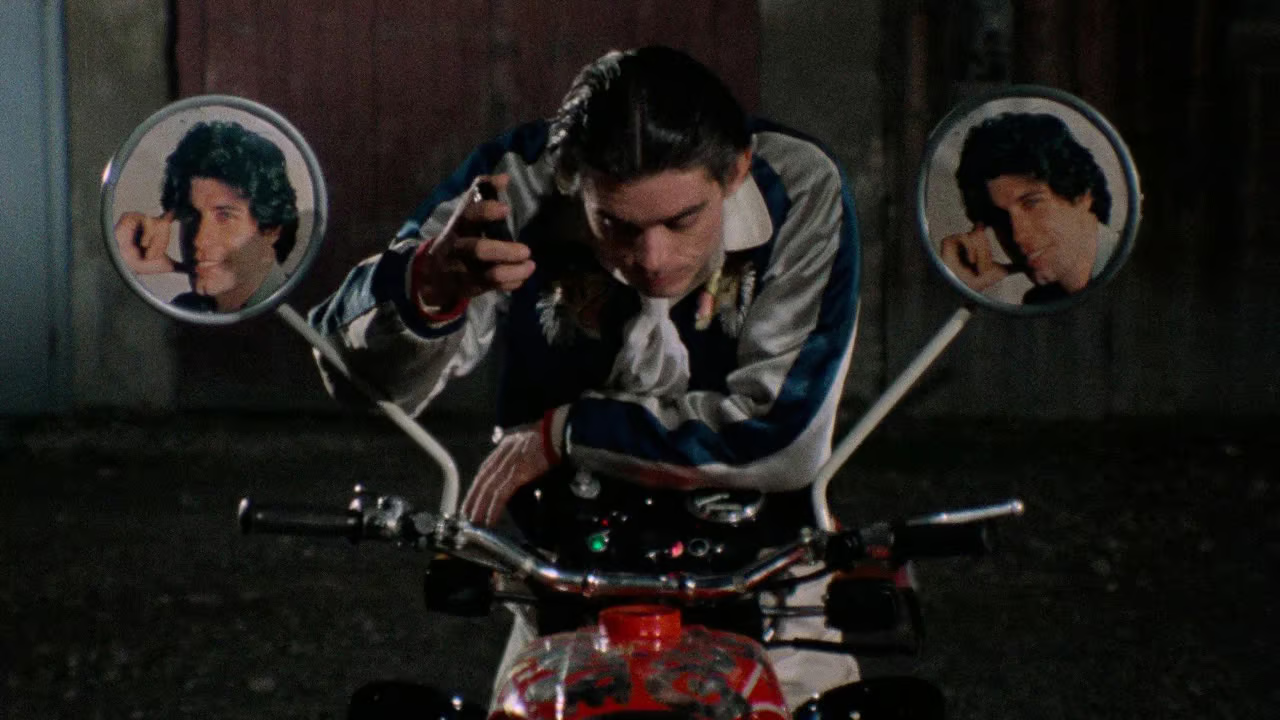
With its realistic edge, “American Fever” is one of the Discoploitation movies that most closely resembles “Saturday Night Fever” and comes the closest to replicating its strengths. “Grease Rock,” which came out in 1979, is much sillier — and more fun. Like the characters in virtually all of these movies, young Robbie (a deliciously hammy Monty Ray Garrison in his first and last starring role in a feature film) worships John Travolta; he even drives a custom motorcycle decorated as a tribute to “Grease,” complete with Travolta photos where the rearview mirrors should be.
Once again we have a character who escapes from his working class surroundings by frequenting the local dance club, and once again there are elements (like a disco contest on which the hero places all his hopes and dreams) lifted wholesale from “Saturday Night Fever.” What makes “Grease Rock” special, aside from the clever conceit of stealing iconography from not only “Saturday Night Fever” but “Grease,” is the sheer exuberance of the disco set pieces. The dancing is truly impressive, and the pleasure the performers take in it is infectious.
The obsession with John Travolta reaches its peak — or, depending on your perspective, nadir — in 1979’s “The Face With Two Left Feet,” a movie whose marketing materials promoted someone named “John Travolto” as the star. Travolto is in fact Giuseppe Spezia, an actor who looks so much like Travolta that it’s kind of unsettling, and the entire film is built around the resemblance. Spezia plays a nerdy guy whose friends give him a makeover so that he can convince the object of his desire, as well as all the cool patrons at the local disco, that he actually is John Travolta; “The Face With Two Left Feet” thus becomes a kind of commentary on itself and all the other “Saturday Night Fever” imitations. It doesn’t really work as a movie, but it’s a fascinating curiosity.
“American Fever,” “Grease Rock,” and “The Face With Two Left Feet” never got much, if any, distribution in the U.S., but now they’ve been collected in “Disco Italiana,” an incredible Blu-ray boxed set from Severin that loads the movies up with extra features and presents them in beautiful new transfers taken from the original negatives. None of these movies were ever released on DVD, even in Italy (where they’ve been more or less forgotten), which makes Severin’s archival excavation all the more valuable; one can only imagine the amount of technical and legal work that went into making this set happen, but it was well worth it in terms of the contribution to film history and scholarship.
Separately, Severin has also released a new Blu-ray of “Music Machine” (1979), which infuses the “Saturday Night Fever” template with British sociopolitical concerns and a great use of London settings. That’s one of the most interesting things about all of these movies — since they all have essentially the same narrative structure, the variations provide compelling glimpses at the cultural concerns and urban landscapes featured in each particular film. To watch the Severin discs is to be reminded of just how many cinematic discoveries remain out there waiting to be unearthed — and of how essential their work and the work of other boutique physical media labels continues to be.
“Disco Italiana” and “Music Machine” are now available on Severin’s website.
>
William Goldman’s adage that “nobody knows anything” never gets old.
If studios and financiers knew what was going to work every time, everyone would be rich and the industry would be a lot less interesting.
The old saying reared its head today at the Zurich Summit when filmmakers and brokers behind the year’s horror phenomenons Backrooms and Obsession admitted that they didn’t know their films were about to go stratospheric. There’s absolutely no shame in admitting that. No one knew quite how enormous both films would become, even if many clearly believed in the films and the filmmakers.
“You know, it’s funny,” CAA Media Finance Co-Head Roeg Sutherland mused during a panel on the independent business. “We have a colleague in our department who sold Obsession. I can promise you, we had no idea that Obsession was going to become Obsession.”
CAA co-repped the domestic deal with Capstone, selling the Curry Barker-directed movie out of Toronto for around $14M to Focus. The film went on to make a staggering $264M in the U.S. alone off a $1M budget. It took $520M global.
But believing in a filmmaker is where it starts, added Sutherland.
“I think the most important thing, is less about IP and genres, though those things can be important, but it’s always about the filmmaker. Whether it’s an established filmmaker or a discovery, it has to be someone that you’re willing to go on a ride with. You never know what’s going to happen. But that’s the central element that will decide whether a movie is gonna be good or bad. The filmmaker is the person you’re betting on.”
In an earlier panel, Backrooms director Kane Parsons was asked whether he contributed to the distribution and marketing of the A24 smash. While A24 clearly mounted a brilliant campaign, Parsons admitted that there was a level of uncertainty over what the film could do and who exactly it would reach.
“The truthful answer”, the 20 year-old said about the horror film that took a whopping $400M global off a $10M budget, “is that I don’t think there was a real sense of what it would be prior to the release of the film. I don’t. Even at the height of projections.”
Parsons added that he didn’t know whether the film would truly click with fans of the creepypasta genre, but that he “liked to think we did the core idea that they were expecting”. Clearly he did, and plenty more.
Later in the day, CAA Media Finance co-head Sarah Schweitzman also noted the serendipitous element to this summer’s record-breaking $4.7BN domestic box office. But also to the success speaking to a desire for authenticity and irreverence.
“When you look at the landscape today, the movies were so amazing this year, and they’re so different to what they’ve ever been, and unexpected in achieving the success that they’ve they’ve achieved. There is no way in which you can categorize the film business as unhealthy, because it’s burgeoning, it’s booming. I think that also speaks to where we are politically. There’s a lot time for irreverence. It’s a time for saying things that are maybe unpopular or maybe scary, but there’s a real underground belief and desire to hear the truth, which is not necessarily something that everyone is encouraged to do right now.”
>

Eyes (and ears) are once again on Taylor Swift with the release of her album “The Life of a Showgirl: The Encore.” But what’s more pertinent to IndieWire’s interests: the upcoming music video for the track “Patient Zero.”
The video is set to premiere on Sunday, September 27, during the 2026 MTV Video Music Awards — where Swift receives the inaugural Artist Director Honors. The already-teased musical short, directed by the Grammy winner herself, stars Oscar nominee Colin Farrell and BAFTA Award nominee Dakota Johnson. Also notable: Oscar-winning cinematographer Emmanuel “Chivo” Lubezki shot it.
So where do the Oscars actually come into play? And will Swift make a run of it again? Her “All Too Well: The Short Film” led to an Oscar campaign for Best Live Action Short that included her speaking to “The Banshees of Inisherin” filmmaker Martin McDonagh for Variety’s “Directors on Directors” lineup. She also sold her feature directorial debut to Searchlight Pictures in 2022, though news has been quiet on that front. So all eyes are on a potential campaign, and with precedent: A short film that also functioned as a music video worked for Riz Ahmed, after all, with his “The Long Goodbye” winning the Live Action Short Oscar in 2021.


But “All Too Well: The Short Film” ultimately didn’t land on the shortlist for Best Live Action Short the following year. It did eventually lead to Swift being invited into the Academy a year later, though. Since then, Swift has released several high-profile music videos, including “Fortnight,” starring five-time Oscar nominee Ethan Hawke and his co-star from the Oscar-winning film “Dead Poets Society,” Josh Charles. Or “Opalite,” starring “Past Lives” actress Greta Lee, “Ex Machina” actor Domhnall Gleeson, and recent Best Actor Oscar winner Cillian Murphy’s voice. Four-time Best Cinematography Oscar nominee Rodrigo Prieto (“Killers of the Flower Moon”) shot most of those videos.
For “Patient Zero,” or any of the aforementioned music videos, the biggest tell that Swift was after a Best Live Action Short Oscar again would’ve been some form of theatrical distribution for at least a week in major markets. That is how “All Too Well: The Short Film” qualified.
Right now, there is no expectation that “Patient Zero” will hit theaters. The last one of her music videos to premiere in movie theaters was “The Fate of Ophelia,” from the initial release of “The Life of a Showgirl,” but that would not have qualified for the Oscars for the separate reason of being a short film created from materials substantially taken from or cut down from completed, publicly exhibited feature films. It counted as only one sequence within the film she released via AMC to promote the album.
Swift’s focus still seems to be on her “Toy Story 5” track “I Knew It, I Knew You” as her ticket to the Oscars. Though Best Original Song can seem impenetrable, as the Music Branch that determines the shortlist and nominees for the category has its own insular politics, Swift has inched her way closer to a nomination with every song she’s written for a film. The last one was “Carolina” from “Where the Crawdads Sing,” which made the Best Original Song shortlist for the 2023 Oscars.
“I Knew It, I Knew You” is off to an even better start: “Toy Story 5” is the most successful animated film of the year, and the song topped the Billboard Hot 100, staying in the Top 10 for 15 weeks and counting.
In this case, her ubiquity is the asset. “Golden,” the most recent Best Original Song winner, was another song no other artist could catch up to. But it is still smart of Swift to ingratiate herself with the filmmaking community through her music videos; if she ever finally gets a nomination, most of them will have a chance to vote for her this time.
>
There are worse ways to be introduced when you’re about to unveil your new film as the Opening Night selection of the New York Film Festival, as “one of the great living American filmmakers.” But that’s exactly what Artistic Director Dennis Lim said as he brought Paper Tiger director to the stage at Lincoln Center’s Alice Tully Hall on Friday evening.
Gray has a long history with the festival, having closed it with The Lost City of Z and marked its anniversary with a special screening of Armageddon Time. But still, this felt different — as Gray himself noted in his moving introductory remarks, reflecting on growing up a few miles away from the Upper West Side. He remembered, after telling his parents he wanted to become a movie director, their skeptical reply: “How are you ever going to do that?” Gray then looked to the full house inside the theater and said, visibly taken aback: “Well, here I am.”
The general feelings around Paper Tiger feel distinct from Gray’s past films as well. Although a consistent critical darling, the Queens native hasn’t been able to break into the Oscar race in his career thus far, and at this point seems overdue — certainly, it wasn’t hard to think so hearing Lim’s comments framing the relaunch of Paper Tiger, which has not screened publicly since its world premiere in Cannes. The film had been widely acclaimed on the Croisette, and despite the jury overlooking the drama — as has, frustratingly, been a pattern for Gray’s movies at the festival over decades — it was being primed to roar with its fall launch by distributor Neon.
Adam Driver and Miles Teller in Paper Tiger.
Courtesy of Neon
Indeed, this one has arrived with the bells and whistles that typically elude the rollout of a Gray movie; its mix of bold classical filmmaking and rich memoiristic undertones is ideal for placing the movie in the context of his career. In his introduction, Lim spoke about how difficult it is to make personal, independent American films in the current climate; earlier this month, he called Paper Tiger “miraculous” in an interview with The Hollywood Reporter for just that reason. In a season dominated by international directors and blockbuster hits, that framing stands out.
Paper Tiger stars Miles Teller and Adam Driver as Irwin and Gary Pearl, brothers in 1986 Queens, caught in a scheme that puts their family’s lives at risk. Gray’s tight screenplay weaves these crime-thriller bones into textured family drama, with the plot coming to hinge on Irwin’s wife, Hester (Scarlett Johansson), considering how best to protect her sons and ensure their future, while also contending with her own personal crisis.
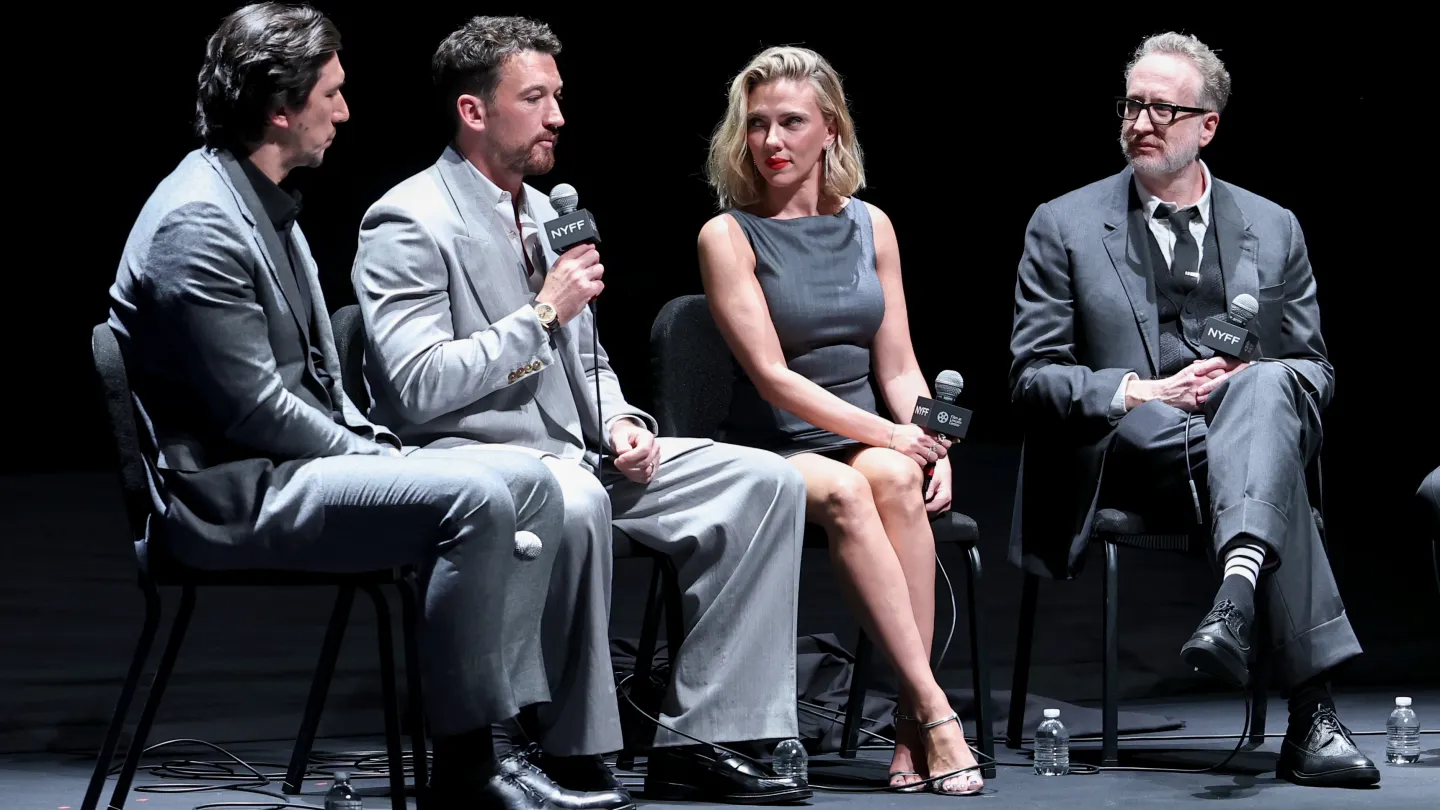
Shown on a 35mm print at Lincoln Center, this North American premiere was warmly received, with the core cast all on hand. As THR reported last week, Teller will campaign as a lead in the film — Irwin POV opens and closes the film — with past Oscar nominees Driver and Johansson going supporting. The best-actor race may be too competitive for Teller to make much of a dent, but the transformational work of Driver and Johansson, who’ve earned raves for Paper Tiger, could gain traction (and help push the film as well) coming off of the NYFF momentum.
“We were on such a small set…and also it was extremely hot, and when you have a group of actors hanging around with everybody on top of each other — honestly, that’s a labor of love. You do it because you love to do it,” Johansson said in the post-screening Q&A. “You end up hanging out and talking and sharing stories and feeling closer…. You have to survive the day, and it’s hard making movies, and it’s very hard making movies [like this].”
>


Search For Canadian TV Actor Stewart McLean Now Homicide Investigation


These ’90s fashion trends are making a comeback in 2017
According to Dior Couture, this taboo fashion accessory is back
Model Jocelyn Chew’s Instagram is the best vacation you’ve ever had
Emily Ratajkowski channels back-to-school style
9 Celebrities who have spoken out about being photoshopped


Rurouni Kenshin: Hokkaido Arc Manga Takes 1-Issue Break – News


HIDIVE to Stream English Dubs for The World Is Dancing, The Forsaken Saintess and Her Foodie Roadtrip in Another World, The Dangers in My Heart: The Movie Anime – News