
Tech
Boston Dynamics Spot’s Interaction With the Public


Building the next generation of robots for successful integration into our homes, offices, and factories is more than just solving the hardware and software problems—we also need to understand how they will be perceived and how they can work effectively with people in those spaces.

In summer 2025, RAI Institute set up a free pop-up robot experience in the CambridgeSide mall, designed to let people experience state-of-the-art robotics first hand. While news stories about robots and AI are common, with some being overly critical and some overly optimistic, most people have not encountered robots in the flesh (or metal) as it were. With no direct experience, their opinions are largely shaped by pop culture and social media, both of which are more focused on sensational stories instead of accurate information about how the robots might be used effectively and where the technology still falls short. Our goal with the pop-up was twofold: first, to give people an opportunity to see robots that they would otherwise not have a chance to experience; and second, to better understand how the public feels about interacting with these robots.
Designing a Robot Experience for the General Public
 Some earlier version legged robots, built by the RAI Institute’s Executive Director, Marc RaibertRAI Institute
 The ANYmal by ANYrobotics (left) and a previous model of the RAI Institute’s UMV (right)RAI Institute
The pop-up space had two areas: a museum area where people could see historical and modern robots, including some RAI Institute builds like the UMV, and an interactive experience called “Drive-a-Spot.” This area was a driving arena where anyone who came by could take the controls of a Spot quadruped, one of the more recognizable, commercially available robots today.
The guest robot drivers used a custom controller built on an adaptive video game controller that was designed so that anyone of any age could use it. It featured basic controls: move forward, back, left, right, adjust height, sit, stand, and tilt. The buttons were large so that tiny or elderly hands could use the controller, and the people who drove Spot ranged in age from 2 to over 90.
 The guest robot drivers used a custom controller built on an adaptive video game controller that was designed so that anyone of any age could use it.RAI Institute
The demo area was designed to be a bit challenging for the Spot robot to maneuver in—it contained tight passages, low obstacles to step over, a barrier to crouch under, and taller objects the robot had to avoid. Much to the surprise of many of our guests, Spot is able to autonomously adjust itself to traverse and avoid those obstacles when being supervised by the joystick.
RAI Institute
The driving arena’s theme rotated every few weeks across four scenarios: a factory, a home, a hospital, and an outdoor/disaster environment. These were chosen to contrast settings where robots are broadly accepted (industrial, emergency response) with settings where public ambivalence is well documented (domestic, healthcare).
The visitors who chose to drive the Spot robot could also participate in a short survey before and after their driving experience. The survey focused on two core dimensions:
- Comfort: How comfortable would you feel if you encountered a robot in a factory, home, hospital, office, or outdoor/disaster scenario?
- Suitability: How well would this robot work in each of those contexts?
The survey also recorded emotional reactions immediately after driving, likelihood to recommend the experience, and open-ended responses about what they found memorable or surprising. The researchers were careful to separate the environment participants drove through from the scenarios they were asked to evaluate in the survey. This distinction is important for interpreting the results given below.
Did Interacting With the Robot Change People’s Feelings about Robots?
Out of approximately 10,000 guests that visited the Robot Lab, 10 percent of those drove the Spot and opted in to our surveys. Of those surveyed, more than 65 percent of people had seen images or videos of Spot robots online, but most had never seen one of the robots in person.
Increased Comfort Through Experience
Across all five contexts presented in the survey (factory, home, hospital, office, and outdoor/disaster scenarios), comfort scores increased significantly after the driving session. The effects were small to moderate in magnitude, but they were consistent and statistically robust after correcting for multiple comparisons across all participants spanning children to older adults.
The largest gain appeared in the outdoor/disaster context, which started with low comfort despite high perceived suitability. People already thought Spot would be useful in search-and-rescue scenarios; they just weren’t comfortable with it performing in that scenario. This discomfort may stem from media portrayals of quadruped robots in military contexts. A few minutes of hands-on control appears to partially dissolve that apprehension.
Participants who drove through the factory-themed arena showed no significant increase in comfort, but this scenario already had the highest rating of any rated context at baseline, leaving little room for improvement.
No matter their previous experience, most people were neutral about having a Spot robot in their home before their driving experience. However, after the experience of controlling the Spot robot, people had a statistically significant increase in their comfort at having a Spot in their home and also felt that a Spot robot was more suitable for work in any environment, not just the one they had driven it in.
Better Understanding of Where Robots Can Fit Into Daily Life
Perceived suitability for Spot to operate in each context also increased. However, the pattern in the data is different. The largest gains weren’t in the high-baseline industrial and outdoor contexts. They were in home, office, and hospital—the very environments where people started out most skeptical.
Participants who drove the Spot robot in a home-themed environment didn’t just consider homes more suitable for robots; they also rated hospitals and offices as more suitable. This result suggests that hands-on control alters something more fundamental than just context-specific familiarity. It may change a person’s underlying understanding of a robot’s capabilities and, consequently, where they believe robots are appropriate.
Results by Demographic
The hands-on experience seems to be similarly effective across genders, although it does not completely eliminate existing disparities. For example, men reported higher baseline comfort than women across all five contexts. However, all genders improved at similar rates after interaction. The gap didn’t significantly widen or close in most contexts, though it did narrow in factory and office settings.
Age effects were more context dependent. Children (aged 8–17) rated factory environments as less comfortable and less suitable before the study. However, this could be because most children do not have experience with factory settings or industrial environments. After interaction, this gap largely persisted. By contrast, children showed stronger gains in office comfort than older adults and entered the study rating home contexts more favorably than adults did.
 Participants ranged from age 8 to over age 75.RAI Institute
Participants who had previously driven Spot (mainly robotics professionals) began with higher comfort across the board. But after the hands-on session, people with no prior exposure caught up to experienced drivers. This level of familiarity would be difficult to replicate with images and videos alone.
Post-Interaction Results
Post-interaction emotional data was overwhelmingly positive. “Excitement” was reported by 74 percent of participants, “happiness” by 50 percent, and only 12 percent reported “nervousness.” Over 55 percent rated the experience as “brilliant,” and 62 percent said they were very likely to recommend it to a friend.
The open-ended responses added a lot more color. The most commonly mentioned moments were locomotion and terrain adaptation (22 percent). This included the way Spot navigated steps, tight spaces, and uneven ground and expressive tilt movements (22 percent), which people found surprisingly doglike or dancelike. A smaller set of responses (3 percent) described anthropomorphic reactions: worrying about “hurting” the robot or finding its behavior “silly” in a way that prompted genuine emotional response.
When asked what tasks they’d want a robot to perform, responses shifted meaningfully. Before driving, answers clustered around domestic assistance and heavy or hazardous labor. After driving, domestic help remained prominent, but entertainment and play jumped from 7.5 percent to 19.4 percent. Companionship also appeared at 5 percent. References to hazardous or industrial tasks declined as people who had operated the robot began imagining it as a companion and playmate, not just a labor-replacement tool.
Key Takeaways from the Robot Lab
In the not-so-distant future, robots will become more common in public and private spaces. But whether that integration into daily life will be accepted by the general public remains to be seen. The standard approach to building acceptance has been passive exposure such as videos, exhibits, and articles. This study suggests giving people agency and letting them actually operate a robot is a qualitatively different intervention.
Short, well-designed, hands-on encounters can raise comfort in precisely the social domains where ambivalence is highest and where future robotics deployment will likely take place. This hands-on experience shouldn’t be limited to tech conferences and museums, as it may be more valuable than just entertaining.
 Fun for all ages!RAI Institute
We consider the pop-up a success, but as with all experiments, we also learned a lot along the way. For our takeaways, in addition to the increased comfort with robots, we also found that the guests to our space really enjoyed talking to the robotics experts who staffed the location. For many people, the opportunity to talk to a roboticist was as unique as the opportunity to drive a robot, and in the future, we are excited to continue to share our technical work as well as the experiences of our humans, in addition to our humanoids.
Does building a space where folks can experience robots firsthand have the potential to create meaningful, long-term attitude shifts? That remains an open question. But the effect’s direction and consistency across different situations, ages, and genders are hard to ignore.
Pop-Up Encounters With Spot: Shaping Public Perceptions of Robots Through Hands-On Experience, by Hae Won Park, Georgia Van de Zande, Xiajie Zhang, Dawn Wendell, and Jessica Hodgins from the RAI Institute and the MIT Media Lab, was presented last month at the 2026 ACM/IEEE International Conference on Human-Robot Interaction in Edinburgh, Scotland.
From Your Site Articles
Related Articles Around the Web
>
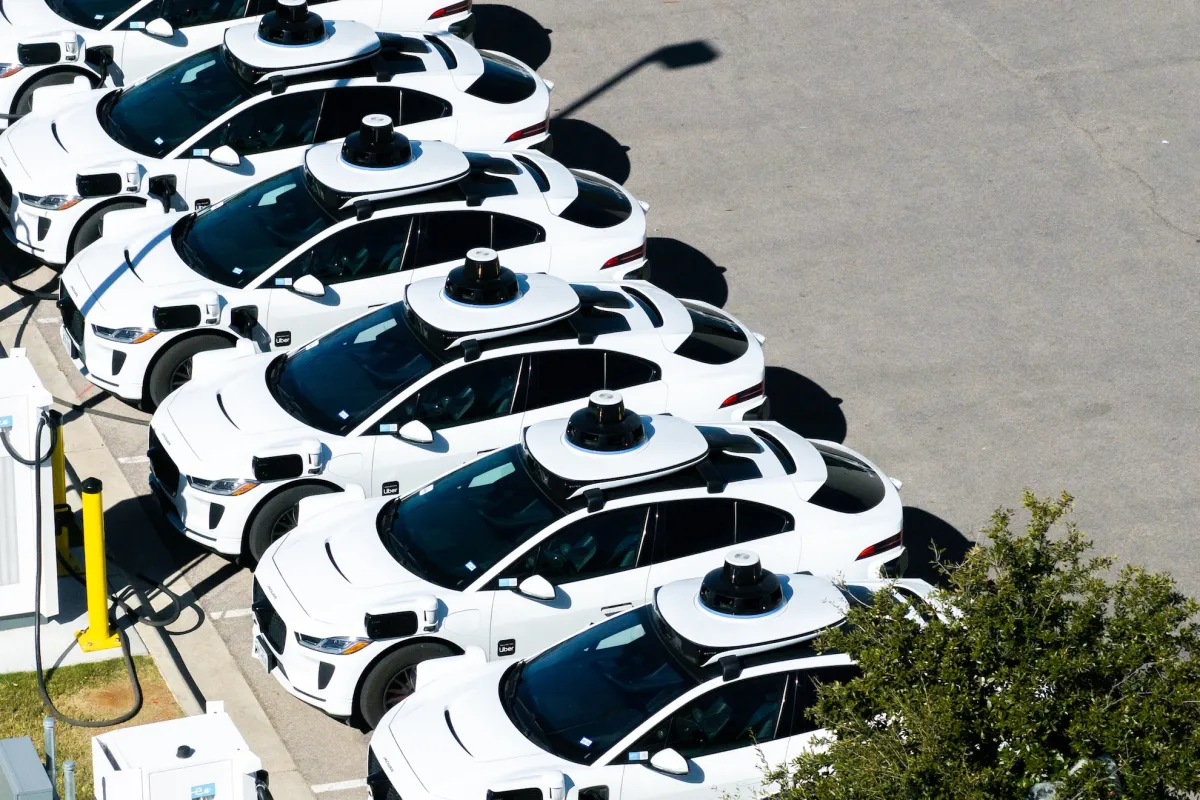
Waymo’s commercial robotaxi ramp-up looks expansive, both in geographic reach and in ridership. And by almost every measure, it is — until you pay attention to where the bulk of those robotaxis are actually showing up.
The numbers over the past two years reflect the kind of commercial rollout you’d expect from a deep-pocketed company like Waymo, which spun out of Google and still counts Alphabet as its majority owner. In September 2024, Waymo was operating in just three cities — Phoenix, Los Angeles, and San Francisco. Today, it offers robotaxi service in 15 U.S. cities, with most of those commercial launches occurring in the past year. Ridership has skyrocketed, too with Waymo now averaging 500,000 paid robotaxi rides every week.
But a closer look at its fleet shows a company concentrating its efforts in just two states. About 80% of Waymo’s roughly 4,000 robotaxis are in California and Texas, and Texas is where the action is now: Waymo’s fleet there has grown by nearly half in the past three weeks, fueled by a new Chinese-built minivan the company is betting will help it scale, even as tariffs drive up its costs.
The other 800 or so vehicles are spread across cities in other states, including Arizona and Florida, another burgeoning hotspot. Most are the familiar white Jaguar I-Pace electric SUVs, but a growing share are that new minivan — a modified Zeekr RT that Waymo has branded “Ojai.”
Waymo’s focus on California is no surprise. It is headquartered in Silicon Valley, and much of its early testing and development work was conducted there. Plus, a segment of the population there is inclined to adopt tech at its earliest stages.
The recent growth in Texas is more interesting. Waymo has increased its Texas fleet by 49% in the past three weeks, according to state vehicle registrations and data from the Texas Autonomous Vehicle Fleet Tracker. As of September 24, Waymo had 1,102 autonomous vehicles registered in the state.
Waymo first launched in commercial service in Austin through a partnership with Uber in March 2025, letting riders hail its robotaxis through the uber app. Since then, the company has expanded its robotaxi services in Dallas, Houston, and San Antonio.
Waymo’s Texas fleet remained relatively static for most of the summer, inching up from about 600 vehicles in June to more than 700 by the end of August. Then came September, when the he fleet surged, driven by an influx of new Ojai minivans, which now make up about a third of Waymo’s Texas fleet.
Expect that share to grow.
The Ojai robotaxi, equipped with Waymo’s sixth-generation self-driving system, is supposed to help Waymo reach mass scale. Its interior is built to withstand heavy use, and it comes with an upgraded rider interface and Google’s Gemini AI, which acts as an in-car assistant for riders.
Strip away that technology, though, and the Ojai is a minivan made by Zeekr, a brand owned by China’s Geely Holding Group (which also owns Volvo). The Ojai is built on Zeekr’s SEA-M platform, a shared vehicle platform designed for uses like robotaxis and delivery vans. The base Zeekr vehicles are shipped to the U.S. without any Chinese connected-car technology on board. Once they arrive, the vehicles are sent to Waymo’s Arizona factory, where they are outfitted with Waymo’s self-driving system.
The Ojai is supposed to drive down costs and ultimately help Waymo reach profitability. For now, though, tariffs are cutting any savings. Under current U.S. trade policy, vehicles built in China face steep import tariffs, raising Waymo’s costs for every Ojai it brings into the country.
Waymo appears willing to absorb that cost. New York-based research firm MoffettNathanson, which tracks Ojai imports using detailed shipping records, said in its September report that Waymo is on track to bring 5,100 of the vehicles into the U.S. by the end of the year.
Where will all those Ojai vehicles go? Texas is certainly on the list. But Florida, where Waymo operates in three cities, and newer markets like Las Vegas will likely see an influx as well.
When you purchase through links in our articles, we may earn a small commission. This doesn’t affect our editorial independence.
>
Lindsey Elliott is big into bolts. At last year’s Bolting Symposium — the 13th annual — she said the highlight was playing “Bolting Bingo” against the many self-proclaimed “torque dorks” who were in the room.
A former engineer and planner at ExxonMobil, Elliott has spent years thinking about how to improve the infrastructure that moves oil, gas, and petrochemicals. Bolts are what she landed on. Specifically, the bolts that connect sections of pipe (technically called “bolted flange joints”). These bolts require hard, physical work to loosen and tighten, and are the source of many pipefitters’ injuries. Like many trade industries, there’s also a labor shortage.
“Those people get really tired when they’re asked to work 12 hours a day for three months in a row,” she told TechCrunch. “I’ve talked to pipefitters across the U.S. across Canada, and just repeatedly have been told North American pipefitting productivity is notoriously low.”
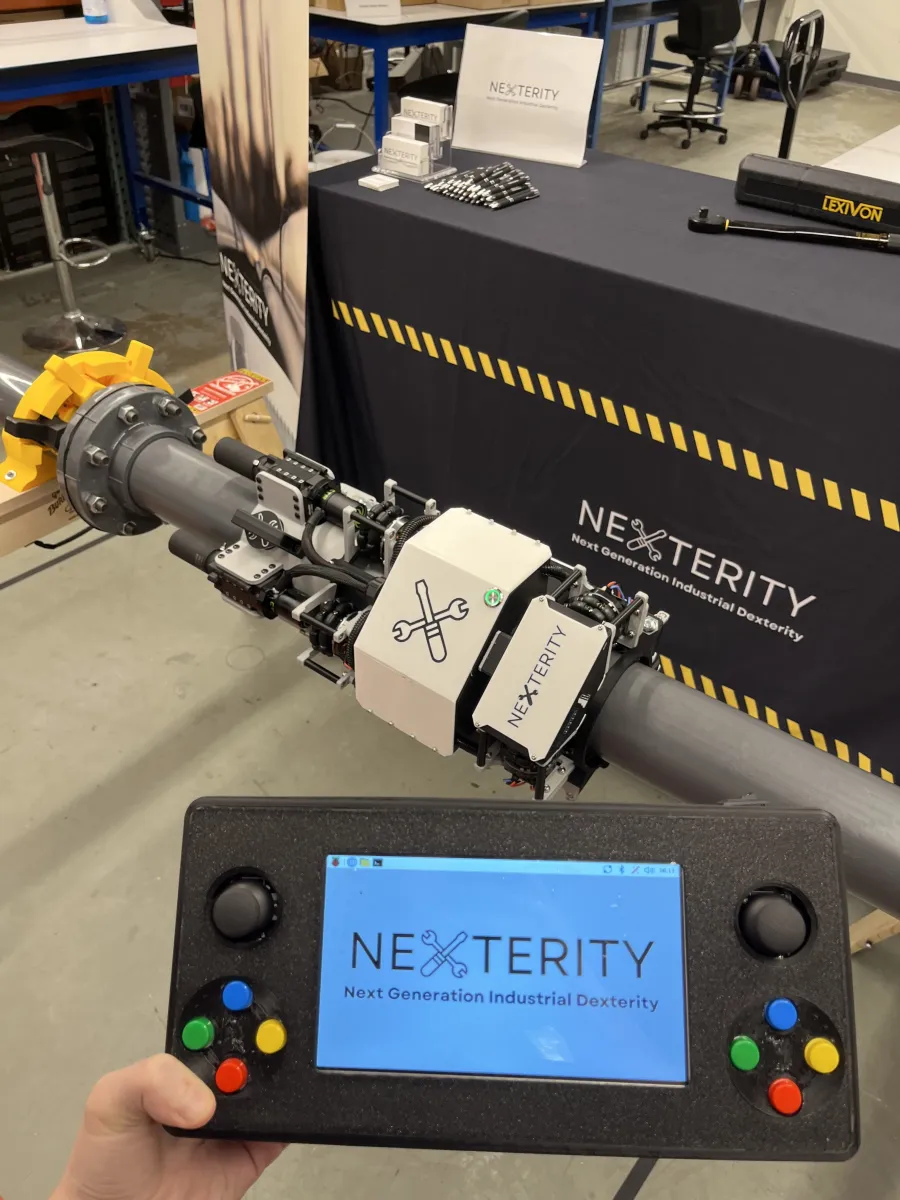
The solution Elliott came up with at her startup Nexterity, which is one of the Startup Battlefield 200 selected to participate in TechCrunch Disrupt, is a remote-controlled robot that can handle this part of the job. It’s the kind of idea that could fundamentally change this particular blue collar job if widely adopted, making the workers safer and more productive.
Think: more dork, less torque.
The robot comes in two main pieces that fit around a pipe. Powered by batteries, the robot can slide across the pipe once it’s attached and quickly loosen and tighten four bolts at a time.
Elliott said Nexterity has developed a few different configurations of the robot to fit different standard pipe sizes, but they’re all small enough to fit in a Pelican case and be carried by a single worker. That makes them easy to deploy to new sites — flexibility that is crucial to Nexterity’s business model of treating the robot like rental construction equipment.
Elliott said she arrived at this particular design as a result of conversations she’s had over the last few years — not just at the Bolting Symposium, but also with members of the Pressure Vessels & Piping Division of the American Society of Mechanical Engineers.
“What I learned from the people, the torque dorks per se,” she said, “is that 80% of our pipes are between two to eight inches in diameter, or what they call NPS2 to NPS8. And so when you have that much repeatability, you have a fantastic candidate for automation.”
It’s a pretty straightforward idea, but one that Elliott believes has a lot of upside.
“I think it would shock a lot of people just how big this market is,” she said. “I mean, day to day, most of us don’t think about piping infrastructure, but even water, wastewater, water treatment, food and beverage, mining, nuclear, any kind of green and sustainable manufacturing facility — they all use the same kind of piping.”
When you purchase through links in our articles, we may earn a small commission. This doesn’t affect our editorial independence.
>

In Guadalajara, Mexico, many high schools have motivated teachers and talented students with an interest in science, technology, engineering, and mathematics, but they lack access to advanced tools such as robotics laboratories. The resources shortfall limits the students’ opportunities for hands-on learning on cutting-edge applications.
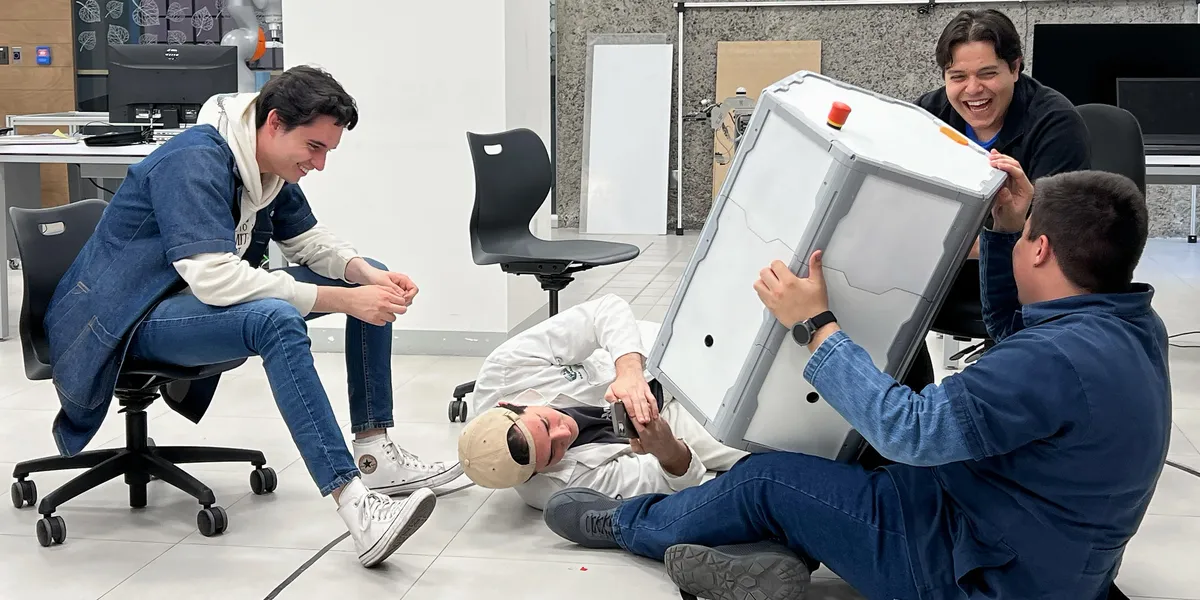
A team from ITESO, Universidad Jesuita de Guadalajara, is working to change that. Through the EPICS in IEEE initiative, a multidisciplinary group of 15 engineering students, faculty advisors, and IEEE Guadalajara Section volunteers developed RoboMeshA. The portable, self-contained educational platform brings robotics and AI experiences into classrooms.
EPICS is administered by IEEE Educational Activities and funded by the IEEE Robotics and Automation Society.
A mobile laboratory
Rather than requiring a school to build a dedicated computer lab or install complex software, RoboMeshA operates as an all-in-one mobile learning network.
“RoboMeshA brings robotics and AI to students who don’t have access to specialized facilities or preinstalled software,” says team member Fernando Vidal Luna, an IEEE student member and a mechatronics engineering major at ITESO.
Students connect directly to the platform from a user-friendly web browser. They can interact with the robot manually or use its control modes to watch it move and detect and avoid obstacles.
“The project combines mechanical design, embedded systems, control engineering, computer vision, and AI into a single robotic system that functions as a mobile learning laboratory,” says faculty advisor Jorge A. Lizarraga.
The team says young students are interested in technology, programming, and robotics but don’t have an opportunity to work with systems that combine mechanics, electronics, software, and control.
“RoboMeshA allows students to see how all these disciplines work together in a tangible and understandable way,” says team member José S. González, who also is studying mechatronics engineering.
The team has built two units and is developing a modular coupling framework to expand the system’s capabilities for research and classroom demonstrations. The structured system design approach connects independent software components while minimizing internal dependencies, enabling four RobotMeshA robots to operate together.
Overcoming design challenges
The team faced significant hurdles while designing the project.
“One key challenge involved the robot’s structural design,” Luna says. “It wasn’t only about making a chassis where all the components fit and the design had sufficient stability, rigidity, and weight distribution. It was also about ensuring that the electronics were protected while still being accessible for maintenance, testing, and modifications.”
“It was also challenging to design a platform that could be used by students with different levels of experience,” González adds.
“When students realize the technology they develop can inspire others and improve lives, engineering becomes far more meaningful.” —Luis Fernando Luque-Vega
The team partnered with the CETI Colomos and Prepa ITESO high schools to validate the platform in classroom settings.
“We wanted the first interactions with the robot to be simple and intuitive,” González says, “such that students could simply power the robot, connect to its network, and begin interacting with it, rather than having to deal with software installation, extensive configuration, or troubleshooting.”
Engineering with social impact
Many of the students who participated were from ITESO’s applied professional projects program. The experience offered them practical training in project management, system integration, and user-centered design.
The team also presented a research paper and a project poster in May at the Engineering Congress of the Jesuit University System.
“Seeing a design move from a digital model to a physical system was invaluable,” González says. “Working with students from different backgrounds taught us to listen to end users and design for their actual needs.”
Project lead Luis Fernando Luque-Vega, an IEEE member, says he’d like the venture to serve as a blueprint for engineering education.
“I hope RoboMeshA is adopted by schools, universities, and IEEE student branches across Mexico and internationally as a model for integrating technical innovation with community engagement,” Luque-Vega says.
By pairing engineering talent with community service, initiatives such as EPICS in IEEE demonstrate how targeted support can turn academic concepts into real-world solutions.
“When students realize the technology they develop can inspire others and improve lives, engineering becomes far more meaningful,” Luque-Vega says.
For more information on service-learning opportunities, visit the EPICS website.
From Your Site Articles
Related Articles Around the Web
>

Lili Reinhart Says Hollywood Is “Afraid To Make” Her Lesbian Vampire Film
Minnesota Twins, assistant GM Daniel Adler mutually part ways: Sources

Richard S. Reisberg Dead: TV Executive At Viacom, MGM/UA & Lionsgate Was 86
-

 movies4 months ago
Search For Canadian TV Actor Stewart McLean Now Homicide Investigation
-

 Fashion9 years ago
These ’90s fashion trends are making a comeback in 2017
-
Fashion9 years ago
According to Dior Couture, this taboo fashion accessory is back
-
Fashion9 years ago
Model Jocelyn Chew’s Instagram is the best vacation you’ve ever had
-
Fashion9 years ago
Emily Ratajkowski channels back-to-school style
-
Fashion9 years ago
9 Celebrities who have spoken out about being photoshopped
-

 Anime4 months ago
Rurouni Kenshin: Hokkaido Arc Manga Takes 1-Issue Break – News
-

 Anime3 months ago
HIDIVE to Stream English Dubs for The World Is Dancing, The Forsaken Saintess and Her Foodie Roadtrip in Another World, The Dangers in My Heart: The Movie Anime – News