
Tech
From RSA to Lattices: The Quantum Safe Crypto Shift



The race to transition online security protocols to ones that can’t be cracked by a quantum computer is already on. The algorithms that are commonly used today to protect data online—RSA and elliptic curve cryptography—are uncrackable by supercomputers, but a large enough quantum computer would make quick work of them. There are algorithms secure enough to be out of reach for both classical and future quantum machines, called post-quantum cryptography, but transitioning to these is a work in progress.
Late last month, the team at Google Quantum AI published a whitepaper that added significant urgency to this race. In it, the team showed that the size of a quantum computer that would pose a cryptographic threat is approximately 20 times smaller than previously thought. This is still far from accessible to the quantum computers that exist today: The largest machines currently consist of approximately 1,000 quantum bits, or qubits, and the whitepaper estimated that about 500 times as much is needed. Nonetheless, this shortens the timeline to switch over to post-quantum algorithms.
The news had a surprising beneficiary: Obscure cryptocurrency Algorand jumped 44% in price in response. The whitepaper called out Algorand specifically for implementing post-quantum cryptography on their blockchain. We caught up with Algorand’s chief scientific officer and professor of computer science and engineering at the University of Michigan, Chris Peikert, to understand how this announcement is impacting cryptography, why cryptocurrencies are feeling the effects, and what the future might hold. Peikert’s early work on a particular type of algorithm known as lattice cryptography underlies most post-quantum security today.
IEEE Spectrum: What is the significance of this Google Quantum AI whitepaper?
Peikert: The upshot of this paper is that it shows that a quantum computer would be able to break some of the cryptography that is most widely used, especially in blockchains and cryptocurrencies, with much, much fewer resources than had previously been established. Those resources include the time that it would take to do so and the number of qubits (or quantum bits) that it would have to use.
This cryptography is very central to not just cryptocurrencies, but more broadly to cryptography on the internet. It is also used for secure web connections between web browsers and web servers. Versions of elliptic curve cryptography are used in national security systems and military encryption. It’s very prevalent and pervasive in all modern networks and protocols.
And not only was this paper improving the algorithms, but there was also a concurrent paper showing that the hardware itself was substantially improved. The claim here was that the number of physical qubits needed to achieve a certain kind of logical qubit was also greatly reduced. These two kinds of improvements are compounding upon each other. It’s a kind of a win-win situation from the quantum computing perspective, but a lose-lose situation for cryptography.
IEEE Spectrum: What do Google AI’s findings mean for cryptocurrencies and the broader cybersecurity ecosystem?
Peikert: There’s always been this looming threat in the distance of quantum computers breaking a large fraction of the cryptography that’s used throughout the cryptocurrency ecosystem. And I think what this paper did was really the loudest alarm yet that these kinds of quantum attacks might not be as far off as some have suspected, or hoped, in recent years. It’s caused a reevaluation across the industry, and a moving up of the timeline for when quantum computers might be capable of breaking this cryptography.
When we think about the timelines and when it’s important to have completed these transitions [to post-quantum cryptography], we also need to factor in the unknown improvements that we should expect to see in the coming years. The science of quantum computing will not stay static, and there will be these further breakthroughs. We can’t say exactly what they will be or when they will come, but you can bet that they will be coming.
IEEE Spectrum: What is your guess on if or when quantum computers will be able to break cryptography in the real world?
Peikert: Instead of thinking about a specific date when we expect them to come, we have to think about the probabilities and the risks as time goes on. There have been huge breakthrough developments, including not only this paper, but also some last year. But even with these, I think that the chance of a cryptographic attack by quantum computers being successful in the next three years is extremely low, maybe less than a percent. But then, as you get out to several years, like five, six, or 10 years, one has to seriously consider a probability, maybe 5 percent or 10 percent or more. So it’s still rather small, but significant enough that we have to worry about the risk, because the value that is protected by this kind of cryptography is really enormous.
The U.S. government has put 2035 as its target for migrating all of the national security systems to post-quantum cryptography. That seems like a prudent date, given the timelines that it takes to upgrade cryptography. It’s a slow process. It has to be done very deliberately and carefully to make sure that you’re not introducing new vulnerabilities, that you’re not making mistakes, that everything still works properly. So, you know, given the outlook for quantum computers on the horizon, it’s really important that we prepare now, or ideally, yesterday, or a few years ago, for that kind of transition.
IEEE Spectrum: Are there significant roadblocks you see to industrial adoption of post-quantum cryptography going forward?
Peikert: Cryptography is very hard to change. We’ve only had one or maybe two major transitions in cryptography since the early 1980s or late 1970s, when the field first was invented. We don’t really have a systematic way of transitioning cryptography.
An additional challenge is that the performance trade-offs are very different in post-quantum cryptography than they are in the legacy systems. Keys and cipher texts and digital signatures are all significantly larger in post-quantum cryptography, but the computations are actually faster, typically. People have optimized cryptography for speed in the past, and we have very good fast speeds now for post-quantum cryptography, but the sizes of the keys are a challenge.
Especially in blockchain applications, like cryptocurrencies, space on the blockchain is at a premium. So it calls for a reevaluation in many applications of how we integrate the cryptography into the system, and that work is ongoing. And, the blockchain ecosystem uses a lot of advanced cryptography, exotic things like zero-knowledge proofs. In many cases, we have rudimentary constructions of these fancy cryptography tools from post-quantum-type mathematics, but they’re not nearly as mature and industry-ready as the legacy systems that have been deployed. It continues to be an important technical challenge to develop post-quantum versions of these very fancy cryptographic schemes that are used in cutting-edge applications.
IEEE Spectrum: As an academic cryptography researcher, what attracted you to work with a cryptocurrency, and Algorand in particular?
Peikert: My former Ph.D. advisor is Silvio Micali, the inventor of Algorand. The system is very elegant. It is a very high-performing blockchain system, and it uses very little energy, has fast transaction finalization, and a number of other great features. And Silvio appreciated that this quantum threat was real and was coming, and the team approached me about helping to improve the Algorand protocol at the basic levels to become more post-quantum secure in 2021. That was a very exciting opportunity, because it was a difficult engineering and scientific challenge to integrate post-quantum cryptography into all the different technical and cryptographic mechanisms that were underlying the protocol.
IEEE Spectrum: What is the current status of post-quantum cryptography in Algorand, and blockchains in general?
Peikert: We’ve identified some of the most pressing issues and worked our way through some of them, but it’s a many-faceted problem overall. We started with the integrity of the chain itself, which is the transaction history that everybody has to agree upon.
Our first major project was developing a system that would add post-quantum security to the history of the chain. We developed a system called state proofs for that, which is a mixture of ordinary post-quantum cryptography and also some more fancy cryptography: It’s a way of taking a large number of signatures and digesting them down into a much smaller number of signatures, while still being confident that these large number of signatures actually exist and are properly formed. We also followed it with other papers and projects that are about adding post-quantum cryptography and security to other aspects of the blockchain in the Algorand ecosystem.
It’s not a complete project yet. We don’t claim to be fully post-quantum secure. That’s a very challenging target to hit, and there are aspects that we will continue to work on into the near future.
IEEE Spectrum: In your view, will we adopt post-quantum cryptography before the risks actually catch up with us?
Peikert: I tend to be an optimist about these things. I think that it’s a very good thing that more people in decision-making roles are recognizing that this is an important topic, and that these kinds of migrations have to be done. I think that we can’t be complacent about it, and we can’t kick the can down the road much longer. But I do see that the focus is being put on this important problem, so I’m optimistic that most important systems will eventually have good either mitigations or full migrations in place.
But it’s also a point on the horizon that we don’t know exactly when it will come. So, there is the possibility that there is a huge breakthrough, and we have many fewer years than we might have hoped for, and that we don’t get all the systems upgraded that we would like to have fixed by the time quantum computers arrive.
From Your Site Articles
Related Articles Around the Web
>
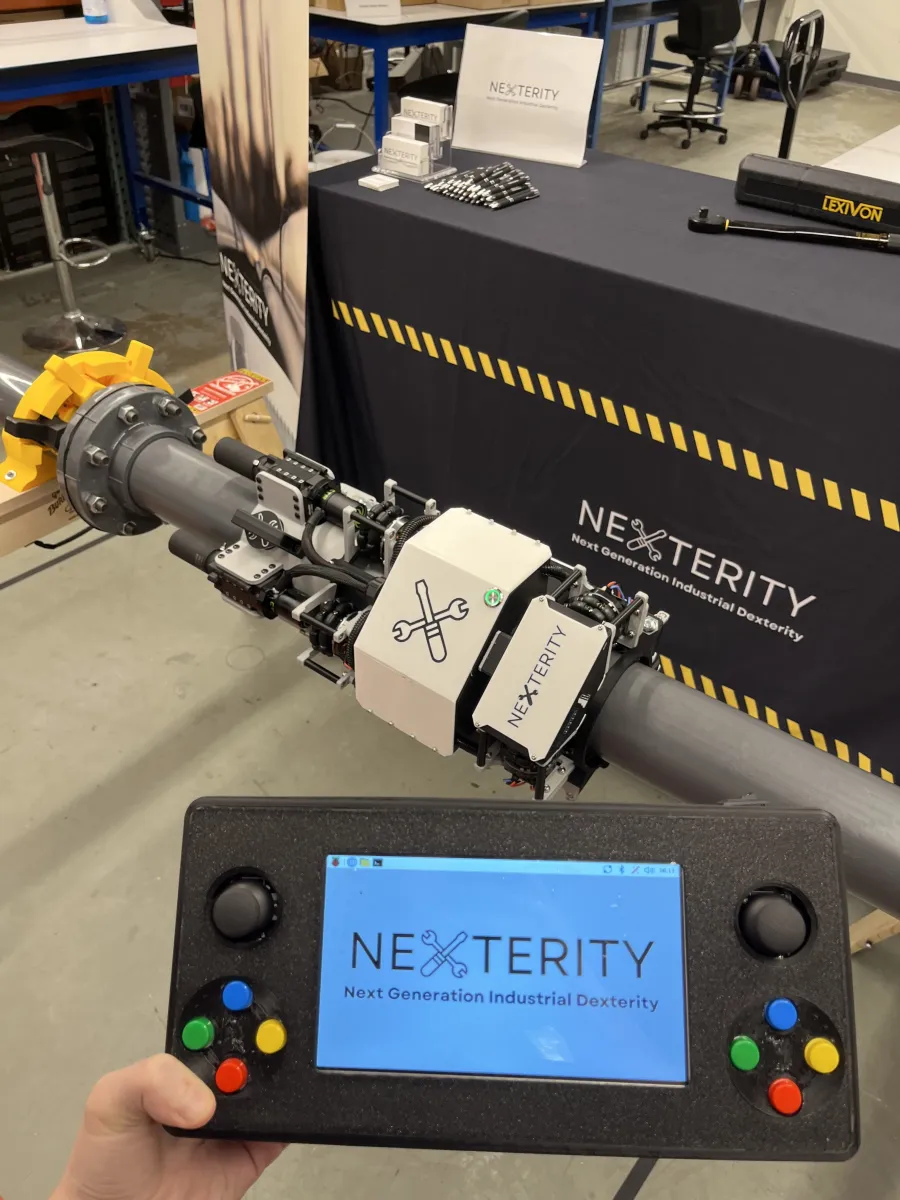
Lindsey Elliott is big into bolts. At last year’s Bolting Symposium — the 13th annual — she said the highlight was playing “Bolting Bingo” against the many self-proclaimed “torque dorks” who were in the room.
A former engineer and planner at ExxonMobil, Elliott has spent years thinking about how to improve the infrastructure that moves oil, gas, and petrochemicals. Bolts are what she landed on. Specifically, the bolts that connect sections of pipe (technically called “bolted flange joints”). These bolts require hard, physical work to loosen and tighten, and are the source of many pipefitters’ injuries. Like many trade industries, there’s also a labor shortage.
“Those people get really tired when they’re asked to work 12 hours a day for three months in a row,” she told TechCrunch. “I’ve talked to pipefitters across the U.S. across Canada, and just repeatedly have been told North American pipefitting productivity is notoriously low.”
The solution Elliott came up with at her startup Nexterity, which is one of the Startup Battlefield 200 selected to participate in TechCrunch Disrupt, is a remote-controlled robot that can handle this part of the job. It’s the kind of idea that could fundamentally change this particular blue collar job if widely adopted, making the workers safer and more productive.
Think: more dork, less torque.
The robot comes in two main pieces that fit around a pipe. Powered by batteries, the robot can slide across the pipe once it’s attached and quickly loosen and tighten four bolts at a time.
Elliott said Nexterity has developed a few different configurations of the robot to fit different standard pipe sizes, but they’re all small enough to fit in a Pelican case and be carried by a single worker. That makes them easy to deploy to new sites — flexibility that is crucial to Nexterity’s business model of treating the robot like rental construction equipment.
Elliott said she arrived at this particular design as a result of conversations she’s had over the last few years — not just at the Bolting Symposium, but also with members of the Pressure Vessels & Piping Division of the American Society of Mechanical Engineers.
“What I learned from the people, the torque dorks per se,” she said, “is that 80% of our pipes are between two to eight inches in diameter, or what they call NPS2 to NPS8. And so when you have that much repeatability, you have a fantastic candidate for automation.”
It’s a pretty straightforward idea, but one that Elliott believes has a lot of upside.
“I think it would shock a lot of people just how big this market is,” she said. “I mean, day to day, most of us don’t think about piping infrastructure, but even water, wastewater, water treatment, food and beverage, mining, nuclear, any kind of green and sustainable manufacturing facility — they all use the same kind of piping.”
When you purchase through links in our articles, we may earn a small commission. This doesn’t affect our editorial independence.
>
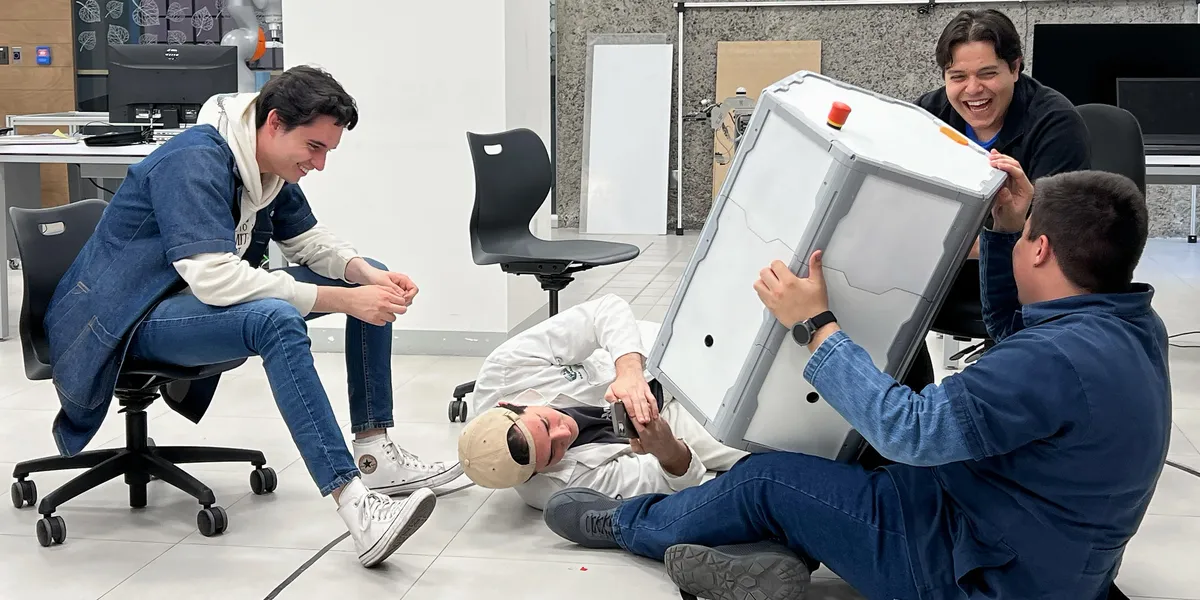

In Guadalajara, Mexico, many high schools have motivated teachers and talented students with an interest in science, technology, engineering, and mathematics, but they lack access to advanced tools such as robotics laboratories. The resources shortfall limits the students’ opportunities for hands-on learning on cutting-edge applications.
A team from ITESO, Universidad Jesuita de Guadalajara, is working to change that. Through the EPICS in IEEE initiative, a multidisciplinary group of 15 engineering students, faculty advisors, and IEEE Guadalajara Section volunteers developed RoboMeshA. The portable, self-contained educational platform brings robotics and AI experiences into classrooms.
EPICS is administered by IEEE Educational Activities and funded by the IEEE Robotics and Automation Society.
A mobile laboratory
Rather than requiring a school to build a dedicated computer lab or install complex software, RoboMeshA operates as an all-in-one mobile learning network.
“RoboMeshA brings robotics and AI to students who don’t have access to specialized facilities or preinstalled software,” says team member Fernando Vidal Luna, an IEEE student member and a mechatronics engineering major at ITESO.
Students connect directly to the platform from a user-friendly web browser. They can interact with the robot manually or use its control modes to watch it move and detect and avoid obstacles.
“The project combines mechanical design, embedded systems, control engineering, computer vision, and AI into a single robotic system that functions as a mobile learning laboratory,” says faculty advisor Jorge A. Lizarraga.
The team says young students are interested in technology, programming, and robotics but don’t have an opportunity to work with systems that combine mechanics, electronics, software, and control.
“RoboMeshA allows students to see how all these disciplines work together in a tangible and understandable way,” says team member José S. González, who also is studying mechatronics engineering.
The team has built two units and is developing a modular coupling framework to expand the system’s capabilities for research and classroom demonstrations. The structured system design approach connects independent software components while minimizing internal dependencies, enabling four RobotMeshA robots to operate together.
Overcoming design challenges
The team faced significant hurdles while designing the project.
“One key challenge involved the robot’s structural design,” Luna says. “It wasn’t only about making a chassis where all the components fit and the design had sufficient stability, rigidity, and weight distribution. It was also about ensuring that the electronics were protected while still being accessible for maintenance, testing, and modifications.”
“It was also challenging to design a platform that could be used by students with different levels of experience,” González adds.
“When students realize the technology they develop can inspire others and improve lives, engineering becomes far more meaningful.” —Luis Fernando Luque-Vega
The team partnered with the CETI Colomos and Prepa ITESO high schools to validate the platform in classroom settings.
“We wanted the first interactions with the robot to be simple and intuitive,” González says, “such that students could simply power the robot, connect to its network, and begin interacting with it, rather than having to deal with software installation, extensive configuration, or troubleshooting.”
Engineering with social impact
Many of the students who participated were from ITESO’s applied professional projects program. The experience offered them practical training in project management, system integration, and user-centered design.
The team also presented a research paper and a project poster in May at the Engineering Congress of the Jesuit University System.
“Seeing a design move from a digital model to a physical system was invaluable,” González says. “Working with students from different backgrounds taught us to listen to end users and design for their actual needs.”
Project lead Luis Fernando Luque-Vega, an IEEE member, says he’d like the venture to serve as a blueprint for engineering education.
“I hope RoboMeshA is adopted by schools, universities, and IEEE student branches across Mexico and internationally as a model for integrating technical innovation with community engagement,” Luque-Vega says.
By pairing engineering talent with community service, initiatives such as EPICS in IEEE demonstrate how targeted support can turn academic concepts into real-world solutions.
“When students realize the technology they develop can inspire others and improve lives, engineering becomes far more meaningful,” Luque-Vega says.
For more information on service-learning opportunities, visit the EPICS website.
From Your Site Articles
Related Articles Around the Web
>

We’re closing in on the last couple of weeks until TechCrunch Disrupt 2026 kicks off! To help everyone in your network gain new tech insights, discover emerging tech, and make impactful connections that move the needle, we’ve opened up a 50% discount on a second ticket across all ticket types.
This BOGO offer is live until the Disrupt doors open on October 13 at 8 a.m. PT. Buy one pass to Disrupt 2026 and get 50% off a second of the same ticket type.
This is a short window to bring someone with you — and get more out of being there. Bring a colleague. A co-founder. A partner. This offer ends when San Francisco’s Moscone West doors open on October 13 at 8 a.m. PT. After that, prices go up, and you’ll be paying more for the same access. Lock in your 50% off a second pass savings now.
You’ll get more out of Disrupt if you don’t go alone
Not one person can cover Disrupt on their own. This conference is built to bring your co-founder, partner, colleague, or friend and share the new insights and connections that are being made
From October 13-15 in San Francisco, 300+ showcasing startups and 10,000+ founders, investors, and tech leaders come together for three days of 200+ tactical sessions led by 250+ tech leaders across six industry stages, roundtables, and breakouts. Unparalleled AI-powered matchmaking drives conversations and connections that move fast and change trajectories.
When you attend with a colleague, peer, or partner, you don’t just experience more — you make better use of what you hear and who you meet. You can:
- Get into more rooms and more conversations.
- Compare what you’re hearing on the spot.
- Split up and cover more ground.
- Leave knowing what you’re going to do next.
It’s a simple shift, but it changes the outcome. Find your ticket match for you and your plus-one and save up to $450.

From idea to IPO, this is where startups figure out what’s next
Disrupt brings together 10,000 startup and VC leaders focused on what it takes to build and scale right now. Disrupt is for you if you’re:
- Evaluating opportunities.
The value comes from connecting with people working through the same challenges and learning from those who’ve already done it. Explore the Disrupt events page to see what’s planned.
Who you bring matters — choose the right pass
This buy one, get one 50% off deal applies when you purchase two of the same ticket type for Disrupt by October 13 at 8 a.m. PT, making it easy to bring someone from your team.
Investors, find your next deal faster
Buy one investor pass and get a second one for 50% off — up to a $450 savings. Connect directly with founders, access curated networking, and spend time where deal flow happens. Bringing another investor or partner helps you compare signals and act faster.
Founders, build investment momentum
Buy one founder pass and get a second one for 50% off — a $425 savings. Meet investors aligned with your stage, challenge your thinking, and hear what’s working from operators. Attending with a co-founder or teammate helps you divide and move quickly.

Operators, build, ship, and scale with more clarity
Buy one attendee pass and get a second one for 50% off — up to $412 savings. Built for product, engineering, growth, and go-to-market teams, this pass gives you access to stages, breakouts, and networking to optimize your roadmap to revenue systems.
Non-profits, apply what’s next to real-world impact
Buy one non-profit pass and get a second one for 50% off — a $237 savings. Connect with builders and investors and explore how emerging tech applies to your work. Bringing a peer helps turn what you hear into something usable.
Students, get in early and start building your network
Buy one student pass and get a second one for 50% off—a $175 savings. Learn from founders and investors and start building your network early. Attending with a peer helps you navigate more and make stronger connections.
Explorers, see what’s emerging up close
Buy one Expo+ pass and get a second one for 50% off — a $162 savings. Go behind the scenes of disruptive startups. Use the show floor to scout talent, demo emerging tech, and land your next role at a high-growth company, while covering more ground with your plus one.
You’re not just choosing a ticket, you’re creating momentum
The value of this limited-time discount goes far beyond saving on a second Disrupt pass. It’s about deepening relationships and making the most of the time you’ll spend in San Francisco. It’s the difference between attending and turning conversations into deals, hires, and next steps.
This offer is only here for five days. Buy one pass and get a second pass for 50% off while you still can. Once the offer ends, the opportunity to attend together at this price does too.
Lock in both passes before Disrupt doors open on October 13
Buy one pass. Get 50% off the second of the same ticket type. Decide who you’re bringing, and lock in your two passes before doors at the venue open at 8 a.m. PT on October 13. Secure your passes now for Disrupt and amplify the value you get from being here.
And if it’ll be just you attending, save up to $200 before prices increase tomorrow, September 25, 11:59 p.m. PT. Don’t miss out on any of these ticket savings and one of the most anticipated tech conferences of the year.

When you purchase through links in our articles, we may earn a small commission. This doesn’t affect our editorial independence.
>
Rob Pelinka on LeBron James leaving Lakers for 76ers: 'It was a great era'

Jena Malone, Dermot Mulroney, Vannessa Vasquez Land ‘Moon People’
Braves place Martín Pérez on injured list 6 days before postseason
-

 movies4 months ago
Search For Canadian TV Actor Stewart McLean Now Homicide Investigation
-

 Fashion9 years ago
These ’90s fashion trends are making a comeback in 2017
-
Fashion9 years ago
According to Dior Couture, this taboo fashion accessory is back
-
Fashion9 years ago
Model Jocelyn Chew’s Instagram is the best vacation you’ve ever had
-
Fashion9 years ago
Emily Ratajkowski channels back-to-school style
-
Fashion9 years ago
9 Celebrities who have spoken out about being photoshopped
-

 Anime4 months ago
Rurouni Kenshin: Hokkaido Arc Manga Takes 1-Issue Break – News
-

 Anime3 months ago
HIDIVE to Stream English Dubs for The World Is Dancing, The Forsaken Saintess and Her Foodie Roadtrip in Another World, The Dangers in My Heart: The Movie Anime – News