Connect with us

Entertainment

‘One Spoon of Chocolate’ Review: RZA’s Powerful Action Drama

Published

on

Some action movies take place in Action Movie World™, where fighting is baked into the concrete, and filtered into the blood. Films like “John Wick” and “Kill Bill,” to name just two, have very little in common with reality, because everyone is kicking everyone else’s ass, all the time. You can’t go to the corner store without kicking some ass along the way, because someone’s always starting a fight or finishing one. In Action Movie World™, violence is everywhere, and violence solves everything, but breaking into violence is nothing special. It’s just a day that ends in “y.”

Hip-hop super-producer and filmmaker RZA has made a film in Action Movie World™ before. His debut feature “The Man with the Iron Fists” was a larger-than-life martial arts extravaganza starring RZA himself as a kung fu blacksmith with literal iron fists. He needed those fists to beat up a villain who had a body made of brass. It’s a fun film, if not always a sensical one, but it’s a very different beast than his latest action drama “One Spoon of Chocolate,” where violence still matters and violence still hurts. Usually. It’s not set in Action Movie World™. It’s not quite the real world either, but it’s close enough.

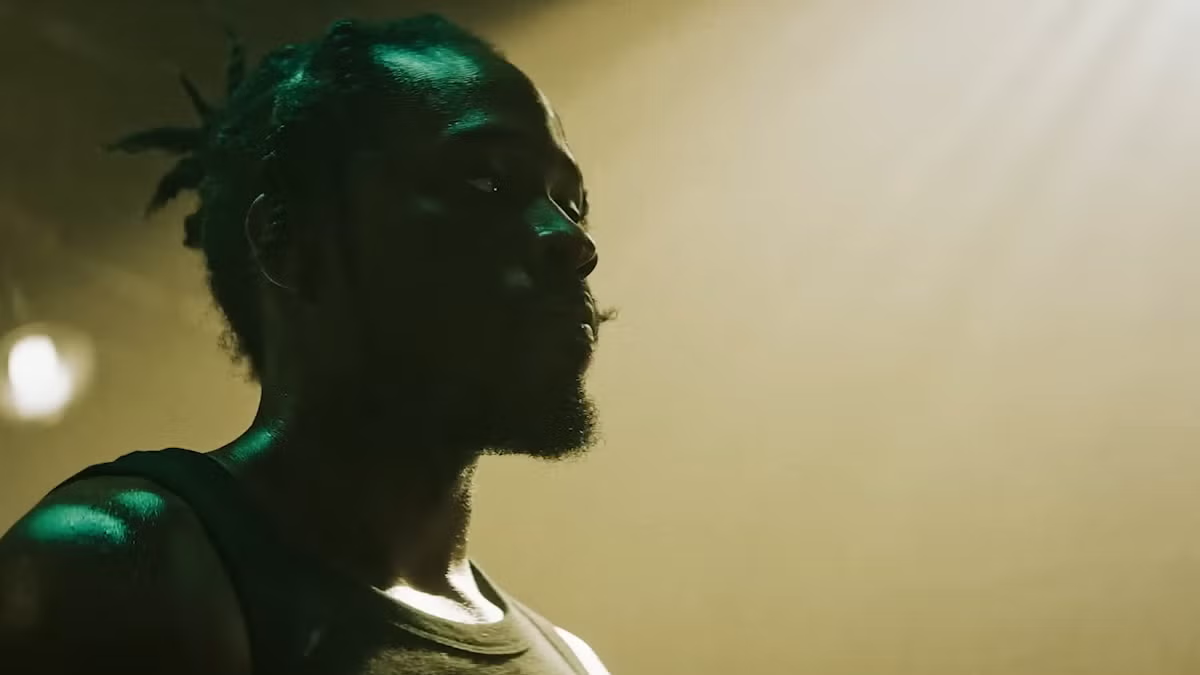
“One Spoon of Chocolate” stars Shameik Moore as Randy “Unique” Joneson, a military veteran and ex-convict who returns home to get his life together. His cousin, Ramsee (RJ Cyler), welcomes Unique with open arms and puts his name on the deed to their house. All is going well until the local white supremacists barge into the community center, where Unique and Ramsee are playing basketball, and throw their weight around. Ramsee knows these racist monsters run the town but Unique is new here, and pretty soon Unique kicks their butts six ways from Sunday.

The satisfaction is short-lived. These aren’t your typical movie bad guys. They’re kidnapping Black people and harvesting their organs, and they’re not used to meeting resistance. Their leader Jimmy (Harry Goodwins) retaliates, Ramsee gets thrown in prison for fleeing and hitting a racist with his car, and Unique goes into hiding. He also goes into training. The time for his roaring rampage of revenge is coming.

And that time is… later. Much later. “One Spoon of Chocolate” isn’t a non-stop action spectacle, it’s a drama with action in it. Unique and Ramsee get to live realistic lives before the plot kicks in, so when it does it’s not awesome, it’s tragic. There’s nothing “fun” about white supremacy, or killing Black people, or corrupt cops. Eventually they’ll all get their heads caved in but you’re going to have to wait for it, and whether this movie works or not depends entirely on whether you’re as patient as RZA is to get to a catharsis. If that’s what you can even call it.

If you’re the patient type there’s a lot to appreciate about “One Spoon of Chocolate.” RZA has assembled a cast of richly textured protagonists and despicably one-dimensional villains. They aren’t one-dimensional because it’s a bad screenplay. They’re one-dimensional because racism isn’t a side-effect of having an intelligent and soulful personality. We meet a lot of complicated Black characters with different perspectives and values. We meet only one kind of white supremacist. The only variation is how much power they have to act on their ignorant cruelty. But it’s always too much power.

If you’re not the patient type, it’s fair to say “One Spoon of Chocolate” is slow in the middle. It’s one thing to take your time introducing the characters and the world they inhabit, it’s another thing to ramp up the action a third of the way through and then ramp it all the way down for most of the second act. RZA insists that his hero is not a violent man, not at heart. He’s forced to solve problems violently because bullies don’t respect anything except force, and all the systems that should rein in these bullies are run by — you guessed it — more racist bullies. It’s slow-burn action filmmaking, gradually building pressure, until the hero’s own violence is inevitable, excusable, and irresistible.

But to get away with a slow-burn action movie you still have to keep the audience’s attention, and “One Spoon of Chocolate” could have picked up the pace without losing its depth or personality. You also have to make sure the climactic action sequence is worth the wait, like “The Big Boss” or most of the “Lone Wolf and Cub” and “Zatoichi” films. RZA’s climax is exactly the release we need after wallowing in this wretched burg, and Shameik Moore is up to the task of stomping these monsters’ heads in with homemade brass knuckles and explosives. He’s also up to the task in the film’s quiet moments. He’s a captivating star.

That final fight, which is all over the film’s trailers (and sets an unrealistic expectation for how action-packed “One Spoon of Chocolate” actually is), is worth the price of admission. RZA and cinematographer Brandon Cox don’t always find superb hero shots, and Joe D’Augustine’s editing could sometimes be clearer, but it’s a long and intense battle between a man who becomes a vigilante hero and villains who deserve his wrath. By the time he’s killing white supremacists with a Confederate flag and wiping their blood off the Stars and Stripes, you can’t help but get on “One Spoon of Chocolate’s” wavelength.

This is an angry movie, and it’s not the fun kind of anger. It’s got serious, righteous fury that stems from systemic injustice and personal tragedy. It’s a statement and it’s clear, and while it could be more thrilling, if it was that would probably undermine the message. Nothing in “One Spoon of Chocolate” qualifies as escapism. This isn’t Action Movie World™, where violence is exciting. It’s a recognizable world where violence is wrong, unless it’s wielded against horrible people who will never stop themselves and must, therefore, be stopped. So what if it could be a little shorter? The length of the journey makes RZA’s destination more meaningful.

“One Spoon of Chocolate” is now playing exclusively in theaters.

>
Continue Reading

movies

Matthew McConaughey Performs “Quill” From ‘Rivals of Amziah King’ — Watch

Published

on

Matthew McConaughey shows off his vocal skills (and some hidden banjo talents) with his latest role in The Rivals of Amziah King.

On Friday, Lakeshore Records released the single and music video for “Quill” from the original motion picture soundtrack, performed by the Oscar-winning and co-star Ben Hardesty, also featuring Miranda Zickler, Angelina LookingGlass and Andrea Pister.

Set in the backwoods of Oklahoma, The Rivals of Amziah King follows the musically gifted Amaziah King (McConaughey) and his bluegrass-playing band of misfits while overseeing the premier honey-making operation in town. When Amaziah’s estranged foster daughter unexpectedly returns, he leaps at the chance to reconnect and create a family business. But the honey game is ruthless, and Amaziah’s rivals threaten to destroy everything he has built.

Related Stories

Premiering Aug. 14 in theaters, the Andrew Patterson-written-and-directed drama also stars Angelina LookingGlass, Cole Sprouse, Jake Horowitz, Tony Revolori and Kurt Russell.

Producers are David Heyman, Teddy Schwarzman, Jeffrey Clifford, Michael Heimler, James Montague and Will Greenfield.

>

Continue Reading

movies

Jane Schoenbrun On Tackling “Toxic Soup” Of Slasher Genre In ‘Camp Miasma’

Published

on

With their latest directorial outing, Jane Schoenbrun used subtle pieces of nostalgia to deconstruct the slasher genre.

The Teenage Sex and Death at Camp Miasma writer/director explained to Deadline that they wanted to create “a mindset where you can really enjoy something scary,” noting the frequent symbolism of candy and junk food as providing an atmosphere “that’s actually safe” while diving into a horror movie or exploring sexuality after trauma.

“There is this idea that if it gets too real, you can turn it off, that you’re exploring something dangerous, doing it in a way that’s actually safe,” said Schoenbrun, who is non-binary. “Which in my experience of coming into my sexual identity post-transition, kind of required some gummy candy on hand. What I mean by that is, even if we’re going to be exploring scary and vulnerable and potentially embarrassing, triggering parts of ourselves, we trust each other well enough to know that at any moment, we can be like, ‘Let’s stop, we gotta just eat some fucking gummies.’”

In Schoenbrun’s latest film, Hannah Einbinder stars as queer director Kris, who is tapped to helm a new installment of the long-running Camp Miasma horror franchise. While courting Billy Presley (Gillian Anderson), the actress who played the “final girl” in the original film, to reprise her role, the pair spirals into a psychosexual frenzy as the slasher’s killer, Little Death (Jack Haven), comes to life.

Acknowledging the problematic trans representation of horror films like Psycho (1960), Sleepaway Camp (1983), The Silence of the Lambs (1991) and Texas Chainsaw Massacre: The Next Generation (1995), Schoenbrun admitted the genre has been “catnip to me since I was 10 years old,” and they jumped at the chance to direct their own.

Jane Schoenbrun at the
Jane Schoenbrun attends the ‘Teenage Sex and Death at Camp Miasma’ premiere on Aug. 5, 2026 in New York City.

“So many slashers do have this sense of humor, and even if they’re not overtly meta like the Scream movies are, they’re so aware of their own tropes and the sort of rituals … And I just loved that from a young age and loved all of the little rituals within it, and so, getting to make my own is just like play and joy,” they explained.

“But it also felt like the perfect way to talk about sex and to talk about my experience as a trans person post-transition, learning how to come into a sexual identity that I could feel comfortable within, because so many of these movies are obviously deeply engaged in gender and sexual roles, and these movies have so much to say for better or for worse about deviants,” said Schoenbrun. “It is there in the DNA of the slasher genre that these movies are talking about fear and desire, gender and sexuality, normativity and deviance. And that’s all swimming in the toxic soup of the genre, so I wanted to remake it in my own language.”

Read on about Jane Schoenbrun’s love letter to the slasher genre with Teenage Sex and Death at Camp Miasma, now playing in theaters.

DEADLINE: It was really fun to see the slasher genre through your eyes. Tell me about finding inspiration in that genre and “final girls.” 

JANE SCHOENBRUN: I mean, it was the easiest thing in the world because it’s just one of those genres that has been catnip to me since I was 10 years old. I just raided the horror section of the video store as a kid from an age when I really shouldn’t have been doing that, like in 5th grade, I watched in the span of about one week, every Nightmare on Elm Street movie. I think that I was always drawn to movies and really anything entertainment where it felt forbidden in some way, like the thing on the tape, how is that even allowed? And that’s the thing that I love about a lot of my favorite slashers. Don’t get me wrong, I love like brutal ones, like I love Texas Chainsaw, that’s a nasty movie at its core, and that’s what’s so special about it. But so many slashers do have this sense of humor, and even if they’re not overtly meta like the Scream movies are, they’re so aware of their own tropes and the sort of rituals of, OK, what’s the most outrageous way that like these like dumb kids can get killed? But watching it, it’s not about fear a lot of the time, it’s about joy and celebration. And I just loved that from a young age and loved all of the little rituals within it, and so, getting to make my own is just like play and joy. But it also felt like the perfect way to talk about sex and to talk about my experience as a trans person post-transition, learning how to come into a sexual identity that I could feel comfortable within, because so many of these movies are obviously deeply engaged in gender and sexual roles, and these movies have so much to say for better or for worse about deviants, whether that be Norman Bates or Buffalo Bill or Sleepway Camp or Jason, Michael Myers, Leatherface in drag. It is there in the DNA of the slasher genre that these movies are talking about fear and desire, gender and sexuality, normativity and deviance. And that’s all swimming in the toxic soup of the genre, so I wanted to remake it in my own language. 

‘Teenage Sex and Death at Camp Miasma’ (2026)

DEADLINE: I’m curious about the symbolism of all the processed junk food and the chandelier of wrappers.

SCHOENBRUN: The junk food in the movie, I forget when it found its way in there. It’s like so much of the movie is about, like I said, ritual, about being in a mindset where you can really enjoy something scary, whether that be Kris [Hannah Einbinder] in bed, with, you know, with Raisinets and the popcorn, watching a schlocky horror movie, or the two characters learning how to be present and enjoy sex after a lot of trauma. There is this idea that if it gets too real, you can turn it off, that you’re exploring something dangerous, doing it in a way that’s actually safe. Which in my experience of coming into my sexual identity post-transition, kind of required some gummy candy on hand. What I mean by that is, even if we’re going to be exploring scary and vulnerable and potentially embarrassing, triggering parts of ourselves, we trust each other well enough to know that at any moment, we can be like, “Let’s stop, we gotta just eat some fucking gummies.”

DEADLINE: And one thing I really love—I just feel like it’s a theme in your work—is how it depicts the way media and entertainment influence us. Why does that inspire you? 

SCHOENBRUN: I think it comes from a fascination and sensitivity to the complex relationship between what we think of as fiction and what we think of as reality, which we tend to, as a society, think of as pointing in one direction. Like, reality dictates fiction, not vice-versa, but when you actually look at the way the world works, it’s like one echoes off the other. And I think a complicated, sometimes terrifying and sometimes beautiful way, where the fiction, the cultural norms, the things we grow up looking at on our screens, the roles that we’re told people play, they kind of inspire us to create reality. There’s something liberating when you start thinking in that way. I think it’s a way of thinking that we as a culture, could do a lot more of. To think about the idea of fiction inspiring reality just as much as reality is inspiring fiction, is a potential path to liberating us from this hellscape that they’re telling us is the only way the world can be. 

Gillian Anderson in ‘Teenage Sex and Death at Camp Miasma’ (2026)

DEADLINE: And I know you have the Secretary reading. Tell me what it’s been like prepping for that and why you all chose that movie. 

SCHOENBRUN: I mean, that was such a huge influence on on Miasma. There just aren’t that many fun and funny movies about deviant sex. And just the way that movie is like feather light while talking about really raw and taboo things, it is just really inspiring to me. And the dynamic between those two main characters is definitely one that had a lot of influence on on Kris and Billy’s [Gillian Anderson] relationship in Miasma. And it’s already to me a very queer movie in its way, but having Gillian reading the James Spader part and Hannah reading the Maggie Gyllenhaal part, I think it’s just gonna be like a very unique joy. Honestly, we’ve been prepping a little bit, but I think it’s just gonna be about getting up there and feeling the chemistry of it all, and just letting these folks who we have all gotten to know each other really, really well, but we haven’t actually done anything wacky and creative like that in a while, like as a reunion, it’s gonna be a real blast, I think.

>

Continue Reading

movies

Jane Schoenbrun On Tackling “Toxic Soup” Of Slasher Genre In ‘Camp Miasma’

Published

on

With their latest directorial outing, Jane Schoenbrun used subtle pieces of nostalgia to deconstruct the slasher genre.

The Teenage Sex and Death at Camp Miasma writer/director explained to Deadline that they wanted to create “a mindset where you can really enjoy something scary,” noting the frequent symbolism of candy and junk food as providing an atmosphere “that’s actually safe” while diving into a horror movie or exploring sexuality after trauma.

“There is this idea that if it gets too real, you can turn it off, that you’re exploring something dangerous, doing it in a way that’s actually safe,” said Schoenbrun, who is non-binary. “Which in my experience of coming into my sexual identity post-transition, kind of required some gummy candy on hand. What I mean by that is, even if we’re going to be exploring scary and vulnerable and potentially embarrassing, triggering parts of ourselves, we trust each other well enough to know that at any moment, we can be like, ‘Let’s stop, we gotta just eat some fucking gummies.’”

In Schoenbrun’s latest film, Hannah Einbinder stars as queer director Kris, who is tapped to helm a new installment of the long-running Camp Miasma horror franchise. While courting Billy Presley (Gillian Anderson), the actress who played the “final girl” in the original film, to reprise her role, the pair spirals into a psychosexual frenzy as the slasher’s killer, Little Death (Jack Haven), comes to life.

Acknowledging the problematic trans representation of horror films like Psycho (1960), Sleepaway Camp (1983), The Silence of the Lambs (1991) and Texas Chainsaw Massacre: The Next Generation (1995), Schoenbrun admitted the genre has been “catnip to me since I was 10 years old,” and they jumped at the chance to direct their own.

Jane Schoenbrun at the
Jane Schoenbrun attends the ‘Teenage Sex and Death at Camp Miasma’ premiere on Aug. 5, 2026 in New York City.

“So many slashers do have this sense of humor, and even if they’re not overtly meta like the Scream movies are, they’re so aware of their own tropes and the sort of rituals … And I just loved that from a young age and loved all of the little rituals within it, and so, getting to make my own is just like play and joy,” they explained.

“But it also felt like the perfect way to talk about sex and to talk about my experience as a trans person post-transition, learning how to come into a sexual identity that I could feel comfortable within, because so many of these movies are obviously deeply engaged in gender and sexual roles, and these movies have so much to say for better or for worse about deviants,” said Schoenbrun. “It is there in the DNA of the slasher genre that these movies are talking about fear and desire, gender and sexuality, normativity and deviance. And that’s all swimming in the toxic soup of the genre, so I wanted to remake it in my own language.”

Read on about Jane Schoenbrun’s love letter to the slasher genre with Teenage Sex and Death at Camp Miasma, now playing in theaters.

DEADLINE: It was really fun to see the slasher genre through your eyes. Tell me about finding inspiration in that genre and “final girls.” 

JANE SCHOENBRUN: I mean, it was the easiest thing in the world because it’s just one of those genres that has been catnip to me since I was 10 years old. I just raided the horror section of the video store as a kid from an age when I really shouldn’t have been doing that, like in 5th grade, I watched in the span of about one week, every Nightmare on Elm Street movie. I think that I was always drawn to movies and really anything entertainment where it felt forbidden in some way, like the thing on the tape, how is that even allowed? And that’s the thing that I love about a lot of my favorite slashers. Don’t get me wrong, I love like brutal ones, like I love Texas Chainsaw, that’s a nasty movie at its core, and that’s what’s so special about it. But so many slashers do have this sense of humor, and even if they’re not overtly meta like the Scream movies are, they’re so aware of their own tropes and the sort of rituals of, OK, what’s the most outrageous way that like these like dumb kids can get killed? But watching it, it’s not about fear a lot of the time, it’s about joy and celebration. And I just loved that from a young age and loved all of the little rituals within it, and so, getting to make my own is just like play and joy. But it also felt like the perfect way to talk about sex and to talk about my experience as a trans person post-transition, learning how to come into a sexual identity that I could feel comfortable within, because so many of these movies are obviously deeply engaged in gender and sexual roles, and these movies have so much to say for better or for worse about deviants, whether that be Norman Bates or Buffalo Bill or Sleepway Camp or Jason, Michael Myers, Leatherface in drag. It is there in the DNA of the slasher genre that these movies are talking about fear and desire, gender and sexuality, normativity and deviance. And that’s all swimming in the toxic soup of the genre, so I wanted to remake it in my own language. 

‘Teenage Sex and Death at Camp Miasma’ (2026)

DEADLINE: I’m curious about the symbolism of all the processed junk food and the chandelier of wrappers.

SCHOENBRUN: The junk food in the movie, I forget when it found its way in there. It’s like so much of the movie is about, like I said, ritual, about being in a mindset where you can really enjoy something scary, whether that be Kris [Hannah Einbinder] in bed, with, you know, with Raisinets and the popcorn, watching a schlocky horror movie, or the two characters learning how to be present and enjoy sex after a lot of trauma. There is this idea that if it gets too real, you can turn it off, that you’re exploring something dangerous, doing it in a way that’s actually safe. Which in my experience of coming into my sexual identity post-transition, kind of required some gummy candy on hand. What I mean by that is, even if we’re going to be exploring scary and vulnerable and potentially embarrassing, triggering parts of ourselves, we trust each other well enough to know that at any moment, we can be like, “Let’s stop, we gotta just eat some fucking gummies.”

DEADLINE: And one thing I really love—I just feel like it’s a theme in your work—is how it depicts the way media and entertainment influence us. Why does that inspire you? 

SCHOENBRUN: I think it comes from a fascination and sensitivity to the complex relationship between what we think of as fiction and what we think of as reality, which we tend to, as a society, think of as pointing in one direction. Like, reality dictates fiction, not vice-versa, but when you actually look at the way the world works, it’s like one echoes off the other. And I think a complicated, sometimes terrifying and sometimes beautiful way, where the fiction, the cultural norms, the things we grow up looking at on our screens, the roles that we’re told people play, they kind of inspire us to create reality. There’s something liberating when you start thinking in that way. I think it’s a way of thinking that we as a culture, could do a lot more of. To think about the idea of fiction inspiring reality just as much as reality is inspiring fiction, is a potential path to liberating us from this hellscape that they’re telling us is the only way the world can be. 

Gillian Anderson in ‘Teenage Sex and Death at Camp Miasma’ (2026)

DEADLINE: And I know you have the Secretary reading. Tell me what it’s been like prepping for that and why you all chose that movie. 

SCHOENBRUN: I mean, that was such a huge influence on on Miasma. There just aren’t that many fun and funny movies about deviant sex. And just the way that movie is like feather light while talking about really raw and taboo things, it is just really inspiring to me. And the dynamic between those two main characters is definitely one that had a lot of influence on on Kris and Billy’s [Gillian Anderson] relationship in Miasma. And it’s already to me a very queer movie in its way, but having Gillian reading the James Spader part and Hannah reading the Maggie Gyllenhaal part, I think it’s just gonna be like a very unique joy. Honestly, we’ve been prepping a little bit, but I think it’s just gonna be about getting up there and feeling the chemistry of it all, and just letting these folks who we have all gotten to know each other really, really well, but we haven’t actually done anything wacky and creative like that in a while, like as a reunion, it’s gonna be a real blast, I think.

>

Continue Reading

Trending

Copyright © 2017 Zox News Theme. Theme by MVP Themes, powered by WordPress.