
Anime
HoYoFair 2026 “Once Upon a Time” Fan Concert LA


Hoyoverse fans are nothing if not dedicated. Ever since Genshin Impact launched during COVID, its pitch of “Breath of the Wild: the MMO” fostered one of the most long-lasting gacha communities I’ve seen in this space. Honkai Star Rail repeated that spike in interest three years later with a planet-hopping turn-based RPG, inspired by Galaxy Express 999 with enough content to rival an ATLUS game. I finally jumped on the hype train when Zenless Zone Zero introduced parry-based combat into a retro-analog urban sci-fi setting. You might even know someone who joined before the pandemic wave back when Honkai Impact 3rd stretched the limits of what a mobile game could handle. All four of these have formed their own fanbase, but one event has kept them united: HoYoFair.


Formed initially as a fan art contest, it has since become a sponsored film festival where creators are selected and given funds to produce various animated music videos. The best are given prizes as well, but the true highlight is seeing them air together LIVE on their channel. The results are doujin works with production values that rival the company’s own viral animations and music videos. Some of these are proudly showcased in official concerts for Genshin Impact and Honkai Star Rail. But for their fifth anniversary, HoYoFair decided it was time for those fan works to take center stage. While including official tracks from HOYO-MiX and San-Z, “Once Upon HoYoFair” offers fanservice from the fans themselves. But how well were fans served in the end? Well, that depended on which game you were a fan of.


Genshin Impact opened the night with very much a party vibe, taking liberties with the canon whenever possible. Some, like “time&time,” are as simple as seeing them have a blast in our world, while three others involve them splintering into pop groups. Arlecchino leads a boy band as the sole woman (Musication), Furina turns Lumine and Venti into idols (Haruka), and Yelan formed a part-time K-pop group with Ei, Yae, and Eula (OH MY MY). Others go much further with their concepts. Venti switching from Bard to Acrobat (Circus Addiction), Ayato leading a crew of secret agents (Nightfall Ops), and Siegwinne crashing Escoffier’s cooking show (The Heavens full-course) sound like what-if scenarios that happened to stumble onto a budget. The most memorable example was “The Diagnosis,” in which Kaveh’s jealousy over Alhaitham is explored through a Hamilton-esque therapy session by the Forest Watchers. It really stood out for its playfulness compared to the somber official songs with Arlecchino, Furina, and the Travelers (Emberfire, La vaguelette, The Road Not Taken).


In comparison, Honkai Star Rail‘s fan works seemed to value connection to the main story more (particularly Amphoreous). Whether the Chrysos Heirs are in urban wear (PULXE Breakers) or reliving their adventure through the style of retro JRPGs (Trash King Quest), climactic songs like “Proi Proi” don’t feel out of place in a setlist where they’re already facing titans anyway. Mem living out her magical girl era in “Memimemi myunmyun,” only to officially leave on a bittersweet note with “Ripples of Past Reverie,” feels natural when Phainon is recounting his tragedy in “Reikou” in between. “FOCUS” was like Herta and Ruan Mei’s Promo for the Space Station, so ending on the most recent EP “Side Quest King” with Silver Wolf makes sense.


This isn’t to say they didn’t have fun with the material, though. “Glorious” was a compilation of last year’s Pirate-themed Tide and Seek event, where Commodore Fei Xiao meets Mermaid Robin, Sea Witch Tingyun, and Pirate Aventurine. “Dr. Ratio’s Metaphysics of Bathing” takes the concept of your best thoughts coming in the shower to its absolute extreme, as Space-Socrates prances around in nothing but a bathrobe. My favorite of this bunch was “TRASH CAN SONG,” where everyone in Penacony feels like they got dumped for a dumpster by the trash panda awoken inside of you. Even with just these songs, their chaotic energy served just enough variety to keep it from becoming the Amphoreous show. There’s just one problem: despite equal billing on the poster, these two IPs hoarded more than half the songs.


Yes, two of the games in this line-up had only three songs each, while the others had eleven. Zenless Zone Zero got “Tiny Giant” (Zhao’s Official EP) and the two viral issey fan-songs “Arareya Kon Kon” with Miyabi and “MoeChakkaFire” with Ellen Joe. Now I personally like all of these: Tiny Giant gives off a catchy “what if Bugs Bunny did k-pop?” vibe, Arareya Kon Kon was animated by Juhachi Bancha (tuki.‘s Guilty), and MoeChakkaFire was so popular even her JP seiyuu (Shion Wakayama) released a cover of it on HoYoFair’s channel. But if there was only room for one official song, Angels of Delusion felt like a fresher pick, and Burnice still has the most staying power. It also didn’t help that one fan had to fill both spots for the fan songs.


That’s a blessing, though, compared to what their oldest title had to deal with. Honkai Impact 3rd had no fan-songs whatsoever: Regression, Rubia, and Da Capo are all official songs starring Kiana. At least Ellen got her own song; Mei seems to be there only for marketing reasons. They tried announcing each game like a new record placed on a turntable, but was there even a need to switch disks for these two? They feel like bonus tracks to what came before anyway. Why not just paste a ZZZ and HI3 sticker onto the Genshin and HSR vinyl?


I only harp on this because of how rewarding it must’ve been for fans of the HSR and Genshin. When an encore performance of “The Song of You and Me” played a montage of the night’s greatest hits, I couldn’t help feeling that it must’ve been super easy picking out the shots for ZZZ and HI3. It really encompassed the whole night: impressive, but uneven. I’m glad that HoYoFair as an event continues to exist, and I’m still happy to see it move to a LIVE stage. 「Once Upon HoYoFair 」 rewards Hoyoverse fans’ passion by showcasing that their works belong in the same space as their own songs, even if certain properties get more time to shine.
>
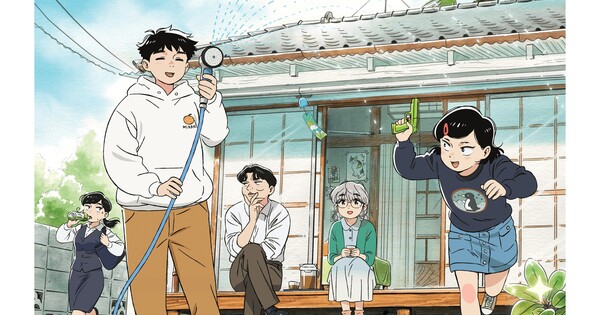
Viz Media revealed a new teaser trailer, a new key visual, and the cast for the anime of Keigo Shinzō‘s Hirayasumi manga (a co-production with Shogakukan-Shueisha Productions Co., Ltd and Production +h.) on Monday.

© Keigo Shinzo/Shogakukan/Hirayasumi Project
Yūma Uchida stars as Hiroto Ikuta, Mayu Takahashi as Natsumi Kobayashi and Rikako Aikawa as Hanae Wada.

© Keigo Shinzo/Shogakukan/Hirayasumi Project
Viz describes the human drama story:
At 29 years old, carefree Hiroto Ikuta doesn’t have a girlfriend, a full-time job, or a plan for the future—and he couldn’t be happier. Hiroto’s breezy attitude isn’t easy for everyone to understand, though. In a world filled with anxiety, confusion, and grief, Hiroto and the people around him are all just doing their best to figure out this thing called life.
Kei Suezawa (Fate/Grand Order The Movie Divine Realm of the Round Table: Camelot – Wandering: Agateram, FLCL Progressive) is directing the anime at Production +h. Naoyuki Asano (Urusei Yatsura, Keep Your Hands Off Eizouken!, Mr. Osomatsu) is designing the characters. Mika Nishimura (Dead Dead Demon’s Dededede Destruction, Typhoon Noruda) is the art director. Kaori Sawada (What Did You Eat Yesterday?, When Spring Comes) is composing the music.
The anime will premiere in January 2027 in Japan on the NHK General channel. Viz Media also announced in English a 2027 release.
Viz Media and Japan Society are also hosting the world premiere screening of the first episode at Japan Society’s location in New York City on October 7 at 7:00 p.m. EDT. Composer Kaori Sawada and producer Junichi Katsutani will be in attendance with Viz Media‘s Community Manager Godswill Ugwa as panel host.
Shinzō launched the manga in Shogakukan‘s Weekly Big Comic Spirits magazine in April 2021. Shogakukan published the manga’s ninth compiled book volume on July 30, and the series has over 1.1 million copies in circulation worldwide. The manga was nominated for the 15th Manga Taisho awards in January 2022, ranked #18 in the 2023 edition of Takarajimasha‘s Kono Manga ga Sugoi! (This Manga Is Amazing!) guidebook in December 2022, nominated for the 27th Annual Tezuka Osamu Cultural Prize in February 2023, and nominated for Best Continuing Manga Series in the 2nd American Manga Awards.
The series also inspired a live-action series, which premiered on NHK in November 2025.
Denpa has licensed Shinzō’s Holiday Junction collection of short manga. The book contains seven one-shot
manga. Shogakukan shipped the book in Japan in July 2016.
Source: press release
>
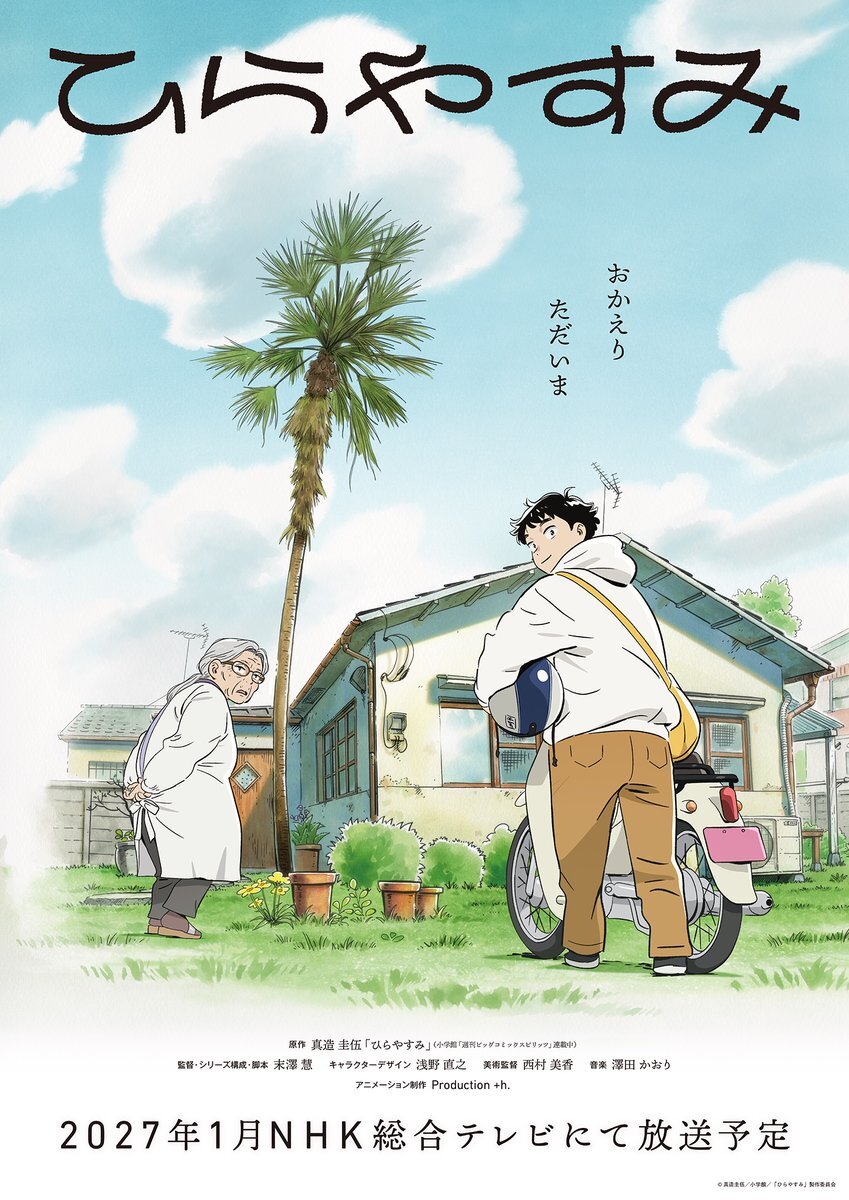
 The official website for the television anime adaptation of Keigo Shinzou‘s Hirayasumi manga revealed the main cast, a main visual (pictured) and a teaser promotional video on Tuesday. The anime is scheduled to premiere on NHK in January 2027.
Cast
Hiroto Ikuta: Yuuma Uchida (Fruits Basket 1st Season)
Natsumi Kobayashi: Mayu Takahashi (Long Zu II: Daowangzhe Zhi Tong)
Hanae Wada: Rikako Aikawa (Pokemon Sun & Moon)
Kei Suezawa (Fate/Grand Order: Shinsei Entaku Ryuoiki Camelot – Wandering; Agateram) is directing the anime at Production +h and handling the series composition and script with character design by Naoyuki Asano (Eizouken ni wa Te wo Dasu na!) and Mika Nishimura (Dead Dead Demons Dededede Destruction) serving as the art director. Kaori Sawada (Gakkougurashi! ending theme performance) is composing the music.
Shinzou began drawing the manga in Big Comic Spirits in April 2021. Shogakukan published the ninth volume in July 2025, with the tenth volume going on sale on April 30.
VIZ Media licensed the manga in English in October 2023, with the latest ninth volume released on May 19.
Teaser PV
Source: Animate Times
>
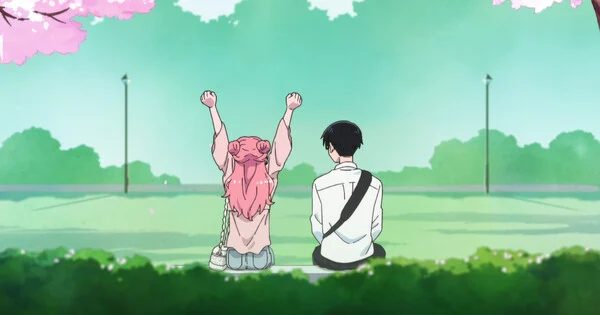

©Kocha Agasawa/SHUEISHA, You and I Are Polar Opposites Committee
The show’s actual finale might be next week, but you sure could have fooled me into thinking otherwise. For all intents and purposes, a lot of this episode feels like it’s barreling straight towards an ending, and while only two out of the three couples get any focus, what we get with them feels conclusive enough that the show probably could have stopped here if it wanted. I’m certainly not gonna say no to more, though, because while this episode does put these pairs in a much healthier spot than they were before, the path to getting there is nothing short of an emotional rollercoaster.
The bulk of that ride goes to Tani and Miyu, who at first seem to be in a pretty good spot in their relationship despite Miyu’s previous threat to split up if Tani didn’t consider all his options for where to go to college. However, while they might be hanging out more, there’s still a bit of tension lingering in the air as they both know they’ll see each other less after high school, and it is becoming increasingly apparent to Miyu just how much Tani is straining himself to make time for her. Only when Miyu talks to her friends about it does she realize that while she wasn’t wrong to tell Tani to prioritize himself over her, doing so has inadvertently put a lot of pressure on him to avoid showing any signs that he’s struggling. Fortunately, it doesn’t take too long for Miyu to correct this mistake, and she reminds Tani that even if she can’t exactly help solve all his problems, she can at least be a shoulder for him to lean on, which gets him to finally admit to feeling exhausted. While the framing here is mostly as good couple advice, even without that angle, it’s still a good reminder that there’s nothing wrong with having someone to lean on when you need it, and we all need to let ourselves be vulnerable every once in a while.
With that whole situation resolved, that just leaves the 2000-pound elephant in the room that is Taira and Azuma, and to be honest, it really wasn’t looking good for these two. For one thing, the second half of the episode flash-forwarded to spring, with still no tangible progress between them, meaning any chance of seeing them as an actual couple on screen before the end of the show was basically nonexistent. Not only that, but it even skipped straight to graduation day, meaning that the only resolution we could really hope for with these two that could still feel a little romantic would be a last-minute love confession where they don’t start dating, but express their feelings clearly enough to have grown from the experience.
Alas, even that was starting to look unrealistic, as even when the two of them manage to be alone and cry over how much they enjoyed their high school experience, Azuma decides to herself that she’d still rather keep her feelings to herself, under the mindset that without having any kind of defined romantic relationship, she still found joy in their time together. It’s a fairly mature way of looking at the experience that would have made sense for these two, and while going that route with them would have only made the constant will-they-won’t-they of their relationship more aggravating, that really looked to be where the show was going, so I was about ready to finally throw in the towel here. That made me just as surprised as Azuma when Taira stopped her from walking off by asking if they could still see each other after high school, and I’m equal parts thrilled and angry at just how effective this rug pull was since the show really did have me on the edge of my seat here the entire time leading up to it. It’s certainly not how I was expecting things to go with these two, but all things considered, it’s a pretty solid resolution.
The Taira of old would have never gotten out of his head long enough to ask Azuma that question, and even without giving a direct confession, going out on that much of a limb still indicates how much she’s come to mean to him. Of course, going this particular route means we’re unlikely to see them ever confessing to each other on screen even in next week’s finale, but leaving their relationship open-ended in such a way makes it easy enough to imagine that they’d likely just casually hook up at some point later in life, and in that sense, it doesn’t feel strictly necessary to show it. At the same time, though, there’s every chance that whatever we get in the final episode could undo that ambiguity for the worse by having their relationship stay unchanged in the future, so in that sense I’m a little worried about what we’ll be getting out of it. Frankly, I’m not entirely sure what another episode could offer beyond seeing what all these characters are like as adults, and while I can’t say I’m not curious, it is hard to imagine that sort of epilogue being worth a full 20 minutes. Still, as I said before, though, I’m not gonna turn my nose at getting to spend a bit more time with this cast, so whatever lies in store for the actual end of this show, I’m certainly down to find out.
Rating:
You and I Are Polar Opposites Season 2 is currently streaming on
Crunchyroll.
The views and opinions expressed in this article are solely those of the author(s) and do not necessarily represent the views of Anime News Network, its employees, owners, or sponsors.
>
AEW wrestler Benjamin Satterley, known as Pac, dies aged 40
Kawhi Leonard declines to answer questions about NBA investigation, punishment
Dolphins put running back De’Von Achane on IR with season-ending torn ACL
-

 movies4 months ago
Search For Canadian TV Actor Stewart McLean Now Homicide Investigation
-

 Fashion9 years ago
These ’90s fashion trends are making a comeback in 2017
-
Fashion9 years ago
According to Dior Couture, this taboo fashion accessory is back
-
Fashion9 years ago
Model Jocelyn Chew’s Instagram is the best vacation you’ve ever had
-
Fashion9 years ago
Emily Ratajkowski channels back-to-school style
-
Fashion9 years ago
9 Celebrities who have spoken out about being photoshopped
-

 Anime4 months ago
Rurouni Kenshin: Hokkaido Arc Manga Takes 1-Issue Break – News
-

 Anime3 months ago
HIDIVE to Stream English Dubs for The World Is Dancing, The Forsaken Saintess and Her Foodie Roadtrip in Another World, The Dangers in My Heart: The Movie Anime – News