
L-R: Pedro Almodóvar on set with Leonardo Sbaraglia and Quim Gutiérrez
Sony Pictures Classics


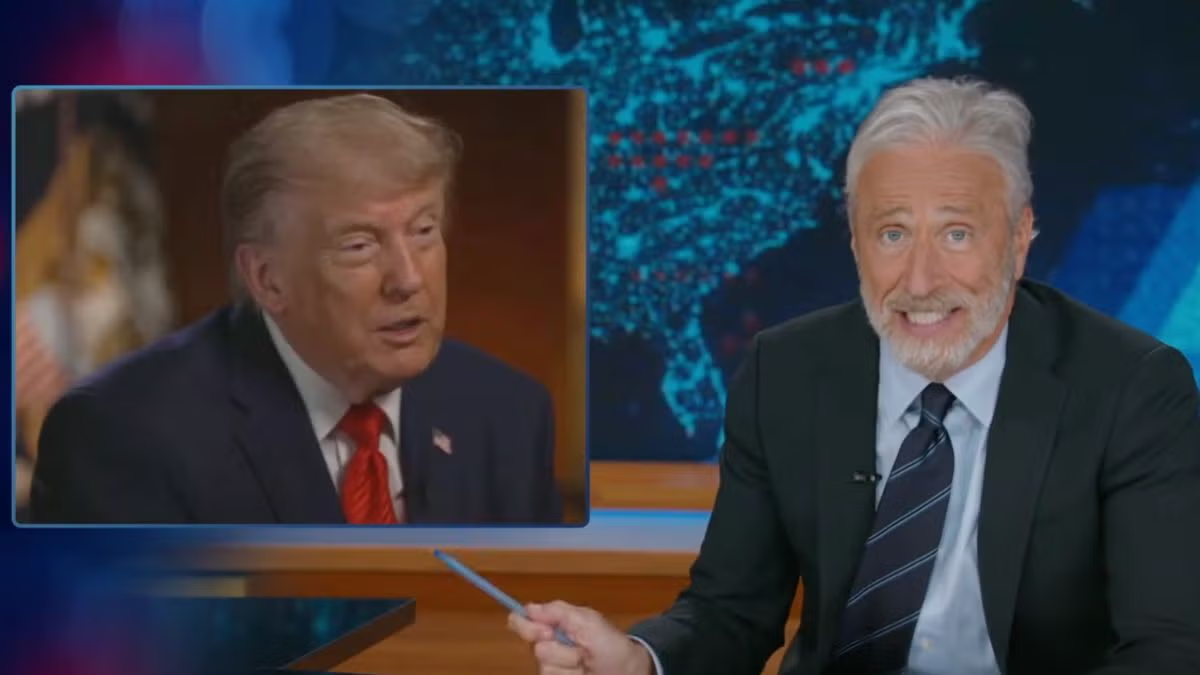
Jon Stewart blasted President Donald Trump’s excessive praise of Xi Jinping after his China trip, questioning how he was ever elected.
Stewart addressed Trump’s state visit to China during Monday’s monologue for “The Daily Show,” where he roasted the president for complimenting Xi’s leadership quality and looks.
“Everybody feeling good? You feeling good? You feeling safe? I know why you’re feeling good. I know why you’re feeling safe, ’cause daddy’s back home,” Stewart said at the top of his show. “Daddy’s back home. He’s gone for a couple of days in China. We were scared. Oh, where’s Daddy? I’m so scared. Where’s Daddy? But now he’s home. And I’m sure he brought us all the goodies from China.”
He added: “Because as we all know, nobody, and I mean nobody, is tougher on China, rhymes with vagina, than Donald J. Trump.”

“The Daily Show” then played all the times Trump boasted about the “strength” he’s displayed to China over the years, but suggested that the president failed to act on that promised “toughness.” Specifically, the comedy show aired a compilation of the many compliments Trump showered on Xi during and after the trip.
“Yeah, take that, President Xi,” Stewart said. “He’s the only leader with the balls to come to your house and say right to your face, ‘Who’s better than you? No one.’”
“And you know what? Trump’s going to say something right now, Xi. You don’t even have to say it back to him,” he added before doing a heart symbol with his hands.
While Stewart admitted that “sometimes you get more flies with honey,” he questioned what Trump actually accomplished from this trip abroad. Yet, after playing Trump’s Fox News interview, in which he said the visit helped cement the U.S.’ relationship with China, Stewart exclaimed: “So, nothing. You got nothing!”
“You flew to China. What is it, 400 million miles? I don’t know how far it is. China’s far,” he said. “You flew there to personally confront our rival superpower on the escalating trade and geopolitical tensions between us, and all you came back with was his Instagram?”
Stewart then exploded over Trump’s comment that “Hollywood couldn’t find a guy like [Xi],” as well as his odd fixation on the Chinese president’s tall stature.
“What the f–k are you talking about?” Stewart bemoaned. “You come back with, like, ‘This guy is like [GRUNTS]. I mean, you’re Chinese. You think, [GRUNTS]. But this guy, [GRUNTS].’”
He continued: “So apparently, what you came back with is, President Xi is apparently taller than what a 79-year-old white guy’s idea of what a Chinese person’s height should be. Listen, it’s probably as good as we can expect from Trump.”
Stewart then did his best impersonation of Trump, telling his audience: “Xi’s eyes are definitely wider than I thought they’d be. Can I do the eyes to show ’em? Is it OK if I do the eyes? And there was no pee pee in my Coke, contrary to what I’ve been told.”
“What are we doing? You might be watching this and wondering, how the f–k is this guy our president?” Stewart went on. “How? How is this possible? He should not have this job, and yet he does.”
Watch Stewart’s full monologue above.
The Daily Show airs weeknights at 11 p.m. ET on Comedy Central.

>

Pedro Almodóvar is known for mining his own personal experience, but Bitter Christmas (Amarga Navidad) explores this on a whole new level.
His viewpoint is reflected in the film in two interwoven protagonists — director Raul (Leonardo Sbaraglia), and Elsa (Bárbara Lennie), the cult filmmaker at the center of Raul’s screenplay. As Raul grapples with telling the story of Elsa’s life — she is wracked by panic attacks and migraines — he’s confronted by the murkiness of borrowing from real people for the purposes of fiction. Meanwhile, Elsa’s boyfriend Beau (Patrick Criado), a fireman who moonlights as a stripper, brings classic Almodóvar-esque humor, while Raul’s assistant Monica (Aitana Sánchez-Gijón) serves as the voice of reason.
DEADLINE: How long have you been thinking about this film? It feels like the culmination of so much personal experience.
PEDRO ALMODÓVAR: It’s been about four years that I’ve been working on the script intermittently while I was also working on some other projects. So it’s been brewing for about four years, which is not one of the longest periods of time for me to write a script.
DEADLINE: A hallmark of your films is the complexity and twists and turns of your plotting. How much do you plan in advance before you begin writing?
ALMODÓVAR: It sounds a little bit paranormal, but I really do feel like something else takes a hold of me during the writing process, and there comes a point at which it’s the story that’s dictating what’s happening. I was surprised by the ending myself when I got to the end of the story. This is actually the adaptation of a short story that I wrote many, many years ago, that told the story of Elsa with her boyfriend, the firefighter/stripper, and her friend Patricia (Victoria Luengo), and the trip that they take to Lanzarote. It was a complete surprise to me that Monica, the character that appears in the last half-hour of the film, is the one who’s challenging the author. She was not part of the story previously. She came to me.
L-R: Pedro Almodóvar on set with Leonardo Sbaraglia and Quim Gutiérrez
Sony Pictures Classics
DEADLINE: Speaking of that character, I wonder if that, for you, is the internal antagonist who asks those questions of yourself?
ALMODÓVAR: You’re right. Monica’s character is a reflection of the ways in which I may question myself. I’m always very aware and wary of not wanting to become complacent, and I particularly didn’t want to become complacent vis-à-vis the figure of the director, which is a reflection of myself in the film. And as Monica is challenging him, yes, she’s challenging me as a director. And I found the experience of displaying that both liberating and amusing because it did become a process of criticizing myself. Sometimes a writer doesn’t think of the way precisely that they’re going to hurt the people around them, because at the end of the day, they don’t think about the hurt, they think about the idea, and that becomes a dangerous thing. And so at a certain level, my screenwriter is kind of also the villain in the film.
One of the things that I was the most interested in that really became quite organic in this film — perhaps in a way that hadn’t been in some of my other films, although it is a topic that I have covered in other films — is the relationship between reality and fiction. I’m endlessly fascinated by that relationship, as I am fascinated by the origin of creativity. It is very mysterious to me where creativity comes from. And so that really becomes the principle theme in this film.
I have touched upon this in films like Bad Education or Broken Embraces, but I do feel like I have done this so definitively in this particular film that I may never again come back to that topic.
DEADLINE: Have you ever had a situation — as Raul does with Monica — where someone has confronted you about your work in such a personal way?
ALMODÓVAR: No, fortunately not. Because, as I said, the writer is someone who can be dangerous for loved ones, because you are always inspired, more or less, by someone that is close to you. I mean, I write with absolute freedom. So when I’m writing, I don’t think about other people, or I only think about the story itself and do exactly what the story demands me to do.
But after that, there is a debate about what are the limits of autofiction because there are no legal limits, but it’s an ethical issue. I’ve always made it a point to not hurt the people who are being reflected in my films. For that reason, I haven’t had anybody be upset at me, so I’ve never had a confrontation like the confrontation that you see in this film. And in fact, if I was ever grabbed by a story about someone who then asked me not to have their likeness be represented in the film, I might just not do the film at all.
DEADLINE: There’s a great scene with Beau set to the music of Grace Jones. Can you tell me about building that scene and about casting Patrick Criado?
ALMODÓVAR: I was very lucky with the actor. He’s very young, and I was amazed that he could be so versatile. And the key of that sequence is not only that he’s very hot, but also the response of the girls — the reactions that he’s getting from the women and the chemistry between them — is key to that scene. I had a lot of fun directing that scene. That scene is also very important to establish that Elsa is there not for erotic purposes, she’s there because she wants to cast him. And so she’s interested in his physical appearance in so far as his ass and his crotch, but not necessarily for erotic reasons.
DEADLINE: I laughed out loud in the scene where Elsa explains what it means to be a cult director. That feels so real. Is that a conversation you’ve had in your own life?
ALMODÓVAR: No, no, no. I just invented it. But it’s curious because it’s one of the favorite sequences of many people. I think there is a lot of fun explaining what a cult movie means. I mean, a cult movie means more things than that. And you have the doctor in the scene, as played by Carmen Machi, a very well-known actress, and she really lends that comedic aspect to that particular scene. The audience in Spain really laughs a lot during that sequence.
DEADLINE: I loved seeing Lanzarote in this film. I’ve been there and it’s unlike anywhere else in the world. It’s like going to the moon.
ALMODÓVAR: Yes, it’s a landscape that doesn’t seem real. It’s also almost like a mental landscape. And given Lanzarote’s volcanic, dark characteristics, it’s also the perfect place for someone to either go hide themselves or mourn, as is the case of Elsa as well. And so these particular characteristics make the island almost a character in itself.
Read the digital edition of Deadline’s Disruptors/Cannes magazine here.
DEADLINE: Do you feel you’ll ever return to English-language films?
ALMODÓVAR: First of all, with The Room Next Door, it really taught me that yes, I could direct in English. I could direct the actresses, they could understand what I was saying, I could understand what they were saying to me. And so, I knew that I could overcome that challenge. I realized that I can shoot a movie in English, but of course, not just any movie. The Room Next Door is ultimately an extension of many of my films. It’s a film about two women of a particular age, in a particular situation. And I was blessed with having these two marvelous actresses who carried the film on their shoulders — Tilda Swinton and Julianne Moore. I did that because I discovered the novel of Sigrid Nunez called What Are You Going Through. I felt like I was [working] in my own themes. So that’s why I said that I could do that movie, because I felt it was close to my interests. I’m not talking about the American culture, I don’t know it enough. I’m just talking about these two female characters. If it’s a comedy, you can invent something, but I don’t know so much the language and the country.
So, it depends, but I’m reading [English-language material] because I would like to keep on working with those actors. With Ethan Hawke I made a short film called Strange Way of Life. I would like to work again with Tilda and Julianne. And I really am looking to find something that I could manage and that could make an adaptation. So, perhaps in the future there will be another movie in English.
>

An actor who started at 22, Miles Teller earned rave reviews out of the gate for his debut performance in “Rabbit Hole,” when he was signed swiftly by CAA, followed by “Whiplash” and “The Spectacular Now.” He has worked steadily ever since, with everything from auteur fare like “Whiplash” and studio franchises such as “Divergent” and “The Fantastic Four” to his name. Holding his own opposite Tom Cruise in the blockbuster “Top Gun: Maverick” pushed him into the limelight, but he was still playing Rooster, the son of radar intercept officer Nick “Goose” Bradshaw (Anthony Edwards).
His latest role in James Gray’s “Paper Tiger,” which earned raves at Cannes, sees Teller play a real grown-up, Irwin Pearl, a Queens engineer and family man opposite Scarlett Johansson as his wife Hester, and Adam Driver as Gary, his older brother, a former cop. No longer the onscreen son of a leading man, Teller is now firmly in father roles. Irwin is slowly building a solid business when his brother offers a quicker route to success. Alas, the naive Irwin goes for the idea and, during an unscheduled night reconnaissance, blunders with the Russian mafia, seeing things he should not see.


I sat down with Teller at the Carlton Hotel in Cannes after the movie wowed in its world premiere. He was seeing it for the first time. We do not count fake standing ovations at IndieWire, but I was there and can vouch that it played well. The dynamic between Adam Driver and Miles Teller is powerful, with Scarlett Johansson holding her own in the middle. The movie could land a Cannes prize, which could push it into awards contention in the fall.
This interview has been condensed and edited for clarity and length.
Anne Thompson: You’ve played the Cannes game before.
Miles Teller: I’m one of those actors [where] it’s pretty hard to watch yourself. I always have a hard time. I was here with Nic [Winding] Refn for this limited series that we did [“Too Old to Die Young”]; that was my first time at Cannes. I’ve done Cannes with “Maverick.” It’s truly an overload of the senses.
You’ve never given this kind of performance before.
Hopefully, your taste evolves as you get older. It struck me that on my first film, “Rabbit Hole,” I was playing the wide-eyed teenager, and we filmed the majority of that movie in a house in Queens. And now I’m playing the part of the parent.

That was your breakout. You revealed some strong emotions related to your own car accident. I’m so sorry you lost your home in the Palisades Fire.
When I met James for this movie, our house had just burned down. And I had just lost my grandfather. We were renting a place in Santa Barbara, and then I got the call saying James wanted to meet me for this. That infused this story and performance with a lot of love as well, because of that feeling of home that Keleigh [Sperry] and I had lost. I’d lost it with my grandfather, but then also just the physical place where you can have people come gather, where you have memories attached. We did not have that, so that probably came through.
Do you believe that you have to grow up a bit before you can find your way in Hollywood?
If you want to have a long career, the audience, hopefully, that you attract in your early 20s, as they get older, and they start having kids or not having kids, but just getting more life experience under the belt, you want to reflect that in your choices as well. And James makes movies for adults, he deals with characters. I’ve loved every one of his films, and I’ve always felt like he gets incredible performances, so I was excited to play a man at this point.
Every actor is going to get to a place where you know it’s tough because you do something that has some success to it, and then people want you to keep doing that same thing, whether that’s from the studio side or you keep getting scripts that are that same kind of thing.

What was your pigeonhole?
When I started out with “Rabbit Hole,” and then I wanted to audition for comedy, they’re like, “he’s not funny.” And then you do comedies, and you want to be going back to drama, and they’re like, “Willard from ‘Footloose,’ what are you talking about?”
I remember “Bleed for This.” [He gets up to close the shutters to block the noise for my audio, and pours me some water.] That was a point where I was 27, and I said, “OK, I want to step up and play, not the funny friend. Playing Vinny Patz, as a five-time world champion boxer, very much a man’s man, absolutely, that was something. But it always comes down to a director, oftentimes taking what I feel is a chance on me, casting me in a role that I haven’t necessarily shown those abilities before, but believing that I could do that.
You had to carry the TV series “The Offer,” in which you play Al Ruddy, who produced “The Godfather,” running interference between Francis Ford Coppola, Robert Evans at Paramount, and the mafia. That must have been tough.
I was intimidated by portraying Al, to be honest with you, not just his bravado and accomplishments, but it felt like I was playing somebody who had more life experience than I had at that point, and there was a certain maturity to that. I enjoyed that Al, being a man of action, if he takes a step back, he’s taking two steps forward. Typically, there’s five or six different producers doing all these things: that was all Al.

In “Paper Tiger,” there’s one scene between you and Adam Driver where you get into a fight. Your face was shaking with anger.
I know. I saw that. Yeah, there was a twitch going on there. At least in my own life, your family can get to you in a way that nobody else can. Those feelings are so deeply rooted and established from childhood, so I guess in that moment, and neither one is fully aware of the ramifications of the Russians, this deal going bad, and how it’s affecting that person in their life. In that particular scene you’re letting out. It’s not just about what they’re talking about right there. It’s an entire lifetime of misgivings — he’s going to let him have it. When that’s happened to me in my personal life, you feel so bad afterwards. It’s a horrible feeling when you’re not talking to a sibling or your parents, and often it’s hard to make amends.
How did James Gray base this film on his own father’s experience?
With his father, that was the biggest regret. He took it to his deathbed, the fact that he brought this [danger] into his home, and his family became collateral damage for his business ambition. [In the movie] the venture that he went into, to go into business with his brother, he makes a mistake that was very naive. I think it’s easy to forgive this mistake. When I read this script, I had a ton of empathy for this family in this situation, and then also what Hester is going through.

Did you have any models for your character in this movie? Your own father was an engineer.
No, he was a project controls manager, but worked nuclear. The men that I grew up around, my father and my grandfather, were strong men, but very sensitive, and were dependable, reliable. My grandfather was married to my grandmother for 60-something years. I never saw her open a door for herself. I never saw her carry her own bag. He was a Marine, but he also was well-versed in world history, and he was a sweet man who was never afraid to show that side of him, but he also would stand up for himself, or his wife, or his kids, whatever it is. He took a lot of pride in that.
I found it refreshing, even comforting, to watch a movie about a kind, loving family man who’s good at his job, who’s competent. He’s a good dad. You haven’t shown that side to such a degree.
I felt immensely for this father and husband. It was clear he loves his kids, and he’s trying to lead by example, and to show them that success in life is not based on the car you drive. He wants to show them that you can build something on your own merit, and if you work hard and treat people right, that you can earn it.
Those values are no longer as respected as they once were. So, if you were to look back at your career, you did some studio work, like the “Divergent” series. Have you made a course correction? That comes with maturity, too, when an actor recognizes what they want to do rather than doing what people tell them to.
Early on, I didn’t want to feel like I was repeating what I had just done. I didn’t want people to be able to expect what I was going to do next. I always want to defend young actors in their careers, because people say, “Oh, why did you make that choice? Why did they make that choice?” You’re just hoping to get a role, and it’s less than 10 percent of people in SAG who pay their bills off acting alone. We all want to work on the best material with the best directors and the best actors. There’s an ebb and flow. I used to be more critical of work other people were doing, because you get thrown into this rat race when you’re first starting out.
Who were you competing with? Who was in your class?
It was me, and Michael B. [Jordan] and [Robert] Pattinson and Shia [LaBeouf] and [Zac] Efron was big, “The Hunger Games” stuff was blowing up. As I’ve gotten older, I appreciate and have respect for longevity, if you can hang around. I always wanted to contribute. When I was going to the Lee Strasberg Institute at NYU, and looked on the wall, there’s all these incredible actors that went through there. I hold acting and actors in such high regard, whether it’s theater or film or TV.

You seem to be delivering performances at such a level that you keep getting more work. The work itself is selling you. You had to counteract some bad press. Did that hurt you in terms of getting roles?
That was so mishandled. The reason why I have not done profiles is because I said, “Wow, if I’m not doing this interview on camera, this person can misquote things or put things out of order or say things that didn’t happen.” It felt like such a violation of what actually transpired. I told my team, “Guys, I don’t think I’m doing this again, because I’m reading this and this doesn’t sound like me to me. This is not life, so why would I ever want to be a part of something where they can just put that in?” So it’s unfortunate that being a good person, that doesn’t sell. People want to click on the negativity. If you go to bed and put your head on your pillow and how you treat people truly, that’s what matters. That [2015] interview was like 12 years ago.
Some people still remember. Well, casting directors know who you are and what you can do.
The actors, the directors, the crew, the producers, you can’t hide who you are when you’re on set.
Legal questions surround the Michael Jackson estate and his lawyer, John Branca, who you play in “Michael,” which has grossed $707 million worldwide. What’s going on with the sequel?
They had to rework the third act of the last movie. As far as the sequel goes, I know they’re working on it. I haven’t had any direct discussions, other than the team is excited to complete that story.
>

Jimmy Kimmel returned to his ABC late-night show Monday after a week in New York where he attended the Disney upfront presentation, delivering his annual roast.
Among other topics, he discussed the NBA playoffs and addressed a conspiracy theory circulating about the Eastern Conference semifinal between the Pistons and the Cavaliers, in which the Pistons tied the series at 3 games apiece before the Cavaliers took Game 7 to face the Knicks in the Eastern Conference final.
“Some believe the series was rigged in favor of the Cavaliers by the league because of this promo that aired on our network ABC the day before Game 7 took place,” Kimmel said and played the promo, which teased “The Eastern Conference Finals: Cavaliers-Nicks Game 1 on ESPN.”
A day after the promo ran, Game 7 indeed produced the the outcome “predicted” in in.
“ABC said they ran the promo by mistake and I believe them,” Kimmel said. “If ABC could predict the future, we wouldn’t have wasted $20M on a canceled season of The Bachelorette.”
In March, ABC pulled Season 22 of The Bachelorette only days before its premiere over as Taylor Frankie Paul became engulfed in a domestic assault-related controversy. Two months later, there has been no update on whether the season will be released on ABC or Hulu.
Here is Kimmel’s monologue:
>


These ’90s fashion trends are making a comeback in 2017
According to Dior Couture, this taboo fashion accessory is back
Model Jocelyn Chew’s Instagram is the best vacation you’ve ever had
Your comprehensive guide to this fall’s biggest trends
A photo diary of the nightlife scene from LA To Ibiza
Emily Ratajkowski channels back-to-school style
9 Celebrities who have spoken out about being photoshopped
The tremendous importance of owning a perfect piece of clothing