
Politics
Politics Home Article | John Healey Set To Push For More Defence Investment To Stay In Britain



3 min read
Exclusive: Defence Secretary John Healey is set to argue that more defence investment must stay in Britain.
Healey plans to make a speech at the Good Growth Foundation (GGF) on Tuesday evening, at which he is expected to argue that increased defence investment in the UK and support for British SMEs must deliver visible benefits for jobs, businesses and local communities, to sustain higher public support for higher military spending.
The Times reported on Friday that Prime Minister Keir Starmer, who is starting a fightback against a potential challenge to his leadership, is expected to approve an £18bn increase in defence spending.
Last week, Healey threw his support behind Starmer to stay on as PM, despite more than 90 Labour MPs calling for him to set out a timetable for his departure, and multiple ministers resigning from government.
The defence secretary’s speech will likely draw from a new report by GGF, a progressive independent think tank, which is set to be published on Monday. The report proposes reforms to the country’s defence industry and connects defence spending to concerns that the public feels in their everyday lives.
The think tank argues that defence is “politically fragile”, drawing on polling and focus groups that show the public does not see defence in itself as a top priority issue.
While 46 per cent of the public say they are more worried about Britain’s defence and security than ten years ago, and that the government should increase defence spending, only 10 per cent rank defence and national security among the top three most important issues facing the country.
Fifty-two per cent would support a major defence skills package, and 46 per cent said they would support ensuring SMEs receive a large share of defence spending. There is also public support for non-core defence spending going towards supporting essential public services (44 per cent), cybersecurity and protection from online attacks (40 per cent), and strengthening border security (39 per cent).
The report makes several recommendations, including proposing a new national Defence Bank that would provide government-backed finance to support British SMEs, a Sovereign Capability Regime which would require foreign defence companies that win large UK military contracts to put money back into the British economy, and a Cyber Crime Resilience Fund.
This report is based on nationally representative polls of 2,070 British adults between November 2025 and February 2026, and two focus groups in November 2025 – one with 2024 Labour Party voters who say they will vote for either the Lib Dems or the Greens at the next general election, and the other with switchers from Labour to Reform UK.
Director of The Good Growth Foundation, Praful Nargund, said: “Most voters support higher defence spending, but when there is a trade-off with essential public services like the NHS, it quickly falls down the pecking order.
“That makes Britain’s defence settlement politically fragile – and in an increasingly dangerous world, fragile is not good enough.
“We need to hard-wire defence investment into Britain’s long-term resilience: creating enduring routes into work, backing the small businesses that underpin our defence industry and protecting public services from the cyberattacks they already face.”
>


(Timon Schneider/Alamy)

7 min read
News of an AI system too powerful for public release has raised fears it could be weaponised for cyber-attacks. How much of a threat could it pose? Noah Vickers reports
It was neither just a savvy marketing move nor simply a selfless act of corporate responsibility. Instead, most informed observers agree, it was a bit of both.
On 7 April, AI firm Anthropic announced that its latest model, Claude Mythos Preview, was “strikingly capable at computer security tasks”. So capable, in fact, that they were not releasing it to the public.
Through an initiative they dubbed Project Glasswing, Mythos has been made available to America’s biggest tech giants and financial institutions. By giving them privileged access to it, Glasswing’s participants are using Mythos to find ‘zero-day’ – that is, undiscovered – vulnerabilities in their systems and patch them up.
Anthropic still intend to publicly release “Mythos-class” AI models at some stage. They just aren’t saying when. And in the meantime, experts warn that the UK’s critical national infrastructure could be vulnerable, built as much of it is on legacy systems in urgent need of modernisation.
While Mythos is said by Anthropic to have “already found thousands of high-severity vulnerabilities, including some in every major operating system and web browser”, it is only a matter of time before other AI developers devise models with similar or superior capabilities – including in China.
“I think the Chinese are not too far behind,” says Joyce Hakmeh, an associate fellow at Chatham House. While China has made public pronouncements emphasising the need for AI safety, the actions of hackers tell a different story.
“Publicly, they’re saying they want responsible AI, but we also know that the capabilities the Chinese have are quite sophisticated. We know they’ve infiltrated critical infrastructure in the US.”
Groups like Volt Typhoon, sponsored by the Chinese state, have targeted power grids and pipelines across the US, she points out. The prospect of these hackers gaining the ability to search out zero-day vulnerabilities with Mythos-class technology is therefore “really worrying”.
But a more fundamental issue, Hakmeh suggests, may be the fact that the US, UK and others are for the moment relying on the goodwill of AI firms to act responsibly.
“We’re basically expecting the AI developer to police its own products – and this can only go so far,” she says. (Although the White House last week signed a deal with Google’s DeepMind, Microsoft and xAI to conduct “pre-deployment evaluations” of their upcoming AI models, with the aim of ensuring they do not pose national security threats.)
Nevertheless, as rival AI models are developed over the coming months, not all of Anthropic’s competitors may be so cautious.
“I think there’s a concern about competitive pressures and how that drives frontier AI model producers to not always implement the same care that Anthropic has taken in this instance,” says Connor Attridge, a visiting researcher at the Alan Turing Institute.
There is already a substantial time lag between vulnerabilities being exposed and then patched, he says. A 2025 report found that even in large global businesses with more than 1,000 employees, on average, 45 per cent of vulnerabilities discovered in a 12-month period remain open.
“I think that gap between the two is going to increase and become exacerbated,” says Attridge. “The risk, there, is in UK Civil Service legacy infrastructure. There’s a tail of legacy infrastructure in places that deal with really critical data of citizens. NHS trusts, for example, have quite [a lot of] legacy software and from my understanding, pretty small IT teams. That’s a concern.”
A government review found that, on average, 28 per cent of systems in central government departments in 2024 were composed of “legacy technologies”, an increase from 26 per cent in 2023. The figure ranged from 10 to 50 per cent in NHS trusts and 10 to 70 per cent in police forces.
As far as access to Mythos for British high street banks and businesses is concerned, the UK is still in talks with Anthropic. In the meantime, large companies are exploring alternative options to secure their systems.
Katharina Sommer, director of government affairs at cybersecurity firm NCC Group, says clients at “the more mature end” of their market have been asking NCC if they can “replicate a similar level capability” to Mythos, on which they can test their IT estates against.
Behind these requests, she says, is a desire to check whether the patches they’ve put in place are sufficient and to reduce the risk of “something completely unknown being unearthed” by a Mythos-class model in future.
Experts also warn that, even before Mythos arrived, the rush from businesses to incorporate AI systems into their workflows over the last few years could itself be creating new vulnerabilities for conventional hackers to exploit.
“Everyone’s worried about the attacks from the outside, but not how they’re making themselves more vulnerable, perhaps, by rapidly deploying AI technologies in the business,” says Rafe Pilling, director of threat intelligence at cybersecurity firm Sophos.
We’re basically expecting the AI developer to police its own products – and this can only go so far
Pilling says there is “plenty of scope” for large language models to be used both for social engineering and for exfiltrating data from organisations.
“It really depends what that [AI model] is connected to and what access it has,” he says. “So, in a rush to provide a great experience for the customer and plug it into your order management system, financial databases and customer information systems, you may inadvertently provide a route in to access all that stuff.”
So far, Whitehall’s response to Mythos has been well-received by the cybersecurity sector. The government has written an open letter to businesses across the country, urging them to plan and rehearse their responses to critical incidents. Security minister Dan Jarvis has meanwhile invited technology firms to “partner with” the government “to co-develop AI” for a “national cyber defence” project – though the details of this remain unclear.
Following some delay last year, the government has also been progressing its Cyber Security and Resilience Bill through Parliament. The legislation will bring ‘managed service providers’ – the technology firms who provide core IT services to businesses – within the scope of existing regulations.
This will place a legal duty on them to have “appropriate and proportionate measures” to guard against cyber-attacks, while also tightening the requirements to ensure that breaches are swiftly reported to regulators.
The bill is yet to reach the Lords, but many in the cybersecurity sector argue it is an important statement of intent from ministers.
“The proof will be in the pudding,” says Sommer. “On the whole, there is very clear signposting from government to say ‘This is what you have to do’.
“The way in which regulators will be empowered and resourced to do the enforcement properly, I think, will be a really important part of the success of the legislation.

“If it’s a piece of paper that’s ultimately toothless, it might not have the desired effect, but I think the way in which it has changed the conversation has already made a really positive impact… The level of maturity and informedness by parliamentarians scrutinising the legislation is miles ahead of where we were five or six years ago.”
The fact that the UK is the only known government, other than the US, to have been granted direct access to Mythos – and for the UK’s AI Security Institute to then publish the world’s only independent assessment of Mythos’ capabilities – has also been positively remarked on.
“It speaks to the relationship that the UK has developed with these [AI] companies,” says Hakmeh, who adds that news of Anthropic expanding their London office is another boon for Britain.
If the right steps are taken over the coming months, tools like Mythos could be used to ensure software is “secure by design” at the development stage, she points out.
“If you are producing systems which are much more secure, because AI is letting you do that cheaply, then that starts changing the equation quite considerably.
“It’s not all gloomy. This is a dual-use technology: use it for good, you do brilliant stuff. Use it for bad, you have a big problem. It’s basically a question of who gets there first.”
>


Andy Burnham launched his Makerfield by-election campaign on Friday (Alamy)
4 min read
Andy Burnham said he is running a by-election campaign for “change” in politics, the economy, housing, transport, and care, as he launched his bid to become the new Labour MP for Makerfield.
Last week, Labour MP and former minister Josh Simons announced he would give up his Makerfield constituency – after being elected for the first time just two years ago – to allow Greater Manchester Mayor Burnham a shot at re-entering Parliament via a by-election.
With Burnham now having been selected as the Labour candidate, the by-election will go ahead on 18 June. If he wins, the mayor is expected to challenge Prime Minister Keir Starmer for the Labour leadership.
“British politics is tired,” Burnham said, addressing a crowd of supporters at the Labour campaign launch in Makerfield on Friday morning.
“It needs a new script. And over the next four weeks, the people of Makerfield are going to write that script.”
He repeatedly tapped into a sense of Westminster politics not working for people around the country.
“This by-election will force Westminster to focus on the places it usually looks past,” he said.
“I love this place, I love the people of this place, but what I have inside is a burning sense of injustice that the proud communities of this place face a Westminster system that puts them at the bottom of the list. They should be at the top of the list.”
He called for “change to Westminster politics so that it works for people”.
“This by-election is a clarion call for change, change for people, a place I love so much,” Burnham continued.
“Change to the economy, change to education, change to housing, change to transport, change to care, and yes, to make it all possible, change to politics.
Summarising his campaign in three words, Burnham said: “I’m for us.”
He also said he recognised that the Labour Party “needs to change”.
“We need to be better than we’ve been,” he said.
“We’ve not been good enough, and I want to leave people in no doubt today. A vote for me in this by-election campaign is a vote to change Labour. It is a vote to give the people here in these communities who supported us through the years their party back. This is a vote for a party that is solidly on the side of working-class people and working-class communities.”
On transport, Burnham said “I like my buses”, referring to the scheme he oversaw which brought Greater Manchester buses back under public control in 2023. However, he highlighted ongoing concerns about the cost of rail journeys.
“£364 is the cost of an anytime return from Wigan North Western to London Euston,” he said.
“So how can people here connect with the capital and all of the opportunities it’s got, if they cannot afford those train fares? We need to use rail re-nationalisation to reduce those train fares and make them affordable to people again.”
He also brought Liverpool Mayor Steve Rotheram to stand alongside him, and praised the successes of Greater Manchester and Liverpool since they both left Westminster as MPs to become mayors.
“In those ten years we have built a new politics,” Burnham said.
“We’ve worked on a place-first basis, rather than party first. We’ve focused on problem-solving rather than point scoring. And you know what? When you do that and you work differently, it’s amazing what you can achieve, isn’t it?”
Burnham also pointed to the need to change education and advocated for an education system “that doesn’t just focus on the university route”, but “focuses on the kids who want technical pathways to those new industries”.
He said he was feeling “emotional” about the campaigning bringing him “back to where it all began” in Westminster, and batted away accusations that he is using this by-election as a “stepping stone” to power.
“How can it be a stepping stone if it takes you back to where it all began?” he said.
“Surely it can’t, and the reason it comes back to is because I’ve never stopped what I started 25 years ago. I fought for these people in these places as a member of Parliament, I fought for them as a minister… We fought for people in the North West of England, fought for people here, we fought for them as mayors together…
“I would carry that fight forward if I am lucky enough to be elected as the MP for Makerfield. I’ll take that fight as high as I can possibly take it, and that’s the journey I’ve always been on. And it’s not a new journey for me, it’s the same journey, just in a different phase, and that’s what this is all about.”
>
Politics
The House | Fit For Service? Royal Navy Fitness Test Pass Rates Fall Sharply Over Last Decade

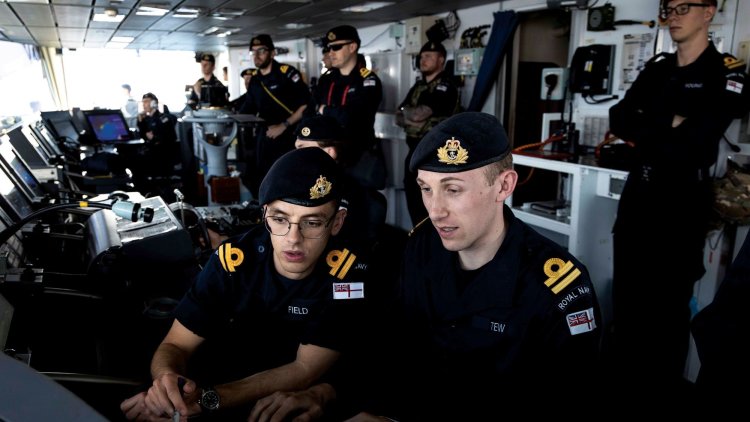
Officers at work on the bridge of HMS Dragon as it sails into Limassol, Cyprus, 27 April 2026 (Photography, LPhot Helayna Birkett. UK MOD © Crown copyright 2026)
6 min read
The Iran conflict has drawn attention to gaps in Royal Navy capability but, as Tom Scotson finds, it’s not just its ships that need to get into better shape
In the early days of the Iran conflict, as UK allies in the Gulf – and even Cyprus – were being hit by drones and missiles, Keir Starmer pledged to send a warship to help defend them.
The only problem was the only available vessel, HMS Dragon, was undergoing a refit in Portsmouth. The effort to get the ship ready was extraordinary but there was no escaping the embarrassment.
The Royal Navy has been the object of ridicule from US secretary of war Pete Hegseth and, repeatedly, Donald Trump himself. It is widely acknowledged that the UK has an inadequate number of warships currently available, with new frigates only coming into service at the end of the decade.
But a navy is about more than its vessels – and data uncovered by The House suggests that not all is well with its personnel.
On the face of it, the health of the Royal Navy is improving after decades of cuts. By January 2026, it was reported that there had been a 14.5 per cent uptick in the numbers of people joining the navy, with the fleet boasting a strength of around 32,160 personnel.
But according to a Freedom of Information request made by The House, the number of personnel who passed their fitness tests between 2014 and 2024 fell dramatically.
Between 2014 and 2015, 96.6 per cent of both men and women in the fleet passed their fitness tests on first attempt. However, 10 years later only 77 per cent of people passed the exams initially – a drop of almost 20 percentage points.
The number of Royal Navy personnel who failed their fitness tests at the first time of asking but passed within a year increased from 21 people to 1,219, 10 years later. Meanwhile, the same data found that Royal Navy personnel who failed their fitness tests on their first attempt then passed more than a year later rose from six people in 2014 to 86 a decade later.
As the navy grapples with falling standards and recruitment shortfalls, how can it restore and improve standards within its ranks?
Fred Thomas, Labour MP for Plymouth Moor View and a former Royal Marines officer, tells The House why he believes the numbers have declined.
“The overall offer was eroded year by year under the Conservative Party when they heavily cut funding,” he says. “The combined total of: how enjoyable is the job, what does it pay, what perks do you get including housing and medical benefits, how much status does it confer in society? How proud are you of your work for the navy and what sacrifices are you willing to make for the job?
“This will sound political but they hollowed out the military and it’s in a bad place now. It’ll take many years to turn it around. And at the same time we desperately need to modernise our capabilities.”
Many of the navy’s problems do not emanate from just cash flow problems either. Experts argue that in an increasingly competitive job market there are more careers out there which attract people’s interest – whether they be easier or more glamorous.
Commodore (Ret’d) Steve Prest, Rusi associate fellow, says people join the navy for one reason and that is it is better than the alternatives.
He adds: “Now it is different because young people, especially, often don’t want to be away and disconnected. A recent patrol had submariners away for 205 days under water, where they don’t have the ability to send information off the submarine. In the modern era, people expect to remain connected; when they see a blue tick, they expect a response instantaneously.
“It’s not to say a career in the Royal Navy is not rewarding. I know of people who were recently on that trip and thought it was one of the best things they ever did. It’s just harder to persuade people to go into the navy when everywhere else is so connected.”
Prest admits numbers have gone up a little, as recruitment has improved – despite the trained strength in the fleet having dropped. This means that the overall experience in the navy has reduced, with experienced staff leaving faster than the experience which can be grown in newcomers.
This will sound political but they hollowed out the military and it’s in a bad place now. It’ll take many years to turn it around
“With limited opportunities for people to gain sea experience, owing to the paucity of seagoing vessels, this is a real concern,” Prest tells The House.
“It means the ships’ companies bringing the new-build frigates into service will be vastly less experienced than their predecessors.
“We need a more balanced pipeline. The new recruits all need time at sea and interesting places to visit. There are no shortcuts to learning under those who know the ropes.”
The navy has also been affected by falling wages, which have cut across the public sector.
From day one, new officer recruits earn £34,676 per year. This will increase to £41,456 after their first promotion, followed by £52,815 as a lieutenant. The highest captain within the fleet will earn £122,849.
With a healthy pension and access to subsidised accommodation, the offer on the face of it looks good. Yet the problem is two-fold: talented people can earn far more in the private sector, in blossoming careers such as software engineering and coding; secondly, experts say demand is still depressed from cuts inflicted during austerity.
Admiral Lord West, former first sea lord and chief of the Naval Staff from 2002 to 2006, says: “Part of the problem is there was no pressure to recruit more people, the manpower was cut. When you depress something it’s difficult to try and bring it up to the same level again.”
He tells The House that the bottom line is that there is not enough money for the MoD – like most government departments.
And without greater investment, existing naval talent is going to waste, warns Prest: “If we don’t have enough ships to get them out on missions, then we can lose some of the best recruits as they idle ashore – that’s not what they joined to do.”
>

‘The Birthday Party’ Lands 12-Minute Ovation At Cannes Premiere

Mary Earps, former England goalkeeper, talks to BBC Sport

Emile Hirsch on the Legacy of Speed Racer
-

 Fashion9 years ago
These ’90s fashion trends are making a comeback in 2017
-
Fashion9 years ago
According to Dior Couture, this taboo fashion accessory is back
-
Fashion9 years ago
Model Jocelyn Chew’s Instagram is the best vacation you’ve ever had
-
Fashion9 years ago
Your comprehensive guide to this fall’s biggest trends
-
Fashion9 years ago
A photo diary of the nightlife scene from LA To Ibiza
-
Fashion9 years ago
Emily Ratajkowski channels back-to-school style
-
Fashion9 years ago
9 Celebrities who have spoken out about being photoshopped
-
Fashion9 years ago
The tremendous importance of owning a perfect piece of clothing
