
Entertainment
‘How We Grieve’ Trailer: Rachel Bloom PBS Documentary Series on Death


Grieving is a deeply personal experience that manifests in different ways for everyone. Some people laugh through their tears, while others couldn’t laugh to save their life, but the hard truth remains: Everyone is going to experience loss.
To help prepare for the inevitable — be it losing a loved one or your own eventual passing — filmmakers Meghan and Justin Ross made “How We Grieve,” a “traumedy” documentary series that explores the various ways people mourn those who move on first, while helping all of us ready ourselves for our own “turn in the urn.” Mixing comedy with earnest discussions of death, the series visits comedy shows hosted in funeral homes and talks to end-of-life doulas at death-themed film festivals, all to get people talking “about the stuff no one else (especially [our] Arab family) wants to talk about.”


Rachel Bloom, the “Crazy Ex-Girlfriend” creator and star, is onboard as an executive producer. She recently tackled the topic of mortality with her own stage show, “Death, Let Me Do My Show,” which toured the country from 2022-2023 and then developed into a Netflix comedy special, “Death, Let Me Do My Special.”
Bloom previously worked with the Rosses on a short they made in 2020, but the parties never met in person due to pandemic restrictions. They stayed in touch over social media until “How We Grieve” presented another opportunity to collaborate.
“I knew she had toured with a comedy special that addresses the grief she experienced from the loss of her writing partner early on in the pandemic, so I reached out to see if she’d be interested in supporting as a mentor/EP,” Meghan Ross said in a statement. “She was kind enough to respond quickly to request the pilot link, and then followed up to say she’s down to support it!”
The Ross siblings’ previous short films have been featured in The New Yorker and nominated for Webby Awards. On May 28, Meghan will be in Austin, Texas at the ATX TV Festival to participate in a panel called “The PBS Process,” which takes “a look through the lens of PBS as a powerful platform to tell stories in a variety of formats and showcase local and regional storytelling to audiences near and far.
The filmmakers are actively raising funds for a second season, after many of the organizations and nonprofits they partnered with in the past were impacted by the Trump administrations’ cuts to the National Endowment for the Arts. To learn more about the project and donate, visit their fundraising page.
Watch the trailer for “How We Grieve” below. Season 1 will premiere on PBS in October. Visit the ATX TV Festival’s official site for ticket and badge information.
>
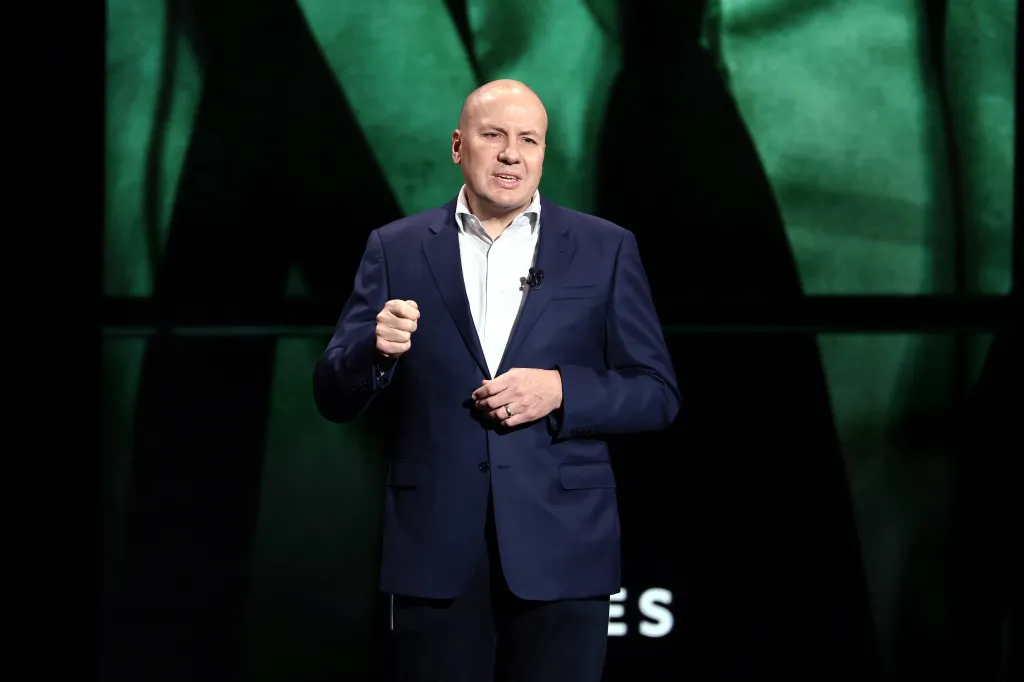
When Skydance confirmed the company’s executive leadership team Monday, most industry reaction centered on elevated roles for content execs like Casey Bloys, Channing Dungey and George Cheeks.
But another exec in a key new post is JB Perrette, a veteran of streaming since its earliest days and a close associate of Warner Bros. Discovery CEO David Zaslav. He is not only making the leap to the new company from a top position at WBD (something of a surprise given that execs at the company being acquired generally head for the exits), but his turf is also expanding in some intriguing ways.
Skydance is due to close the deal Tuesday morning, and Perrette will join Co-CEOs David Ellison, Ynon Kreiz and others at a press conference later that afternoon on the Paramount lot.
Upon the close of the $110 billion deal, Perrette will be Co-Chair & Chief Business Officer, Skydance DTC and Co-Chair & Chief Business Officer, Skydance TV. He will have direct global oversight of global distribution, advertising sales, content sales, DTC strategy, marketing and business operations.
Perrette is poised to benefit handsomely from the merger. An SEC filing last March said he would receive $142 million in various deal-related proceeds, though some portion of that could be deferred given his post in the new company. One source cited the massive payday as a potential motivating factor. “He certainly didn’t need the money,” the person said. “He obviously felt compelled by the opportunity.”
At WBD, Perrette was head of global streaming and gaming, leading the global rollout of HBO Max across more than 130 global markets, including the UK, Germany and Italy after the end of a longtime output deal with Sky. The WBD streaming business (which includes some niche services along with mother ship HBO Max) also turned profitable on Perrette’s watch. One less-desirable line on the resume is presiding with Zaslav over the inauspicious rebrand of HBO Max to Max in 2023. (After confusion and a degree of backlash among viewers, suppliers and advertisers, it reverted to its original name in 2025.)
While any exec who is in a high position long enough will have missteps, many industry and company sources Deadline spoke with described Perrette as a solid operational executive. Bloys may be the rainmaker with HBO and HBO Max content, but Perrette oversaw product design, global distribution deals and a host of other aspects of the streamer’s growth. Plus, he comes with a pedigree.
At Discovery, Perrette was head of digital and helped launch Eurosport’s streaming service as well as Discovery+, but his 11-year run at NBCUniversal yielded an industry milestone. Overlapping with Zaslav during their time at NBCU, Perrette rose to president of digital and affiliate distribution. He helped usher in the streaming era as one of the key execs behind Hulu’s launch in 2007 as a joint venture with Fox, later serving for several years on the streamer’s board.
Company insiders describe a series of conversations between Perrette and Ellison over the past several weeks, a period when he gradually gained the confidence of the new Skydance boss and his co-CEO, Ynon Kreiz. “He is often the one asking the best questions in the room and has the most comprehensive view,” one former colleague said. Another person from the Paramount orbit said the execs had a “mind-meld” encompassing the future capabilities of streaming services in the AI age.
Perrette also has experience with the blocking and tackling of things like password sharing and other lucrative but detail-oriented operational tasks. Paramount board member and major Skydance investor Gerry Cardinale last week noted that efforts to merge the back ends and tech stacks of Paramount+, Pluto and BET+ have borne fruit. “We’ve already done a hell of a job,” he said. “Then we are going to do the same thing when we bring the HBO universe into this.”
A high-level streaming executive at another company noted that the move could save hundreds of millions of dollars in expenses at a time when Skydance will be eager to deliver on its promise of saving at least $6 billion in costs. “JB is good casting for that kind of thing because he’s willing to get into the weeds on it,” the person said.
While the fundamentals of streaming technology are familiar to Perrette, advertising and distribution may be a bit less so. “There was a lot of confusion when that popped up in the release because it doesn’t seem like he has a very extensive background in that,” one insider noted of the official announcement. As the former Paramount and WBD come together, there are some unanswered questions about the hierarchy of ad sales in particular, with both companies having recently gone through leadership changes. More details about the second level of top execs will be revealed in the coming days.
On second thought, noted one source, “what we took for granted all those years at the upfronts is up for grabs. Ellison is trying to turn it into a tech company. What will advertising even look like in that kind of environment?”
>

A group of Paramount subscribers and viewers have petitioned the Supreme Court to put at least a temporary halt to the merger with Warner Bros. Discovery, a transaction that is scheduled to close on Tuesday.
In a filing on Monday, the petitioners — Pamela Faust, Len Marazzo, Lisa McCarthy, Deborah Rubinsohn and Gary Talewsky — argue that the merger is still anticompetitive, even with the conditions put in place by the settlement of the state attorneys general lawsuit last month.
“The States’ settlement itself requires that the combined company not sell or close the Paramount or Warner Bros. lots during the commitment period, provides reapplication rights to employees displaced by the transaction, and creates an editorial-independence board. Those safeguards show the magnitude of the integration that closing will unleash, but they do not preserve competition between Paramount and Warner Bros.”
The petition is a longshot, given that the plaintiffs’ efforts to stop the merger has been rejected by the district court and the Ninth Circuit Court of Appeals.
The plaintiffs, represented by Joseph M. Alioto, sought a temporary restraining order to block the merger. But U.S. District Judge Araceli Martinez-Olguin, in a ruling last week, cited the plaintiffs’ “repeated failures to advance any evidence in support of their motions for preliminary relief in this case to date.” She also cited an earlier decision in which she granted Paramount’s motion to dismiss the lawsuit, in which she wrote that she had “serious concerns” over the plaintiffs’ standing.
A federal appellate court denied their petition on Friday.
In their petition to the Supreme Court, the plaintiffs pointed to the record of transaction materials, CEO statements and consumer verifications.
Their brief states, “The requested order is narrow: preserve separate ownership and prohibit integration pending disposition of the petition or further order. It does not decide final antitrust liability. It preserves the Court’s ability to decide the legal questions before the October 6 closing changes the competitive structure the Clayton Act is designed to protect.”
The plaintiffs describe themselves as Paramount subscribers, viewers and cable customers. Their lawsuit was originally filed last spring, before the group of state attorneys general sued to block the deal. The settlement includes a consent decree that spells out a 30+ theatrical releases per year schedule, as well as separate negotiations for the Paramount and Warner Bros. Discovery cable channels.
>

How do you recommend a porn theater? Steve Koltai, owner of Montréal’s historic Cinéma L’Amour, might start by telling you to watch it on your phone. “You want to watch the newest movie out there? Watch it on your cell phone. That’s not my business anymore,” he told IndieWire. “My business is giving you social interaction, fulfilling a fantasy.”
That makes suggesting Koltai’s establishment for a movie outing a bit more complicated than your typical midnight movie. Pitch a little trip to Cinéma L’Amour, and there’s instantly a question of intent. Are you appreciating its crimson interior and risky atmosphere from afar — or suggesting an immersive experience that warrants more discussion with a… partner? (Priest?) Hell, even an overeager endorsement of its gift shop can invite some very private questions around the city.


“I’d say a majority of the people that buy our merchandise have never been here,” a Cinéma L’Amour tour guide told IndieWire this past summer, amid the 30th annual Fantasia International Film Festival. “But they love the fashion part.” Dakota Johnson has been photographed rocking the porn theater’s merchandise. But in Québec’s largest city — which has its own local constellation of film celebrities — the logo carries a hometown significance that doesn’t need Hollywood’s approval.
Koltai remembers doubting his son Devyn’s suggestion to sell tote bags. “We sold thousands, thousands of tote bags,” he said. “I didn’t realize how important tote bags were.”
The movies still play, with the program changing each week, but they share the heart of Cinéma L’Amour with plenty of other attractions. Tourists pop in for a quick look around, while music fans sometimes come for raves and concerts. Yes, people masturbate and have sex here. But Koltai and the guide also described lesbian and trans nights, as well as recurring rentals by a local feminist group. A cashier called the mix of older patrons and artsy employees “half ‘Cheers,’ half ‘Cruising.’”

“You wouldn’t expect it for a porn cinema type thing, but it became more than that,” the guide said.
There are plenty of ways to participate, and just as much room to wonder what everybody else is getting out of it. (Putting into it? Sorry.) It’s a fascinating preservation project, no doubt. But for a taboo exhibition business whose competition now fits inside the patron’s pocket, what, exactly, is being kept alive?
The venue now known as Cinéma L’Amour opened as the Globe in 1914, presenting films and live entertainment in the heart of Montréal’s Jewish community. Yiddish films were among its offerings in the 1920s and ’30s. Renamed the Hollywood in 1932, it later pivoted to adult titles as the Pussycat(!) in 1969(!!). The picturesque horseshoe balcony and ornate interior survived the programming shift, and still give Cinéma L’Amour its undeniably regal feel today.
Before the Koltai family took over the spot in 1981, Steve’s father, Ivan, had already expanded from distributing erotic films to exhibiting them. In the 1970s, he’d built an adult cinema in Hull, Québec, about two and a half hours from Montréal by car. Steve remembers tagging along on his father’s drives and seeing audiences treat the porn theater like a proper evening out.
“The mom and dad and the adults would dress up like they’re going for dinner, but they’re coming to watch a movie,” he said. Customers arrived for the seven or nine o’clock show, with matinees on weekends. The audience dressed for the occasion, even if most of the actors… didn’t.

Championing genre — and adult film is its own genre — means cultivating an audience willing to take a chance on somebody else’s taste. In Montréal, Nicolas Archambault sees people getting practice long before they enter any kind of theater. “I think it’s been acquired without us knowing it because we’re a land of immigration,” said Fantasia’s director of Asian programming, who has spent 18 years programming for the festival.
Asked what makes the city receptive to unfamiliar art, he pointed to the everyday pleasures of living among different cultures: the restaurants, music, and films. He described walking down a street where Caribbean music gives way to Lynyrd Skynyrd from a passing truck. Encountering somebody else’s favorite thing becomes an ordinary part of the day. “It’s just normal,” Archambault said.
Open-mindedness needs somewhere to become a habit, and keeping a place for unfamiliar work gives an audience time to develop — without requiring every movie to justify the existence of the room. At Cinema L’Amour, room to experiment also requires clear limits.
The upstairs couples’ section and the more open downstairs offer different experiences. The posted rules, offered in both English and French, spell out consent: “‘No’ means no — and silence also means no.” Koltai asks visitors to communicate their expectations and boundaries, but acknowledges that people can feel violated and that staff aren’t always present or equipped to monitor encounters.
Keeping the doors open takes some decidedly less mysterious work. The family owns the building, where apartments accommodate short-term rentals. Cinema employees help with laundry, cleaning, maintenance, and guests’ needs. The staff sustaining the fantasy have a whole property to look after.

“It’s only because we own the building that we’re able to survive,” Koltai said.
The merchandise business reaches well beyond the city’s local film scene. The guide listed France, New Zealand, Australia, and Japan among the destinations for orders, but said Trump’s tariffs had interrupted shipments to the U.S. Koltai later confirmed that tariffs had affected the business while clarifying that American orders were continuing: “We still ship,” he said, wryly.
Customers keep suggesting more products. But Koltai would prefer to manage the shirts, sweatshirts, and all those damn tote bags already taking up so much space, first. (Suffice to say, a porn theater need not become a full-service supplier of shower curtains.) One shirt, though, means more to him than most inventory. The cinema recently recreated a ringer tee Steve’s late mother wore in the early-1970s. Now he can show customers the picture when anyone considers buying it.
“She’d be honored to know that we’re still continuing,” he said, reflecting on the joy of turning a cheeky souvenir into an excuse to talk about his late mom.
Ivan, still alive at 93 when Steve spoke to IndieWire, wants the family business to endure. But Steve said Devyn had left the business six months before the interview, and Steve describes relying heavily on a longtime administrative employee and other staff who care about the theater. Being busy hasn’t settled who will eventually take over: “Actually, I want to slowly fade out of it,” the elder Koltai said. “I’m consumed by it because we’re busy, our merchandising is busy, our short-term rentals are busy.”

His commitment comes with a practical condition. “As long as I can keep it open and survive and it’s feasible,” he said, “I’ll keep it open.” Before hanging up, he had one request about explaining the business to strangers: “Just keep a little bit of a mystery, OK?”
Two Fantasia attendees who spoke to IndieWire on condition of anonymity were willing to explain their own visit. He hoped for a taste of the vintage adult theaters he’d seen in documentaries. She’d mostly heard gossip and read Reddit.
A friendly concierge explained the setup and handed them a clean sheet. They settled into a nook in the couples’ balcony and progressed from watching the screen to having sex themselves. “Something about the charmingly seedy red-lit environment just brought it out in me,” she wrote. “We bought a bunch of cool branded merch to commemorate the experience and were on our way.”
Her partner had one note for the programmer: “If I could change one thing, it would have been the movie. It was basic contemporary pornography,” he said — adding the couple would still come to Cinema L’Amour again.
>

Arsenal must be accountable for their own failings in faltering Women’s Super League season | Football News
Joe Mixon joining Seahawks in wake of running back injuries

WBD’s JB Perrette Makes The Leap To Skydance, Taking Top Role In Ellison’s Executive Suite
-

 movies5 months ago
Search For Canadian TV Actor Stewart McLean Now Homicide Investigation
-

 Fashion9 years ago
These ’90s fashion trends are making a comeback in 2017
-
Fashion9 years ago
According to Dior Couture, this taboo fashion accessory is back
-
Fashion9 years ago
Model Jocelyn Chew’s Instagram is the best vacation you’ve ever had
-
Fashion9 years ago
Emily Ratajkowski channels back-to-school style
-
Fashion9 years ago
9 Celebrities who have spoken out about being photoshopped
-

 Anime4 months ago
Rurouni Kenshin: Hokkaido Arc Manga Takes 1-Issue Break – News
-

 Anime3 months ago
HIDIVE to Stream English Dubs for The World Is Dancing, The Forsaken Saintess and Her Foodie Roadtrip in Another World, The Dangers in My Heart: The Movie Anime – News